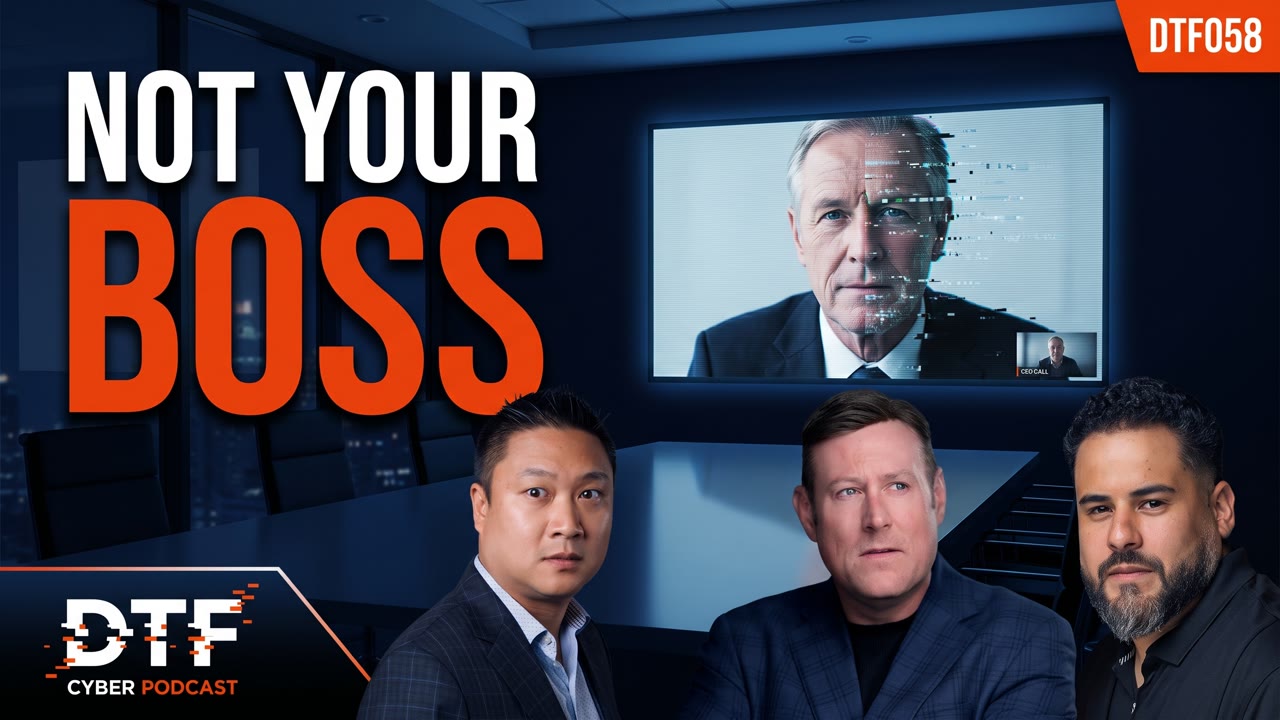
Your Boss Isn't Your Boss
0:00Hey, Fern, I need you to do something confidential for me. No emails, no teams chat. You get all the details from our attorney.
0:07How much money are we talking, Trey?
0:10We'll get to that. But first, don't discuss this with anyone on your team.
0:13Wait, wait, wait. Right there. That sentence is the attack.
0:16So what you're saying is the scariest voice might be the one that you actually trust.
0:22This week we are covering the deep fake SEO. And why? Seeing and hearing someone isn't proof anymore. This is episode 58 of the DTF Cyber Podcast. I'm Damian.
0:34This is.
0:34Troy LLC Boyd Firm. So Deepfake SEO. And we're not talking about the CEO that was worried about the wrong Chinese model. We're talking about deepfakes today. So let me put this Shownotes.
1:00Yeah, we've been talking about like Asian attacks and stolen keys, but this one's a human version. You know, the attacker doesn't break in. They're just calling.
1:12Yeah. So let's see here. So between so there's an indictment. This, by the way. So for our listeners, this is in New York on November 5th, right? Jacob So all Sharon Hasan and Guy Sheetrit were arrested over a scheme that ran from 2024 to 2026 and allegedly, allegedly they use A.I. to impersonate the voices and images of corporate executives and even attorneys at major law firms.
1:44And what they were doing was tricking the employees of each individual organization into wiring money to accounts that the group owned. So this is essentially I have prior business email compromise, Right?
2:00Executive impersonator Was it also a phone calls and video deepfakes?
2:05Yeah, I think overall executive impersonation. Right. So they were all arrested overseas and they're waiting on basically coming back to the U.S. So they weren't even doing it here for what I would imagine.
2:17Well, I would be surprised.
2:18There's so many questions here about, you know, how this can actually be pulled off. Like, I mean, what kind of banks are going to let these kind of nefarious funds in without checking who the owners are? You know, I always I wonder, follow the money. You never heard that statement. But as an example, Damian, four or five years ago, when the word Deepfake first came out, our CEO and my board meetings, they kind of laughed.
2:38They actually thought it was funny that, that at that time to believe someone could impersonate them, to sound like them and look like them on camera. They thought they said, technology isn't there. We're not going to have that issue. We don't worry about that script today. And we were just talking about our agents that we can call, text, talk to.
2:55We can even give them our own voice, clone our voice into our agents, or to make phone calls on our behalf. So we're living in a world where, you know, what you see and what you hear is not what you can believe. So we're going to talk a lot about trust today. I have a feeling.
3:09Or you know, what's funny is I sent the OR you guys remember when the new roster came out, right? I did. I sent you guys a video of that.
3:18Well, it didn't come out. It was just announced.
3:21What do you mean, The roster? Yeah. No, no, no. They did a live demo.
3:24Yeah, but you can't buy it. I mean, you can. You still have to wait. We have been waiting for, what, a decade already?
3:29Yeah. I'm so outside of the waiting. What I thought was the demo specifically when they had the car on the ramp and kind of went upside down, you know, like, flew off of there.
3:38A lot of people think that's a deepfake, too.
3:39Exactly. That's my point. It's like people kind of just expect stuff to be fake now. So what's interesting is this was a person or people being it was a defect and it got through. But who are who are thought, you know, flying cars, You know, people don't believe that. Yeah.
3:57I mean, how many products are generated? Not real.
4:02I think mostly everything that you see nowadays is kind of so easy. Just click a button, say what you want. Boom, done. I don't even have to hire anyone. I got to go.
4:09So maybe the differentiation is having a real product in your commercials. Maybe that's the key to success now. Because if I was going get tired of air slop, my kids can't stand it. By the way, Just so you know, as soon as something comes on TV or online, that's air, they pointed out, and with disgust. So I'm not sure the advertisers are really winning any market share by air slot, but you see a lot of it.
4:29Yeah, Yeah. But we're saying it's not a slop anymore. It's so good. You can't tell the difference between an air product, you know, a fake product versus something that actually.
4:38Somehow my kids have a different lens they can spot it in a second. Maybe it's that generation, But I agree with you, Damian. It's getting better every day too. So you know, where we are today is not going to be where we are in six months. So as an executive at a Fortune 500 company, how do you combat this?
4:52All right. So so your kids say what the Roadster, that whole don't know.
4:57They believe that's real. And actually, there was a lot of reporters that were in the building themselves reporting on it live. So there's some trust that was built there that this wasn't just done in a vacuum.
5:06Yeah, but there.
5:07Were way more questions. But yeah, they were like, yeah, I mean, they saw.
5:09Their feet away. They were 100 feet away. They weren't like, right, right up close to it. So it could have been a big screen.
5:16I've seen David Copperfield, so I don't believe anything there. You know, horror. But for sure my kids can spot I online pretty quickly. They thought the Tesla Roadster was really cool. It would look look real. So I'm going to go with them on that.
5:28So. So what you're saying is we don't need to train people. We just hire kids because they can tell the details. Yeah.
5:35No, that's good. That's that's bad for all the people that are, I want to say our age.
5:41Okay. So the playbook simple here, right? Step by step. You pose as the CEO.
5:46Yeah. Yeah.
5:47All right, then. You present a confidential transaction.
5:50And.
5:51Maybe the CEO's voice and maybe video. Mm hmm. Mm hmm. Hand the employee to lawyers. I mean, how many employees know their lawyers?
6:01Zero.
6:03And then fake the lawyer to wire the money? I guess.
6:06So. Talk to the legal team because they're a third party. Typically, you're not going to verify them. But if you do try and do any research, I'm sure whoever was set up as the fake legal team or maybe the real legal team, they're probably, you know, depending on the company, it's easy to find out who the people are.
6:22Well, how many times do you actually talk to the company's lawyers? I mean, you might you see the CEO all the time, right? So I would say that's a little bit harder to fake. So it has to be shorter because I don't know how you get the whole mannerisms and and speaking cadence and everything. I mean, it probably get better and better.
6:41But once you get to the lawyers, unless you're dealing with them every day, you don't know who they are.
6:47So it was it was it the lawyers for the in-house counsel or was it from a third party?
6:53Could be could be either pass you off to a third party lawyer that you have no idea who would who they are.
6:59You have to. Saul Goodman. Saul, better call Saul. Right. Okay, so but the total amount alleged alleged is 189 million.
7:10Well, you know, the the also the other aspect to using the lawyer is that maybe it needs to say confidential. You've got to keep it between us and the lawyer.
7:20Yeah. What do they call that in Breaking Bad or Better Call? Saul was, uh, I mean, obviously the what they call it, but client privilege. So it is called no.
7:30Attorney client privilege? Absolutely.
7:32Attorney client privilege. So and you can't really go out talk about what the lawyer told you because it's a hey, this is confidential. Kind of like when people get laid off like this, people that know about it and, you know.
7:44Well, we are put into a lot of situations where there's confidential stuff going on and you can't really talk about it. You're not sure if you can talk about you. I mean, you shouldn't. But certain people, let's say there is a lawsuit going on or there's mass layoffs going to happen. You typically don't have that open communication with everyone.
8:04So there's a set group of people you can speak, How much about us or M&A, right. If you're going to go acquire another organization that's also confidential.
8:15Yeah. So a lot of these conversations that could happen when it comes to money, transactions, purchasing and things like that, those can really just be assumed to be confidential. So the people that are on the receiving end of essentially being scammed, it's no different than a typical conversation that they would have for maybe the exact same.
8:34But it's not just it's it's a whole process, right? So you start with a deep fake that passes you down, a process of confidentiality and urgency that maybe needs something money most likely.
8:47Yeah. Wild.
8:51Mm hmm. Know, I think this goes back to one of the oldest crimes to man is fraud con men. You know, just basic conning your fellow human out of something of value. And, you know, that's what this comes down to. Technology has advanced, so it makes the job different. But it's the same thing where they call you and they pretend to be something they're not.
9:09They create this sense of urgency to get you to act, or they make you think with compassion to help someone. All of it's a scam to get you to give them money. So again, same attack, just new technology to empower it. And so again, comes back to people who can be your biggest defense. People see, you know, humans are the weakest link.
9:28I think that's a misnomer. I think humans are your biggest opportunity for defense, and you certainly have enough of them as employees to, you know, see something suspicious and report it up.
9:38Yeah, but at what point do you say something if people are like, I guess should you always say something? Because if you say it right, you're like fishing, right? Not like on the boat, but like email, phishing, Like you just hit report spam or report fishing and cool. Like if it looks weird, you report it. And this this is known or whatever.
9:57And if it's not, it's like, okay, it's no big deal. It looked a little suspicious, but thanks for reporting it. It's fine. Right. So I guess you can't necessarily get in trouble for asking questions or reporting it, right?
10:08No. I mean, you could still ask questions whether this lawyer is legit, right. At least validate the lawyer.
10:17This is a process challenge more than a technology challenge. I think, you know, we had to implement certain procedures and policies around money transfers and wires over a certain amount, had to have two signatures or some type of out-of-band multifactor multi-person authentication. And then, of course, changing of direct deposits or changing of payment details for a vendor. We had to call the the number we had on file for that vendor, not accept anything in an email that somebody provided to us because that's likely the fraudsters.
10:49So there were times we would go on Google and look the business up and call the 800 number to get through to somebody just so that we knew we were dealing with the real business. But those are the kind of things you have to put in place. This is more of a process remembrance rather than a technology to solve this.
11:05Yeah, it's just it's just a lot different than getting a text from a CEO saying he needs a $500, you know, gift card, right? Or they need our gift card or somewhere. Home Depot, like for what? Right. So it's definitely more I can't think of the word but was it like higher in robbery. Right. So but like you said, Trace, it's more so just a process thing, right?
11:30Because like, again, it's all software to stop this sort of thing. You could probably buy software that can help prepare people and test them. Right. And see, you know, if they fall for it, like high end phishing. Right. But you can't necessarily, like, do anything because like you said, there is no technology. It's just essentially it's the it's the what they call it the human, the human element, the human firewall.
11:54I mean, we do.
11:55Human risk factor.
11:56Do phishing test, you know, phishing tests. So you just have to up your game and have deep fake tests.
12:03Deep faith. Yes.
12:05Yeah. Yeah.
12:05I mean, there are so many technologies coming out. I know that at RSA this year, I saw several deep fake companies that are there to plug into your teams and plug into different aspects of the enterprise to look for these deep fakes. So there's technology out there for I'm not saying that this is not something you can augment with technology, but I think at the core it's a training and a process problem that you can solve 99% of these problems by just having a very solid process.
12:33I remember having to fly to our global processing center and with some other folks and do this training in-person in classrooms and just cycle people through for an entire day of here's exactly how we're going to do this process. And when it's over this amount, you have to have two people sign off on it separately, different com channels, etc..
12:53And so those kind of things, companies, you know, you can't get around that. You have to still train your employees and your your folks how to deal with this rather than just trying to throw technology at them.
13:03Yeah, I mean, you bring up a good point because $129 million, I mean, obviously that wasn't one company and that was.
13:12Alleged between all of them, I think nine, Right.
13:15So I think there was like a fintech company lost $11 million, a pet food company lost $5 million. The hospital system lost another $5 million. Right. So the list goes on. And in that range. But you can't really I mean, how interesting would this be if one person could transfer out $1,000,000 without any checks?
13:39Yeah. Yeah. And also, the threshold is different for every business, depending on the size of the business, like a Fortune 500 may say we only care about anything over $250,000 to move and use this extra step because it causes friction. Okay, that's fine, because $250,000 to a Fortune 500 is not a huge loss, but to a small business this massive.
13:59So maybe 20,000 is your limit or 10,000, You know, what can you actually transfer before having, you know, some type of a secondary protocol? Yeah, but these come into us.
14:08But these companies lost millions, allegedly.
14:10Yes, exactly. That should not have happened.
14:12So I would just think about it. And I know how we fix this problem. There's only one way to do it. Everyone goes into the office five days a week. Simple as that. So if we get a chance for money, like I'm.
14:25Trying to get listeners not turn them away.
14:28People are quitting their jobs over the return to work, return to the office mandate.
14:32They are. They are. I know of a few people that have left their jobs and of people that have lost employees because of that. Right.
14:39But you can't tell me that this would all go away if everyone was in the office.
14:43Now, that is more of a joke. It's more of a joke, right?
14:46It's way more of a dart. If I if I may there for just throwing darts today. I love.
14:51It. Yeah, I woke up a little. It's, you know, weather's a little cloudy, so I got to stay warm somehow. But I don't know, like when. When I think of something like this, you know, say not as a security person seeking a professional. 24 seven. Right. It's not you know, I'm more so sales. Um, I look at this and think like isn't just a lot is common sense you know like when you when when you really think about this like I don't know, I guess I've never really been scammed out of money like this, but maybe I have been scammed, but I just don't know.
15:29Yeah, right. But like, I feel like at some point people have to ask questions or people will want to verify. I'll give you really good example. I was talking to someone that I know that works in procurement, right? And we're talking about all the money that they could save by doing certain things and you buy more from me, right?
15:48Let me help you save money. And I give the guy a quote and he saved a bunch of money and it was probably like 10%. And when he told me was he's like, hey, anything more than like 5%? Like, don't do it. Because apparently, like, if you save more than 3%, it looks it makes them look bad, right?
16:06For their job. So people, not everyone, but I'm sure some people in procurement, they have a target to save like 2 to 3% at the same. More than that, it's like, okay, great. But they save 5 to 10. The question becomes, well, why didn't we say this last time? And it kind of puts them in a situation where they have to answer to why they didn't perform well the prior year.
16:26So it kind of makes me think is like in that situation there was an opportunity for someone to kind of go above and beyond and and have whatever benefit of savings, but they chose not to because of how it would negatively impact their job. Right. So what I'm curious here is like when it comes to say there's certain metrics for work, whether it's paying bills on time or paying bills within a certain period of time, you know, closing tickets there.
16:52I'm sure there's there's metrics that people are measured by where if they were to raise their hand and say, hey, I got a question, it might be frowned upon because it goes against the metrics for the role. You should be saying like or procurement might want to save money, but it's not too much money, just enough to make me, you know, get to the next page up.
17:10But if we save too much, it's not good, right? So like in this situation, if someone's paying a bill, if it meets all the criteria, like I don't ask any questions. My job is to get as many bills paid within a 30 day period. So wouldn't that be more so like the metrics around the process.
17:28Pay it faster? Yeah, I don't know. Every company is going to be different. What what they value. Um, I don't. Yeah, I was thinking about this too. Like, what if the person who's wiring out the money or paying the bills is the one who's setting all this up.
17:47In the cahoots? In cahoots with them or.
17:48Not in.
17:49Cahoots at that? I've seen that insider threat.
17:50Just just actually setting up doing the whole thing themselves. They can deepfake the CEO, the fake lawyer, and then jump on a call, record it all, and then fire the fire the money out. I didn't know. I just claim ignorance. Is there any liability to the employee there?
18:09For sure. I mean. Well, there is because there's a criminal act, of course. You know, if these found an investigator where the money goes and so on, so definitely criminal.
18:16Well, how would you get caught or how would you.
18:18Get an idea here? How would you go? We see people all the time creating. That's what I mean. How would you get caught? Follow the money because the police will see where the money went and they'll go to that bank and that bank will show where the money was transferred. And and, you know, even if it goes through money laundering tumblers across the, you know, I mean, well.
18:31That's.
18:31You'd have to be very smart to be able to get that money out after you steal it, unless you're a highly organized criminal gang, which that doesn't sound like an insider threat would be. But, you know, there are ways. But again, I don't want incentivize anybody to be.
18:45I'm just like in I was thinking like the movies, right. Your your family's held hostage unless you do this.
18:50Mm. Yeah, yeah, yeah, yeah. We've seen it. I've seen that happen. As a police officer, I investigated a secretary at a law firm who was stealing money from the law firm because their son was in trouble. So it happens.
19:02With. Did she go to jail for that?
19:04Well, she did, fortunately.
19:06No.
19:07I mean, I say unfortunately, she she was found guilty and did serve, you know, 18 months in jail, which was justice. But, I mean, she was a sweet little grandma. Her grandson was in trouble, got into some drugs and trouble and stuff like that. And she was stealing from the law firm to get them back on the right path, all the right intentions.
19:22But she did commit a criminal act.
19:25So intention doesn't matter. So she just left little Tommy alone now to help cover any bills or.
19:31I think there's a second story, right?
19:33Yeah. Yeah. Let me, uh. Let me. Well, before.
19:36We pivot to that, Damien, I wanted to say this isn't just always about money. Think about the deep fakes and how H.R. is dealing with applicants, Right? We see, you know, people deep faking the application process and the interview process to get a job. And then it's somebody in North Korea with a laptop in North Carolina.
19:51Yeah, we can. We can cover that at the end because an on the money, too, so.
19:55Okay, good. Yeah. I mean, I'm I'm saying that the deepfake conundrum is upon us and I think that, you know, five years ago we were like, this is never going to be good enough to fool somebody. And now today we're saying it's they're onto the next story.
20:09Yeah, Yeah. So let's see here, let me pull it up. So this is Hong Kong, Hong Kong government, right? So this is really interesting because it's a it's somebody in finance, Um, they received a phishing email and on the other side was a fraudster posing to be a CFO for UK based company and essentially they invited the will say how not the suspect the well what's the right word like not recipient but the target they received the victim Oh Victor yes they should have known that.
20:46So they received an email with a prerecorded call. Yeah. Which was essentially built from publicly downloaded videos of the whoever is being impersonated the the real CFO. So there was actually no interaction between two people. So think of it like, um, like a webinar type of thing, right? So one person went in, did whatever. Actually we saw something very similar, maybe to the extent unknown, but with, with the Binance, right, there was an employee that was or a couple of employees.
21:21One of them was, you know, essentially applying for a job and they downloaded malicious software. Some, you know, a test. Right. Or a coding thing that kind of did this. So similar in a way where someone is having an interaction with another party and they are essentially getting duped into sending money. So I guess this one was 200 Hong Kong million, right?
21:49So roughly 25 billion USD, so nowhere near like 6.3 billion. But um.
21:56Yeah, I mean the reason why this one's different, I think is because it was a group video conference, a fake group video conference. So instead of having like a one on one with the CEO and then a one on one with the lawyer, you jump on a call and it's like a bunch of bunch of people who are all Deepfake Yeah.
22:15So interesting topic there. Not really to the video, but if you guys kind of I can't I can't really think of the phrase or what it's called. But when when you see someone that is hurt on the side of the road, a lot of people might just walk by and not help Good Samaritan. Yeah, but then when one person stops, you tend to attract a crowd of people.
22:38It's almost like this not like herd mentality, but where where one person kind of makes the effort to help the person that, you know needs help. Then you see more people. But until that first person, you know, makes that decision to help, a lot of times everyone else will keep walking. And so and that's more of like a psychological thing with people.
22:57I didn't go to school for like psychology or anything, but I do find it interesting where if someone is in a room with a bunch of people that they assume to be their peers or whoever, right? And no one steps up and ask a question by nature, you know, perfect example. You guys been in a room where you ask a question, people raise their hands and you ask it and like one person raises it, and then all of a sudden, like the second hand comes up the third and the fourth before, you know, half the rooms raise their hand.
23:24But until like that first person raised their hand, you don't really hear from anyone. So I kind of wonder, like in a lot of ways, like this specific article is taking advantage of human psychology.
23:38It's fake validation, right? I the way I look at it too, is on LinkedIn. I get a lot of requests for connections. I don't accept them all unless I know the person. And then even if still if I know the person, I go to check their LinkedIn to make sure it's authenticated somehow with their email address or ID.
23:59Otherwise it could be pretending to be somebody else.
24:02So you go through all that work just to accept an invite.
24:05Oh yeah. Because what happens is if you get let's say you get a request from someone and you see that there's a bunch of similar connections, shared connections. Um, if you have, let's say you see 100 shared connections, you're more likely to accept them, right?
24:24Yeah.
24:24So that's a validation part of it. Let's say those hundred people did even check and it's a fake profile that all work. It says that it works at your company, so everybody in your company just accepted it because it says they work at your company, but they really don't.
24:41So they got them.
24:42So you got to you also got to verify, and that's why I verify it. But, you know, when you take that profile, so you think about, well, what's what's the need for that profile to show credibility? Well, to ChoicePoint now they want to apply to a job and be a a fake candidate for a job.
25:02Yeah.
25:03Oh, I'll. And their friends with Damian Chung. So they must be somebody important ranked.
25:07There you go. So if I connect with them, you think that I've already vetted them? I may not have.
25:13So little question. Have you ever accepted someone that you found out later was a scammer?
25:18I did. I haven't.
25:19Tried that. Who is a scammer in your life? Tell us.
25:22You know, I connect with, you know, a lot of people on LinkedIn. I feel like LinkedIn is really a public public square. I only say things on LinkedIn that I would publish in a newspaper. I don't have any private information there and I don't use the the LinkedIn messaging too much unless I'm trying to reach out to somebody that I don't have their email or phone number.
25:38So to me, LinkedIn is more of an open networking kind of a business tool. So a little less worried about vetting. But I got contacted by a good friend. I can't remember if it was Chuck Brooks or Ellen Alford, one of those two guys. And like Trey, you've got these three people connected in on your LinkedIn and they're all Chinese spies.
25:56They're all female Chinese spies. And so he's he's.
26:00Going after the wrong Chinese model, too. Yeah.
26:03Yeah. But, you know, again, I didn't connect with them because they were female or they were Chinese, but and I had not interacted with them in any way. But it does appear that, you know, people are trying to connect with you to get to, you know, influence you in some way. And so if you're going to be an open LinkedIn connector, which a lot of people are, just remember that people aren't who they say they are, you know, So before you interact with them personally, make sure that you do your your vetting.
26:27Interesting, very timely story, by the way, Very tight every time. That's kind of interesting. I kind of feel like a lot of times, like profiles on Facebook are always fakes on every use it. But like LinkedIn, I kind of just like, say, whatever I'm thinking of sometimes is dumb. Most of the time is probably, you know, if I had if I if I had a parent that was watching over me, they probably be like, Hey, don't do that.
26:53But yeah, I can kind of see where Troy's coming from. Where?
26:57Well, if you kept your profile open, right, I think in the early days, you could be one of those LinkedIn Open network influencers. LinkedIn Open network, I think they call them Lyon's. So if you see Lyon in some of these name, it means they're open and open networker, but you don't know who you're connecting with. And so, I mean I, I want to use it more for communicating with people that I've actually met or somebody who, you know, if somebody is looking for an internship and they reach out to me over LinkedIn, they drop me a note and say, Hey, I'm a student looking to break in can help me out.
27:32Um, give me some pointers. I'll point them to the podcast, obviously, but you know, I'll still maybe connect with them, have a chat.
27:41Yeah, but I think the best the best way to add people on LinkedIn, you know, in the context of this article is have them take out the phone, pull up the QR code on their phone, you scan it Bill, connect in person. Yeah, yeah, yeah, in person. But then, you know, how am I supposed to be a thought leader if, if I have, you know, 500 connections?
27:59I need to start accepting as many people as possible.
28:02Yeah, there. That's just like the whole fake subscribers and fake viewers. Yeah, we could do that. We don't, But, you know, that's the same. We don't the same thing other others will do is to try to boost their profile. Maybe they connect with everyone. I think then on LinkedIn too, you can buy connections.
28:20You can.
28:21I think so.
28:22I don't think I don't know. I think it's probably frowned upon. I wouldn't do it.
28:25Let me get 200,000. I could be like, I'm the number one security podcaster on LinkedIn. Yeah, I don't know. I Yeah, I guess those numbers don't really matter. What matters how much money you make, not how many followers you have, you.
28:39Know, And people would say it's not about how much money you make, it's how happy.
28:42Ah, I was gonna say, I don't know. That's true.
28:45Well I was Kevin Hart say he I've never seen a sad person on a jet ski.
28:52Oh we got to go back to the Jet ski episode.
28:54Yeah. And I tell you what, money can buy a lot of jet skis, right? So we got to get back to this article. But so at the end of the day, what I'm kind of taking away from this is there are impersonations of every sort. Right. And I think we would. But most people, more than likely listeners understand, is that if especially if they're in security, there's this, you know, zero trust, trust but verify that.
29:20Yeah, you got to verify.
29:21Right? What I would be curious, though, is out of all the people that are involved with these scams or or different will say attacks how many are actually in security because I don't think the issue is people in security, you know, are making these mistakes.
29:40Oh are they do or I don't don't think just because they're in security, they don't make mistakes. But but you're right I mean the easier target is the non. Yeah. Somebody in h.R. Who doesn't pay attention. I mean, h.r. is actually probably the biggest target because they're getting strangers applying for jobs all the time. Right. So you're at the end of the day, they're receiving documents, resumes that might be weaponized.
30:04They're talking to people who might be fake. So I think H.R. recruiting probably are the the toughest group that have to be trained.
30:12Yeah. So they have to be trained. But then when they have Security Awareness month, like how many people actually sit there and.
30:18Oh, you have to I mean, by compliance, they, they probably have to do the training. But do they. Oh here's the thing. Have I do the training for you?
30:26Can you do that?
30:27I've heard cases of it.
30:30But, you know, I actually learning this is like, okay, funny story. My oldest is doing a little bit complicated math, right? So we kind of show her some chatty, petty stuff a while back where she likes, like, Google stuff and like, I just do this instead, right? It gives her better information. You know, it's easier to follow. And at some point, she figured out that she could screenshot the math and ask her for the answer.
30:56So she gets all of her homework done and just like, what the hell? Like, that's not normal. And then I go to her computer, open it up, pop onto the chat plugs and I see the entire homework list. I'm like, Oh, okay, now I, I then I'm kind of like, cool. Like, you know, she figured out how to use it, but at the same time, I was like, you don't actually know if you're doing most like, right?
31:19So at these trainings when well do.
31:21They need to anymore that's that's a question like, for example, do you even need to know how to drive anymore if your car drives itself?
31:28Now we're just going to be back to okay. People eventually, right? Okay. People with with computers. Yeah. I don't know. I kind of feel like people need to be aware of these things, but with with how easy it is to kind of get answers and and and not have to take the cognitive load personally, like, you know, to take it on yourself.
31:48People are just going to, you know, kind of tools to do the heavy lifting for them.
31:52So, as you know, Shannon wrote a whole book about this called Prompted not present but the New Generation and how much our brains are suffering from not learning with our kids. We do let them use air for it with their homework, but they has to check their answers, not do it for them. So we sit at the table when they do homework and make sure that they're doing the work and then checking the answers with them, which is help them, you know, pull their grades up because they fix things before they take it, turn it in.
32:15Yeah. And that's how they actually learn. They see their mistakes, right? Or they, they, they verify it. It's almost like having, you know, flipping to the back of the book. You know, when we were in school, you go to the back of the book, you flipped upside down and you see the number with the right answer, Boom. Now, now you just screenshot and drop it in and get the answer.
32:32But I agree with you. It's kind of like you got to use it as a just as a way to check the answer, but to actually do it.
32:42Well, we're we've been talking about training the user and having the user report. What can the security team do in order to detect that, hey, something might be going wrong here. So be a little bit more proactive, build in some alerts within the SOC. I think that that's something we got to think about.
32:57So okay, so you run a SOC, right? So I'm sure you've run across some of these instances, right? I guess. How have you guys addressed it internally?
33:06You need a source. So what would be your source for the Deepfake? So you have a tool perhaps?
33:13I don't know if there's like a I think if you think source, then it's static. So I don't know what the the real answer is, but you're going to have multiple layers of defense and detection, but a lot of it's going to be behavioral detection, right? If, if um, let's say, for example, you have communications from your CEO.
33:39Well, is that that communication really coming from their corporate account or is the email being spoofed? Right. Same thing with their phone number. If how many times would the ceo call somebody within h.r. That's not a direct report like, let's say three or four layers down. Very not very often. Right. And with that person, even though the cell phone number of the ceo.
34:03So I think in some of those cases, the behavior of you know what what's harder we have a lot of bhiwadi a lot of mobile phones, our personal devices. Not every organization has, um, the you know, in corporate.
34:20The corporate devices.
34:21Devices with on an MDM that are managed and secured, I think larger companies have that. But smaller midsize companies definitely don't have that.
34:29You know, there are the funding for it right? So it's kind of like.
34:33Just like, well, I mean, if you're if you're using your personal phone, would you allow your company to put on management software to monitor? Hmm.
34:41Now, that's a great question. I know a lot of employees are very hesitant to that. I know some MDM can just carve out the Microsoft Outlook and calendar component when it works. Still, employees don't trust it.
34:55If it works. I mean that.
34:57Now. But so that's the thing, right? Do you trust it if it says, Oh, it's only looking at this stuff on your phone?
35:03Mm hmm. Yeah, sure. Yeah.
35:05I don't trust it.
35:06That you can't even trust stuff like that. I don't personally. But that's also why, um, I've never had, like, a work phone.
35:14Yeah, but that's. That's all we're saying. Like, if you're using a personal phone for work, would you allow them to put some controls on that so that they can protect their own data?
35:22Nah, Nah. If they if they want to protect their data, they can. They can pay for the phone. Right? Right. That's how I look at like this is my I bought it. If you want to protect it you, buy me something. Right. And maybe that is that Yeah.
35:35Some I mean some some people carry two phones, work phone and a personal phone. Yeah.
35:39And to me, that's fine.
35:41Especially if you're on call. That's a good way to go.
35:44Yeah, but either way, so. But what that really means is I think what's what's important there is if you take security seriously to the point where you want to make sure that your users have their data or the company data protected, you're going to have to buy that device. Right? Because I think the general consensus is people don't necessarily trust it.
36:07Any sort of software like spyware essentially is private. People look at it. So even in an instance where someone is looking to have a phone for work, um, and you want to protect whatever is on that phone. Yeah.
36:18Because they think about by your corporate e-mails going to that personal phone you lost now you lost control of your emails.
36:24Yeah. Good data. Yeah. So at the end of the day, like, if you're in security or you're a company or is a security first, you're going to you have to spend the money. There's there's no cutting corners with security. And I think that's the bigger issue is there's a lot of people that aren't secure that they can cut corners and they find out the hard way that you really can't.
36:41But I digress.
36:42Um, yeah, we used to have a lot of employees because if you leave and you don't have an MDM or management software to delete that email, you know, they walk to their your biggest competitor with all their emails and all the attachments from all the customers that they dealt with. So they're walking out there with all the intellectual property of your company and they're just, you know, calling up their new book of business.
37:00That's their old book of business from your company. So you've got to be able to be able to pull that email back. And the way to do that is really through Microsoft to lock down the outlook so they can only use the Outlook app on their phone. And then once they're terminated from the company, it'll claw back all the email and attachments.
37:17Yeah. Or you could just have Microsoft like, you know, last week and then just have it not work at all.
37:24Or there's that.
37:25Uh.
37:26Let's see here. So what are you going to look at? You're gonna say something, Damien.
37:29Now, Now.
37:30Okay. He was focused over here, so I guess just for typing, I want to move on to the next one. So this is a yet another older instance, but essentially it just kind of illustrates the point that we're talking about today. Um, so this was at Ferrari, right? So back in July of 2024, so an executive got messages from someone posing as the CEO about it and a confidential acquisition.
37:58Confidential Z was the first.
38:00Acquisition, which is what I was saying.
38:01Mm hmm. Right. So they made a call in the CEO's voice. Um, and the person on the side was, Hey, this is a little suspicious. So they asked a question. Um, the only the real CEO knew, right? And I'm here. My nose here is about a book that the CEO actually recommended, right? So it's kind of like a safe word, but this one is a book, right?
38:30And the person who can answer it both averted.
38:34Yeah. There's ways you can verify. I think that's what we're we're it all comes down to it's like, okay, you recognize the name, but you need to verify. You might even recognize the face if it's a video call, but you need to verify. And so one easy way to do that is just pick another channel to communicate with.
38:53So just say, okay, hey, can I give you a call back? And if you have that person's number, call them directly. Yeah, right. Or if you don't have the CEO's number, call their admin and say, hey, I'm just was just talking to the CEO can, can just verify it was them and so we can continue the conversation Same thing for banks right how many times you get a phone call from the bank saying, hey, there's a fraud charge on your account, Do you just take that call?
39:17Or do you say, Hey, let me call you back because I don't know if you're okay. Are you really the bank.
39:22Or you just log into the bank app on your phone? There you go and check to make sure I get checks all the time. Says, hey, we have a suspicious transaction for an iPad. I'm like, I definitely buy an iPad. And like, hopefully I get charged for one, but I don't know, like it took a lot of guys to scan.
39:36Like they can't get me, you know, too smart.
39:40Yeah, but be smart about it, right? Don't don't ask them for the callback number. Make sure you call them on a number that that you know, you can reach that person.
39:48And the other thing, too, is you can easily trust like a Google search, because a lot of times I forget what it's called is this time I'm getting on, keep forgetting what the word is, but like the advertisement, that's actually a scam, right? We've talked about that before. So sometimes you'll Google something and the first ad that pops up is actually a scam and you're type the number.
40:08And yeah, we used to see that a lot with the Microsoft service centers out of India. You know, they would have these 800 number. So you end up you searching for how to fix my Microsoft exchange and it pops up an 800 number in India they do remote desktop on your machine and steal your stuff. And I'm not being prejudice or racist.
40:24I just had experience with this particular attack tape many times, both at work and with my own family. So that was a common scam.
40:33Yeah, it doesn't matter where it happens all over, all over the U.S. right now. All of the all of the globe.
40:40All over the world.
40:41Right. Pakistan has a lot of air, right? The Philippines is a major call center industry, right. So South America, like we see it everywhere, right. So let me go back to this thing. So question for you guys then. So we so what you talked about Damian is calling back on a number that you already have, but if you don't have that number right, calling other people, right.
41:09Essentially it's like two factor authentication. But at the person level, Right. Um, but I think the, the biggest red flag that popped up in all of these stories is some sort of secrecy.
41:24Secrecy and urgency.
41:25Yeah, well, I think I think people are more so accustomed and expect urgency as being kind of like the red flag, but secrecy, even thinking about it now to me feels like less of a scam because it's more like, Oh, this is confidential. Like, oh.
41:43Yeah, but you can get around that, right? So if you're like for the first story where you get passed off to the lawyer, couldn't you just call your boss and say, Hey, I've been asked to talk to this lawyer about a confidential transaction? Can you verify that? I just want to verify that. These are lawyers. Yeah. You know, at least verify the lawyer.
42:01Yeah. Or at least ask a question. I think they should ask a question.
42:05Yeah, because you're not giving up anything confidential. You're saying, Hey, I need to talk to these lawyers. Mm hmm. I can't discuss what it's about, but I just want to verify the lawyers.
42:12Yeah.
42:13Yeah, I think secrecy is a big red flag and a key indicator. You know, when you think about telling children to let you know when something is not right, the first thing you teach them is like, if somebody asks you to not tell your mom and dad about this, that's a problem and you need to come running to tell us.
42:28And so I think the same thing applies here. If somebody tells you that it's private or secret, that is really odd and you should be thinking really hard about who is this, what is this, and is this real, that should be immediately flashing in your brain.
42:43Yeah, yeah. I've seen a lot of documentaries where, you know, people are doing things and it's just like, hey, you know, if you say something, you're going to be in trouble. And, you know, kids like, I.
42:53Don't want you to know that doesn't fly with me. I don't care if you're a CEO at a Fortune 500 that I work at. You ask me if you keep a secret, I'm going to make sure that I get it through my chain of command.
43:02Yeah, and I guess it's kind of. I guess there. There's. But there's the structures of power within an organization to where some people necessarily don't want to go against the grain. I think of it from the perspective of someone that has a job, they can't afford to lose it. That might just be in a situation financially where if they lose their job, they lose everything, right?
43:25And going against the grain might, you know, put put their financials or put their family situation at risk. Right. And I think that's a tough decision for people to make to where they have to think of other other mouths that they feed. Right. Like like the lady.
43:39You think this is how every every spy movie goes wrong, You know, hey, I need you to keep this secret. Don't tell anybody we're doing this. And now you're going to be fine. I promise. You know, it's just hair on my neck is standing up right now. I even think.
43:51I think the third the third tip there that you're kind of getting at Troy earlier on was that make sure that in the process there is some sort of confirmation. Right. So that not one person is sending millions of dollars. There's got to be some kind of sign off approval process.
44:09Yeah. Like when you send the nukes to people further than, like ten feet apart to saraki's, right?
44:16Yeah. But this cannot just be about money. I think, you know, we see this a lot with intellectual property theft internationally, where they get an employee to believe that they are somebody they're not, and they create this trust relationship in secrecy. This is where it really goes wrong. You know, they start giving away trade secrets, thinking they're doing their job, giving them to an outside counsel or an attorney because the CEO asked them to keep this private.
44:38And then all of a sudden there are schematics for their latest product is out there being replicated. I don't know that that's more common. I think the money even.
44:46Yeah, but you know what? Most people are just doing that because they want to put it into a I. So they're they're, they're voluntarily giving it up.
44:55Yeah. You asked Samsung what are so whatever came from that I mean other.
44:59Than their code. I don't yeah I don't know.
45:01I mean does it.
45:03I think they claim that it was old anyways.
45:04Now that's safe play safely. Okay well so October over right We're already in November Security awareness. So this is kind of this is kind of tagged along to that. The conversations we had during the month of October just around like overall helping people understand what they what they should be thinking of in terms of different attack vectors, ramp.
45:30Um, so let me go back here. So overall, I think the one thing that sticks out to me is the idea of trust but verify or zero trust at the human level. What what else would you add?
45:48Yeah, you got to be able to make sure you have, uh, tooling at least to give you some kind of visibility because humans are going to make mistakes. Mm hmm. Um, I, I don't know where we're going to head when Agent tech agents take over. Can you fool the agent to pay out? I think we're gonna see some of that coming up.
46:06Um, but, yeah, how do you verify that the person you're speaking to and then eventually the agent? I mean, we've seen so many banks shut down access to agents, right? I think even Amazon so has limitations. You can't send an agent to go shopping for you anymore. Yeah. Um, so, so they're that's. They're kind of just blocking it that way.
46:30But within your organization, you got to figure out, how do I validate that I'm speaking to the right person and eventually the right agent. Is there any kind of detection on behavior? So if somebody is, um, let's put it this way. I mean, you watch the whole catfishing stories, so that's like watching those, right? And so they get catfished and then you get, uh, slaughtered by the pigs like that.
46:56Uh.
46:57Yeah.
46:58Pixel pig slaughtering right where they find you up and take your money. Um, but the family members usually can detect. Hey, something's going on. You know, they're. They're talking to someone new. They're their.
47:12Detective. Real suspicious.
47:13Yeah, they're acting different now. They're sending money now. They're sending more money. Like so you got to. The faster you recognize that, the faster you can put a stop to it or at least investigate it. And I think the same thing within an organization is that if you see something out of the norm behavioral wise, you might be able to pick up on that sooner.
47:34Yeah.
47:35Yeah. And we have to too. Like we're armchair quarterbacking this. It's easy to say all these things while we sit here and talk on a cushy podcast with our cigars and whiskey at hand. But you know, there is what we would call in the SOC alert fatigue. There's kind of redundancy fatigue as well. So you just have to really dig in to those things that cause pause work and create this moment of, wait a minute, get out of the UDU loop and just say, let's break the chain of urgency, importance, pressure and come back to who is this, what is this and am I doing the right thing?
48:13You know, once you can break out of that, you know, trap chore.
48:16I do remember when banks used to do voice recognition as a way to authenticate you.
48:22Mm hmm. Yes.
48:24That's out the window now. Can't do that.
48:25Gong gone I haven't seen in a couple of years anyway. But yeah, that's completely gone.
48:29So interesting thing with there because I feel like the stat is something around all they all someone needs is 7 seconds of your voice to impersonate it. This podcast is about an hour. So we're all we're all doomed. If someone were to impersonate us.
48:45Well I mean, so I think one of the recommendations was don't you know, don't put too much audio or video out there too late for us. But most CIOs can't right their publicly facing public figures and they have to do earnings reports. And so they're out there. Uh, you're not going.
49:01To I think it's the same as your Social Security number now, is just assume that everybody has it and prepare for what? What's next with your social? You can monitor your credit, you can lock it, you can freeze it. What can you do with your face and your voice? Can you lock it down so that your employees are like, if you see me on a webcast or a call or something, don't believe it's me until you vet me this other way.
49:22Yeah.
49:22So lock it down.
49:23I have a question though. Who? Who covers that loss? Who eats.
49:27It? Oh, like if something were to happen.
49:28Yeah. I mean, do you think cyber security insurance would cover it?
49:31I don't think cyber insurance covers it at all. But I think business insurance covers it for sure. It's a it's a fraud. Well, you know, up to.
49:37A certain amount of.
49:38Trust and fraud.
49:39Up to a certain amount if you've got coverage.
49:40That.
49:41Depends on your insurance policy. But again, this goes under breach of trust or grand larceny or fraud, even if cyber means are used to facilitate. That's just the technology that helped them accomplish the fraud. Again, it goes back to grand larceny, theft, fraud, etc. Unless it's an insider, then you have an insider threat and you have that kind of breach of trust where they get arrested.
50:02But still, the crime, you know, completely different does not include cyber. So it's not a cyber insurance item.
50:07Yeah, sometimes I, I just want to speculate, you know, and it just comes with the hammer. It's like, No, no, no.
50:15Yeah, but at what point is the employee I.
50:17Should preface that with? In my experience, jurisdictions may vary, Your mileage may vary.
50:21Yeah. When is that employee liable, though? Because we go back to what I said. Like what happens if the employee started it all and it was not a scam from the outside? And how do you believe the employee.
50:34Yeah well that's that's the two big questions when that starts is when he intentionally made any type of effort in defrauding the company that could be setting up the deep fake. That's a step towards the criminal act. So that is already you're here you're doing it.
50:50So the difficult call may not be recorded and they use video calls may not be recorded, Right. So, yeah, I mean if you were the employee that that caused it all, it's hard to, you know, prove otherwise.
51:06So you're talking about truth and fact versus what can be proven two different things. Right. So, you know, as soon as they started doing those negative things, they're criminally liable. But if they get caught and if they get believe that they didn't have anything to do with it, that's up to investigators and a jury at some point, I think.
51:24Well, that's what I was saying. It's it's hard to really, you know, prove one way or the other, whether the employee actually started it as an insider threat or they were the victim.
51:35And then you get, you know, follow the money. I like that saying most of these solo criminals who are, you know, getting their feet wet at work, who who don't understand how banks work generally are pretty are caught pretty easily because the banking system in the you know, the suspicious activity reports and the automated reporting now of the financial institutions, it's hard to get away with anything money related.
51:59So I think that's where they're going to stumble and you're going to see them benefit somehow or their family members or their neighbors. And that's where they're going to get caught for the crime.
52:07So either way, if you're if you're caught in the crossfire, you better just pray it wasn't for more than a million bucks because you might not be able to recover it. Yeah, it was a I don't know how there's like that mean, like, I don't know how I'm going to financially recover from this. I kind of feel like everyone's on the hook at some point, either implicitly or just by being scammed.
52:29Right. Um, okay. Well, we're pretty much close to time, so I don't want to make it this one too long. But yeah, cover three articles today, three different situations where people are essentially, you know, falling victim to. We'll see a progression of scams, right? From video to recordings to I d fake stuff. And again, this is only a two year period between all the articles.
53:01So 2024 to 2026 November.
53:04So well I think it only gets worse going to 2022.
53:08I was going to say, Jamie, real quick, my last thought would be for let's put a pin in this, come back in the next few months and check in. Have they gotten better, have the threats, you know, and the deepfakes gotten better? Are they being more We're seeing more of them. I think that would be a good thing to follow up with.
53:21So here's what I say before we close out the episode. I want both of you guys to give me your prediction for 2027 on how the scams change from 2026. So this is kind of like a time machine. We're going to come back to this, back to the future type thing. What are scams going to look like in a year from now?
53:39I think they just got better, right? I don't know if they necessarily need to change. I think the method works. You just have to be better at the deep fakes and I think they're going to get better with better A.I. models like computer models, not people. But yeah, it's it's just going to get harder. I don't know. You start saying, well the your kids can tell what the AI slop.
54:00I think they were getting to the point where you can't really tell No, we're going to be there next year for sure.
54:07Yeah. And for me, it's going to be I think we're going to see an increase in cryptocurrency crypto attacks. You know, with Asia, finance was just the first domino in that effect. And I also think we're going to see a lot more token theft and compute theft. So the fraud and the schemes are going to pivot towards, you know, taking advantage of limbs.
54:24And if you leave your agents open to the world to be used, somebody's going to steal your compute power, your token power and etc.. I think you can see a lot more advancement in those type of frauds.
54:33Yeah, it won't just be, Hey, wire me some money. It's going to be What's that API key again?
54:42Let me get that API, bro. Okay. Well, I guess we have your predictions locked in for 2027. We'll go back in six months and figure out how close you guys were to being accurate. So I guess with that, thank you for listening. Be sure to hit the like hit the subscribe button and follow or whatever else you need to do.
55:01The Lesson of the Dishwasher. Leave us a comment. Yeah, and we'll see you next week.
55:05Unknown They can hear their complaints. And on the other side, master of.
55:22Deception, where the shadows reside in a secret mission with a desperate plea to some modern notion that only could see the scariest voices. The one you trust the most.
55:34Unknown Leaving you haunted like a digital ghost. They bypass the real firewall.
55:39Straight into my head.
55:40Unknown Leaving me paralyzed with the words you say is lying.
55:45This engineered screen falling from the master of the digital machine. The scariest for.
55:51Unknown Us is the one in your head, leaving you paralyzed with the words.
55:58That he said through this lie.
56:01Unknown And this is strange for for the rest of the digital machine. The reference to file name.
56:11DTA is a 50 year.
56:13Unknown Transcript to find the truth. It wasn't two gentlemen that stole my huge human file crumbled and fell to the floor. The deep fake seal walked right through the door. They breached cyber security in this digital hell. But a human firewall was broken by this guy. Spell a master of deception where the shadows reside. And that was going for my fair and dry program.
56:38Unknown Hindsight enhanced in my scary voice, in your head, face and Google behind this action screen by my my fine. But I'm not sorry I got out alive.