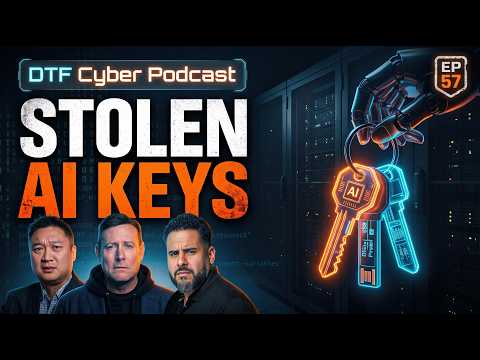
Black October: Hackers Stole the Keys That Run AI
0:00nine AI platforms, one month. Attackers weren't stealing data, they were stealing the keys that run AI.
And here's the number that should worry you, Damian, and every board out there is that there's 109 identities for AI to every one employee. You may not think
0:16so, but just wait. So, basically what I'm hearing is um we hired a whole bunch of robots, a whole army of them actually. Uh they got keys to the office and then uh we never wrote down their names, so we don't know who's who. I mean, I guess what could really go wrong?
0:32We're covering Black October and the identity problem underneath it. This is the DTF Cyber Podcast. I'm Damian.
This is Troy.
And it's your boy Fern. Let's go. [music]
0:51[music] So, let's just start this off here. You said nine platforms. Um, so let's go ahead and name them. So we have Fireworks Andromeda uh Zeber Lightning AI, Open Code, Railway, Warp,
1:06Command Code, and North Flank. Um, those are all of the the nine that we're considering for for Black October. Uh, we have the dates, too. We can kind of put those in the show notes, so if people are wondering what exactly we're talking about, uh, or
1:22the dates for when these things happened, uh, you have those there. Yeah. So essentially we gave AI agents the keys to everything and then we never really gave them an identity. And so this is the result of that. So we've got really two stories we're talking about today. One the Black October part which
1:39we'll go start with and then kind of roll into AI agents and why they need identities. But essentially what's happening here is you know these keys are being uh hijacked or is it like LLM jacking?
1:54But uh can we even see those? And are we are we sure of who's using our keys once they're out there? I think that's the big problem here.
Yeah. And Damian, also if the AI platform has that breach, is rotating the individual keys enough or should you
2:10rotate all the API connections into that platform?
Well, I don't know how many people are actually rotating those keys. That's that's the big question, right? If you look back I don't know developers we may have policies to say yeah you should rotate your keys every what 3 months
2:26every month I mean it gets kind of cumbersome to say yeah you got to rotate them every week so we know that doesn't happen that often but what about a year right do you have any way to check that your keys are being rotated within a
2:42year within 6 months so what's that tolerance for the tolerance threshold that you have
Mhm. M
what's the typical policy right now for most companies like when they just in general as a as a practice because I I've seen things about um uh
2:57[clears throat] some companies saying you have to do it within 45 days by a certain date uh coming up I think in like the next like maybe 6 months or so um but what's like the typical process or the typical um uh runway that these keys are typically given yeah I think that we are seeing
3:13the wild west so to speak where there's not really a policy yet developed per company that uh addresses each one individually. And if you think about when uh you have a business email compromised and one of your employees or contractors has a compromised email box, it's easy to rotate the tokens and you
3:30know make them change their their username and pass or their password to that uh platform. However, as we look at AI now, is that going to be enough? Are you going to be able to take the individual and then just be able to rotate that one key or do you have to kind of reset the entire system kind of like a silver or golden ticket reset in
3:47Microsoft as an example? I don't know that we're treating these identities uh individually or if we're attaching them to the human that created them. And so if you don't have a good policy behind that Fern, how do you know what to change when there is a problem?
Yeah. Yeah. So, it almost seems like if you don't have a a a strong policy
4:04today, uh you're just kind of setting up the rest of the organization for failure down the line.
Exactly. Yeah, I think so.
Well, let's let's back up here for a second because what happened here according to the reports is that the attackers hunted uh stored environment
4:21variables and in those were the keys. And so I think we're we're kind of jumping ahead to keys for AI because I think you know it doesn't really matter if it's AI or if it's a service or it's a it's a an automation or a person. I think those keys exist within environment variables.
4:38And if the attackers can get those environment variables and download keys and maybe even dump data out of it, that's that's also really concerning. So are you monitoring the systems for that type of activity or any kind of um
4:55unusual behavior happening within your your organization within those environments? That is probably a good place to start as well. Um, and then are you monitoring your LLMs for usage? Because if you see a spike, I think in
5:11this case what happened was they were harvesting keys and it may go dormant for a couple days or a couple weeks. Once they knew they had access, they essentially take your LLM and outsource it or rent it out to somebody else who could essentially ramp up that bill. and
5:28and if you don't have proper limitations on the spend, you might be looking at a pretty hefty build at the end of the month.
Yeah. So, what I had here on the notes is that it was within 30 minutes of or two two keys were tested within 30
5:44minutes of one another. Um, and then they went quiet for a while and then a few weeks later from what it looks like there was about 800,000 calls u within a 30 hour span. So, and then 1.7 in uh 13 hours total. So, just like you said,
6:02they were harvested, kept, and then um I guess used later at at those numbers. Well, they were probably okay, you know, probing, do these keys still work? So within those first 30 minutes and then the the bigger
6:19you know the bigger attack is okay let's let's script this so that we can make as much use of the LLM and the keys without you know without being caught. So we're we're going to do this over the next 24 hours or 48 hours. How many calls can we make in that time? I think that was all
6:36planned, right? But as an organization, you you're going to have to have a way to monitor that usage so that if there's a spike, hopefully you catch it within the first 30 minutes or the first hour going on for 30 hours or whatever it was, 13 or 30 hours that you said, Fern,
6:52that's a long time.
Yeah, it's just uh kind of telling that people just are not monitoring that usage as you said, Damian. And this kind of reminds me of back in uh you know when developers would check in code hard-coded secrets into a publicly
7:08available GitHub or GitLab example. But this just reminds me of when we used to check in you know hard secrets into our code and check it into GitLab or a public GitHub repository and it was found by attackers like your Amazon tokens or things that would allow access into your cloud. Um I think we also need
7:24to have that hygiene and that ability to hunt. So, we used to have all these SAS and Dash tools that could look at our code to see if there were, you know, secrets that we were publishing in there. Damian, how do you suppose we would be able to hunt for these type of secrets um in in the LLMs as an example?
7:39Uh so, in internally, there's there's two things I would say. First, it'd be monitoring what you have, right? So, you want to you want to see where you're hopefully see where all your access is going and what is normal behavior. Um the the hunting piece of it is,
7:56you know, I I don't know if you're going to be hunting it like an attacker, but you're going to hunting be hunting for assets that you already know exists. I think that's the biggest problem for a lot of organizations is that they don't even know where their keys are and they don't even know who has access to them. So that's the biggest problem for us as
8:12defenders is really just understanding what are we trying to defend because if we can't we don't know what we're trying to defend, it makes it almost impossible. Mhm. Yeah. And then to the flip side of that is like how are we going to manage to sorry to monitor our resources the
8:29spike in traffic the spike in requests and so I think that there are probably some startups out there coming into that field but you know how do you create the alerts and the thresholds that Matt uh that makes sense for your environment.
Yeah. And it's not just your environment right look at the result of this. I
8:45think one of the platforms you mentioned Fern they're shutting down over this. So, what does
your vendor is gone? What does that do to your team and and the work and everything stored there?
Yeah. Well, so I've kind of got like um maybe like a curiosity and the cat
9:02situation. Um so in here it, you know, it's shown that there was there's two kind of requests that were done that worked and then they didn't do anything for a while, right? And then from there there's 800,000 calls that came in afterwards. So, and what Troy said was
9:18you kind of have to have things that are in place that kind of restrict that. And I think you mentioned the same thing too, Damen, but like what I did what I didn't hear, and maybe it's because it's not realistic, but maybe you guys can let me know, is that there's really not a way to kind of understand like the oneoff or the the couple of requests
9:35that come in that are legitimate requests, potentially legitimate, but not from a legitimate um like person or or or we'll say thing because it could be a machine, right? Um, so there's really no way to kind of catch these things as they kind of happen until they
9:53start to happen at scale. Is that like am I understanding it right? Because it it doesn't seem like there's really a way to to kind of find these things before they before they go for the we'll say the volume.
Uh, well, I mean that that's what I'm saying though, right? Is that you're
10:08going to have unusual volume or unusual activity. I don't know. Did you hear the story about that live streamer? He was live streaming in Japan and uh he accidentally revealed the QR code for the ordering while on the live stream. You guys hear about that story? I have a couple hear
10:25that one.
Yeah. And and so people on the live stream captured the QR code and started ordering food to his table and racked up I I can't remember how much it was, like a million yen, which is like 12 $15,000 US. And and started ordering food for
10:40his table. Now think about that. Do you think the restaurant's just going to make a million yen worth of food and send it to a table with two people?
So, obviously, they came to the table and they said, "Hey, did you order this stuff?" And and then, you know, obviously they figured it out. Uh, I
10:57don't think they made the food, even though he claimed he paid the money for all the food that was made. That's the exact same check that we need to do as, you know, hopefully the the monitors of these systems to say, is this normal? Should I be having a million calls over
11:13the the past hour? Uh because that's not normal and and maybe question it and put a pause to it. Do you even have a way to revoke the keys that fast? Right? So there are a lot of a lot of things happening here that we could learn from. Number one, we're saying make sure you
11:29have observability and visibility into who's using or what keys are using being used and how much are they being used and what's normal and then start to put controls in place beyond that. Okay. Yeah, that makes sense. It's but it it's again it's just only once once things
11:46start to go sideways is when you have to catch it. There's really there's really no answer to catch them before, right?
Yeah. And here's here's the the key thing to this, right? They didn't steal data. They stole the keys and then they took
12:01those keys and essentially gave it to somebody else to use and maybe charged them a fee or I don't know maybe they used them themselves but somebody else used your tokens on your bill right so that's essentially what happened here we're all focused on you
12:19know data being stolen in this case yeah the keys are data the keys are an asset uh what the hackers did with the data with the keys completely different from what you'd normally expect. You would expect them to take your data and maybe hold it ransom or, you know, extort you
12:37somehow. In this case, they just took the keys and said, "Hey, let me let me take it for a run." Right? It's like somebody leaving their keys to their Ferrari sitting outside and somebody's like, "Hey, let me just take this for a joy ride."
Yeah.
We saw this a lot with crypto miners. you know, they would hack into a server
12:53that's publicly available and just put this piece of code in there to steal your compute, you know, and this is very similar to that. They're stealing compute power from your LLM to run whatever they want to, whether it's additional attacks or additional surveillance and reconnaissance or simply to resell it, as Damian said, to
13:09other customers. Yeah, that's a that's a good business to be in because they you don't got to pay anything to get them, right? And you just sell them and make a bunch of money. Um, I think the total damage was like $100,000, too. So, um, let me just go through here. Yeah, there
13:26it doesn't take long to go. Yeah.
Yeah, there was one uh one platform that was shutting down, right?
I thought I saw that.
Yeah. Yeah. Yeah. Uh, I got to pull the name for which one it was, but yeah, they're uh they're officially cooked.
So, I mean, it it it could be that they
13:42racked up so much in uh token usage that they just didn't have the money to pay it back. I don't know how how this works, you know, can you go back to the provider and say, "Look, this was done, you know, without our knowledge." It's
13:58like a credit card. Hey, I didn't spend it. Can I get the credit? Can I get the credit back? Now, you're in a tough spot because obviously power was consumed. Uh, compute was consumed. So, you can't really expect
all of that to be forgiven. But, I don't
14:14know, maybe there's a way that they can negotiate a uh a way to pay it back over time so that they can stay in business. Or do they just shut down? That's that's the the scarier part because if you are a customer of of this AI platform, what's the impact to you? You maybe
14:30you've built around it. Can you just change the model? Can you train another model? I mean, that's I don't know what the broader impact is for this shutting down. So, interesting thought you just gave me, uh, Damian, when you talked about credit cards, cuz like if you have your debit card and the money gets
14:45pulled out of your account, there's no protection, right? But if you have a credit card and the money gets pulled against your credit and you submit like, you know, claims or whatever, um, investigations blah blah blah eventually you get your money back, you know, however that works out. But do
15:01they I mean most most of these accounts for some of these tokens are tied to um credit cards, aren't they? I guess my personal one is tied to my credit.
The company is still on the hook to pay the bill even if the credit card says they were fraud. I mean the compute or
15:17the LMS are going to come after the the end user who signed the EULA to say I would I would pay. Um, I think this hearkens back to resources were consumed and you are responsible for the security of your environment and it's your fault that the
15:33bad guys were able to take your tokens or your keys and use these resources illicitly and the platform pro providers don't care who uses it if it's on your bill. And to shut down a company is bad, but imagine if you're a solo uh worker.
15:48you're you're working for a company and you're you using this on the side to try to help yourself do your job better and then you get a $100,000 bill that you can't get out of. That would be even more traumatic than having to shut down a business and claim bankruptcy. Now you're an individual employee who was trying to do your job better and all of
16:04a sudden you've got a $100,000 bill cuz somebody stole your keys.
Yeah. Think about small health care practices that may be using, you know, a model behind the scenes whether they should or not, right, because of HIPPA,
but they may be. And what if somebody
16:21attacks that model and racks up their credit card bill? Now, that puts them in a in a really tough spot. They can't just claim, you know, claim it back on their credit card. I think there's probably some, like Troy said, agreement between businesses to say, I'm responsible for this. uh because we
16:37can't we also can't expect the platform the AI platform to assume the costs either. So this is it's it's going to be impactful to the businesses and also the customers that depend on those businesses. So there is downstream effect here. Yeah. So okay so this makes
16:53perfect sense because if you happen to have a model that breaks out of the sandbox and then breaches another company, you know, no big deal. But if someone breaks into your stuff and steals your stuff, you're still on the hook for it. So, it's like what uh that's like a lose-lose. [laughter]
17:08Like, it doesn't make any sense to me like how I don't know. To me, it seems like there needs to be more more legislation around kind of all of that as a whole because for people on the receiving end, like the consumer or the businesses that are using these tools, uh they're in a they're in a lose-lose
17:24situation because like I said, like if something happens to their environment that was we'll say sandbox broken out of, then they have no recourse. But if something breaks into theirs or someone breaks in and steals their tokens and
17:39uses them, they're still on the hook. So it's like you're always getting you're always getting cooked, I guess. I don't know. But maybe
at least I think for these platforms, you have to have really a guardrail to say do not spend more than
17:55let's say $10,000 a month. That that is the hard limit. At that point, shut off all tokens. I mean, there has to be that type of guard rail
so that you are your exposure is limited to maybe $10,000, not a million. And and I don't know, you know, I don't know
18:10these platforms really well, so I can't can't comment on them. Uh, but everybody should be looking at this whether you're a business or even a personal individual that is essentially just vibe coding everything because you put your credit card up, right? I know Fern, you use
18:26models as well. You put your credit card up. How what do you have limitations on how many tokens can be used every month? Because I know I do.
No, I probably actually after this conversation, I need to figure this out because um I can't imagine uh walking
18:42into $100,000 bill, right? Um
yeah. Or at least have like a prepaid model, which I think I do with Claude, for example. You could buy credits. You could put $100 in her account and just make sure it's not set to auto reload. And when you run out of that that $100, it just tells you, "Hey, I can't do
18:58anymore."
Yeah. I'm I'm logging into my account settings billing right now usage. [laughter]
Yeah. So, this applies to everybody out there. You know, we all use some type of an AI platform. Make sure that you are checking to make sure it can't run away from you on a billing perspective. Uh I
19:14think that's a great great topic.
Oh, turn on usage credits to keep claw if you hit the plan limit. Turn that off so that way I don't use my usage credits. Right. Um, and then limits. Okay. All right. I think I'm safe now,
19:30guys. Um, but you know, that kind of brings us to like the next topic, which is around identities as a whole. And let me see here. So, so this maybe this is kind of in my way a segue for this is
19:45now assume that one machine or one agent, one account that was tied to a person was used and it has a $10,000 limit. But there's no restriction on a um agent, right? So, all someone has to
20:00do, and of course I'm making all this up right now, and you guys can tell me if I'm like making up too much fake stuff, but if someone has an agent that they use, and they use it to a $10,000 limit that, you know, we're just going to say potentially exist on tokens and what you can use and they hit that limit and then
20:16they just make another agent, right? Um as 2026 survey says that out of 2900 security leaders that were surveyed um they found that for the organizations that these people work at human identities um were outnumbered 109 to1
20:34on average up from 82 about a year ago. So in my mind, what I see there is the number of agents that exist for a person potentially on average, right? Not saying that they're using all of them, but on average a company would
20:51have about 110. So if you use one for 10K and then you burn that and then you go to the next one, you burn it for another 10K. Like you're still going to end up racking up a bill even if you have
Well, you're assuming you're assuming that we can tell a difference between these identities. In this case, it was
21:06one key. So in in in a typical fashion, you might have all 110 machines leveraging the same key. And that's the problem, right? So we're we're not at scale where we could say each one of these 110 per human, right? This is not
21:23110. If you have a thousand humans, you got to multiply that by 100 to get the true machine identities in in your organization. They are not being tracked independently. And there sometimes we're tracking them back to the human and then
21:39giving the human one identity or one key. And I think that's also wrong, right? Where we're going to have to get granular enough where we can identify each one of these machine identities and give them like a just in time access to what they're trying to do. So the the
21:55way to govern this is okay, you got a 100 agents. Uh do all 100 agents normally tap the LLM? if they do, how often do they do it? And what's a normal what's a normal behavior for these machines and and the AI,
22:11right? That that are going to the agents that are going to go tap the the LLM because that's where you want to watch it. We're we're not going to be uh you know, if you're starting to spin up, you have one human identity that's tied to a hundred or thousand different agents, agentic agents, that is not going to
22:29scale really well. We're going to have to treat these agentic agents as an individual identity.
And who owns the agent? Uh who's able to actually revoke the agent if something goes wrong? Who's held accountable when the agent does something off the grid or against our company's policies?
22:45That's I mean that's a good question. That's a great question, Troy, because do you I mean right now we tend to draw that back to human. We we tend to say this agent was spawned by this human. But if you think years from now, this
23:01human may spawn an agent that spawns an agent that spawns an agent that spawns an agent. How many times? And it's not just an agent that you might have a hundred per level. And so that hierarchy of authorization kind of change and
23:18flips into not what one human is responsible for, but what one agent created or spawned the other agents. And I think that's where we're headed. And that's the biggest, you know, that's a huge problem to think about at this point. But we need to plan for that.
23:33Uh I I want people to get away from, you know, blaming the human because, you know, I may and I'm scared of this too because I fire off agents all the time. I try to put guard rails around them, but what happens if an agent spawns another agent and you know, do I got do
23:49I fire that agent? I mean, I can fire the agent. The agent doesn't care. Uh but how do I keep track of all these agents? and who how do you hold them accountable? So, that's the scary part.
Yeah. And then on top of that, I did a LinkedIn post about this recently. It's called little orphan agents, you know,
24:05because well, let's say you have an employee who is uh who departs the company, gets a better job, gets let go, terminated, whatever, and he has already spawned, you know, 109 different agents. Now, who's going to manage them? Now, are they just orphaned? Nobody knows what they're doing, but they're still running their processes, creating
24:20business reports, um taking up data shares because they're creating reports that are stored on Teams or One Drive. And that's just ballooning your storage cost. Uh it's also ballooning your compute cost because these guys are still running and nobody knows about them. So, I think what we're talking about here, D, what I'm hearing you say
24:37is that we've got to come up with an identity platform that's going to treat each one of these agents individually irregardless of the human who created them.
Yes. And you you not only you have to be able to uh monitor those agent credentials and also be able to revoke
24:52them quickly enough. I think that's where where there's a stat probably we found somewhere referring I think it was like 37% of organizations can revoke
agent credentials at all like only 37%. That's scary.
Yes.
Because you you're going to this is
25:08going to explode and you can't revoke an agent's credentials. You can't even map it back. We're talking about mapping it back to a human. and what happens if that human leaves organization then what I mean that's that's a perfect you know that's a perfect problem to talk about Troy but what do we what do we do in this case you you now you have an agent
25:24that's running rogue or you have a key that's out there you can't even revoke the key fast enough uh that's a huge problem right we're not addressing that today
yeah I agree I think it's going to take a platform where we separate a gentic identity from a human we're just not thinking in that way right now we've we
25:40like you said earlier we've been thinking about this as a human to to agent problem or you know solution and I really think it has to be on its own an agentic AI has to get a serial number has to be deployed through an HR type system whether you know and get a
25:56bedrock foundation identity that we track across the environment because they may have access to many different systems your ticketing system your CRM and other things and so you need to have a bedrock foundational identity for that agent everywhere it touches to be able
26:11to account for the changes it has made and to be able to revoke it uh if you are unhappy with it. But I'm not sure we need to differentiate whether it's an agent or a human. I I think an identity or an action taken by an identity is an
26:27identity regardless of if it's an agent or a human. I think whether it's an agent or human is just really a checkbox so we can identify it. I like the flag for H, a human or agent H or A because as a manager, I need to
26:42know quickly who I'm holding accountable. My am I talking to somebody on the phone or am I going into my system to address the agent via keyboard?
Yeah, I got no employment laws when it comes to firing an agent. [laughter]
Unless unless they all create a union and now we have an agent union. I don't
26:58know. But yeah, I could I could just go and and fire an agent because I didn't like the way it,
you know, it the attitude it took or the the the path it took to get to where I needed it to go.
But definitely, I want to I want to advise everybody listening, be nice to
27:13your agents. You guys see that Anthropic said you can be banned from their platform if you are cruel or mean to a to the AI?
No.
Really?
I didn't see that.
Yeah. Yeah. You got to be you gota be nice. Um, if you continually uh are
27:28cruel or mean intentionally to Claude, they can kick you off the platform.
Really? I saw that that Sam said that if you have like uh DRAM or um at home that it should be in a data center somewhere. Um I didn't see anything about if you're
27:44mean um that you can get booted.
Maybe we can share that. I'll I'll send you the link. We can put in the chat below.
Yeah.
Yeah. I want to see that. I don't know. That's that's interesting. I think there are people who will be very short with AI. I I tend to be a little long and I
28:01don't know why you always say please or can you do this.
I'm not just ordering it around. I but I I think that's just normal for for me.
Well, so let me ask you guys this then, right? So when when we think of
28:16identities um or when you guys think of it, right? So we'll say practitioners there's uh what the joiner mover uh levers right so and there's essentially risk along this chain um and that's more
28:33so for people right because it it it governs and and grants things right but it doesn't actually keep track of usage it more or less just provisions it will say access but not whether or
28:48not that access is being used. Now in the case where it's a person, I can only move so fast, right? Uh I can only do things so quickly and if I have if I am doing things say maliciously, it's easy to kind of see me doing that, right? But
29:04if someone is using agents, doesn't the whole like join mover or lever like we'll say architecture or like thought process fall apart once you start using agents?
We're not tracking it. I think that's what we're saying, right? So like a
29:20human,
when we we onboard a human,
we're onboarding them. We're giving them lease privilege hopefully in theory,
we're doing offboarding. We're doing like the monitoring of that user while they're employed. But then what happens
29:35with the agents? The agents get pasted into an environment variable and then we never go back and check or or just get forgotten. And that's what's happening right now. That's what happened in the first story, right? the the key gets kept in the environment uh variable and
29:51then you really don't rotate it or you forget about it.
Yeah. So having having a strong identity or IGA practice in place isn't necessarily what's going to save people from this. It's I think a lot of it this what it sounds like to me is a lot of um
30:07inspection at runtime.
Right.
Yeah. I mean that's that's it right because you look at governance and we we've talked about this uh in the past too right governance is required but it doesn't make you secure and I don't even think we're doing the governance piece
30:23for agentic agents yet so if you can't you don't know what you you should be doing to lock down what do you what do you know about those agents and how do you observe them I don't think we're we're really there yet now there are tools out there that do this stuff so I don't want to say hey we're not there
30:39yet I for the most most organizations are not thinking about it yet and especially small midsize businesses. I know a couple weeks ago you guys were talking to JT and he's trying to help these smaller organizations. Uh they're
30:54not thinking about it, right? They're not equipped to use the latest tools and and experiment with these new cyber tools coming out.
Exactly. Yep.
Yeah. I mean, it seems like uh a lot of these major issues are kind of we'll say
31:10like on the frontier, you know, like small businesses and medium businesses probably aren't really thinking about it. They probably should be, right? But realistically, they're not because they're more worried about keeping the lights on, uh, you know, paying their payroll. I think like Troy's always said before in the past and some of the other
31:26episodes is like there's there's more important things to people than, you know, agents and and MCP servers and uh AI in general. Um, but I think these things are always important for people to be aware of because it's like um I mean to me it's just like security like
31:43you can't protect what you don't understand or have inventory of. in this case is like you can't make decisions on how to proceed if you don't understand what the risk are in front of you that are you know maybe we'll say at the on the frontier side of technology right or
31:58maybe on the bleeding edge right anything that's on the bleeding edge isn't necessarily top of mind for maybe most people but for the people that it is top of mind for you know hopefully they're making the right decisions but I think there's a lot more people at risk
32:14because these conversations aren't necessarily ones that they're having every day. Which is exactly why you should like and subscribe for the DCTF Cyber Podcast because we're having these conversations weekly or roughly weekly. Uh we didn't do too well in October, but
32:30we're having the conversations weekly. So, all you have to do is hit the like button, share it, subscribe it, send it to your friends because if they're not reading the news, we are and we're talking about it. That's my plug. That's all I got to say for the
I heard a I heard a wild wild statement
32:46today from the founder of Tesla who said uh in three years time we will pretty much be done trading time for work for pay. So in other words he's thinking that humanity will be away from all jobs in three years pretty much and it will
33:01be either robots or agents etc etc. So, as we grapple with that reality, um the security of agents will continue to be top of mind. If you tie it into what we're thinking about here, we're not going to have any shortage of new agents
33:17in our environments. We're going to have an explosion of them. And so, whatever identity platform really gets agent and human identity right, I think is going to do very well. There's some startups out there I think we all know and love, but really companies should be thinking
33:33about how am I tracking every agent in my environment. Yeah, I think one of the things you got to think about too would be, you know, when you look at the joiner, mover lever aspect for humans, how does that apply for software in
33:49agentic agents? Because the agents don't join, they get created. they don't how do you handle the move between the actual you know maybe a human overseeing it to a different human or a different agent and then do they leave? I mean I
34:04think the the one of the points we're trying to make here is they never leave. We don't rotate them out or we don't take the agents out and then you know put something else in. They kind of just stay and the keys kind of just stay. So that's those are the things you got to think about as you start to deploy these
34:19agents.
Yeah. And if you're looking to stay up to date, [laughter] you'd already know what to do. Um Okay. Yeah. I I I really um I kind of feel like people don't necessarily think about these things on the regular. Um
34:35and because most people Well, me I don't know about most people. what I can't like broadstroke blank a statement it but I feel like a lot of times whenever I go online to look at stuff it's always about AI AI AI uh and how to use it but not necessarily how to protect yourself
34:50or how to protect your business like oh look at what we're doing these cool things look what AI can do it can make your life simple uh you know we're headed towards the matrix but like no one cares because you know agents are awesome but I don't know I mean like when said that in 3 years um we're not
35:06going to have to work. Like, what are we going to do? We're just going to sit at home and play video games all day. Like, I know plenty of people that do that already. But, um, how are you supposed to make money if if Oh, I guess
Mhm.
if you're if if you Okay, if you can afford a robot, it can go to work and do
35:23your job for you and then it makes you money. But if you can't afford a robot, you have to go to work. I guess that's just how it's going to work, right, Troy? I mean,
yeah, but it's not physical. Yeah, they're they're not physical. There's they're software agents. Mhm.
So, you just have to know how to really
35:40uh tell the agent what you want done.
But, you know, here's the scary stat like we said before was like, you know, over 60% of organizations can't even revoke the agents. So, even if you could see something happening that looks wrong, uh we're we're just not able to
35:57revoke those agents. And
you know, what does incident response look like when
that key is stolen
and it shows up under bill? I think we we got to cut that time down to be a lot quicker to be able to identify the the
36:13you know the behavior that we're not expecting and hopefully not get surprised with that big bill and cut off the access as soon as possible. You know what I see here Damian kind of a coral area is that for years we've been terrible at asset management. One of the foundational parts of cyber
36:28security and IT in general is knowing how many assets you have on your network at any time. I feel like we're heading into that same quagmire with agents. Like nobody's going to have a really good number of how many agents do you have? How many agents are running? How many agents are, you know, have access to your database and how can you quickly
36:45revoke them if necessary? I I feel like we're all heading there with that same level of confusion as we do with asset management. Would you agree?
We are. And it's exponential. So now it's you're looking at a 100x problem versus what we have right now. And if
37:01anyone tells you they know exactly what agents are out there and what they're doing at any one time, I would I would tend to think they're they're lying. And if they're not, send them our way cuz I want to learn what they're doing.
Yes.
Or the other the third option, they're
37:19Oh, wait. Is I don't know if I should say that. They're ignorant
because I don't I don't So ignorance we we used to hit a time. I remember this, right? I'm old enough to know there was the time where companies used to say I'm not using cloud because I don't know where my data is going.
37:35You're over that, Troy?
And
Oh, yeah. For sure.
Yeah. And then it became, well, we're not going to use AI. We block all AI because we don't allow our users to go there. And then so users kind of find ways around it. They go to SAS around it, right? So we had shadow IT.
Then they'll go to AI and Gen AI around
37:53the the company controls and you got shadow AI. And so we're kind of, you know, I think we always go through these cycles of people saying, "Hey, we don't do X or I know, you know, they they kind of overexaggerate uh the things that
38:10they think without knowing because they have no visibility into what their users are doing."
Yeah. I lived through the time very graciously when AI popped up and we had all these CISO pows, all these, you know, peer groups that would get together and there was always at least
38:25one or two CISOs that would say, "We're not using AI. We're just going to block it. Nobody in my company's ever going to use it. We would never allow that to happen." And it's hilarious to look back and say, "How'd that turn out for you?"
You know, well, where we are now, right? We spent 20 years learning to manage
38:41human identities and then we handed the keys to a workforce that never got hired. We never hired them and then we never fire them.
So they'd never have their access reviewed. And I think that's where we're at right now. We're just saying you got to uh you know have better visibility
38:56and better blogging, better access reviews for agents.
Yeah. But people don't even have a um a a good understanding with the CMTP, right? And that those things are physical, right? A lot of these things are are physical devices and people still can't keep inventory of it, right?
39:13I I feel like we're uh we're up the creek without a paddle. Um when it comes to identities and machines and agents, right? So one one thought maybe to kind of carry us over to the next episode, and this one's for you, Troy, is out of all those people, [clears throat] and maybe this is a is a closing thought.
39:29Out of all those people that said, "Hey, we don't allow AI in our in our organization." Uh I'm sure you know who those people are. I'm curious for next week. Do those people still have a job? [laughter] You know, I think you're spot on, Fern. A lot of them have retired. Um, a lot of
39:44people who just were just resistant to the AI, you know, transition. Honestly, they're like, I'm tired. I'm I'm old. I want to retire. I've had enough. Um, it was the same reaction I saw from doctors when we went to the electronic health record, the EHR back in 2016, 2017 when
40:01it was mandatory that doctor's offices switched from paper charts to EHRs that could be submitted. Um, some doctors chose to retire and not deal with that. And I think I'm seeing that with CISOs as well with the agentic and the AI revolution. So, you know, I always told people you've got to lean into, you got
40:17to understand it because our employees are going to do it whether we like it or not. And that evolved into now companies are using it. So I I still say the same thing to my peers like out there. You have to lean in. You have to be on the cutting edge of what's happening around you because that's going to happen whether you like it or not. You can
40:33dislike the AI transition all you want to, but you're not going to stop it. You know, a lot of people are saying we should stop building data centers. We should stop, you know, improving our AI. It's going to get too powerful. Well, that's great if we all chose as the, you know, um, as a country or as a as a
40:48society to stop doing that. There's still countries and societies out there that are not going to stop and they're going to be farther ahead with these weapons than we are. So, um I definitely agree with you, F. I think some of those people are just not around anymore.
Yeah, they um they self- selected themselves,
41:04right? [clears throat] They're um they're out they're out of the uh out of the game. They've retired. And I guess with that, any uh any closing thoughts from from you, Damian? Yeah, I was going to say let's let's just, you know, give some pointers here for everything that we covered. So, if
41:20you you're glazing off and you're coming back to this, here's what we're recommending, right? We be able to have better visibility. Rotate everything you you know, all these keys that you don't know when they were issued, who has
41:35access to them, we we're just not sure, right? So, we go ahead and rotate those keys. Give every agent an owner. I'm saying that now, but in the future, an owner uh may be an agent, right? So, an agent might be owned by another agent. How about scope and expiry for those
41:52keys? I think that's really key for everyone in every organization. Make sure there's no shared or standing on scope keys because I think that's where we are as an industry today where we have a ton of shared access. Um maybe alert on AI spend, put those guardrails in. We saw Fern do it in real time on
42:09this podcast for his own personal account. Um, and then make sure that you know if you got a if you have bill spikes that often come up, we're we're being alerted on those. Uh, because a key could be resold easily and then taken advantage of.
42:27Cool. Anything you want to say, Troy?
Yeah, I think we get back to the fundamentals. You know, key management has been crucial for for as long as I can remember. continue doing that now with the AI age, making sure you can keep up with the keys that are being generated for your environment. Uh, and then identities, again, identity is fun
42:44foundational to a zero trust environment. We've built so long to get to zero trust. Um, it comes down to the identities that have access to your data, understanding who has access to your applications, who has access to your network. Those that hasn't changed. So again, you know, we're we're not
43:00talking about something that's coming and upending how we've done things in the past, but it's going to require people to do a lot more work around uh allowing their employees to generate agents just out of the thin air and not knowing what they're doing or capable of doing.
43:16Nice. Nice. And if you want more of this, we do it usually every week. Hit the like button, hit the subscribe button, and uh tell your parents about it because we all know that they're not following security like you are uh or your friends, too. So, um we got to we
43:32got to get some boost on the on the audio numbers for um well, it's the podcast in general for audio. But um yeah, I appreciate you guys taking the time chat today. Uh for everyone listening that made it to the end, we appreciate you listening to this and hopefully there was something useful from the legends that are Damian and
43:48Troy. Um, not so much me, but hey, maybe next week we we'll get you something good. Uh, until then, take care. [music]
44:06They found the environment [music] where secrets are saved. The variables whisper of keys that they craved. October went dark as they harvested flow. [music] No data was stolen. They just let it blow. A quiet protest at the 30 minute mark. The silence descended out here in the
44:22dark. A million computer [music] cars were spun on our dime. The runaway agents are running on time.
[music]
You got to lock the system down before the run away.
44:40You got to keep holding every [music] vanish in the night. In this galaxy [music] we hire a robotic and automated force and let them just run at the [music]
44:56head of the source. They multiply quickly with no known address. Outnumbering humans but leaving [music] a mess. Orphan little agent with keys that still fit. Still making reports as the data gets hit. If you can't revoke them at [music] 30% you're bleeding out cash on a ghost of a
45:13you got to lock the system down before the bill can [music] run away to the run away. You got to keep [music] know who is holding every
45:31vanish [music] in the night in this automated galaxy. Do we blame the operator sitting at the screen or blame the operation and the [music] shadow in between? We built zero trust for a human and a face, but machines are taking over every open
45:47space. They need an identity, a cereal to [music] own so we can shut them down before they leave us all alone. I fire off a nation and [music] it spawns another 10. If we cannot revoke them, we will lose it all together. The system down [music] the can away
46:08[music] [music] in the night in the galaxy. [music] This is DDF cyber on the line. We wash
46:24the machines [music] and we read between the code. Keep your identities and lock them down tight. The agents are watching [music] and living in the light. Turn the usage credits off and secure the key or you will face the bills in [music] this galaxy until next week. Keep the guardrails high. We watch the digital
46:41frontier in the sky.