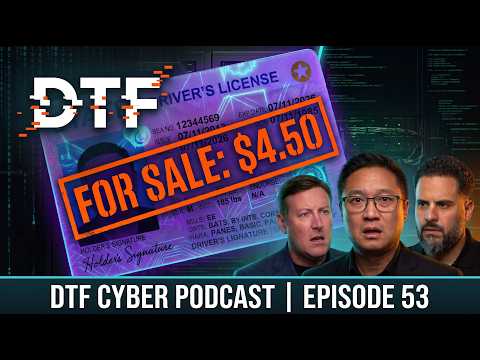
153M Drivers License Breach Analysis
0:00If you rented a car this year, your driver's license might be for sale right now. You know, 153 million records. You know, these are the front, the back, and ultraviolet scan from one vendor.
Yeah, you can reset your password, but can't reset your face.
0:16Very true. The FBI is probably investigating right now, but this is worth the discussion. This is the DPF Cyber Podcast. I'm Damian. This is Roy.
And it's your boy, Fern. Let's go. [music]
0:39The main story today, Nexus idscan.net breach. Now, I read about this last week, I believe. Essentially, this is the the numbers for it, right? So, just for context, 153 million driver's licenses of US,
0:55Canadian, or between both US and Canadian citizens. 10 million plus ID cards. 3 million travel documents and international IDs. And about 508,000 medical cards.
1:11Including cannabis dispensary cards, by the way. So, yeah, there's what they're claiming is that they have that there are 170 million people affected in total. And I think that's probably the the main the main thing, right? I think what US has
1:27what close to 550 million. So, almost 30% of the US, you know, normalized even though it's US and Canada. So, about one in three people in the US potential probably a little bit less. I don't know how many people are in Canada.
1:43Are affected. So, people might just know
Well, we don't we don't we don't know where this is all speculation though, right? Did they
Mhm.
Did they track it back to this service for sure? Cuz I know that the IDs are out there. They were on the dark web and people were getting access to them. But did
1:59they correlate it back to a specific vendor?
Oh, I don't know.
So, yeah, I think Damian, you mentioned at the beginning, the FBI is investigating it. And also some of the most affected states also have their attorney generals looking at opening investigations into it. I don't think we really know where this is going to be
2:16attributed to. There's like three big categories I've seen so far. It's from an ID scan place. It's from rental agencies. Definitely some one vendor has been compromised. But you know, we talk about privacy on this channel a lot. What about, you know, for us citizens who continually over and over our public
2:33information is being, you know, put out into the public? So now you're thinking about doxxing when you're trying to find somebody's home that you don't want to be found or just even, you know, your kids information out there, young young children. So interesting to see what's going to happen here.
2:48Yeah, I think you're jumping way too far ahead, Troy. I think we're just right now figuring out, okay, what what happened first of all and then the impact.
Yeah.
Obviously a huge impact. But you know, I I think they were tracing it back to that one particular vendor because because the amount of driver's licenses,
3:03right? If you're you're scanning, for example, to rent a car, you've got to scan that driver's license and maybe verify it or keep it somewhere. And that's probably the source of these. And I think to your point, Fern, the the dispensaries also
3:18I believe will scan your ID when you walk in or when you do a purchase in in Las Vegas. So that that it will probably be a central point of focus for this investigation of where those IDs came from. And then Brian Krebs,
3:33an amazing journalist as well in the cyberspace, broke the news which is you know, recent as well. So we're we're not sure. I think even his ID was in there in in the the actual amount of IDs that were released or or in the dark web.
3:49Yeah, and what's interesting about this one, Damian, to me been doing this a long time, but the fact that they have the ultraviolet scans, which mean like, you know, some states have different holograms embedded in the driver's license so that you can tell it's real or not. Yeah, I thought that was an interesting add to this one. Have you seen that before?
4:05Is it useful, though? I mean, I thought that the that infrared was just for that specific state. So I mean, if you have one license with the infrared, are they unique for every license?
don't think so, but I I guess what is interesting is that if you're going
4:20to make a copy or a fake ID of someone uh and you're not familiar with the states kind of like embedded holograms, it makes it a lot easier now that you know how to do that.
Yeah, but can't you just like pick one up? Or are you saying like for someone
4:36that's not in the US to be able to get access to what the latest ones look like?
Exactly. Yeah, somebody who doesn't have access to that states or who may not be even be in the United States or Canada.
Oh, okay. Is so this is a random thought, though. Like are most of the people that do things like that, are they outside of
4:52the US? So they're kind of in some way protected from like, you know, getting busted or is there's a lot of that stuff happened within the uh within like the continental US?
Yeah, I don't I don't wouldn't say majority. I would just just say there are some people from outside that would do that. But if you think about it, you
5:09know, international criminals who have collected a lot of credit card data from another data dump, now having identification data, how they can recreate an ID and recreate a credit card before it gets canceled and really wreak some havoc, whether they're in another country or not is uh yet to be
5:24seen.
Mm. What's interesting, though, is that the the Nexus site went uh went down right after uh Krebs published the report, right? So but but the data's already been leaked. So have either of you guys looked to see if your information's on
5:40there?
I haven't. Damian, how about yourself?
I I haven't personally looked, but I do have, you know, services that monitor for my information on the dark web. I've not seen a hit yet, but uh I'll go try to uh you know, obviously we're not going to have access to the full database. That would involve going and
5:58purchasing it, and I don't know if anyone's actually indexed it for people to search yet. That may be coming. I mean, that happened with uh for example the remember the Ashley Madison incident with the email addresses. Somebody made a database, took that and made it searchable. So I I I'm assuming that
6:13this will be the case as well.
Ah interesting. Okay. Yeah definitely don't uh if you're going to use your email for stuff like this make sure you make a special one. Yeah don't don't use a family email account. I guess maybe pro tip even though I'm not a pro. Um [clears throat] that's just the first
6:29thing I think of is like I have special accounts for um you know whenever you sign up for uh like a shopping account like the um like the Fries account or like the Walmart account it's kind of like the throwaway email that you know they're going to sell to someone else. Just have like a special one um where all your
6:45stuff goes to so I don't know. Um
Yeah but that's not going to help you with a driver's license. You you're you only got one. You can't have a fake one.
Yeah yeah yeah no I know. I I was just thinking like when when choice of the Ashley Madison thing right. But I guess getting back to this thing it says that
7:01it was it was basically all traces back to uh idscan.net right. So just for for the listeners that's a Louisiana based identity verification um provider. So they're used by a bunch of rental uh companies uh retailers and then
7:16dispensaries. So that's kind of how um you know we talked about renting a car in the last year or so or dispensaries. That's kind of the um common denominator is this tool which to me really just seems like a supply chain thing right um or maybe not necessarily supply chain
7:33but more so like third party risk right. Um [clears throat] what are people supposed to do in this case though because if this company is where it all kind of originated from like the people that are affected from the
7:49retailers or the rental companies or even the dispensaries it wasn't done by the people that they have their first party association with right. So I mean is there really anything to do there or is it kind of just one of those things where you scan it and you just pray that uh you don't get caught up in
8:06something down the line from from a a third-party company.
typically typically with, you know, with the credit cards and your social security number, when that gets leaked, those organizations, the companies that um were at fault would provide you with monitoring
8:22for, you know, a year or two years. I've had that happen um especially with AT&T, for example. I think there was two major incidents they had with uh customer data, and they provided mon monitoring for your uh credit in in dark web, right? So that was all
8:37provided for a year or two after the the uh incident. In this case, I'm not sure, right? If it's a third party, who is responsible for providing that or or reaching out to the customers to let them know. Is it the rental car companies? Probably, cuz that's who you gave your data to.
8:54Now, behind the scenes, how do they go back to their vendor and and try to reclaim some of the costs to to make this right for for their customers and even for their brand? Because the last thing you want to do is be associated with a data breach and it
9:10wasn't you specifically, it was down the line in services that you're purchasing.
That's right. This is kind of like a data broker, right? So if you purchase something at target.com and target uses a third-party data broker like Axiom or one of these others to, you know, track
9:25your buying habits across multiple platforms and then Axiom had a breach, who's responsible [clears throat] for that? I think target's going to be the one that's holding Axiom accountable, but as the consumer, what rights do we have? Is target going to pay us or give us any kind of monitoring? You know, there's all kind of class action lawsuits as well. So it will be
9:42interesting to see. I don't think we're going to necessarily see a precedent set here. I do think you will see uh just us get familiar with how that fourth party claim is going to work.
Yeah. And one thing I will add too is target has publicly denied involvement. They said they don't use ID scan, so
9:58[clears throat] um that was in my notes here, but I know you just mentioned target and I'm not sure if that's cool.
a That was Sorry, that was a hypothetical trying to use two brands that were not associated with the story. So, you know, Axiom and target are not associated to this license scam. So I appreciate you calling that out Fern. I was trying to make an example just of
10:13online data brokers and how that works. Um, and how a consumer could hold those data brokers accountable through that third party somehow. I feel like that's similar case here. How do we as consumers uh, who have rented cars or whatever they find out is the mechanism how the third party was
10:30breached um, who are you know first party was. We may find it was a rental car company, we may find it was Live Nation, we may find it was who knows somebody that took a scan of your driver's license and used this third party. Are you going to have multiple hundreds of third parties you know first
10:45party complaints? That's going to be interesting to see how that would work.
Yeah, and
Yeah, I mean how many times think about how many times you use a driver's license and how many times it's scanned.
Mhm.
Uh, I mean some bars and clubs will take your ID and scan that too. So where is that going?
Yeah, but
Yes, exactly.
So so I have a question there because I
11:02um, I haven't been to a club in hm long time. You know I'm I'm past my prime of the clubbing days but um, from what I remember they would they would like look at it you know and then you know look at it and then like look at you and make sure look look back at it right and maybe like they would have like a light
11:18like the infrared light or the ultraviolet light you know kind of you know twisted in the in the twisted in their hand a little bit see some reflections. I don't remember them actually scanning it. So are you guys saying that now most places whenever you go in they they actually scan and save
11:34an image of either the front or back of your ID as like some form of like recourse or like I mean we talked about the flat cameras what last week or two weeks ago um, whether you know they're scanning license plates. So is this kind of very comparable in the sense that when you
11:50walk into a club or you walk into a bar they they actually scan it so they have a physical copy of that actual document?
Mhm. This is an interesting thing at the Circa casino in Las Vegas. Everyone under no one under 18 is allowed in the entire property. So as you walk in
12:05there's a line to get in to the entire property and they're scanning every license of everybody that comes in. Now when I say scan we're talking a barcode scanner, scanning the back of the license with that little barcode, and now you're in their system. And so, from that perspective, they're scanning it, but they're not making a
12:21like a copy of it and storing it locally, but others might be. And since in this breach we have front, back, barcode, hologram, everything you could need, you know, that information is now out there as well. So, imagine if that's now compiled with all this other data.
12:38Well, you're talking about that casino where they're they're scanning your barcode when you walk in, but how many times do you get a player's card or a rewards card and they're they're taking your ID and scanning that? That does get scanned into the system.
Mhm.
Yeah.
point yet. So so so many times, I mean, to your point, Damian, this happens
12:54multiple times a month probably as you go and do things. So, this could be from anywhere.
Mhm. So so this brings up an interesting idea that I kind of thought of while you guys were talking about it is um just got back from a little international travel on a cruise, right? And when I
13:10was going through the line, they, you know, they take your ID, they scanned it, I believe, and then they actually took a picture of me while I was going through. All right? And that actually might have been hopping on the plane, right? Uh so maybe that's a little bit different there, but it's the same idea, right? They're
13:26they're essentially scanning my document and then taking a picture of me. So now, not only do they have a the image that's on the ID, they also have an image of myself, my present self in those pictures, right? So we'll just say, for example, something where it happened and
13:42I believe this would probably be with the TSA, something happens with them, now not only is my ID available to everyone, uh so is it a current image of myself that uh frankly doesn't necessarily look like my photo ID, right? Um is it is that kind of like along the same lines of where
13:59this is kind of a a very it's a complete set of data for each individual person based on kind of what we know so far?
Yeah, and I think you said it best in the opening, Fern, is that you can change your password, but you can change your face. What do we do when our driver's license is compromised? So now
14:16there's a lot of things on there that are not necessarily public data, our driver's license number, expiration date, uh things like just the barcode number on the back of it that um creates legitimacy when it's being questioned by either an officer or somebody else. So, uh it's very
14:32interesting to see how much new information about us is out there. We all assume on this podcast at least that our information is out in the in the dark web somewhere. There's been so many data breaches it's impossible for us to think that our data's not out there. So, now we add this to it. Um you know, we just have to be overly
14:47proactive. So, I'm sure we'll get into tips and tricks after, but that's where my mind is going. It's like what can we do?
Yeah. Well, the you're you're you remember your driver's license has your address on it, right? Or it should be your current address cuz they I think most states have a a law or rule in place where you
15:04have to change your address within two weeks of you moving. Right? So, it should have your your address on it. Now, I don't know how how important is it for for your driver's license to have your actual address on the actual driver's license. Wouldn't it make sense for them to
15:20encrypt that and have it in the database where law enforcement or the right authorities have access to that data and maybe just put some kind of a smart chip into the the driver's license itself and once they insert it into their laptop in the car
15:36or into a a computer it it would open up access to to your address if they really wanted it. Right? So, I'm not sure if there's a a purpose anymore to have your actual license um your your your address on your license. Um a lot of people carry their pass
15:53passport card. Actually, I was just talking about this to a a friend. They get the passport card because the passport card does not have your address on it, so you can use that as ID. You can't use it at a rental car company. You you actually need a driver's license, but you might be able to use that passport card at other
16:08places that don't need your address.
Yeah, and you can get um I think you can get your ID as an Apple card, too. I I won't when I had it on here and then I had to get a new one, So it's the old one's missing. But um I don't think I've ever actually used it. Well, one, I've never been pulled over, at least
16:23recently, um to where
Knock on wood.
I don't All right, I got some wood in front of me. Um but the typically the, you know, when the officer asks for your ID, you just hand it over, right? But like, you know, I guess we're getting to the point now where it's just like, hey, like let me let me Apple tap you uh your machine
16:40and just hope, you know, nothing bad happens. But um I do remember seeing that when I had it for a second.
Why do they need that? Why do they even need that? I mean, think about it. With all the facial recognition, why couldn't they just walk up with a phone, take a picture of you, and ID you? Hm. Now we're talking about future.
16:57I don't think we have that quite technology. One thing that's amazing to me, Fern, is that, you know, being a police officer, you find that people think that police officers have technology they don't have. I mean, facial recognition just isn't there quite yet, I think. You know, talking to officers today and on the street, I think we uh still aren't quite to that
17:13level. We may be getting there with uh our technology, but I think that you still need a physical, you know, identification so that people know who you are. But does it need to have your your address? That's a good question.
Well, how is someone supposed to return it if I lose it?
17:30Uh man. So I guess maybe the first thing I think of is like even like meta glasses, right? So they've been restricted or or at least banned like in casinos, right? Or you can't wear them at like a poker table or any sort of table game from
17:45from what I recall uh hearing about and maybe even seeing at uh on a cruise where someone showed up with glasses and they're like, hey, you can't have glasses. And he was like, well, these are prescription. And they're like, we don't care. You have You can't wear glasses. Um and I didn't think about it at the time, but I guess
18:02there is some potential where someone can have a You know, you have the camera going to another device somewhere, maybe on the boat, and then that is then calculating, you know, whatever um whatever the count is for blackjack, for example, and then that person could, you know, have an earpiece in and So no
18:18earpieces, no meta glasses because there are ways that people do cheat um at table games. So I can get that, but at some point it seems like maybe cops might even get meta glasses just to kind of wear and do exactly what you're talking about, Troy. Like just kind of scan as they as they're talking.
18:34Yeah, that'd be cool. And And I think that, you know, we see body camera footage that's so shaky when you're actually watching it and it makes you dizzy to try to follow this. If they had meta glasses, maybe it would be maybe more smooth. They should all have to wear them, but I don't know.
No. I mean that's essentially what you're saying is
18:49have them wear flop cameras, which I don't think is the right approach. They They should only have to ID you if there's a need to ID you, right? They shouldn't be an automatic identification just because you're walking down the street. So I think that's a little [clears throat] bit over the top.
No, no. I'm saying like if they have to
19:05wear body cameras anyway, however often the body camera is on, you know, maybe facial glasses like that is a better vantage point than a chest based device. I'm not advocating for them to be recording or identifying anybody anymore than they have to or
19:22are lawfully required to.
I don't know, Troy. You used to be You used to work in these You used to work in these places. I think you might You might be a little bit biased, or maybe not. Maybe that's why you're not there anymore, right? But I think at the end of the day when
19:37when it comes to who's affected, right? Mostly for like the listeners, as of today, the the high exposure states are listed as Louisiana, California, and New York right? So luckily not anything in Arizona so
19:53far, or at least maybe not considered high exposure. So if you're listening from Arizona, you might be with us a little bit lucky. But people Yeah, in Louisiana, California, New York. And those mostly go back to
20:08what's the right word? Not theoretically, but according to the data, there's a couple companies named. Should we name the companies just so people have an idea or do we just let them read?
Yeah, I don't know if we know those are true or not, so they can just read the article and find out what names there
20:24are.
Okay. So we'll leave that out for now because it's still speculation, but um at the end of the day, the the in terms of high impact, high exposure, those three those three states. So yeah, I luckily I haven't rented a car and I don't live in those areas, so I'm I am
20:40fingers crossed, toes crossed, um whatever I can cross that I'm not affected but I guess it doesn't necessarily preclude me from being affected in the future because there's been plenty of times where I have to give my ID to to do anything, uh especially renting a car,
20:57right? Or even uh I think rental in general, like when I had to rent some camera equipment, I had to give them my ID, had to give them a deposit, but you know, I don't feel as confident giving a camera supply store my ID as I do um meaning like some of these other places,
21:12but um I guess that's just the risk you kind of take when you need to get some equipment. Maybe so the the bottom line here is this is still a fairly new story uh as of the time of this recording, we're still unsure on a few things. So uh if you happen to live in those areas,
21:28definitely look into it. Um but even if not, it's still worth, you know, a second look because the things that are exposed, uh your name, your address, your date of birth, all the information essentially that's on your ID today. So at a very at the very minimum, I think Troy, you've always you've always kind of um advocated for this is having
21:45credit monitoring services on your stuff. Uh it's probably I believe like less than 10 bucks a month. So uh Starbucks and a half, a Starbucks Venti and a half, and you have something that's monitoring your credit or pings for new new accounts. So um maybe there's nothing we can do today uh as a
22:02consumer who may have been affected, but at the minimum, there is an action that everyone can take which would essentially be um credit monitoring services. They are not sponsoring this episode, so we don't have anyone to recommend, but if you're listening and you'd like to sponsor the show, let us
22:17know.
Yeah, it's very interesting. You know, we always talk about identity theft and what do you do? Obviously lock your credit, freeze your credit, monitor it. That's got to be the only thing we have left is a last line of defense against somebody using our identity to open a bank account or buy a car and those kind of things. But, you know,
22:33we live in a world now where all of our information is out there. And I think we talked about this in the past as well. Are we migrating into a world where, you know, we just lock down our information so that it can't be used and pivot away from, you know, the protection of it? I don't think that's where we are yet, but
22:48what are your thoughts, Damian?
Well, remember there was a time we everybody used to get a big book with everybody's address. Remember that?
You mean the yellow pages? The white pages? [laughter]
Oh, yeah. You were just like in the phone book.
Let the kids know what the white pages were.
23:05Actually, uh what was it? Dumb and Dumber, remember? When they were looking for the lady, he pulled out the white pages and he was like looking for I forget her name, but yeah.
Mary. Mary. [laughter] Mary Swanson. I don't know.
You're right, Troy. It was for sure
23:20correct. But what were you going to say, Damian?
Yeah, I mean when I was a kid, I used to have to deliver phone books and those were heavy. So just imagine trying to deliver phone books to, you know, hundreds and thousands of houses. Uh that was quite the job. Nowadays, you know, that stuff's on the internet or it
23:36can get delisted. Um but you know, marry that data with your date of birth and a image of your face, I think it's kind of scary.
Yeah.
And so let's think about the third party risk for a second. We all have third party risk teams at our companies that
23:52are trying to prevent, you know, things like this from happening. Let's say you are a rental car company and you're doing business with this, you know, driver's license company in Louisiana that validates your customers and tells you whether or not their license is real, if it's suspended or not, etc. etc.
24:08And maybe even looks at the face of the person that you're renting to to verify it's who it is. How do you uh hold your third parties accountable? What kind of an MSA is in place? Master Services Agreement with legal terms? Because now you've got consumers, you
24:24know, millions of consumers looking at you and you didn't do anything wrong. It's just a third-party relationship you have where they didn't protect the data that you entrusted to them that was entrusted to you by your customers. That's a huge risk for a company to do nothing wrong and hold and still hold
24:40the bag in a lawsuit.
Well, most most of those agreements would have some sort of liability built in, right? If you don't, you're essentially leaving a lot of risk on the table. And so that's you know, that's a good point. You got to make sure you address that type of
24:55potential incident. Like if you're taking my customer data and you're processing it on my behalf, if something happens to that data while you have it, what are the implications and how do you uh pay restitution back to the the
25:11customer, the the original company providing the service to the customer themselves, the actual consumer uh because it it would be a nightmare for you know, obviously these rental car companies that are just simply checking IDs to make sure they're valid
25:27to have to now pay for all of the monitoring for these these customers.
Yeah, and we think that monitoring is like the only cost to this, right? There's a class action lawsuit that can come out of this. Uh there's there's heavy fines in some states because of
25:43regulatory uh some countries. Um you I don't know if Canada has one, but there are certain countries that have these type of punitive cases where they have to pay. So you know, the the $15 a month credit monitoring for every consumer that was affected, that's one thing. When you
26:00start talking about class action lawsuit and tort liability, that's really getting into the deep pockets uh of these companies. And so again, on the rental car company, I trusted you to protect my customers' data and now we both are in the seat of having to pay
26:15them millions of dollars.
Well, not not only that, what about future losses? What if you were the only rental car company that had this incident but your competitor didn't?
Yes.
Where do you think you where do you think the consumer is going to go? They're going to go to the competitor.
26:30So you're in the the future are impacted as well.
Exactly, Damian. And I can't stress that enough, right? When we talk about brand reputational damage from a data breach, you know, I think that boards and and leadership gloss over that so quickly, but there are many times when customers
26:47will take their business elsewhere because they understand that this company is not protecting their data.
Yeah. I mean I mean I think every every consumer would do that regardless of what data that is. It's just like if you don't feel safe, you know, doing any sort of transaction with someone, um
27:02you're going to go to their competitor, right? And I'm sure it happens all the time even with like on online retailers, right? If you're looking to to rent a truck to move and their site is down or they've had issues with you know, you've seen them on the news, you're probably like less likely to go to them just out
27:18of caution, right? You might just move over to someone else that you've never heard of, like two guys in a truck kind of thing, um because you haven't heard of them in the news, whereas you might have heard of other companies, right? And it's just nothing other than what you've seen, but
27:33it's still enough incentive for you to kind of feel safer um with a different company, right? So, I don't know how much there has to be a way to find out how much money people lose in those cases, but I'd imagine it's a lot.
Yeah, it's it's hard to predict future revenue as Damian said. So, you can do a
27:48guess number, but I can tell you one thing, you you know, it's a lot easier to determine the the loss during an outage or a ransomware because it's hard costs. You see it. This is revenue loss. This is, you know, bookings lost. Those kind of things are easily easy to calculate, but when you say how many people sat in their house and decided to
28:05go with company A versus company B because of the data breach, it's almost impossible to put a number on that, but it's significant. And I think boards and leadership should be listening to that a lot more than they actually are today.
Yeah. And the only time it really hits is when it matters the most because a lot of these companies if they're publicly traded, um they kind of see the
28:22year-over-year um uh projections, right? So, if they're expecting one thing based on last year's performance, based on the prior year's performance, you know, they have certain numbers that they're looking for. Um and if they miss those numbers, I mean, at that point it's too late. If you if
28:37you miss the numbers and it's publicly available, um, that immediately affects your share price. Like we have we see it all the time where when companies um, when companies surpass what they're expecting by, you know, $500 million. Like uh, some recent companies that just had their um, their quarterly reporting come
28:54out and they they beat projections by like half, you know, what was it? Was it 50 or was it 500 million, Troy? Um, for some of these security companies recently.
Yeah, 500 million. It was huge.
Yeah.
I think we all know who we're talking about here. That's just crazy beat expectations at the all-time record high
29:10of their stock. Yeah.
Yeah, and but what happened with their stock you know, right after those those uh, that information came out, right? So in some cases it works in to the advantage, right? If you do well, then the stock performs well. But in the cases where you know, people are less likely and have less of an appetite to
29:26work with your company or purchase from your company as a result of things that happened in the past, the minute you find out is once it's affected the market and then consequently affected the stock price, which I mean, that's probably the worst thing to recover from, right? I I
29:41imagine that's a hard conversation to have uh, with any with any executive for any of these publicly traded companies is, you know, how do we fix what happened and what's broken and in the rearview mirror right? [snorts] Um, but
29:57there so this the whole ID scan is not the only one that is kind of in this bucket. Did you guys see the note about Discord related uh, stuff going around?
Well, I think Discord had an issue maybe last year. So I don't know if this is
30:12the same issue or is there related to the same ID processor. But I'm not surprised, right? Because you do have to uh, Discord does collect IDs, especially if you're you're signing up or you're you're making purchases just to make sure that you're of age
30:27and you are a real person and not uh, you know, using their platform to scan people.
Yeah, so the Discord one was September uh, 20th, 2025, right? But in that one specifically, it was related to a customer support vendor. So a third-party customer support company
30:42called 5CA. And essentially what they had was not driver's license like how we just talked about with the ID scan, you know, alleged uh stuff. But this was more so about uh like you said Damian, information to verify age um of the
31:00participants because I I'm not I don't have a Discord I have a Discord account but I don't use it. But there are like Roblox is a big one. Um and my kids have that and sometimes we play with them like on the weekends we'll play like a bunch of Roblox games and as like a
31:15family, just the four of us hanging out playing video games. But um I've seen it where like if you want to chat in those games, you have to submit verification to make sure you're of age and within the age range that you say you are, right? Um so to some extent maybe there's potential uh
31:33you know negligence that could happen in in a place like that. But the the Discord one was more so about 70,000 users had their uh photo IDs exposed, right? And they kind of worked through that but I think it was something like 2 million
31:492 million uh photos were exfiltrated. So but you know Discord publicly says it's 70,000. So I don't know. It's
Yeah, that's and that's that was last year like I thought. So over the past year though have have they provided any kind of restitution to the
32:06people whose IDs were leaked? That's the question.
Uh let me see. I can look that up real quick.
Okay. I I I do use Discord as well. Um I think my ID's probably in there. I'd have to check if mine is included in the
32:21in the uh this you know this case but I would be surprised. It's it's you think about the other services that you would submit IDs for. Online gaming, right? So how many times they have um what about sports betting? Um
32:36prediction markets. Every time you sign up for those accounts, you got to submit a copy of your ID.
Yeah, and those things don't go on your credit. Like, let's say you sign up for Calyx, and you use a fake ID from this dump somehow, they're not it's not going to hit your credit, so you'd never know if you were monitoring it.
32:52Oh, really? Interesting. I didn't didn't realize that. Um but the Discord one there are a couple of class action lawsuits that were filed in October of 2025. It doesn't look like as of today, mid 2026,
33:09no Discord settlement has been reached. So no no payment or any sort of restitution or settlement or fine since then. But it looks like there are some things that are expected to conclude late 2026 or 2027. So there are things
33:26out there, but um nothing official.
Yeah, and it's it's too early to say how these attackers even got that data, but it could be as simple as a single email, right? A single phishing email that
33:42somebody thinks they're logging in to their their administrative system and gives away the password and for whatever reason, there's no MFA on it. So you know, we we always talk about defense in layers. It it just takes one
33:57or two layers to break down or one user to make a mistake and not realize that they just gave away the keys to the kingdom.
So here's the point of I say reference for for I guess all of us and listeners is so when 23andMe had their class
34:14action lawsuit, they had a fine payment of 50 million for 6.4 million users. Okay? That's just kind of an example. And then in terms of the AT&T breach, they paid out 177 million for 73 million customers.
34:32So if we look back at kind of what's going on right now with the the ID scan, we're talking 153 million potential driver's license, which is essentially in comparison to the AT&T,
34:48more than double, right? So, does that mean that the fines could be 350 million plus? I don't know. But Yeah, but but what does the what what does the consumer get? Cuz I think with AT&T I got $7.
Yeah, it's ridiculous.
Not much.
35:03It all goes to the attorney's fees.
Yeah, that's how it works, right? Like what a what a day to be a lawyer when this kind of stuff happens cuz you're just like, yep, we're going to feast today, boys. Um yeah, it's a shame because I I was an AT&T customer at the time.
35:18Um so I didn't get anything, but it's kind of a shame to hear that all this stuff gets out there. People could do some serious damage to your credit, your reputation, and uh things like that. And it's like a slap in the face just to get seven bucks in the mail. I wouldn't even cash it. I would just
35:34Well it get it gets a little worse, right? So Troy made a a a good point. So if you're signing up for like an online gaming, sports betting, prediction market account, you're providing them with your driver's license. And you may even be connecting your bank
35:49account to it to fund it. And there's no it doesn't that does not hit your credit report. There's no credit checks. And it's what happens if somebody uses your ID that they get from this exploit on the dark web. They have your address
36:06and somehow get into your gets into your account or creates an account on your behalf. You're not even going to get notified that an account on this gaming system has been created.
Mm. Oh yeah, that is [clears throat] interesting. I
36:21guess I don't have any of those accounts so I hadn't really thought about that, but if you if you're not required to do a credit check um well I guess one, they're not giving you credit. You're essentially just kind of ACH and cash, right? Like you're depositing, but you're right. If they have if they have your information, they
36:37have your name, your address, all of your information. They don't need your social cuz they're not doing anything with your credit. Um and if there's a way for them to tie your banking account information from another source, potentially, um, yeah, you're kind of cooked, right?
Cuz Or if I have if I have your ID, a
36:54copy of your ID, I can pretend to be you and take over your account.
Oh, like as in call in customer support line? Um, oh, you know what would be terrible is if they had your phone number cuz then if they were really good, they could probably spoof your number or at
37:10least like um, do a SIM swap on you, right? And then they have they get they call the company, they give all the correct information cuz they have a valid ID that was we'll say stolen. Um, and then they know the number it goes to is yours because maybe they found that out. Then they
37:26have it where the text confirmation that you know the banks typically send goes to your phone or their phone. Oh man.
Okay. See see friend's telling the bad guys what to do.
Yeah.
I don't I don't know if
just the world just the world we live in. I think we've already seen a lot of
37:41those SIM swapping and you know collection of data on people attacks. And that's that's And Damian, you touched on something I wanted to go back to is that you know this is what keeps us up at night. People are what keeps you up at night? Well, this is it, right? I mean one small email that a person in accounting clicks on could
37:57lead to something this significant. Like how do you protect a Fortune 500 enterprise or even a small HVAC company against that? How do you protect against Steve in accounting who clicks on everything because he thinks it's the right thing to do for his job and gives
38:14that password and then it's off to the races downloading customer data.
That so you just brought I just reminded me of something. I was at a conference last week and one of the vendors hadn't the swag that they're handing out was actually a sleep mask
38:30so you can sleep better.
Yeah, there I need that. No.
[laughter]
Is this like the little hoodie that you put on and like close your eyes so the Wi-Fi doesn't hit your head?
No, it's just straight up sleep mask, branded sleep mask. Kind of cool.
Oh, like so when you're on the plane,
38:46right? Maybe?
No, cuz cuz Troy was just saying, how do you, you know, what keeps us up at night, right? So I guess the vendor is saying, well, if you buy our solution, we'll give you a sleep mask cuz you can sleep better at night.
I guess. I I want to see what these look
39:01like because that seems like a a cool idea but I don't know. I just feel like it would get really hot for me [laughter] as I'm breathing trying to get out of this mask. But okay. And no no one really asks what keeps you up at night, do they? Like do
39:18people actually ask you guys that question?
That's a that's an instant hang up for me.
Okay.
It's yeah.
[laughter]
Tell me.
mean, I've had it asked to me a thousand times in different ways, you know. They we've gotten away from the cliché and gone to, you know, what's your biggest
39:33problem? What's your biggest challenge? What's the biggest project you're working on this year? What is your team's biggest, you know, uh roadblock this year? You know, they've asked the question a million ways.
If you had a magic wand, what's the first thing you would what's the first thing that you'd wave it at? Like Harry Harry Potter it, right?
39:48Oh man, so many so many terrible ways to ask the same question. Oh man. So finding a sleep mask is what we need to do uh or finding something to put our head in the sand because there is a lot of people that are going to be affected from from the situation
40:05and and the fallout that comes from the whole ID scan uh alleged uh situation.
Yeah, but how many people are even paying attention, right? We we're paying attention cuz we're we're in the cybersecurity industry. We're looking at these news articles and data breaches
40:20and uh stuff on the dark web. But the average grandma, right? They're not they're not paying attention. They don't even know that their ID has been compromised.
No.
They're not watching out for it.
No, and I think that's the scariest part
40:37is the people that, you know, I will say the people that you love, um could be at risk, right? Because they're not necessarily listening to the GDF Cyber Podcast. So if you're listening and you have a grandma that needs to be up to date or grandpa that needs to be up to date with the latest things, go
40:53ahead and hit that subscribe button. Um and then pass it to them so they they can be prepared cuz that's what we do around here. That's my plug. All right, back to the [laughter] back to the episode. Um but yeah, so okay, perfect example. So this actually happened.
41:09So my mom uh she called me and she was like, hey, can you uh actually it was my dad. He called me on last week, like Tuesday or Wednesday. And he said, hey, can you come over and and do your mom's Google account stuff? I'm like, all right, cool, whatever. I don't know what that means, but I'll show up. So I go I go to their house
41:25and she's like, yeah, my Google is missing. I'm like, okay. What what are you trying to do? And she's like, well, I'm looking for my Gmail account. Normally it's like right here I can click this button and then it pops up. So I look at it and they have a few shortcuts on their computer for Google. So like the Google desktop
41:40shortcut, one of them is linked to three accounts, hers, my dad's, and another one that was my dad's um that he uses more, but it's not named after him. It's just like a random like, you know, third person thing. Um and then another one they go straight to my dad's. So she was clicking on the one that was going to
41:56his thing. So I had to go in, delete that shortcut, go and put the new one like in the middle of the screen. Like they have a three screen setup and in the middle screen, right in the middle of the monitor, uh I put the the Google um shortcut. And I said, just click on this. And when you click on it, it
42:11brings you up to a page with the three different accounts. And then you click on the one to the right cuz it has your name on it and boom, you click on Gmail. Oh, great. This is awesome. I got my Google's back. She literally said, I got my Google's back. That's the kind of people that are out there right?
42:26Is not just my parents, it's your parents, right? Everyone's parents have probably some extent where they they can run into these issues without even realizing it. And that's the worst part because typically, and I think we've talked about this too, is most of the wealth in America is
42:43highly concentrated in the people that are 60 plus, right? Um more people that are um uh yeah, 60 plus have uh accumulation of the wealth in America because of you know I will say
42:59the generations and the things that they've done over their lifetime whereas you know people that are coming out of college right now can't even afford a house because it's so expensive. Um whereas my grandparents had like four houses. That's a lie but you know what I'm saying like it's it's easy to buy a house like 50 years ago than it is
43:14today. I don't know how we get back to the episode cuz I kind of went off but with my parent story is yeah if you have parents and there's there's things that like this that we talk about I think most people take it for granted that oh we know we are insecure we are aware of these things
43:30but I think it's really important to at least make a phone call to people that you know that aren't in technology and say hey have you heard some of the latest things that are going on um you know if you ever see this if you ever see that you should be aware of these things because without those phone calls I mean they're likely to try and cash in
43:46on being a Nigerian prince.
Exactly I think it's more about awareness. Vern we're talking about ID theft here and you know educating people in your family on how to protect themselves freeze your credit keeping keep a monitor on that kind of thing. That's just one part of it you know we're going to have to deal with it as a
44:01society on how much we uh you know the fine line between regulation and you know companies doing the right thing because when companies stop doing the right thing and these breaches become more prevalent it requires regulation and audits to to come in and fix that and we don't want that right we want
44:17fewer audits fewer requirements but to have that you need to be good at stopping it in the first place so it's a fine balance.
And I think
I'm I [clears throat] I'm surprised Troy said fewer audits. I mean I look I one of the the worst things I I hate
44:33doing is going through audits but I think they're they're necessary right not not just mandatory for some of the compliance pieces that you're hitting um just as a check
Mhm.
cuz how many times do you get an auditor come in and say oh did you do these things it's just a checklist.
44:48Sometimes I roll my eyes because the checklist I always talk about this right just because you're compliant doesn't mean you're secure but every once in a while something comes up and you're like, oh shoot, we didn't think about that.
Yeah, exactly. I mean, audits are just like, you know, doing your taxes at the
45:03end of the year, you know. Basically checking off the box that you did what you should do and you paid the the dues that you were supposed to pay, not too much, not too little. And I think that, you know, the more we have audits internally, we should be auditing our self. You know, uh that is the most
45:18important thing. External audits should be few and far between. And honestly, regulation from a government is should be fewer, but we have to be responsible. And and that's where we're starting to see an increase in regulation instead.
So one of the things I was thinking about, um you know, with 153 million
45:35drivers licenses, that's a lot. The first thing I would do is maybe drop that into AI to sort through them. So I would hope that these LLMs would recognize that, hey, this is this is, you know, data that shouldn't be here and we shouldn't process it. I
45:52wonder if they will take it that far to at least understand that this is this is the data that they shouldn't even have in their system or would they help these, you know, these bad guys parse through it a lot quicker with with their AI systems.
Yeah, I think that these uh threat
46:08actors are using their own private LLMs. I think they're too suspicious of any public company like Anthropic or OpenAI to dump any information there, but maybe I'm wrong. Maybe we get lucky.
Yeah, they're probably they're probably
46:24doing their own thing. They've probably built their own their own tools, right? Um
No, I mean, you're you're thinking that everybody's sophisticated. I mean, look, I was one of those script kiddies too, when I was younger, and I'd just get get a bunch of scripts and run them. I think there's still a lot of wannabees out
46:40there. Maybe they're young, maybe they're inexperienced, and they don't even think about running it in in a closed model, right? It's just easy. Let me just dump it into into Claude and query it. I mean, we do that all the time with with large amounts of data personally, not just at work. So
46:57you know, they may not even think about that. But, do we have the ability to see when that data hits the, you know, a public public LLM?
Yeah.
Good question.
Well, at the end of the day, right? When it comes to all these issues, right?
47:13There's there's some things certain things that you have to do like rent a car, right? Or go to the cannabis store. I don't know. You have to do certain things and you're going to have to give up your ID, right? And that ID has a lot of personal information on it, a lot of valuable information to threat actors. So, um and not in every case you're not
47:29going to be able to protect it, you know, as you hand over this information willingly, right? At that. So, when you hear about stories like this, right? It's good to kind of take inventory of, you know, the details for the specifics. Uh in this case, you know, we kind of talked about those in this episode. So,
47:44hopefully if you are affected or might be affected, you go check on that. But, you do like what Troy said is you go in and you do credit monitoring services and you find a way to um you know, reset passwords or or just do things that, you know, probably should be done um continuously, like you know, password
48:00resetting and you know, changing things that you're using semi semi regularly, but definitely have things in place to, you know, monitor what's could have changes because at the end of the day, you're not going to be able to protect everything uh
48:15of your personal information, but the best you can do is kind of put um put some guardrails around it um and make sure that if things do come up, you do get tagged, right? Like Damon, you said you have a um a dark web uh search option that you use or not search option, but something that kind
48:31of monitors the dark web?
Yeah, I do I have one personally. Um we also use it for cyber defense in our organization. So there's there's a lot of monitoring that you could do potentially for your details, right? Your email address, your your
48:48name, your physical address that that might pop up. Uh there are services out there. Obviously, we're not sponsored by one, so we don't want to uh push one over another, but you can if you're really worried about it, um go look for them and hopefully sign up for one to monitor and also delete
49:04any public data that's out in the public.
Try what what would you say for people that um are in this situation or anything that we haven't said?
I I think you're spot on Fern and Damian both about this is just the new normal. Just get we used to it. We're we've we
49:20have data breach fatigue ourselves as consumers. So it's going to be interesting to follow this one, but just take care of your basics, you know, freeze your credit, monitor your credit and take action if you see anybody trying to use it illicitly.
Yeah, or if you got bad credit, maybe it doesn't matter.
49:36[laughter] I don't know.
The bad guys will make it better?
Maybe the bad guys will make the credit better. Who knows? It's possible, right? They get a credit card and then actually no, there's there's no way they can make it better. [laughter] If you're cooked, you're cooked. Don't
49:53count on bad guys to make it better. Okay, well I I think that covers everything. So it was interesting story about, you know, people's personal information, what 153 million licenses out there potentially. So
Yeah.
hopefully if you were affected, you can have a chance to go look. Um and if you
50:09want to stay up to date with the latest uh in the news of security, uh hit that subscribe button below and I guess we'll see you next week. Thanks for listening.
[music]
50:27[music]
150 million lines of code. [music] Drivers licenses sold right down the road. They took the front, the back and
50:44scanned [music] the lights. Your privacy is disappearing in the night. Password reset [music] won't save your face. Identity stolen [music] in a high speed chase. Lock it all
50:59down and freeze it in place. The new normal in
[music] [music]
51:15[music] [music] [music]
51:37[music] [music] [music]
51:55[music] [music]
52:12[music] [music] [music]
52:31[music] [music]