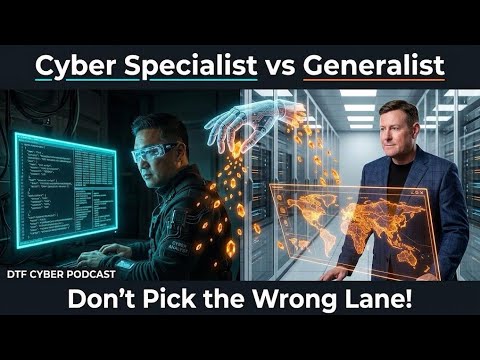
Specialist vs. Generalist: The Ultimate Cyber Career Debate
0:00You know, when the hackers are in your colonel at 2 in the morning, a cyber generalist is not going to save you. You need an obsessive specialist living there.
Yeah. You know, Damian, though, when that specialist is staring at packets, he might be missing the bigger risk picture, and the business could be
0:15bleeding millions of dollars in data,
which explains why the rest of us in security have no clue which lane to pick. That's right. In this week's discussion, it's how to build your cyber career. Is it becoming a specialist in cyber security or just being a generalist? What's the right path? This
0:32is the DTF Cyber Podcast. I'm Damian. This is Troy. And it's your boy Fern. Let's go. [music]
0:48There's a lot of places people can go these days. Um, and it depends on where you go. People have at choices. You ask a 100 different people what to do, you get 200 different answers, right? And what I think of is when most people are looking to get into security, they have
1:04a plethora of options. And none of those are pentesting, right? I think we just need to call it out right now. If you're new to security, do not expect to be a pentester on day one.
Yeah, but everybody coming out of school, that's what they want to do, right? That's a cool and sexy thing. I
1:19want to be a pentester. I want to hack. I want to
break into stuff. Yeah, but that's that's the worst path to go down because what ends up happening is you go up against these juggernauts who've been doing it for 20 years that'll smoke you like I don't know like a Friday night. What's easy to smoke?
1:36A
cigar [laughter] biscuit.
Yeah. They'll smoke you like brisket on a Friday night in Texas because at the at the end of the day, if you're not able to compete at the highest level in these fields, you're going against people that have been in the industry for, you know, decades, right?
1:52Yeah. But I think Fern, I think it's like the same motivating factors that get people to want to go into cyber security like TV shows and movies also propel them into those, yeah, I want to be like the guy I saw on Hackers, you know, and so everybody thinks they're going to come out of college as a pentest or a red teamer. Those jobs are
2:08fewer and far between. And so what happens is people have this really rude awakening when they get to the job market looking for those roles. like, wow, either the role's not there or as you said, Fern, somebody's already in that role with much more experience. So, back to Damian's point, do I go
2:24specialist route or do I go general? I think it's a great discussion.
I don't want to talk people out of becoming a pentester, though, right? I think if that's where your passion is, go for it. Or if you can evolve that into, you know, breaking stuff, but then learning how to fix it,
you're much more valuable if you can fix
2:40something that you, you know, how to break.
Yeah. But I think the the expectation that you're going to start on day one as a pentester needs to have some sort of like pullback where people say, "Hey, like we understand where you want to go, but realistically if okay, let
2:55[clears throat] me ask you this. You Damian work at a company, security company, right? You're hiring for a role. You just happen to have a pentester role open, right? Are you looking to hire someone that just got out of college that may or may not have experience or are you looking for a
3:11seasoned pentester for your offensive security team?
No. So that's there is no right answer to that. It depends. And I'll tell you this right now, half of the team that does application security testing and pentesting against our application and infrastructure came through the
3:26internship program.
Okay. But you know who they are by way of the internship program. You were able to kind of vet them. If you have an internship of 50 people, you're going to pick your top two or three, right? So, you you are essentially going through the interview process for them. You're not picking them out of, you know, a
3:43random crowd, one out of 50. You've essentially seen them do what they do best. And then you you're what like uh what's the phrase when you skim the milk from the um from the top like uh you're picking the cream of the crop essentially,
right?
So, that's a little bit different than
Well, I mean, you're focusing on
3:59pentesters, right? I I I think you need to broaden this out because we're talking about should you specialize and pentesting is a specialization that just so happens to be one that a lot of students and new graduates want
4:14to do because like Troy said,
you know, there's a lot of coolness in in this. There's a lot of movies about hackers. You know, there's so many things that make you excited about pentesting and breaking stuff. One of the things Damian is that we would never on this podcast want to discourage
4:30somebody from following their passion. In fact, we talk about it all the time. Find the place in cyber security that you love. But what we want to be here is real, right? We want to make people aren't coming out of college expecting to take a job in this type of a role. Now, there is a path and we'll talk about that here when we get to it a second. There is a path to getting in
4:46the door and working your way into penetration testing, application testing type of a role. And that's my recommendation to get that experience. And I I think you do absolutely need to figure out what you're passionate about and then specialize for sure.
The the question though is there are
5:03students coming out who are trying to learn everything and be very broad and that's okay from a new graduate perspective because you do need to know a lot of areas in cyber security. For example, you may not like GRC, governance, risk, and compliance, but it
5:21would be to your benefit to really understand that even if you're a pentester,
you know, like when I think about this, I think of cooking. Uh, a chef isn't necessarily specialized like um what do they call it? The sue chef. And then they have they have different like categories of chef and then they have
5:36like the the head chef or master chef, right? So, it's kind of like when I think of these different areas, there's there's so many different facets to security, just like there is with cooking and like the the cooking uh the chef crew is what I call it for whatever I don't know what it's actually called.
5:52But there's a lot of specialized people in these roles that support the the main person, right? And I think if you look at it through that lens, it's very similar to security where there are a lot of people that are highly specialized and there are a lot of people that might be generalists, but they're supported by the specialists,
6:08right? Even like even in sales like you're never going to have one salesperson that does everything. You're going to have one salesperson um like from my side is like the core rep is what they call it, the core AE. Uh and then there's specialist. So there's maybe there's an AI specialist, there's a security specialist. You know, you
6:25can't expect one person to know everything about technology, but you expect one person to be able to quarterback and understand where to bring in the specialized people to do the job. And I think when you're looking at a career, it's kind of like we said is you either go one route or the other,
6:40but you have to realize that it's probably going to be difficult to be the highly specialized route early in your career. But more than likely, I think we're what we're getting at here is starting out as a generalist, getting enough of a foundation underneath you from a broad lens of what security is
6:59and then kind of moving into a specialist type of role because I mean you guys hire way more people than I ever hired, but specialists tend to get paid more than generalists, right? So if people are are looking to, you know, improve their financial situation, they
7:14should be specialized at some point, right? Um, I don't know if I necessarily agree with that. Yeah, I think yeah, you you need to be I I agree. You need to specialize. You need to have something that you're really good at.
Um, but you also have to have broad knowledge.
So, it's not just specializing versus
7:31being a generalist.
I think early in your career, you do want to have the ability to learn as much as you can.
So, any exposure to that security department would be beneficial for you as you specialized. Uh but let's be real, right? Once you
7:46become a manager, if that's your career path, you're no longer What do you specialize in?
Leadership.
Yeah. People management or project management and
Mhm.
leading people, right?
Mhm.
Um so then you become that generalist again, but specialize in something maybe
8:03different for the the people skills part of it. I have seen I've seen um let's say highly technical engineers really struggle with that transition Damon into a managerial role where as an individual contributor they're great and they love their job but as soon as they get you know saddled with managerial
8:19responsibilities and having a team to look over you know it changes that dynamic and so you really want to be hands- on keyboard but you have to do all this other administrative stuff that you don't want to do that you have to do so it's a whole change of dynamics that's an interesting interesting thought because there are people who
8:35come into this industry in a specific um kind of focus area and stay in that focus area their whole career and if that's you that's great you you love what you do and you have that passion and you stay in that role and that's uh you know very interesting. I wanted to talk about my personal experience with this because I started out as a police
8:52officer doing digital forensics and I was pigeon holed into that role for the first half of my career honestly and so I worked around the globe for the US government doing digital forensics but that was what I did in cyber. It wasn't until moving home to the US and getting a job as the head of IT at an e- health
9:08company uh for Sigma, Walgreens and Disney and so on that I had to pivot into a broader knowledge of cyber security and that really you know increased my horizons and I loved I love learning about compliance and risk and development and deployment and production and UAT and all the things
9:25that we had going on. Um so I I did exactly the opposite. Instead of coming in as a generalist and knowing a lot about a lot, uh, I came in as a specialist and then had to pivot into that generalist role.
Yeah. And I don't think we're saying know a lot about a lot. I think when you're starting your career, you should
9:41kind of have a broad enough knowledge or experience to really figure out what your niche is, what your passion is, right? What what do you want to go for? And so if it's forensics like you did um that's one path but you did specialize
9:57and then came back out. I I'll tell you my my personal story as well. Um I became a specialist in data. So data resiliency, data recovery, disaster recovery, business continuity. That's where my early career started and it all
10:13was kicked off because of 9/11. So 9/11 was a huge disaster from a not just human lives but data being lost as well and services because there were data centers in that in those buildings. And so that kind of kicked off my career to
10:28becoming a specialist in in that whole um security aspect of data resiliency and data protection. And then over through my career as I moved into leadership and management, like you said, Troy, it's difficult to make that shift if you don't give up your hands-on
10:44keyboard, right? Shifting over more into strategically what the larger team needs and then eventually what the larger department needs from an overall IT or security perspective with a bunch of other specialists that play a key role. So much to what Fern was saying about
11:01the the cook in the kitchen. Mhm.
Well, that master, the chef that runs the kitchen,
the executive chef,
okay,
they [clears throat] have to oversee all of the areas, right?
But where did they gain their experience where they specialize in? Cuz we know
11:17that a pastry chef is not the same as somebody who's probably cooking steaks, you know? I don't know. Can they can they go back and forth? Probably. But in a high-end restaurant, would you really take somebody who's making all
11:33the desserts and just drop them in on the meat station?
Kind of scary, right?
Right.
Yeah. So, just out of curiosity, so there's the executive chef, there's the sue chef, which is right in, you know, next in command and the chef owner, right, which is the person that owns a
11:48restaurant. But in terms of chef stations, there's a sauceier, the person that makes the sauces, stews, hot soups, and gravies. It's literally that's all they do. The paster chef, the rotissicier [laughter] the roast chef. This like what I mean
12:06this is all in French and you know I'm probably going to sound crazy for even trying to say these things, but well I mean this these are all you're talking like big high-end restaurants. I have friends that own restaurants and I'll tell you there's usually one or two cooks in there and sometimes owners back there cooking and taking orders. So it
12:22it just depends. All relative. the entree matier is the vegetable cook. Crazy. Um, but going back to security, right, is everyone starts somewhere, right? And I think what you're getting at is as as you move up into your as you
12:38move up in seniority in your career, you tend to lose a specialization, right? Or you tend to have like fall back from it. But the I think the other thing is true where you don't necessarily lose it but you you you lose the the need to do it for payment like you're not getting paid
12:55to do it now right because well
you're maturing right you're maturing in your role and I would like to say that for me personally it really helped having that deep technical background before becoming a leader because I was able to keep my teams in check when they tried to provide me a solution that didn't make sense or if they were trying
13:10to explain something in a way that wasn't the most efficient I was able to push back on them and get real technical and they were always like wow you know you know your stuff and that's important that you have that base knowledge of how systems work so I always tell people you have to know networking you know networking is core to cyber security and
13:27so network plus and and the network route is so important to understanding how hackers pivot laterally in an environment as an example and so uh as you go through that it's it's important to have the general knowledge as you grow that specialization as well Damian but people who like to stay in that one
13:43lane you know as a career path that is an option.
Yeah, that's interesting because like I've heard stories where people um have made bad decisions purchases because of the people at the top weren't able to kind of like sus it out in terms of what
14:00they were buying,
right? So people I don't know if you guys have any horror stories of where this happened or someone you know or someone you heard of where they weren't we say okay so when you think about security you think of the top of security most people would say the chief
14:15information security officer right but there's you know there's you know we've talked about this in the past there's a technical security uh chief security officer and then there is a nontechnical right and we had discuss this this discussion of which one is better right I think even on that episode we talked
14:31about how one in one area may not be able to do things that the other would be able to. And I think Troy's example is when he had people on his team bring him solutions that weren't technically sound. He was able to kind of sift through that. Not everyone has the
14:46capability to do that if they aren't technical, right? So that, you know, I think there's there's a Yeah. And I don't know if you need to be technical. I think you need to be able to ask the right questions, right? You have to really understand what the need is and maybe some of the nuances. I mean, just
15:03like previous episodes, we talked about build versus buy. It's a very similar conversation, right? You're going to buy a product. How how does that product fit into the rest of your architecture and your your strategy? I think you really have to have a handle on that and ask a
15:20lot of questions, not just
Yeah.
accept it. I mean, maybe maybe if you trust your team, yeah, you're going to just say whatever whatever you guys need, just tell me. I'll I'll go to the board for you. But like fundamentally that requires a foundational level of knowledge, right? I think we keep coming
15:35back to that like you're you these these rudimentary like type of um knowledge essentially is what you're going to need.
Well, you're you're so you're going up and down the stack of somebody's career, right? We went from like entry level straight up to executive. So not let's
15:52not confuse the conversation here. I think when you're starting your career, get as much broad knowledge as you can,
right? University programs are built that way. They're built to try to give you exposure to a lot of areas. It's not, you know, it's not going to get you
16:09deep in any of these, but hopefully it gives you enough experience to want to learn about some of these areas on your own and dig deeper and and go and spin up your own projects. And when you get into the workforce, it's the same thing. I think my approach especially for new
16:25in career is to try to expose them to a lot of things because they may think they want to be a pentester and then they realize you know what I I really like to defend the pentesting piece of it is just testing my controls but then I want to be able to create better
16:42controls to protect other hackers right and then maybe cycle through your own type of testing pen testing against your own controls to improve them so That that's one approach. Once you have that passion, you figure out, okay, this is
16:57what I want to do, then go specialize, go go really deep cuz that will take your career into at least the mid-range 5 to 10 year before potentially making that decision to become a team lead or a manager. Right? So, I do think the
17:14specialization is really important.
And back to Fern's example, you know, imagine associ moves up to executive chefs. Could you imagine when the new sauier brings him some gravy to taste, he's going to know very well what's missing, what's wrong, what's happening with that sauce. Um,
17:30and so that's exactly kind of the example we're talking about. When you have a specialtity and you move up to be a leader. Now, let's say that the executive chef was never a saucier. He still knows what a good gravy tastes like. And so I think that you can still be a generalist and understand what good
17:45looks like and you surround yourself with the right team so that you can ask the right questions as Damian mentioned.
Yeah. As soon as that saucier puts MSG in there to try to cheat up on that, right?
A little good old actually some of the best things in life have MSG in them.
18:01Now I don't know what MSG does. I just know my wife says don't eat any of it. But there's times where um you try some food and you're like, man, like I just want more of this. I just want more. It's like, what is MSG?
Monos sodium glutamate is a synthetic
18:16form of sodium that you add to food to get a better flavor. Um and that's the problem with it, but in small doses, it's fine.
So, it's a fake salt. It's a
It's an AI salt. [laughter]
Think about that. Everyone's AI now. We're taking AI salt. We're making AI
18:32salt.
Yeah. Well, it's like tequila, right? There's tequila with additives. You don't want the additives.
It's like cheating as well.
Oh, instead of like the agave and like
No, like pure agave and
aged, not without any additives to it [snorts]
or like wine where they add sugar
18:48instead of just having better grapes,
right? Um I Yeah, MSG is wild, but Pringles, I think, have MSG in them because you know how they say once you pop, you can't stop. What they forgot to tell you was because they stack stuff MSG all over those chips.
19:05It's good stuff though. Um, [clears throat] back back to the discussion at hand though. So, at the end of the day, there is a path that people go, right? And I think from what I'm hearing from you guys is as you start out, generalist is best because it
19:23it's really hard to be highly specialized straight out of college, right? It's possible, but it's very unlikely, right? But being a journalist gets you into areas of the business or expertise or the ability to learn more in different areas of the business as a
19:40whole, right? Because you're not kind of like specialized into a certain area. And then throughout your career as you get better at what you do, uh as you learn more, as you go through, you know, go through an incident, you learn things, you might just go through an incident, find out you rather be on the uh resiliency side of the house, right?
19:57Versus the offensive side of the house. Um [clears throat] and then as you keep keep progressing, you kind of gain a specialization along the way, right? Is kind of what it sounds like to me.
Yeah. But here's a question. Yeah, I would I would only say disagree to that because you know if you have an opportunity to take a specialist job and
20:14you have that opportunity to go and do something you love like I did with digital forensics there's a path right so I think that what we're saying here also Fern is that cyber security is a very vast industry with many specialtities and you know as we always tell our interns you know take a look at everything inside of cyber security from governance and risk and application
20:30security and vulnerability management and all the stuff and then find where your passion is so that you can go and follow that path. I think the same thing is true like if I I met a college student who's studying forensics right now and you know they are going through the forensics certifications and access data and FTK and they're going to go
20:47full headstrong into forensics that's what they want to do. So there's nothing wrong with that, you know, as long as you have that knowledge that you might have to take a job in the sock to start and continue to, you know, work on getting a role in the forensics team. I think that
Oh, okay. So you bring up a good point.
21:04Here's a good question for you, Troy. So what if you're really passionate about that forensics job, but there is no job today, but there is, you know, you mentioned, okay, there's a sock role or maybe there's a governance
compliance role. Would you recommend that that person take that job
21:20uh even though they're not passionate about it?
Absolutely. And so I think that uh you know we talk about penetration testing being a very rare job. Forensics is even more rare. So the opportunities are more rare. There's few companies even in the Fortune 500 that actually have on staff IT forensics personnel. And if they do,
21:36it's one or two. And so my point is that you have to find a company that you want to work for and take an opportunity to get your foot in the door and then work your way into that role. And that's actually very helpful because you get to learn about the business. And I'm going to say something that's very controversial. Um, but in cyber
21:52security, we tend to have an ego like cyber security is the most important thing in the whole wide world. And that's not the truth. You know, the business does business and we need to make sure that we're managing risk for the business. But at the end of the day, the business can make decisions that are counter to what cyber security experts are recommending to them. So what I mean
22:08is like we are not the end all. You have to help uh the business understand the risk that they're facing and they can make the decision. We are just informers not decision makers. And so as it relates to all of the things that you do in your cyber journey, you know, understand that uh just because you know
22:24the company's not taking your advice or you're not getting the results that you want. It's not because you're not doing your job or that the you're not informing the right way, but the business is there to make money. If the business doesn't make money, they don't need cyber at all. You're fired anyway. So you need to make sure that you
22:40understand cyber's role in the the entirety of that business. We are a support mechanism. So my point to that was just, you know, find a place inside a company that you like and contribute and then work your way into the role that you would like.
Yeah. I mean, I'll tell you that was a
22:56case for me early in my career. There there was a job that I wanted actually. I knew the team really well and knew the culture and um knew the the leadership, but for for whatever reason, the original job they want they wanted to hire me for
23:11wasn't available anymore. and they said, "Well, you have something else. Do you want would you be interested in it?" And uh, you know, I I said, "Sure." You know, I'll take it simply because I I knew that I could probably work my way into um a job in the future. And yeah, I
23:28spent maybe about a year in that existing position and then something opened up and I just slotted right in. So, I think that was mostly because I knew the company, I knew the people, I knew the culture, and I knew I was going to enjoy it and and work my way into the
23:44position or something that was more suitable towards my career goals.
Yeah, it's so much easier to get an opportunity from the inside than trying to apply cold from the outside. So, being there, knowing the company, knowing how they make money, knowing their business, you know, logistics really helps you when you're trying to
24:00move laterally inside the company.
That's early career, though. Let me ask you this, Troy. Like at the executive level, let's say there was a CISO job. You applied for it and you go through all the interviews and everything and they they came back and they they said, "We'll offer you the deputy CISO role."
24:16What would you do in that case?
Depends on who you where you are in your own career. If you're a first-time CISO or uh or whatnot, then that might be an opportunity. Or if you were already a CISO and this is a much larger company that might be an opportunity as well to let's say become a deputy CISO at a
24:32Fortune 500 that you know the progression path uh might be into that role. Absolutely. Just depends on you know where you are in your career, what your aspirations are, the size of the company, the culture of the company as well.
Yeah, that's my take on it too actually. If um you know if you you feel like it's
24:50a step down, don't don't take it. But sometimes it's worth it to take a step back. you take a step back in a larger company with the potential to move into that CISO role in the future, then I I think it it's worth that shot. So, don't
25:07necessarily say no, but I I think yeah, every every situation is going to be different.
Yeah. In fact, um I was a multi-time either head of IT security or CISO when I took the job at IPG in a lower role and then it turned out the progression plan worked out and I was able to move into the global CISO role um after just
25:24two two and a half years. So that was for me moving into a larger company uh with a global footprint to with a potential becoming the CISO one day was definitely enough for me to take that role.
Yeah. And not every CISO or CIO role is the same level, right? We've seen that.
25:40We've seen where some of them are VP level and some are director level.
Oh, but they're still called the CESO.
Yeah. And some companies um don't use that title at all. You're just the VP of IT security or you know the head of IT security. You know those kind of things are still out there but your
25:56responsibilities are pretty much the same. You're in charge of securing the business.
Yeah. So going back to like midc career, early career, I I would say the same thing applies, right? Don't get caught up in the titles. I think it's much more important to be able to describe what
26:12you do and show, you know, here's all the accomplishments and things I were things I was responsible for. I think that's probably more important than the actual title
or do the work.
If hubris is a career killer, right? Ego is a career killer. If you if your ego won't allow you to take a step down or
26:28backwards or a title that doesn't match what you think it should, then that could be a career limiting move.
Yeah. You just have to get at podcasting. [laughter] What do you do? I do podcasting for fun. [clears throat]
Um, yeah, I think it's true because
26:43there's a lot of times where people won't take a role because of the title doesn't match what they what they want want it to or what they expect it to. Um, and then funny enough or maybe not funny, then sometimes roles get eliminated, right? And I think that's the other thing too is where if if
26:58you're kind of staring down the barrel of job or no job, I think most people would just take the job, right? I know plenty of people that are are in roles today that they don't want to be in but they have to do something right to make money or whatever and then as new things come up they have the experience to save
27:15right so I think the other side of that uh situation is if the role isn't what you expect or what you want um it's better than no role right and it's also gives you exposure and experience so that way as things do come along you have another story to tell because like
27:31let me ask you guys this because both of you guys hired people all the time and and will hire and continue to hire. Um, if you're looking at a candidate that's very well-rounded, right, that has experience in different parts of the business or someone that's um highly specialized for a role that isn't highly
27:48specialized, right? You're more than likely to pick someone that has the generalist type of experience versus, you know, I don't want to keep saying pentester, but like that's the first thing that comes to mind is like a pentester in a a program management position, right? you're probably going
28:03to look for someone that has a broader uh range of experience versus highly specialized even at some of those levels right?
I think it depends because there's maybe somebody wants to do something different, have a different challenge.
Mhm.
28:19In those cases, if they've proven themselves in a specialist type role and wants to try something different, I think we're totally open for that. Right. It's just
it's just, you know, trying to gauge whether that person really wants to do it. you know, are they stopping the
28:35pentesting because they absolutely hate it or maybe they're poor at it, you know,
or they realize that they're just not up for the challenge anymore. There's all types of reasons. So, I wouldn't say, you know, don't you can't specialize and then hop over to a different area. I
28:52think it's always possible. Just make sure that you know you're you're passionate about the new area as well. But be open about that conversation to whoever's hiring you or if you're doing a lateral move to a different team.
Um just talk talk it through to say this
29:07is I really want to try project management for whatever reason. You know I I don't know maybe there are people out there have made that jump from pentesting to project management. Why I would ask why would you why do you want to do that and and really understand it? Well, we both
29:25know people that have gone from it to security, from security to CISO, from CISO to retired, right? So there there's really no one path into these, you know, into these roles. But I think let me ask
29:42you this then, Damian. So you hired someone that we both know at some point became a CISO and has now since retired, right? And this person specifically came from it.
No, no, that's that's a common that's a common pattern, right? Because we we
29:58didn't have big security teams even like 20 years ago.
Mhm.
Uh even my career, you know, was started out in it. So, you know, a lot a lot of us, especially associate our age,
30:13[laughter]
we uh yeah, we didn't have cyber security programs.
Yeah. We didn't graduate with cyber cyber security degrees like they do today. Uh we we argued about this before. Is that the right approach for entry level? Um
30:29yeah. So the one thing I love about this industry and the one thing has always drawn me to this industry is the diversity of paths that people have taken to get to where they are. And so as we talk on this podcast, you know, we're talking in, you know, the terms that we're that we're familiar with, but every single person has a different path
30:45and a different voice. Whether you're transitioning mid-career from military or police work or whether you're changing careers, some I know a construction worker who's now in cyber security or where you're coming right out of college and you're getting your foot in the door. Everybody's path is different and I think some of the general things we talk about in this podcast may apply to some folks but not
31:01others. And so, you know, this is a career that's only limited by your imagination. You know, what do you want to be? What do you want to do? And if once you focus on the outcome you want for yourself, there are ways to get there. Whether it's certifications and networking in your local networking
31:17groups, uh, finding the company you want to work for, taking a different position, and moving into that role you want. You know, there's so many ways to get into this industry. I'm excited about it, but I'm also interested to see what happens in the next 3 years with AI in cyber security. Now, we're not going to talk about that today. We've talked
31:34about it 100 times, but I just think that this whole path journey is going to change somewhat and somehow over the next three years for folks.
Oh, yeah. Just be flexible. are going to have specialization in AI
in security.
Mhm.
Right. That's just going to happen. It's
31:49happening now.
It's already happening. Yeah.
So, you know, that is a an area to specialize in as well. Now, where does it go beyond here? Because obviously we didn't have anyone working within AI for security 3 years ago. Probably started
32:05about 3 years ago where we started to really look at Gen AI and now we're into the whole agentic movement. Yeah.
Right. So, it's going to evolve. I think if you're going to specialize, just realize you're going to specialize and then have to adjust. Anyways, you're
32:22going to have to hop maybe not a drastic hop over to things like program management. But a lot of times the program management is actually what leads you to to actual management because you're looking at these highly technical projects and trying to get them complete. And as you start to look
32:37at a broad number of projects happening within your area, you're going to have to deliver those on time, within the right budget, um making sure that they're done right.
And if you're leading a team that's doing all these specialized projects,
32:54guess what? You're managing the outcomes already.
Yeah. Kind of set yourself up.
Well, so choice is something interesting that I kind of want to at least um as I say, double tap, right? Um, when it comes to offensive security, pentesting,
33:10that tends to be like the go-to for people that want to get into security, right? Like if I want to be a hacker, right? Just want I grew up be a hacker, put on a hoodie, be a hacker. Um, something that's interesting that I kind of have seen is um there are companies
33:26that came out in offensive security, autonomous offensive security back in 2020,
right? And now these companies are valued at the at least $2 billion, right? And all they do is autonomous pentesting. Boom, boom, boom. Every, you
33:41know, all day long, right? Just just keep firing at your environment. That's a role that historically people have done, right? And now it's getting to the point where there are companies that that's all they do. There's multiple companies that are in this area of agent pentesting or autonomous
33:57pentesting, offensive security, right?
Yeah. That's not the only area, right? there's a gentile
and you still need people in your company to run those tools and to decipher the results as well. I think that there's still a place for you but it is going to change. Yeah, I think as you mentioned, Fern, that the more
34:13autonomous uh tools are still coming. Like there's one that just got $180 million, a very famous person who has a very famous board of directors um who's taking on that company from 2020 that you're referencing. And so I believe that the AI pentesting is going to uh
34:30pretty much wipe out human pentesters, but those human pentesters are going to become the people who run the AI tools and decipher the reports. Yeah.
And see, you know, the validity of those results.
Yeah. That that's just the beginning, right? You're you're only thinking about testing against systems.
34:46Mhm. But there's also the social engineering aspect which we know we just had another company um that we were talking to talking about actually just before we started hit record.
Uh looking at the human aspect and human
35:01protection.
Yeah. And so there's there's that piece of it too which is all AI.
Mhm.
So it's not just don't think of it as pentesting as just against systems but there's pentesting against humans as well,
people social engineering. But I think the point here is that yes AI is going
35:17to take away functionality that people used to do Fern but the people who used to do those things now have to pivot into the the management of the tool the deciphering the reports the you know the uh
well you got to validate it so they have a lot more things. Yeah
you got to validate it
35:33right just because the system says hey you have this weakness. I mean, I I get this all the time. We recently getting alerts, AI alerts of within the sock and and saying, "Hey, this this might be suspicious. This might be suspicious." So, yeah, that that's great, but now I got to send a human to go and validate
35:48it. Right now, I don't know if you you lose that specialization cuz you still have to specialize in understanding what the tool does so that you can decipher it and then validate it.
Exactly.
I don't think that's going away. So, you still need to specialize in pentesting.
36:05Should you be doing this all the time? Probably not. But you're going to leverage these tools to help you do more of it over time. You still need to
The sheer number of humans it used to take to do a pen test at a Fortune 500 was massive. Now the AI tools are doing it at scale and at speed and it takes
36:22much fewer humans to decipher those results.
Yeah. I think my point was more so like when I think of hunting and you think of an animal running, right? like a deer running or something and you kind of have to time it like to you know essentially they say like and I'm not a hunter right but recently I've kind of
36:39watched more videos randomly don't even own a gun right but I'm like watching videos cuz I'm learning right and it's like they say oh typically you'd want to like aim two feet ahead of whatever you're kind of firing at as it's running because they're going to kind of you know collide at some point. So, I'm I'm
36:56kind of thinking the same logic when it comes to people in their careers, right? If they're if they're looking at a career, don't just look at it where it's at today. I think you have to have enough understanding of the tools and the the technologies and the things that are being used in the enterprise today.
37:11And then the the direction those tools are moving into and kind of point your career in that direction where how can you become and just just because it's easy for me to say is like how can I focus on the autonomous pentesting side versus just the pentesting side.
Yeah. But I don't think you should I
37:27don't think you need to second guess yourself, right? If you want to get into pentesting, at least understand the basics.
You're not going to say, "Oh, I'm not going to pentest because these tools are going to come out and I just want to manage the tools."
No, no, that's what No, I'm not saying that at all. Um, this is more like if I want to go outside, I'm going to check
37:42the weather because I have to make sure that I have
No, but you're going to go outside anyways, right? So, that's that's what I'm saying. It's like, okay, is it going to rain or is it going to be hot? But at the end of the day, I'm still going to go outside. So, if I'm going to look at my career at the end of the day, I'm starting my career regardless. It's not
37:58do I start my career or do I do this? Like, I think that's to me that's just noise.
Well, it's not it's not to say do or don't. It's, you know, be prepared or not be prepared cuz if you're going to go outside
and Fern, so in hockey there's a saying that says don't skate to where the puck is, skate to where the puck is going. And I think that's exactly what you're
38:14saying here is, you know, understand the job you want, but also understand where it's heading to in the future and skate towards that outcome.
Yeah, I think that Yeah, that's that's
Yeah, but the problem with AI is it's changing. So the the I think what I'm saying is you don't just stop and don't skate.
Exactly. Yeah. Skate to where the puck
38:30is going. Yeah.
No. Billy Dory just keeps
keep Yeah.
He keeps skating, right?
Keep swimming.
Yeah. Okay. Well, yeah. Not trying to confuse it with like, oh, the world's ending. AI's taking over.
Now, where where you may make that decision is if you were to say, look,
38:45cyber security is not a field that's going to exist after AI. If that's what you see happening, then that's different.
Be a lot of really sad VC companies if that was the case.
Yeah. I mean, it's uh maybe not cyber security, but let's say software development. Do you think software
39:01development will be where it is now in the next few years with AI just developing everything? will be materially different if it exists at all in the
so so that's the difference right I would say okay if you're planning to be a software developer you may want to pivot
39:16right or you might want to specialize into something else it's good to have that skill set because I think a good software developer is still beneficial but just realize you're not going to be developing software
like you're used to
yeah by hand you're not going to have like a folder with all your prior code
39:33written in there for like to reference back and forth
but things like pentest testing, the sock analysts, um, investigations, those are still going to exist. You still need that skill set.
Mhm. I guess at the end of it, specialization is is still important,
39:49but it's it shouldn't be the foundation that you build from. It should be the po it should be the path that you get to. No, no, no. It's it's just a path along the way, right? It's not not the endgame. Never is. So, even if even if you specialize, you're like, "Hey, I'm
40:04good here." you you still have to be able to pivot into adjacent areas because it's going to change.
Yeah. So, just a a mindset of continuous learning is kind of what I'm hearing.
Yeah. But I I do think you need to specialize, right? And I don't think you can stick enter into an organization and
40:20say, "Okay, I'm just a generalist." Like I know I'll know everything.
Mhm.
What is it? Jack of all trades, master of none.
Yeah. There's there's that's the line everyone remembers, but there's another piece of that. Let me look it up. But I mean that's what I'm saying like you you have to you do have to
40:36specialize. You got to know something really well to to provide value and fit within the construct of an an overall department. So when I'm I say like architecting a department of where we need skills, there's a lot of times I will go to individuals and say, "Hey, I
40:52think you should do something different. Try this." And it's one because the company needs it like like Troy you said, right? the company needs to run and we have deliverables. So there's requirements and two it might be good for that individual to branch out into
41:08something adjacent which would help them broaden their knowledge and career as well.
So let me give you the actual quote. A jack of all trades is a master of none but often times better than a master of one.
There you go. We just dropped that last
41:23part.
Yeah, we just dropped the last part but it's part of the actual quote. That's because the first two lines are easy to remember for me.
Oftentimes better than a master of one. So there again, it's just saying generalist. This I mean I don't know how old this thing is, but this is at least
41:39like 200 years old.
Well, it's like the chef, the executive chef.
Mhm.
If you had a team, you can get things done, but if you didn't, because you were an and you lost your team, you'd be the master of one,
41:55right?
That is so true. Yeah, I I think it's more so referring to the master of Oh, you know, it's weird. Is it
I don't know.
Is it talking skill set or is it
I don't know.
It's 400 years old, though, by the way. That quote is 400 years old.
It probably wasn't even written in
42:10English. It's translated.
Probably not. This is back back in the day. This is um this is back when people were running around with Actually, I shouldn't say anything because I probably don't know my history well enough to say 400 years ago. So, so let's let's take um Fern's analogy again
42:27a little bit further. So, imagine you have a Fortune 500, you have all those roles, Sauier, you got the vegetable guy, I forget the name of it. I can't pronounce it anyway.
Entre.
That's what we think uh cyber security should be. But most of us, you know, outside the Fortune 500 are an
42:43executive chef and a sue chef and that's it. You don't have anybody else. So the executive chef has to be the salier and the dessert guy, the pastra and all these other things. You know what I mean? We are running security on a shoestring budget with a team of two to 10 in most companies outside the Fortune
42:59500. And so it's an interesting world to live in. So I think that people who go into those roles, we talk about specialization. When you work in a company that has a smaller team, you wear a lot of hats and you get to to experience a lot of different specialtities.
Well, let me see here. I've got some
43:16notes on kind of some of the some of the stuff that we haven't talked about. Right. So, what I'm kind of picking up from Damian though is something we've talked about maybe like episode 1 through five, right? And that comes down to being
43:34excited about what you do, right? Because when you're excited about what you do, you tend to have a passion for it, which is something else we've talked about. Um, which means that you end up tending to have initiative, right? If you have the passion for something, you have initiative for it. And if you have
43:50the initiative, you end up kind of putting yourself in this position of what you described as or what I call the a continuous learner. And Troy said, correct? Right. So, it's kind of like at if you kind of look back at the root cause of all that, what it really boils down to is genuinely being excited about
44:07security, right? So maybe the first question that people need to ask themselves before they even look for a role or try and get into it is are they actually excited about security? Because it's very likely that without the excitement you don't have the passion. Without the passion you don't have the
44:22initiative. No initiative you don't have the essentially the will the motivation to continue. Right? So I think the toughest question maybe people need to ask themselves from day one is does security actually excite me? because if it doesn't, it's like a life uh I'm sure
44:40there's a famous quote, it's like a life of something is isn't worth living because there's there's no passion with it, right? Um and you don't necessarily want to go down a career path because it's it sounds cool or it looks cool. It's like if my so really good example
44:55is my my oldest daughter wants to be a vet and I told her I said like I don't think vets make you any money. You're going to you're going to have trouble paying your bills, right? And she's like, "Well, yeah, but I like pets. I like helping pets and animals."
Do do you need me to talk to her? Cuz I was going to be a vet.
45:11Oh, you were? [laughter]
Well, yeah. Well, then I said, "Well, how do you expect a person that has a, you know, that's a vet to, you know, make the same kind of living that others make?" And she goes, "Well, you can just own your own business." Okay. Right. Whatever.
I I don't know, you know, what vet you're talking about, but as much money
45:27as I spend at the vet, these guys must [laughter] be living in the mansions up on the hills. I'm telling you.
Yeah. I got to say it's it's not cheap to take your your your fur fur babies to the the vet these days.
Yeah. I took I took our our new dog and so we got a dog. It's a pocket pit bull.
45:42I think that's what it's officially called. It was like 50 bucks when we first got it cuz we got it from the pound. It's kind of like, you know, someone left it and my wife liked it so we ended up keeping it and I was like, "Oh, great." And the the pets cost me like a couple thousand since we got it like 2 months ago. And there was like a $300 shot for allergies recently. You
45:58don't realize this, but apparently pit bulls have are really bad with allergies. I learned that the hard way, right? So, it's, you know, off topic, but
yeah. I mean, this, so I think one of the things, the reason why I say you need to, you should have a broad knowledge when you start your career is
46:14to really understand what the other person's going through. Because if you jump in there and say, "Hey, I'm I'm a pentester. I got to break this stuff, right?" you have to understand when the right time is to break it because you don't want to, you know, interrupt something that might be critical to
46:30running the business.
So, you just got to be aware of everybody else around you while you do your, you know, the things that you're passionate about. So, it's good to be passionate about it, but also don't be ignorant to everybody else that has to maintain their area of security.
46:48Don't leave Roy Jenkins, though. Do you know who Leroy Jenkins?
Leroy Jenkins. Oh yeah.
Troy plays video games. His kids play video games. I know he knows who Leroy Jenkins is.
Leroy Jenkins.
Yeah. Don't don't just break stuff to break it, right? Um but what were you going to say, Troy? You going to say
47:03something?
Yeah, I was going to say that, you know, also Damian, I'm sure you've seen in your career is that there are people who are, you know, passionate and they have a specific skill set and they have no tolerance for people in other roles. They don't understand the other person's role, but then they they're like, "Oh, I could do it faster. I could do it better. I could do it this, that, and the other." and they they they're so
47:19judgmental and temperamental about other people and how they produce and yet they have no idea what that person goes through on a day-to-day basis. So sometimes I always tell my folks like why don't you go step in his shoes for a week and come back and tell me how much or how easy that job is. It's never as easy as you think it is.
47:34Usually there's been times I'm like what do you do? Like how do you get paid? Right? And then you kind of like sit with someone you learn from them like oh okay you don't
what is it that you say you do here? [laughter]
Yeah. we're going to need you to come in on Saturday.
Um cuz meeting with the Bobs is always
47:52fun, but I think it depends on like what what someone does, but sometimes you don't know what people are dealing with, right? Personally, professionally, and a lot of times you don't really know what their day-to-day is. Cuz here's the thing is there's plenty of people that I'm like, I don't know what you do to get paid. I'm sure they're busy and
48:08there's a lot of people that I'm sure are not busy, but at the end of it, there's they're doing something, right? I do have kind of like a maybe a thought that I think is is helpful for people that are listening that are early in their careers, right? Because we kind of talked about journalist specialist, you know, kind of how to navigate um and
48:25this is something that I feel very strongly about, right? And it is uh certifications, right? I think um how would I describe it? I would say there there's a phrase that says, "Show me the incentive and I'll show you the Yeah.
48:41Wait, do you guys know what I'm talking about? Show me the incentive and I'll show you the outcome. Right? It's essenti essentially what it says is incentive drives behavior. So like if every day you show up late to work, you're going to get, you know, you get yelled at, yelled at, yelled out, eventually you get fired. So the
48:57incentive is to show up on time so you don't get fired, right? Um money is a big one. You show me where people are getting paid money and I'll show you where they focus on selling. see it all the time in sales where people get paid more for selling new technologies that their company just
49:12came out with. So, you ever wonder why your sales reps are always trying to sell you the the latest and greatest? It's because their companies are paying them more realistically and they're getting higher quota attainment for selling things that are new to the company, right? Because they're trying to boost their their stock price, right? Shareholder, you know, increasing.
49:28Yeah. But but getting a certificate doesn't necessarily mean you get paid more.
No, no. So, that's what I'm saying. What I'm saying is there's a lot of times where certification and certification programs are incentivized to sell the idea that there is value in these certifications, right? And there's a lot
49:45of people that haven't been around long enough to know that that may not actually be the case, right? So when I say incentive drives behavior, what I'm saying is the incentive is, hey, you can get a really good security job if you get all of these certifications. The reality is is the projects that you do,
50:01the people that you know, the relationships that you've built are more far more likely to get you a role than a piece of paper. And the reality is is a lot of times these programs are built to they're a business. They have to sell and those what they sell are certifications.
Yeah. So I kind of just
50:17Well, it goes back to passion because as you go and meet other people outside of your company.
Typically your passion comes out in the conversation and you
leave a mark hopefully.
Yeah.
Or you could be the other way and just be a total downer,
50:32sticking the mud
and and you the other person walks away thinking why is this person even insecurity?
Yeah. Like I got to go shower now after talking to that person. Um, but I I so but the certifications I think are a good litmus test, right, for
50:48people to say, hey, if I'm not actually passionate about what I do, I probably shouldn't pursue these things cuz I feel like there's a lot of times where people have this misunderstanding of if I get the certifications, I will get the job. And I think, do we all agree that that's not true?
Yeah. Yeah. Of course, you're not The
51:04certification doesn't guarantee you a job. Actually, a degree doesn't guarantee you a job either.
Yeah. I think that's what it comes down to is a piece of paper will not outperform someone that is passionate and hardworking um and dedicated to their craft uh at any at any level,
51:22right? It's like I keep coming up with these I don't I don't come up with them. I've heard them, but it's like uh what does it say? Hard work beats talent when talent doesn't work hard, right? I think of it like that. It's like if but instead of passion, instead of talent,
51:37we'll just replace it with passion, right? Passion will out will out out or passion will beat out um interest when someone that isn't interested is in the in the situation, right? Maybe that's a good way to kind of flip it. But that's
51:54all I had. That's all that's all I just wanted to say. Just that was that was up.
That's your final thought. I love it.
Yeah. How about you, Damian? Well, I mean for anyone who who has been listening to this and obviously you probably have your own opinion, let us know. How did you start your career and
52:09where are you now in your career? Are you specialized? Are you still considered a generalist? And where do you see yourself going? Because I I don't think there's any direct path. So regardless of what we say here may not apply to everyone for sure.
Yeah. Yeah, and I'll just end it with uh
52:24as I've said before and I'll say it again, follow your passion because when you're passionate about something, you enjoy what you do, it'll feel like work is not work. It's a passion. So, you know, uh if you have to take that role in a job and then pivot over, do that to get where you want to be. Just keep following, keep studying, keep going,
52:41and you'll be exactly what you want to be.
Yeah. And with that, we'll see you next week. [music]
53:01[music]
The expert stares at the colonel trace while I'm just looking for a lane to pick. Another path, another face. [music] The brisket's smoking and the smoke is
53:17thick. We're hunting [music] shadows in a glass house. I want to break it, make it real. But [music] I'm a program. I'm a mouse. Just a cog inside the rusted wheel.
53:35Skate where [music] the puck is going. A salt on the table. The poison's flowing. Wash it away [music] with a shower of lies.
53:51It's not that easy to [music] pick a side. Yeah. [music] Three men [singing] talking in a basement room about the hackers in the colonel deep.
54:07AI comes to [music] sweep the gloom while all the humans [singing] go to sleep. [music] I have no clue which lane to take. The path is paved with sodium. [music]
54:23Another dollar, another [singing] ache to make the bank rolls go numb. Skate where the [music] buck is going. A salt on the table. The poison flowing.
54:40Wash [music] it away with a shower of light.
[music]
It's not that easy to pick a side. Yeah. [music]
54:56Jack of all trades. [music] Master of none. But better than [music] a master of only one. [music]
55:11Only one. Only one. Skate where [music] the puck is going. A salt on the table. The poison's flowing. Wash it [music] away with a shower of light.
55:31It's not that [music] easy to pick a side. Yeah. [music] We'll see you next week. I got to go shower now.
55:47[music]