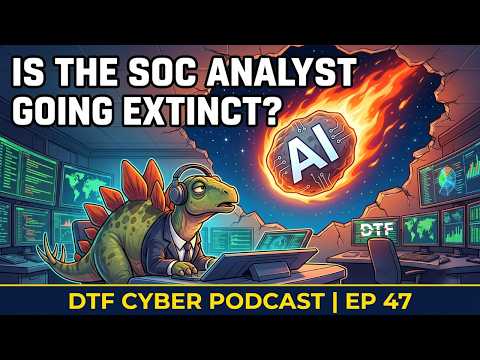
Is Your Entry-Level Cyber Job Officially Over?
0:00All right, guys. So, I've been looking at some of these uh university programs, the cyber university programs out there. And what I'm wondering is it looks like they're training thousands of students, right? For an entry-level sock role. Um
0:15but based on the products that we see moving around in the market, I'm worried that there's not a could be a job for uh layer one support in the near future.
Hey Fern, you know what? It's not just the students. If your security operations is still focused on metrics that involve basic
0:32alerts and how many you close every day, you're measuring a dead job. Those tier one log parsing jobs are over.
Yeah, but if we take away that bottom layer of the pyramid of our hiring program, I think we're going to miss out on a a very important pipeline to talent. And what's going to happen in 5
0:49years with that, you know, pipeline of getting people into the industry and training them at that level?
That's right. Are the level one sock analyst jobs dead? What happens with the sock? This is episode 47 of the DTF Cyber podcast. I'm Damian.
1:04This is Troy.
And it's your boy, Fern. Let's
[music]
So, um so I was at dinner last Thursday.
1:21And it was uh three CISOs and a couple other people with me, just kind of hanging out at a place in Phoenix. And one of the things that we were talking about is these uh regional SOCs and just SOCs in general. Um
1:37university SOCs that are coming out and regional SOCs like for the for the government, like the uh public sector, right? And I was talking to one of the guys there and I said, you know, it's really interesting because I see a lot of AI SOC related companies
1:52right now. You know, I think there's there's at least 60 of them that exist, you know. A handful of them out there are are are fairly larger than the rest, but at least 60 of these AI SOC companies. And I asked one of the guys that was there, I said, you know, when it comes to these R SOCs or these
2:08student-led SOCs at the universities, kind of training them, um what happens when there's products now that are kind of pushing to have those tier one roles removed? Like, are you worried that this program isn't going to be useful for these students uh by the time they
2:24graduate? I don't want to tell you guys their answers or answers, but kind of want to start off with this episode with with that topic. So, that's kind of like what I'm wondering for uh just the the the pipeline talent moving forward is if people are looking at
2:41these roles as an entry-level role, but those roles don't exist, like are we doing things backwards?
Yeah, I think, you know, we we talked about this. Are they Are they even entry-level roles? I don't know. Like, is Some people would argue a SOC role is not entry-level. And some people would
2:58say, "Yeah, it is entry-level." But I agree with you, right? There's a lot of new tech out there that's coming out. I I think you said 60 plus, I think we're probably closing in on 100 different technology companies that are addressing the security operations space.
3:14You know, you're going to eventually have tier one level one SOC analysts being replaced by AI. I think I mentioned that last episode. What does that mean for students? What does that mean for what they're being trained for today? And and how do
3:29they break into this market? I think that's a a really good topic for for today.
Yeah, and I think that, you know, as we look at the entire security ecosystem, we'll use this today as an example, but I don't think it's going to replace jobs or remove ability for us to get talent
3:46into the industry. I think it's just going to change how we do business. If you think about, you know, doing math with an abacus, and then you, you know, you move to writing down formulas and then you move to a calculator. It's just the tools that we use to do the job that we're doing. And I think we have an opportunity here to upskill even those
4:03folks who have not even started yet in the industry. Uh upskill them at college, upskill them through internships, upskill them through uh the knowledge that they're gaining uh through certification prior to joining a company. So, that's where I would hope is uh the future of this.
Let's have this conversation, Troy, cuz
4:19I I don't necessarily agree with that completely. All right. I think there there there are going to be tasks that are going to be handled by AI. I think there's no question. Whether that takes away jobs, I think that's where we got we we need to have a
4:34conversation. I think it does take away that those entry-level, low-level jobs. What happens to the students as they, you know, like Fern said, can they get into a sock now if looking at basic alerts no longer exists?
Mhm.
And I think
4:50if you are a student today and you're you're learning these tools, I don't think it's wasted. Right? I think you still need to understand how to deal with basic alerts, triage, log parsing. I don't think you get away from that. It's just like basic math. You you mentioned
5:06the abacus, right? I don't know how many people still learn how to use that in school. But you still learn how to add, multiply, do manual mathematics without calculators or computers before you can move into doing some more advanced stuff
5:21with with computers and and calculators, right? So, I think this is very similar where if you're a student today, you still have to learn how to parse that data. You still have to learn how to do correlations and basic triage within a sock. I don't think that goes away. But
5:38when you get to that job, you have to realize that you may not be doing this with manual methods anymore.
Mhm. And I think there's an important distinction here I want to be clear about. I think AI is going to replace some functions or functionality. It's
5:53not going to replace jobs. So, now the folks with the humans that are working in those industries are going to have to focus on different things. And that's a good thing. I think that we should be able to automate some of those lower-level tasks. We've tried for years to have security orchestration and automation in place that we just really
6:10haven't been able to get that to that full SOAR with the response piece. I think with AI now we're able to see that true function being replaced. So, what do the folks do who were there? They're doing more upskilled threat hunting and other other
6:26more gray matter type roles. How about people who aren't there in those seats yet? They need to be looking at that tier two and tier three role, maybe preparing themselves for something a little bit different than the entry-level tier one.
Yeah, but okay, so I I I think we're
6:41saying the same thing, right? If you're already in these jobs, it's not like your job gets eliminated and you're out. I think it means that you get upskilled into the next levels, right? That if you don't upskill, you're out of a job. That's your own fault.
Yes. Yeah.
6:57Now Now, if you're if you're trying to break in, that's the conversation. So, if you're finishing high school and you're trying to get into college or finishing college and you want to get that first security job, maybe the path isn't
7:13a tier one SOC analyst anymore. Yeah. I don't know what that what that path is yet today.
Are those, you know, we're saying some of those jobs are not necessarily going away, they're being upskilled, but those tasks that happen at the level one tier
7:28one level, they're gone. They're going to be handled by AI and they're going to be overseen by a handful of people, but you're not going to have people looking at screens like, you you when we're we were looking at um some of these movies.
7:45With some of these movies, maybe WarGames in 1980s, people looking at screens and watching attacks happen. We still have attack maps. I think they'll still they're still out there. They're they're kind of cool to look at. But, do you really need to have a human watching those
8:00screens day in day out 24/7? Or do you just throw AI at it and if anything interesting happens it just alerts the human. Or eventually it would just take care of it of itself. Right? So, where is that entry point now for these students?
8:16You know what's interesting though is every [clears throat] major movie that has a security guard in it, they wait for that security guard to fall asleep and then they break in. Or they do something with the with they do something with the camera like they just repeat the same frame so it looks like nothing's happening. They're
8:32breaking in. I don't think I mean, if movies in Hollywood tell us anything it's basically that people staring at a screen is probably not the best thing based on these movies. Personal opinion. But,
Yeah, because I mean humans humans don't
8:48you I mean even if you get a ton of alerts, you get alert fatigue. You kind of get neutralized [clears throat] to the fact that hey, something's happening. And you may just click okay, click okay, click okay and not actually do anything about it. So, I think AI throwing that into the mix and having something's really really
9:04specialized into understanding the alerts, understanding what an anomaly is, and then automatically doing basic triage before a human takes it is much more efficient. But, remember I said that the human still
9:19need to understand what's happening at that level. You may not be doing it day in day out, but as a student you should still understand how to do those things manually.
So, I'm thinking back to um the first time we took a road trip, Damien, me and you. We went to Vegas to
9:36go to uh AWS re:Invent, right? And it was like a uh the first time we'd ever been in a car together, right? It was a 4 and 1/2 hour drive. We went from Phoenix to Vegas, right? And one of the things that we had talked about along the way was
9:52uh automating the SOC, right? And and having using AI in the SOC, right? And that was over a year ago, right? I remember thinking to myself, like, man, that seems pretty wild that uh people are doing that, right? Because I I'm mostly expecting or used to hearing
10:09about students or or like entry-level roles in the SOC. And a year ago, you were talking about kind of automating the SOC and using a lot of some of these these AI tools in the SOC. And I hadn't, you know, never really even heard of it at that
10:25point. But now, according to Gartner's mid-2026 uh baseline metric projection, what they're saying is that AI will automate over 50% of the tier one SOC analyst task. So, we go from a year ago
10:40to where this was news to me till now, maybe just a little bit over a year, maybe like a year and a half or so, and um almost 50% or more than 50% of that role is kind of going to be automated within, we'll say, 18 months max, right?
10:58Yeah.
For someone like me to have no context on that that's where the market was going to now being 18 months later and saying that that's where it's at today, it kind of makes me feel like in the next 18 months, kind of like what you said earlier is that role may not exist.
11:16Yeah. And so, Jas- Jason Clinton from uh Anthropic's, he's the CISO over there, said, "In a rolling 12-month over the last 3 years, in a rolling 12-month period at Anthropic, they've seen an eight times increase in the uh capabilities of the models that they're putting out." So, if you think
11:32about just in the next 12 months, we're going to see eight times the productivity and capabilities of the models that we're seeing even today. Just think about how they can be used to automate a lot of these tasks that, you know, humans, as you mentioned Fern, they look at screens 24/7, they get
11:48tired, they miss things, you know, they don't see uh all the picture of the whole, you know, attack chain in that one second. Um it's so easy to miss something. And so, I believe that we are definitely at the precipice of changing how we do security operations completely. And that's a good
12:05thing. And then going back to the the entry-level roles here, it may not be a SOC analyst because that may not be something that we even need anymore cuz AI's going to be able to to take that function. Remember, function versus job is different. So, now that entry-level may be, okay, come in and learn how we
12:21deploy AI. Come in and learn how we create an agent in the SOC, a threat hunting agent to go look for a new uh zero-day, etc. Those may be the talents that you need. So, don't come into it with a fixed mindset of I need to be a
12:37SOC analyst to get my foot in the door of cybersecurity. Open your mind and be flexible to what that definition might look like.
Yeah, you might start at analyzing risk, right?
Mhm.
Maybe taking policies and auditing against
12:52them. That might be a the the entry point now. But, I like the idea, Troy, that maybe these entry-level roles turn into tooling type responsibilities, where you are now responsible for AI configuration
13:07and prompting or validation. That that may be the the entry into the SOC.
Absolutely. And I met a detection engineer from one of the large EDR companies this week. And just fascinating to hear what they're working on as you think about how to leverage AI
13:25to do detection engineering. You know, it's the AI is only a mirror of what we give it. It only reflects what inputs we we provide it. So, therefore, you still need humans to guide the detection engineering. And so, I thought it was very fascinating what his job is today and
13:40what I what I foresee is that there's going to be a lot of opportunities and I think that if you look into detection engineering, you know, being the threat hunter, understanding how, you know, what that even means and how to do it is so important.
Well, so I have I have an interesting idea. Um are you guys familiar with
13:59Jevons paradox at all? Have you heard heard of it before?
No, but you always you always have uh You guys good stories and analogies, so go go for it.
Okay. So, it's this idea that as you as a tool or system becomes more um
14:17efficient, you need less of it, right? So, it goes back to coal and and trains, right? As as the steam engines became more efficient, they ended up needing less coal. But what people actually find out is that you end up using more coal
14:34because of the efficiencies. So, because of the efficiency, what ends up happening is people it ends up being cheaper to operate, cheaper to use, and it actually drives up consumption. Um and in a lot of ways, it's very similar to data where you think of Yeah, like these pictures
14:51of the first the first memory card or like the first um like computer that had however many megs of memory or whatever it was, and it was like the size of a room, right? But now you look at you can hold petabytes or at least terabytes in your palm of your
15:07hand, right? It doesn't mean that you no longer use you use less of it because you can get access to it. In fact, you actually use more. And so, it's kind of like this paradox where as you become more efficient um at, you know, whatever
15:23system or tool that you have, you end up utilizing it more. And I kind of see in a lot of ways data and AI tools being very similar, where if you, you know, 10 years ago, someone didn't have these tools and the access to it, right? Now
15:39they're spending $20 a month. In the future it might be less. But as time goes on and these tools become more like efficient with what Troy said, like in 12 months, an 8x increase, it doesn't mean that you're going to be using the same amount and you're going to get 8x more out of it. What it means is you're
15:55probably going to be using a lot more because it's now become more efficient. And then you kind of see this like what what I said with like, uh, storage, right? Back in the day when storage was expensive, you would you would only buy, you know, SAS drives and you wouldn't buy NVMe drives.
16:11And then now when you look at companies that have, you know, petabytes of data, they're now storing all kinds of things on full array NVMe drives, right? And it's because it's so much cheaper than it was 10 years ago. So, my thought is,
16:26you know, even though Troy said that like I I've the CISO from Anomali said they're seeing this 8x increase in, uh, productivity, I don't feel like that's going to change much because as as becomes cheaper to process these logs, as becomes cheaper
16:42to have AI in the SOC, I think more people just throw more data at the SOC because it can handle it. So, is there is there maybe a situation where those entry-level roles don't necessarily disappear, but then they just get burdened with more data because it's easier and cheaper to just throw
16:58more info at it and try and contextualize everything?
because the the problem is you you'll have more data, but the AI will process it a lot quicker and faster. Right? So, do you really need a human? I mean you you need a human to go and configure the data sources, right? So,
17:15if you're Troy was talking about detection engineering. I think one of the the biggest pieces for detection engineering would be where are what are your sources? What are you watching? In order to build the detections. And so your AI right now would only know about
17:30the sources you give it. And if you put the walls around it to say you can only access these data lakes or this set of data and that's your only parameters, that's all it's going to go after. Eventually we're going to face a a point where it's
17:46more than a 50% of those tier one jobs going away. Could be 100%. And eventually the the detection engineering will be sourced by the AI. So it will tell you what sources it's going after and it would just go get it. Right, so
18:03that's going to be more along lines of AI expanding. So more use of AI, more use of the tokens, more use of data. I think that follows your your what you've been saying. Uh but on the human side right now we're going to have to just
18:18babysit the AI, babysit the systems, make sure it has the right information and it's not just going out there and pulling random data. But eventually where does that lead? The humans interacting with AI.
And Fern, I I want to say I agree. Uh I
18:35think that you're spot on and the more capable it is the more we're going to consume it. But that doesn't mean that it's not going to, you know, automate that that function. Again, remember function versus job. I don't think that a tier one uh job is going to go away. We're just going to define it differently, right? So I just think that the function that
18:51used to be considered a tier one or entry level is going to be much much different. I don't think that we're going to really be hopefully uh removing too many jobs at the entry level. We still need to have a pipeline of talent. We need to have internships. We need to have people getting into the industry. So that was kind of my point from the very
19:07beginning. It's if we take away that bottom of the pyramid, we're going to have have a big lack of uh capabilities in five years. We're going to really find out that we are missing talent because we have this gap.
Yeah, I I think that's a that's a legitimate problem, right? Because we the way we deal with talent
19:23in the talent pipeline is to feed these students and interns through a lot of times a sock. And if that entryway for them and the base of the pyramid starts to erode, how do they jump to the next level? Now,
19:39Troy, are you saying that level one tier one does not disappear because it's still like the those tasks are still there or are you saying we're going to redefine that level so that what we call
19:55level two today becomes now the new level one.
Exactly. Yeah, I think the latter then there. I think they the tasks are automatic going to be automated pretty quickly with AI if they're not already. I think that we're just going to redefine what a tier one and a tier two and tier three is. And those are
20:10constructs that we came up with in the industry that don't really matter too much to many people outside of security. But as you look at the security operation center, I think we're going to redefine where those stratifications are. But I want to go back to what you were saying about determining the inputs for the AI sock. I already know an AI
20:26sock company that I really like that has an agent that is entire job is to make sure you're getting all the telemetry in that you need and it tells you, "Hey, you don't have this, this, this, and this. Can we get it in?" And it's constantly doing an evaluation of those sources so that if a source particularly stops coming in, it tells you. And so
20:43it's is a pretty interesting um technology. I think we're already there Damien.
You said they they has an agent that tells you what you're missing and what you need?
Yes.
So like if something breaks, it's kind of like a watchdog on your in like entire like flow of data?
20:58Exactly. Yeah, and tells you all the sources that you don't have that's normal for a sock. It tells you all the things that it does see, tells you the quality of those sources, whether it's, you know, normalizing the data, if it's only getting certain fields that it expects more. Um, you know, so that's just one function of this AI SOC. Has another one
21:15that uh, you know, does threat hunting. Has another one that does uh, red teaming.
Yeah, so let's let's back up there, Troy. Because I think that's part of the confusion, right? We have hundreds of new technology that's coming out in the SOC and security operations space. How
21:31how do we I'm just kind of working through the whole idea of do we go and build some of these capabilities internally? Or do we go and buy these technologies? Right? I And I think a lot of companies are kind
21:46of going through that analysis as well. And with with AI, can you just spin up that capability on your own? Can you point AI to all of your data sources and say, "Hey, do I have everything?" Or do I need to go out to a third party and have them you know, come do it for
22:03me? I don't know what the answer is, right? I don't think it's as simple as build versus buy for for all of these things. But it is something that a lot of CISOs are talking about today.
I heard a really good answer to this last week. And it was a very large CISO that said this, and I I respect him. And
22:20he said, "If you want to build something internally, whoever comes to you and says, 'Hey boss, we can build this functionality. We shouldn't buy it.' Ask that person, 'Do you want this to be your entire job for the next 5 years? Because if we're going to build it, you're going to need to maintain it.
22:35You're going to need to support it. You're going to need to sit here and and watch it and make sure that it's doing the function that you're you're programming it to do.'" You know, people say, "We can easily build it." And the answer is, you sure can. You can build a lot of this functionality. But the reason that
22:51companies exist is to continually update to make sure that they are not you know, have vulnerabilities, so security vulnerabilities and things like that. So, the answer is, if you want to completely dedicate a person or a team to that function it yourself internally. But, if you are a resource restrained
23:07from a person's perspective, I would highly recommend buying it because the company that you're buying it from you can hold accountable to keeping it up to date and making sure there's no security flaws in there.
Yeah, but there's some risks to that, too, right? Because a lot of these new new technology new new companies, there could be risks. I mean, they may not be
23:22in business the next two or three years. So, it's it That's a There's a risk there. But, I'm also thinking maybe this is an opportunity to take the interns and then maybe throw them at managing the tools or building the tools.
Mhm. And then you have an intern
23:37managing something that may not be there in 6 months. And then who knows, you know, this legacy enterprise AI sprawl that nobody knows what it does or why it does it or who maintains it or who supports it. I think that's a bigger problem than just purchasing it. And yeah, there's a risk to any company going out of business. We're solving,
23:53you know, new problems with new technology that didn't exist 2 years ago. So, there's that risk. But, I think it's a much larger risk to have all this stuff internally with access and, you know, agents running around with, you know, API keys and tokens that can get access to sensitive data that nobody
24:08understands fully what they're capable of.
Well, I think there's there's different drivers in different organizations that that treat risk differently. Mhm. So, you know, maybe from your point of view, there are companies that say, "Look, I just we can't build. We're not developers. And we can't accept the
24:25risk. So, I would rather buy a tool and hold that tool or company accountable for what they've built. And then on the flip side of that, you may have organizations that feel like they can build the stuff or they don't want to go spend money. It's a lot cheaper
24:40for them to just go and build on their own or just cloud code it themselves, right? So, yeah, there's risks to that big risk to that as well. Uh but, if you have a proper engineering team development team, maybe you can pull off some of these,
24:56you know, these features yourself.
You could try, right? I was at an event last Thursday afternoon, and I was talking to someone who works at a very large organization, and they were telling me how, you know, their team is responsible for building a tool
25:12internally. And I go, "Oh, why don't you just go buy this other product instead?" They're like, "Oh, yeah, I guess we could, but, you know, we're we're working on building it." So, you know, how big is this team? It's like 10-plus people. And I'm like, "Oh, okay." So, then this vendor that I kind of said, "Hey, you guys should just go buy their
25:27product, right?" They had a presentation. And this person went into the presentation, and they came out. And I end up talking to them again, and they go, "Oh, man, I think I think we got to get in front of leadership with with what we're building because these these other companies over here are are doing
25:43some really great work, and I feel like we're behind, right?" Which is which is crazy to think that like someone had been building as part of a team internally to do a very specific task, and then they go to see a a vendor presentation, and they're like, "Man, like, we're behind." Like a very
26:00well-funded organization, right? So, I think it just adds to the point like what Troy said, you want to build it, it's going to take you 3 to 5 years, but, you know, you may not have hundreds of millions of dollars to invest like some of these large organizations that are out there that have been doing it for the last, you know, 3 or 5 years.
26:15Yeah, but you with AI, you don't need that kind of funding anymore. You don't need a whole development team cuz you just cloud code it. So, even behind the scenes, like, you you may be purchasing something from a company that just got stood up a year or two ago with two guys in their basement.
26:31Mhm.
Basement.
So, is that's an interesting thought though because So, are you saying that if someone if a company's been around for 7 years, that they would have had a longer runway to get to the point where they are if they would have started today and had cloud code? Because then that kind of
26:47like levels the playing field where it doesn't matter how long an organization's been around for is if that if they're new now and they have access to the tools that are available today, that they could affect effectively do the same work?
I don't think it matters how long that that company could be 20 years old. And
27:03a year ago they decided to pivot and cloud code a bunch of stuff.
Mhm.
So, you know, it's just a matter of doing your research and and digging in asking a lot of questions, kicking the tires on the features that you want to implement within the organization. So, I don't think there's a right or
27:18wrong answer on the build versus buy. Um but there are companies that look at it both ways, right? They Some may want to go out there and build their own cuz they feel like they can handle it. And then some probably a lot probably majority would probably say,
27:34"I don't want to build this cuz I can't own it and I can't manage the vulnerabilities and I can't keep up with the tech. So, I may as well go and buy it from another vendor."
But I think we're at one of the most exciting times in in my my history, of course. Uh but we we have the capability
27:50to build just about anything internally. And so, there is a real temptation to do that, Damian, and I just I just caution people to really think through the life cycle of whatever you're building. Go ahead and build a life cycle management uh thesis about it. How long is this product going to be within our environment? Who's going to maintain it?
28:06Who's going to support it and and document it as well as you can to make sure that, you know, it stays within the guardrails that you intend it to stay within. Uh what I find right now, and I've talked to several large Fortune 500 CISOs who have team after team after team building either functions or or
28:22features inside the company, and it's they're doing amazing things, but nobody really can track what the hell's going on. Our asset management, our application management, uh inventory, those kind of things are not being updated. People are just going fast with innovation, but they're not really taking time to document things.
28:38So, uh I definitely believe in the power of innovation that we are sitting at the precipice of the change of the world. But uh I just caution, you know.
So, okay. So, I've got a question then for you. So, if these roles, because of the tools that are available, these
28:54roles are kind of going to be start maybe moving up the stack, where people will be doing other roles instead of like this tier one. Um
[clears throat]
one of the things that we have in our notes here for the episode is how, you know, people can kind of pivot, right? And one of the things that's listed here
29:09specifically is instead of, you know, doing the the tier one support role, it's becoming more fluent in um AI decision auditing and AI security agent orchestration. Because if there are going to be more AI tools deploy, and
29:27less people watching, you know, the glass as they say, then all these agents are essentially going to have someone that not necessarily a manager that they're reporting into, although, you know, at the conference that we were at, Troy, they were showing how, you know, companies are now, you know, four to five agents per person
29:44doing tasks, and then all of those roll up to another like master agent, right? So, is it is it reasonable for people to start looking at roles that are more AI AI decision-based and automation around agents instead of uh upskilling in the
30:01SOC specifically? Because then those those those skills then become transferable to any well, I will say any any sector of technology because it's not just security that's going to be using agents, right? Security is more about, you know,
30:16governing them, but they're being used in different parts of the business. So, if your skill set overlaps with an agent that is, you know, deployable to any part of the business, you you essentially can kind of pivot to any side, right? Or am I
30:32like am I missing something there?
That's spot on. Absolutely. I think I encourage every young person, every college student, every person getting their their foot in the door in this industry to focus on AI learning uh of all kinds. You know, it's not just security. We We're focused on security because that's where we live, but every
30:47aspect of the business is using AI, AI agents, uh AI capabilities to improve what they're doing. So, this is something that's changing the world and I would focus on learning as much as you can about AI decision-making, AI agents, and genetic AI, identity, and things like that.
31:03Yeah, one of the newest interview questions that I ask are you know, how are you using AI in your personal life today? And And not just to chat to it or you know, have it pretend to be your friend, but more along lines of um productivity.
31:20How are you using AI in your daily life? Have you coded anything? Have you automated anything? Are you using it to make decisions? That That's what I want to hear, right? And so, if you're a student now and you're not you know, other than using AI for your homework,
31:36if you're not using AI to try to develop some productivity within your daily life, you're probably missing out on a lot of real-world use cases inside of a business. I'll give you an example. I just I just started using AI to help optimize my
31:52calendar. And this is because you know, the person that was helping me manage my calendar is out on maternity leave and I needed help because my calendar's crazy. I've got triple-booked, quadruple-booked for, you
32:07know, certain slots and I just can't keep up to it. Started using AI to scan it and tell me how to optimize and then when I felt comfortable enough with it, I just said, "You know what? Go ahead and make the changes."
So, there is a lot of opportunity out there, but I think it's it's very
32:23specialized opportunity, right? So, let me give you guys an example where there's a lot of organizations out there that are helping people, we'll say, break into cyber, right? Whether it's a boot camp or whether it's like a a training course or a course in general
32:39or it's communities, um there's this there's this really high push on or a high volume of opportunities for people to try and, you know, find their first cyber career. And one of the thoughts that I had the other day was it's not just like getting in at
32:55a base level, um it's where there's there's like this, you know, a 10:1 like amount of people or entrants for the the highest position. So, we'll we'll say there's 10 analysts for every CISO role, right? So, and as you move up
33:11the stack where you become a security engineer to director to VP, you know, those roles roles um kind of lower in the amount of availability. So, there's way more at the bottom, right? But there's this interesting idea that maybe the entry into cyber is more instead of a pyramid,
33:29it's more the shape of a diamond where it's very highly specialized um people entering at the bottom of this diamond and as they as they move up to like management level or uh engineering, there's more of those and then from
33:44there as you go to director and VP and CISO, uh those roles kind of are reduced again. So, it's kind of it it creates this diamond-shaped pattern where if you're not highly specialized and if you're not highly um uh we'll say adept with using AI tools, there's a lot
34:01less opportunity than than there was or will be in the future. Like, is that is that a reasonable assumption that you guys are kind of seeing?
think it's like you don't have the the pointed end of the diamond on the bottom. I think what we're probably seeing are multiple pointy ends.
34:19Right? So, it's not like a flat base of that pyramid, but you might have these smaller points. And there might be five or six of them across that base that feed into the that bigger middle piece. Right? Because now if you think about what are my entry points into the the
34:36market and how do I get my first cyber job? They're not It's not always going to be the SOC, right? It It could be GRC compliance based. Now [clears throat] we're seeing it could be AI tool building or tool management or
34:51AI management or prompt engineering, right? So there's there's a lot more entry points. And so I don't want people to think, "Hey, if that you know, that level one job is is gone, I don't have a future or I don't have an entry point." There are other entry
35:06points for you to get into cyber.
Mhm.
Vulnerability management's another good one. Being able to understand vulnerabilities and and manage those. There's a whole team that usually does that.
Well, even that one's kind of at risk, too, right, Troy? Because there's a lot of companies now that are focused on I
35:22mean, I could think of four companies off of my head that their whole business model is we'll say they're looking to kind of disrupt it, for sure. Right? You know, one of them starts with a K and has three letters, right? So
No, no. I mean, I think I just like the SOC, uh those jobs are going to be
35:38optimized and vulnerability management will be much different in two years than it is today, but that's still an area where people can study and go into, right? Just like security operations, there's vulnerability management, governance, risk and compliance, project management. Uh there's several functions policy procedures training employee awareness. There's There's many
35:55functions within the CISO office that are not the SOC.
Yeah, but I mean, AI is going to infiltrate all of those
All of them. Mhm.
all of those pillars as well. What I see happening are maybe more AI
36:10spec- like what AI is creating. So, we think about this data engineers, we need a lot of data to feed AI. And so, you may have more data engineers trying to figure out where all the data is. How do I feed that to the AI? How do I make sure it is
36:26going to remain secure so that we don't poison the AI. So there's a lot more of these level one jobs that would open up. They're just in different areas. You have to think about what do we need to support AI and then maybe that's where the start is. Right? Is it managing
36:44the AI itself, managing the prompts, managing the efficiency of the AI because we talked about a few episodes ago about token use. Right? We're going to have an explosion of tokens. Well, somebody needs to optimize that.
That's a money maker for someone.
37:01You know, there's a Who is the company that used up like their whole budget in like the first four or five months of the year? Uh
Yeah, I think there's a lot of stories like that now where they're
[clears throat]
they're getting surprised bills on their their token use.
37:16Yeah, I just read an article this morning where one of the companies that kind of fell victim to that, they're now setting requirements to where you have to use like $1,500 a month in terms of your usage. Um but like it has to be like it can't just be for everything,
37:31right? Because there are some companies that were doing it based on just usage overall and people are using it for everything. Um and now they're saying you have $1,500 to use, so go use that. So now people are getting budgets for their you know, how they're going to be spending their tokens moving forward.
Yeah, a lot of companies are using token
37:47usage as a way to measure productivity as well. You know, they're heard a story about somebody who's using 10 times as many tokens as his co-workers and the company instead of reacting harshly to his usage said, "Why isn't everybody doing that?" So I think token usage is now a new productivity marker.
38:04Oh, well. You know, that's the crazy part is that it doesn't always equal better output. Yeah. So you could be wasting a ton of money on tokens and getting nothing in return. So how do you how do you take that? You
38:20know, look take a look at the person who's using all these tokens. Are they more productive or are they spinning out way more, you know, productivity than the person that isn't using AI? I don't know.
Or just AI slop.
Yeah. Are they using it for personal stuff?
38:37Generating videos of their dog.
Mhm. Well, there's there's a couple of new AI, you know, security and governance tools that I've seen that can monitor those things to see if they're doing a side project and that they found employees like building a company on their of their own on the side at work
38:53using tokens from their employer. So, there's a lot of that misuse currently, but I think we're going to see, you know, kind of a reckoning and a flattening of that. And I'm certainly not advocating that productivity is measured in tokens, but that I have heard the story where companies are seeing it that way.
Yeah, I've been very careful even with
39:09myself, right? I've taken any work I do on the on the podcast and move that into a personal instance. So, I'm making sure I'm not using any company resources to to do anything for this podcast.
Yeah, I use all my own personal stuff, right? And uh for anything that I do
39:25with with all of this. So, uh sometimes I feel sometimes I feel the cost, sometimes I don't because, you know, depends on what I'm doing, right? But, never made a video of a dog. I can say that for sure. Um I I guess maybe my next question then is
39:43kind of where where people should start focusing their time, right? Because we talked about if people kind of special or are are moved to this highly highly specialized or specialization type of roles, um there's a fewer of those and further
39:58between each of them, right? There's probably going to be a handful of them, but it this what it feels like to me and maybe you guys can tell me if this is like way out of bounds, but it reminds me of like when you're going to college and you're you're applying to like one large
40:16public um and they get like 50,000 applicants or whatever it is. But then if you apply for a the same like undergraduate role at like a Harvard, right? And they're only going to accept so many people. It kind of feels like security
40:31is starting to move into a direction where there's there's not as many available roles, but the ones that are are very much either hand-picked, hand-selected, or for highly specialized people that you know, kind of get
40:48through the process. Like, does it feel that way to you guys? Um or am I just making that up?
Yeah, I think the word you're looking for is competitive, right? It's going to continue to be competitive to get into this industry and we've seen it over the last couple of years already. It's not something that's new. People are finding
41:04it hard to find their their foot in the door, which is why we always advocate for networking and local groups where you can meet the folks in your community. But it's it's going to continue to be competitive for and the more that AI automates things and we change the face of security, that competition is going to shift a little bit from the traditional security
41:21operations center as we talked about at the beginning of this show to what the future of AI automation and threat hunting and, you know, managing the security AI functionality.
Yeah, I don't think the jobs are like there there are definitely jobs out there, but it's
41:36you you have to go and and find them or the jobs have to come and find you. Either way, you have to be a good fit. What I'm seeing are organizations are not just blindly hiring interns anymore. Right? They're not just blindly hiring people because they need bodies. They're actually making justifications based off
41:53of specific people. If they feel that that person is a really good fit for their organization and has real good growth trajectory.
Yeah, Damien, I think you probably have some of the most experience in hiring in this industry, especially in the security operations center. So, I think
42:08you have some pretty good insights into that. Is there anything you would say to folks out there who are trying to understand this s- seismic shift, what they should prepare for?
Yeah, I think it's, you know, one of the things that we've always said and I don't think it changes is that what
42:24really comes out in the are those interviews and even before would be the the passion that you have for this industry. And so if you're watching this and listening to this podcast and you you're throwing your hands up saying, you know what, I got no future.
42:40Guess what? You're right. You got no future. Because you've already given up. And but if you're the type of person that looks at this and says, hey, you know what, I can do all these other cool things because now I have way more tools and I'm more productive and you take advantage of that, well,
42:56that's the type of person that lands that job. Right. So, I want to make sure that everyone understands that that this is still competitive. There are jobs out there, but they're not just going to land in your lap. You're not just going to get a a position because somebody needs a sock
43:12analyst or somebody needs a GRC analyst. Those those days are I don't think they're at we're ever here. When we talked about the disconnect, I think maybe we should re-evaluate the job market. But I think last year, one of our early episodes, we talked about the disconnect between
43:29you know, the abundance of jobs and positions that go unfilled and then the students graduating unable to find a job. Right. Remember, I don't know when did when did we do that? Like a year ago? It's been like a year now. Maybe we should revisit it for 2026 and look at the job market.
43:46But I I would say that's you know, you're not going to just land a job. If you'd be really lucky if you just land a job like that automatically. I think what you have to do is work on your skill set, your passion for getting at the cyber security.
44:02And it's not just a sock like Troy said. There's GRC, there's vulnerability management there's there's a whole, you know, a whole department that has to be filled with different skill sets. And now with AI, there's the the AI tooling that you
44:18have to be familiar with as well. So, I wouldn't give up hope, right? That the those jobs are out there. You have to be able to network and get in front of the right people. Be able to show that, "Hey, I'm I'm the right person and I'm going to grow." Right? Because typically, if I'm looking
44:35for somebody today, I'm not looking at what school you go to, what degree you have, even what your skill set is today. I'm kind of looking at what your trajectory is and what I think you can be in the next three to five years.
44:51So, you said the degree doesn't matter?
Uh I mean I I don't think so. I would say you don't need necessarily need to have a degree, but there are some organizations that set that as an HR requirement. So, you're not going to pass the screening
45:07requirements if you don't have a degree if that's in the job description. So, that's my view on it. The degree doesn't make you any smarter. It What it proves to me What it proves to me though is that you will undertake something and complete
45:22it. And that's a sense of accomplishment. And then, you know, every school is different. So, their all their programs are going to be different.
Yeah, okay. No, I mean, cuz I I I've heard something similar where
[clears throat]
people will not hire for a role if the
45:37person that's applying for it hasn't been in that role, right? So, if you haven't been um I don't know. We're just going to say a CISO, right? If you've never been a CISO, you can't you can't just apply to be a CISO. If you've
Yeah, so I think that's a huge mistake. That's a huge mistake.
45:52It's a chicken and the egg, you know? How do you become one if you can't get one if you don't have one? So, I I think that, you know, to your point, Damien, degrees are a lot less important today than they were five to 10 years ago. You know, they were looked at as the holy grail of education and jobs and so on 10 years ago. Now, it's more skills based
46:10and you know, aptitude and motivation, right? We talk about this all the time in this podcast, but I do think that it's important to you know, dress up and show up and get to work and and have all those soft skills and you know, put yourself out there and learn what you can
46:26and show up and and demonstrate your capabilities. That's more important to me than a degree.
Yeah. Attitude, personality are are way more than an actual degree. I'm not saying don't go get a degree. I mean I I think there's benefits to
46:41having that degree. Um but obviously you could learn a lot of what we what we do without having that degree. Now, going back to your statement of not hiring somebody if they haven't been in that position, I think that's a huge
46:56mistake because what you want to to have are people who can grow into that. So, what I tend to look for are people that show that projection that I think they could be there in in a year or two. And give them that opportunity to grow
47:13into the role. Those types of employees will have way higher motivation and a lot of times they're they're more successful because if you hire somebody as a lateral movement, I don't know how motivated they are to just move from one company company to
47:30another doing the same kind of work.
Like they they almost just don't care. Or not that they don't care, they just don't have the motivation.
I I everybody needs to be challenged. I I mean even we do this podcast every week. We're challenged to
47:45stay up to date. We're challenged to come up with topics every week. We're challenged to really make this happen, all right? This is that's that's a challenge for us. Um but every people in in their daily jobs, they need to be challenged. Otherwise, they're just pushing buttons.
We're always talking about new topics
48:01and new companies or new new thoughts, right? So, I get lucky and maybe for myself it's even like, yeah, I I'm aware of a lot more things than most people are, I I think. But, I think you're right, Damian. Like, the the more that the more that we talk about this stuff,
48:17um which which I think is really cool, too, is that we don't ever really plan anything, right? Like, there's like there's no set questions, there's no script, it's just whatever we're thinking and whatever random questions or ideas I might have, it kind of forces the conversation to go down some like weird
48:33weird rabbit holes.
Mhm.
But, at the end of the day, it's like almost like I always tell people it's like the curiosity is what kind of leads the conversation. Um and I think in a lot of ways if you're working in security, if you don't have the the curiosity to learn or the curiosity to ask the right questions or even ask a
48:49question, you kind of just get stuck in a role that may not have growth for you. But, if you find the ability and you have, you know, the desire to be curious and, you know, continually learn, um you'll find yourself will, one, more educated than your peers, two,
49:06probably more access to opportunities because of your knowledge, and then three, the perception that people have of you is a lot better than someone that they feel just isn't uh involved or care or passionate. And I think you even used the word, too, Damian, it was being passionate um for people that you're,
49:22you know, looking to hire for some of the roles that you have. If they can't show you how they're using AI outside of uh you know, dog videos and and music or whatever, you know, thing that they're doing, it's more complex, it kind of lets you know that they're they're not
49:37necessarily in a position where they would actually kind of take on their own self-development right?
Yeah, I think that's it it starts with you. All right, you you you own your own destiny, essentially. So, take what you can, learn as much as you
49:53can. I I will come to the defense of people that don't know all the technologies and new companies that are out there because there are so many. I mean, we just said there's like maybe a hundred over over a hundred in the AI sock space.
50:09I don't know them all. I mean, I know the ones that, you know, I've I've been researching myself. I may have met them from conferences or dinners and and things that I've seen. But, I obviously don't know them all. I mean, sometimes Troy will say, "Hey, have you guys looked at the at this one
50:25product?" And I haven't even heard of them. Right? So, I can't knock people from not knowing all of these products and tools. Even like the big players come out with new features all the time. You just it's hard to keep up. But,
50:41yeah, the the fact is you still have to try to learn about them. Not be an expert, but just understand what's coming out in terms of new technology and new features for a lot of these security companies.
Yeah, and I think a lot of folks in the industry may not have the luxury of time. You know, they're fighting fires
50:57internally. They have constant pressure and stress about the job that they're doing at their company. They're working incidents. They're going through the, you know, board prep and so on. So, you know, they are singularly focused on their mission and their and their job. And so, it's hard to step
51:14outside and go to a conference and to talk to vendors from time to time. I talk to CISOs all the time who maybe go to one conference a year if they're lucky. The rest of the time is fighting fires and preparing for board meetings. So, um I totally understand how some people can miss some of the innovation
51:30in the industry. I highly recommend for them to listen to our podcast. We'll keep you up to date. DTF Cyber Podcast. That's what we're here for.
Yeah, but for someone like me that's in sales, I mean, you kind of have to know what's going on, right? You can't just be like, "Oh, I don't I don't know." Um you You to be able to at least be
51:46aware of who's out there, who the player who the main players are in the field because regardless of what category that you're looking at, I think most people should have at least an idea. You mean you can't make a recommendation if you have no clue, right? So, um Let me think.
52:01is a different story. That's their job, so.
Okay, so I can't judge. I cannot continually judge people.
Or or at least know what you're selling.
Yeah, yeah. At least know what the company does and not just, you know, what what their logo looks like or what their colors might be.
52:17Um okay, so I know we're we're we're getting closer to the end here. Um probably wrap it up here in in a second, I think. So, out of all the things that we covered, right? Kind of the transition where the sock is moving, uh where where it was a year ago or a
52:33year and a half ago to where it is now, and kind of where where where new talent is going to be pulled from. I think we didn't really necessarily say this, but I think if a lot of that layer one tier one support roles kind of get moved up
52:48uh or replaced or augmented by certain tools, I think it's on security practitioners to start looking into other areas of the technology teams that they work with, like their business partners, and even kind of pulling people from those areas. So, we didn't talk about
53:04that specifically, but maybe that's just something that's worth covering before we get to the end here is if some of these roles start to dry up and if the talent pool available for these, you know, the new entry-level role starts to um you know,
53:21get eliminated, right? I think it's important where people realize that there's opportunity outside of security first to get into security later. And I don't think enough people talk about that where in the in the we'll say in the old days, a lot of security
53:37practitioners came from the help desk, right? They came from the other side of the business. Um and I think that's going to be even more so true moving forward as some of these like tier one rules start to um get replaced with with specific tools. Like
Yeah. It's
53:53It's not You're You're right. It's not always a direct path from school into cybersecurity. Sometimes you go over to IT. I was just having dinner with somebody last week and they were talking about their path to security through being an administrator for an application.
54:08Right? So, and then I had to say, "How did you get to that point?" He was in on the finance team and became the administrator for the the the financial suite and then into the security. So, there's other paths into security.
Mhm.
Even when you're in security and in the SOC, there are other paths to move up,
54:25right? I don't see a lot of people say staying in the SOC for their entire career. There are very few who could make that move up into management or even not not even management, but becoming true security researchers that are
54:41evaluating threats and and at that really, really high level. Right? So, it's I think it's just a matter of being adaptable and really continuing to learn as your career goes on because nothing's ever mapped out. If I were to
54:57tell you 20 years ago, 25 years ago when I started my career that I would be in this position, I would you know, there's no way. Security wasn't even a high focus for me 25 years ago. And even if we look two years ago, were
55:13were we really talking about AI? No. Right? So, things kind of evolve and you as a person need to adapt or you're just going to go extinct as we say.
Mhm. Yeah, that's what I love about this industry is there's so many paths into
55:29it. You know, I started in in law enforcement and I was doing IT forensic investigations. Um that led me into uh an IT role as a CIO and then into the CISO position or into the security leader position. There's so many paths here. Um
55:45when you get an understanding especially of networking and uh TCP/IP and how you know threat actors move laterally across your network, it gives you tremendous understanding of how security works from a threat actor's perspective. You know, threat actors aren't out there just
56:01studying cybersecurity. They're they're actually studying application stacks, how to do a buffer overflow or a SQL injection. They're looking at applications. They're looking at network, how to take advantage of a router or a switch. And so, if you understand that stuff, you come from the IT side, it's a great basis for getting
56:16into security and stopping those type of threats. So, love that. And then look at the police, military, all these folks who are mission-driven find their home here in cybersecurity because this is a mission. We're working together to stop a common enemy. Uh it's it's an amazing place to be, um and that path is never
56:32the same for for everybody. So, you know, get started in IT, go in the networking team, you know, find your way in. And I think I've seen companies prefer to hire from within if there's an opportunity. So, if you're sitting over there in the IT team and I need to hire a new SOC analyst, before I go outside
56:49the company, if there's somebody that's ready, willing, and you know, putting their hand up, maybe we'll give them a chance first.
Yeah, I've seen a lot of times where roles get um filled by internal applicants, right? And I think in a lot of cases, too, companies almost prefer
57:04to hire an an internal applicant um just merely on the fact that they are familiar with the person, right? Because they are an employee today. They they probably report to someone that uh can provide candid feedback on what they can or can't do or or their
57:19tendencies or their personality, um a lot of things that you can't necessarily find on the piece of paper um through like a resume like review, right? Um and a a of times if people are really good at interviewing, there's that too. So, there's yeah, it I think there's just a tendency for a
57:35lot of people to feel more comfort um and a higher level of uh maybe like personal assurance on who they're hiring by the fact that that person could be vouched for by a peer,
57:51right? Within that same organization versus a complete random person that, you know, maybe in uh North Korea um doing whatever sort of uh VPN work that they've uh been known to do, right? So, I agree. I think at the end of the
58:06day um the the people that get the roles are the ones that like what Damian said, who's probably hired So, I would bet Damian's hired for sure more than me, right? Damian's hired way more uh entry-level roles.
go Yeah, I should do some math, but I I
58:23I think the number's probably in the 2 to 300 range over my career. Even maybe even higher. I've definitely interviewed a lot of people. That's for sure.
Yeah. So, I think a lot of times um whenever I hear people giving advice,
58:39the first thing I think of is like, all right, like, what are your qualifications for saying this, right? So, for for me, you know, don't listen to me. When it comes to hiring people, when it comes to hiring people in these entry-level roles, Damian is probably uh first place out of the three of us, right? For some of
58:56these SOC roles. And I would be interested to, Damian, because I think um a lot of times people, you know, just make assumptions on what people are saying in their comment like their commentary versus saying, "Oh, no, Damian's actually hired like 400 people in his life for a SOC role."
59:11So, the fact that Damian's telling us what he's looking for or what he's seen or the things that parts that help him make decisions uh carries a lot of weight, right? I didn't realize it was like four, you know, three or 400 people, which makes
Yeah, it's it's a lot. I I would say
59:27it's it's more of an art. Right? When I one of my very first positions I end up hiring 40 to 50 people. So, right there, that was that was my you know, welcome to management. You got to go build this team. Or we have this
59:42huge project you need to go staff up. But you quickly learn what works and what doesn't work when it comes to interviewing. So, I I it's definitely an art.
Yeah, and the further you move up the the stack as well, the fewer people you
59:58hire. So, you know, I always let my teams have the latitude to hire the folks they feel are a good fit for their teams. And so, as the more you move up, especially in the CISO role, you actually you don't hire that many directs because you're promoting from within, you're you're encouraging talent, you're coming up with your
1:00:13pipeline to your replacement, etc. So, uh I had fewer chances, but I'd say my number's around, you know, 50 to 100 rather than
Yeah, I think even even now, even today, you know, I I let managers make that decision. But I still
1:00:29want to vet the employee or the the candidate more from a cultural standpoint. Right? Just just to see if they're they're a good fit culturally. And not that I don't trust the managers for making those decisions. They've I don't think I've ever said no, actually, in
1:00:44the past 2 or 3 years of the one candidates that they wanted to hire.
So, for the people listening, um you might not get your first role in security, right? You might not get your second role in security, but moving into other uh
1:00:59business units or uh parts of the business where you're in tech, it's probably always going to be a good option. So, if you're if you're looking for a role right now and you're struggling to find something, I think the most important thing is to take what Demetrios, you know, kind of said in that
1:01:15[clears throat]
if you don't have the curiosity, if you don't have the desire, and you don't show the passion for the craft, it's going to be really hard to stand out. So, find that and if you can't find the role in security today, there's always opportunity in the help desk.
1:01:30Sometimes you got to take a step back to take three steps forward. And I've seen, you know, we've actually hired people that don't have any technology background whatsoever. Mid-career transfers from other areas
1:01:46moving into the sock or moving into entry-level positions in cyber just because they're passionate about it. You know, if people really understand that AI is coming for those entry-level sock jobs. I I 100% feel that that will be mostly done by by AI. Now, the question
1:02:04is how much human intervention intervention will be needed in the future and where are those entry-level jobs. So, hopefully this conversation kind of helps you a little bit. We'll obviously come back if if I would if I'm wrong. I'm uh I'll admit it a year from now.
1:02:21But, I think we see the writing on the wall. 50% of those tasks already moving to AI is a big step. I don't see why it can't be 100% or 90% and then have less 10% managed by humans as an oversight.
1:02:37Yeah, and I think just to follow up, I would say my you know, across all the security team functions will be replaced by AI. AI is going to increase the ability to do certain things much faster and better. It's not coming for your job. So, open your mindset, be flexible to
1:02:54what your future looks like. Don't be in a fixed mindset where you have one thing that you do well and that's the only thing you do well because then you will lose out. You could potentially lose your job. Open your mindset, adopt AI, go after it and and lean into it as we say,
1:03:09and that's going to help protect you the best that we can in this uncertain future that we live in.
Yeah, that's Troy is just trying to be nice about it. It It is absolutely coming for your job. You just have to reinvent yourself to take the next job.
Judgment day is coming, people. So, you either learn how to use these tools or
1:03:26uh you get smoked by the uh the bombs. I think. I don't forget what what happened in Terminator, but yeah. I think you're I think you guys are right. I think at some point in in the last year that we've been doing this podcast, I've seen it where it went from an idea
1:03:42of replacing uh certain uh levels of the SOC to where more than half of that role has been uh we'll say offloaded and handled, augmented in a way, through AI tools. So, I would be surprised if in a year
1:03:57from now it's not closer to 100. Um the only reason not being 100 is because there's a lot of people that like Troy specifically that don't feel comfortable, you know, giving that sort of permission to uh a robot, right? Understandably. So,
1:04:14at some point some of these roles will be gone, right? And it's on the people that are in those roles today to to learn more skills, to to upskill, to become better. And for the people that want to get to those roles to understand that if they're not doing more beyond
1:04:29level role in terms of like research and understanding and the things that they're doing outside of their day-to-day, um they have to continually find opportunities to to develop those skills that are desirable in these other areas of the business. So, if you enjoy this
1:04:44episode, click the button click on the net What is it? There's a button at the end. Click on the next button, watch another episode. Um we'll be back again next week with another [music] topic. Thanks for listening.
Tier one is ghosting, Merx is dying.
1:05:02Universities training youth [music] for the silence. I see pyramid fading watching logs turn to ash. AI on the come up, checking every catch.
[music]
60 plus vendors, tools built for the
1:05:17kill. Automating triage, testing the human will. Log [music] parsing jobs buried obsolete and cold. New tales of tech shifts. New tales of tech shifts. Watch the future unfold. Is it entry level [music] or dead in street when the AI agents
1:05:32make the process complete? Change the game, shift the flow. Where the agents [music] hunt, that's where the minds go. No more screens to stare, no more basic triage. Upskill the threat path, control the new [music] Mirage.
1:05:49It's a diamond in the rough, spatulation is the key. Unlearn the [music] old ways, find the new entry.
[music]
Eight times the power, the model is growing. Eight times the agents, the
1:06:05tokens are flowing. Cloud cold in the basement, budget [music] on fire. Watching the headcount dwindle for the higher. Jevons paradox, efficiency [music] turns to sprawl. More data consumed, watch the tokens fall. More data consistency, prompt engineering the craft. Internal transfers, prompt
1:06:21engineering the craft. [music] Internal transfers, keep the organization staffed. No resume talk, tell me about the AI at home. Show me the passion, no dog videos on the Chrome.
[music]
Change the game, shift the flow.
1:06:36Where the agents hunt, that's where the minds go.
[music]
No more screens to stare, no more basic triage. Upskill the threat path, control the new [music] Mirage. It's a diamond in the rough, spatulation is the key.
1:06:52Unlearn the old ways, find the new entry.
[music]
E47 DTF Cyber. Troy Damian Fern, we out. [music] Judgement day coming. Adapt or get
1:07:07smoked. Next week, same time. Peace.