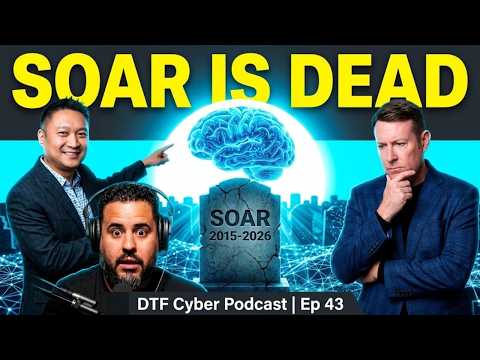
Agentic SOC: Machine Speed vs. Human Liability
0:00Hackers are using AI agents at light speed. If you're waiting for a human to click that approve button, you've already lost the company.
Yeah, you know, but speed is irrelevant, Damian. Especially if it's the middle of quarterly earnings and the AI sock quarantines a CFO's email, as an
0:15example. I don't think I'm ready to turn over my entire sock to an AI blackbox that I have no control over.
Yeah, cuz like what happens if you replace the whole sock with like how 9000s? Like that doesn't end very well for uh the people. That's right. This is the agentic sock machine speed versus
0:32human liability on the DTF cyber podcast. I'm Damian. This is Troy. And it's your boy Fur. Let's go. [music]
0:49[music] So, both of you guys know I got a pretty old school Tesla. Like when I say old school, I mean first generation. like it has a backup camera, but it can't drive itself. So, whenever someone sees my car, they're like, "Oh, this thing looks nice." I'm like, "Yeah, it doesn't drive itself." And they're like, "What do you mean? It's a Tesla." I'm like, "Yeah,
1:04it's that old." Right. So, there's one point where I had to take it in for service work. They gave me a new Tesla. So, I go on the highway and I'm cruising and this car has full self-driving. Like, pretty awesome, right? Never had that in my life before. Never seen it. I
1:21forget how you do it, but like you tap the button twice or something and it goes and it starts going, right? And it's going and it's going and I'm sitting there thinking like this is nice and out of the middle of nowhere it starts beeping at me, right? And then I wake up. [laughter] Just kidding. [clears throat] But what
1:37it did is it started beeping and told me that I needed to like take over. And I'm like, what the hell's going on? Like what's the point of the self-driving? That's what I think about when I think about this topic is it's all fun and games until someone gets in a wreck. Someone gets in a crash. Granted,
1:53doesn't happen very often, but it can happen.
I know. But, uh, FSD, there's studies that shows that it's safer than human drivers. And even that loner you had probably had older FSD cuz my newer Tesla has FSD. I don't even put my hands
2:10on the wheel.
Oh, you don't?
No.
Oh, I've never seen that before. I I the one where I had you had to put your hand on like the, you know, they had to fill your hand. So, you're saying that now the Teslas don't need to do that at all?
No. You want to go for a ride? cars are outside [clears throat]
after this. Let's go. I was tell take me
2:27to McDonald's. Give me a double cheeseburger. Um,
but what were you saying? You don't trust it?
No, it's I think what is less about trust. It's more about like what happens if Right. Because when it started beeping at me, it kind of, you know, like oh, like what's going on? Like frankly, I wasn't really paying
2:43attention because it was like it's on autopilot essentially. Like it's doing what I'm supposed to do. make sure you're paying attention cuz it's not supposed to be left unattended yet.
No, but maybe that's what I expected, right? And I think maybe that's the issue that some people are running into
2:58now is when they're looking at agents in their sock, they're thinking their work's cut out for them before. Now, a machine can take it over, an agent can take it over, but like when you stop caring or stop putting eyes on certain things, bad things can happen. I didn't
3:15get in a crash, luckily. I think it was more or less like the construction I think is what it was if I remember correctly like the the um the divider was coming over and it was making it to where like it didn't know what to do right and when it didn't know what to do I was like hey what am I supposed to do
3:31right so that's kind of what I remember with it but makes me think about the same situation here is if you start deploying these agents in the sock and they do what they're supposed to do like people start losing visibility and if they lose visibility
3:46they're kind of keep an eyes on things and they just expect that the agents do it all 100% of the time which may or may not be true. Um, do you open yourself up for opportunity of a threat actor? Maybe I'm looking at the wrong way. I think if you think about your situation, you would be what we call human in the loop.
4:03So the autonomous system said, "Hey, I don't know what to do here. So I need the human to push a button or in this case put your hands back on the wheel and take over." But you don't always
Yeah. I
I think this is
like So you don't always have to have the human in a loop. What about a Whimo? Have you not been in a Whimo
4:19or or a zuks and
Yeah, but have you seen a Whimo in the middle of like when there's a cop in the intersection directing traffic? Have you seen those videos? It's like the cop is like waving the car and the car is just like uh and it's just stuck and like no one's doing anything cuz they can't doesn't know what to do. Breaks down.
4:35Very specific situation. I don't know. I think
Yeah. And I was talking about his specific situation, human in the loop. But yeah, obviously there's fully autonomous cars and you know to correlate this back to security. I think this is one of the opportunity spaces for us, right? This is where we're going to find a lot of efficiencies. We can
4:50deep dive into the different parts of security operations center. But I do think automation there is, you know, the future. Are we there now is the question.
Uh well, let me ask you that. as a CISO for
you know Fortune 500 are you ready to
5:05take on Aentic AI in your
sock [clears throat] we've we've seen this evolution of soar products and you know sim for years and our you know uh instant response playbooks I think we've seen automation uh to some extent there but we have not seen fully autonomous
5:22decisionm in uh an AI agent before so I am not ready to turn over the keys to the kingdom to an AI agent that could potentially impact production. I do think it's absolutely brilliant to use that to get all the information for a
5:38human to actually make the decision and push the button. In other words, take all the telemetry and give the investigative timeline and say, "Here's our, you know, here's what the agent thinks should happen." And then when the human agrees and pushes the button, the agent can automate the response. That's the, you know, where we're at to where I
5:55would be uh today. I don't think I'm ready for that to be fully autonomous. So still have a human push the button is what you're saying
for now. Yes. Until
and then the response is all automated.
Yeah. I I think Okay. That's I think it's an evolution of comfort
because at some point you're going to
6:11have the self-driving car where you don't even pay attention anymore. I mean Fern is ready to trust that car even though it wasn't ready to trust him. [laughter]
Yeah.
Yeah. But what when was it like two
6:27years ago where Tesla said they were coming out with like these robo taxis? No steering wheels, right? So what happens then? Like you
Well, I mean you go into a Whimo, there's no drivers today.
Well, no, but there's like a
Even the Zuks, have you been to in a
6:42Zuks
car in Vegas?
There is no driver. There's It's essentially just a cabin.
Is there a steering wheel?
No,
there's not. Yeah, but to to that extent, Damian, I think uh I I would be comfortable at some point once I see the efficacy of the AI agents to say, "Okay, now you can
6:58fully automate this chain." But the first time it takes down production or your website goes down, you're losing millions per minute or your CFO's emails get quarantined that he was waiting on for something important, I think you'll quickly realize that the business, you know, still has to have some kind of
7:14decision tree. So you may automate, fully automate the lower impact items, but you still have to have some visibility into those larger things that could isolate a machine, stop important email or impact any production system.
No. So here I I would argue for the the
7:29opposite, right? I think I I agree there needs to be at least some oversight to begin with until you feel comfortable, but you can't stop innovation just because you're scared that you just can't. I mean,
we're not stopping innovation here. If you think about it, we are actually getting to resolution faster than we
7:46ever have before, but we still have guardrails in place so that we don't bring down the house with it.
Oh, yeah. But what I'm saying is there's no difference between an AI agent versus an intern.
Mhm.
Because an intern could take down your company, too. [clears throat]
8:01Absolutely. And we have we have segmentation of rules and duties and things like that. So, an intern shouldn't be able to take down production. And if they do, they have way overprovisioned access.
Let me get in the middle. Let me get in the middle of you guys real quick. Let me get in the middle. So, okay. So,
8:17we're just going to assume we're just going to relate it back to cars cuz that's what I understand maybe a little bit better personally, right? Is [clears throat] so Damian's basically saying like you want no steering wheel because innovation has to move at some at some rate. And Troyy's saying like, "Yeah, that's all cool, but uh I still
8:34want to have some sort of like oversight because what happens if is essentially like the question that Troy's asking is like, well, what happens if?" And I think that's what everyone in security thinks is if you look at things from the optics or a risk perspective, it's it's always, you know, well, we know this
8:52over here, but the question everyone has to ask is like, well, what happens if, right? I think there's always what happens if there's always going to be monitoring whether it's an AI agent or an employee.
Mhm.
Or even a new system that you put in in place, right? A new server, a new
9:08laptop, new software that you install on your endpoints. I think you're going to have to be able to monitor that anyways.
So I I'm not saying you're not going to have any oversight. You're not going to have any kind of guard rails. Like absolutely you're going to have to have those. But you're going to have to start
9:24down this path of how do I get to sock
AI agents
and how much do I give them like although you're not going to have them drive by themselves right for until you feel comfortable.
Yeah. So, okay. So, let me ask you guys
9:40this cuz this kind of reminds me of like the emergence of business resilience, right? So, I think like what Troy's describing here is well, you know, what happens if you know something goes down and something breaks and what's like not to say people aren't doing their job, but if someone had full visibility
9:56into your environment, they knew all the dependencies of their environment. They knew what worked and what didn't. if things broke from a we'll call it cyber resilience perspective the situation of well what happens if kind of becomes like a moot point because now you you
10:12have a full understanding of your your entire cloud environment so if this breaks or what happens if happens you not not that you have like a DR plan in that situation but you have kind of like a path to remediation because you understand the context fully from the business perspective versus well what
10:29happens if this doesn't if this breaks because like if if you say what happens if this breaks. What that's really saying is is like there's a situation out there that you may or may not have visibility into, right? So is it is is soar more or [clears throat] less kind
10:44of like being replaced by or cyber resilience because instead of the automation the orchestration part of it and the remediation that's kind of like the table stakes and now understanding the business context from a resilience
10:59perspective is like sore is kind of like what pushes into that black box and then out of that comes well we don't really matter we don't care what happens in the box because we know our we know our way to navigate it post whatever situation like is am I making sense with that
11:15I think uh so the way sore happens is really
uh uh a way of thinking if this then that and I think that mythology is dead so does the terminology soar go away
11:31possibly
right the the way we think about
soar triggering off of an alert in your sim is probably not going to happen the same way. And and so I don't know if that terminology sticks around. What happens to these sore companies? I have no idea.
11:46They need to evolve, right? So if they're still saying we're a sore company, they're probably going to have to evolve into more, you know, agentic AI type of roles.
Yeah. But if they're if they say they're a sore company today, they're more or less,
12:02not to simplify it or like take away the value of it, but they're more or less just playbooks and automation.
Yeah. static, right? It's like
it is what it is. Here's the input. Here's the output. It's it's not very dynamic. It's not very it doesn't take into context a lot of other things
12:17potentially.
Yeah. It's more like if you see this, do that,
right? So, you got to build these
like if you're hungry,
static. Yeah.
If you if you need if your if your gas is low, fill it like your tank. If your battery is low, plug it in, right?
But at in at a business level of if this
12:33happens, then do that. Right. So, it's just a bunch of if then statements.
Yeah. And if you don't tell it, you don't program it with enough information.
Mhm.
It doesn't follow through. Like if it hits a spot where, oh, I don't have an automation for that, it just stops.
Okay. Well, I noticed truck got really
12:48quiet over there. I So I
I know you guys are going through a couple things. I wanted to come back to an example. You know, I think that the correlation between cars and the sock kind of goes away here and they don't really it's not really relevant when you get to full autonomy, you know, that that metaphor. But what I'm saying uh
13:04what I think is that we are you're assuming Damian that you're working with perfect data. And unfortunately what we find is in most Fortune 500s or even midsize companies is that the fundamentals like asset management and patching and other things it's not perfect. And in fact, you're working
13:20with a highly complex world where, you know, automation is great, but what happens when all the conditions that are supposed to be there aren't there because you just can't do all that cyber hygiene at scale or some companies haven't done it at scale correctly. And so I think that there's that. And then
13:36you're also dealing with real live threat actors. you know what if threat actors get access to that agent or they hack the agent and take over that identity or that agentic capability and now you've given the agents you know full autonomy to go through in a in a you know touch environments like production
13:52I don't think that's what we're saying I don't think we're we're saying give them full complete control and unlimited access I don't think you can get there all I'm saying is if you have an AI agent what's the difference between an AI agent and a
14:09Exactly. And you mentioned interns earlier. So I want to go back to the stratification of a tier one, tier two, and tier three. And so an intern would absolutely be in the tier one, maybe below tier one space. They're the first level. They have certain privileges and entitlements that allow them to do certain things. An AI agent should mirror that. And then you have the the
14:26tier two, which is kind of a step up, more knowledge and skills. And the AI agents that are trained in that level can have those entitlements and privileges. and it should be able to do the same thing that a human should do in that same bucket. And then the tier three, this is where your super smart
14:41humans come in and dissect and diagnose and they can have an AI agent that assists them to gather data and to produce results. But I still don't think at a tier three level you're ready to give an AI agent that kind of power because now you're making them administrators of multiple systems
14:58including production and they could literally just like we talked last week about immediately deleting the entire infrastructure that could happen whether the AI agent did it maliciously through a thread actor or accidentally through its own mistake. I don't think we would ever want to have full autonomy on that
15:14tier three level.
Okay. Okay. What I'm hearing is you agree with me, but how we get there is a different different story.
Mhm.
Right.
Yes.
So, do we we agree that we need to get to hopefully as as much autonomy within a sock as possible using AI?
15:31100%. Yeah. And I think that's a future I've talked many times about. This is where I'm the most hopeful for the impact of AI into cyber security and reducing risk is right here where we're talking. So, I'm not uh a naysayer here, but when it comes to the privileges, entitlements, and access we give to our
15:47AI agents, you have to be very careful.
Okay. So, I I I think what we could cover and and talk about in this the rest of this really is how do we get there? Cuz the way you think about it, Troy, is going to be different than the way I think about it. Right. I I'm very
16:02I want to move as quickly as possible.
Mhm.
I don't even like to worry about compliance and governance.
You don't even have a rearview mirror. you just go.
I don't I mean I know I have to do it,
but I don't like to do it.
Okay. So,
and then and then I know, you know, I
16:18the the the one reason why I appreciate Troy on this show is because he's thinking about it more from a corporate level and and large company. We just can't deal. There's too much at risk.
Yeah. Troy kind of finds like the missing scale under the dragon's belly, right? It's like, well, hang on a
16:34second. What about this one situation? Right. So,
what about this uh fern? So, we talked about a rearview mirror there with Damian and going fast. Do Whimos have rearviews and if they do, why?
They do. They even have steering wheels, but the answer Yeah. question is why I think
yeah, they have them there just in case,
16:50right? But okay, so this is something that I was thinking of when Troy was talking and it is uh relating, you know, a big part of security is understanding what you have, right? Your assets, right? Um I have we'll say observed
17:07conversations at work where um what is it uh CMDB comes up and the reliance of people have reliance on that but the reality is is most of these conversations say that's probably the worst idea for your business is that you rely on this CMDB as like a living
17:25breathing um asset like inventory right because it depends on how often you scan and it it's not it's not like up to date. It's not current. Right.
Well, I think that's with any what Troy mentioned this earlier, right? It's it's
17:41like we never have enough asset inventory whether it's hardware, software identities and so how do we get to making sure AI agents are operating at that level where they can make proper decisions?
Yeah, they can't if they don't have the
17:57right information.
So, okay. So this is exactly where I was thinking in the context of like asset. If if you have a CMDB that's outdated and you have something that does patching, right? The idea shouldn't be do we do the patch. It's or you know is
18:14it patch needed is did we send the patch, right? Was it delivered versus do we need it? Because you know you probably need it or you don't need it. If you deliver it and you know that it was received and it was done, the the fact that you don't have record that it's been done or showing that it's been
18:30updated may not matter until the next scan, but you can prove that you've done what you needed to do, right? You've taken the action to kind of remediate the issue. So, am I wrong in assuming that the sock should operate the same way? It's like it needs to be able to take the action regardless of what it
18:47knows because the action is the best course of action based on the situation. Whereas like if there's a patch that needs to be done, you don't have it. Hey, if if I send out this, you know, missile to blow something up and fix it or we'll send out the the repair shop,
19:03right? Do something to fix it. at least I know that's been repaired versus not having an accurate inventory and then relying and say well what do we do now right so it's kind of like
one thing for I was going to say that you know the sock does normally push patches that's an infrastructure component
19:19but we have an old joke in cyber security which is if you ask uh the CIO the CTO and the CISO how many assets do we have you get three different answers because nobody has the source of truth and so your CMDB should be your source of truth and it should be constantly you differentiating between all of the
19:35connected systems from your EDR to your network scanners to your applications and your cloud and so on so that you can continuously be identifying new items. And here's one of the key things that helps during your pentest season is you got to be able to see what's new on your network. So if somebody plugs in a
19:51device that shouldn't be there, you should be able to see that very quickly. So that's how upto-date your asset inventory should be. And when you think about asset inventory, I talk to people and they're like, "Oh yeah, we know about all of our applications." That's not an asset inventory. asset inventory is physical items, applications,
20:07identities, SAS applications. There's so many things to uh an inventory, an asset inventory and a CMDB that uh some people might be missing. So, I think that's important. But the patching side of things, you know, we like to leave to the infrastructure and then we go back and scan and we report those
20:22vulnerabilities and the gaps. But Methos has uh, you know, thrown this big wrench in the works. we're going to be seeing a huge uptick in the number of zero days or exploitables externally facing that have to be patched with urgency. So I'm
20:37just curious how people are going to handle that in the autonomous sock but also you know respond to those incidents when bad things happen.
I don't think it's just mythos. I think it's any really any AI no tech.
And I'm not even worried about mythos to be honest cuz it's still behind closed doors and being neutered, but I'm
20:53worried about Chinese models that are advancing to the level of mythos that are going to be used without guard rails by threat actors against us. Exactly. So mythos isn't the problem here, folks. It's the other models like Mythos out in the world that we're going to be facing very very quickly. But I mean this is
21:08where I have hope in terms of you leveraging AI because
we all know we just said we we can't keep up to date with inventory.
But what if you had a different agent monitoring every aspect of the business
and then reporting in to another AI
21:24agent that's collecting it all
and then that one would be able to say I know where everything's at and they could just tap the right sub agent to to go grab it in real time.
Right. Mhm.
So you could have a CMDB that's a point in time.
Mhm.
21:39But what happens if that changes? So the the AI needs to be able to say, "Okay, this is what I know from last week,
but let me quickly check." And I think that can do it a lot quicker by tapping all these sub agents and saying, "Hey, tell me what you got." And then consolidating it,
21:56updating that database in real time and then providing the human with or maybe another agent with real-time info. That seems like a pretty good workaround.
So I mean I think the centralized database is probably where
we need to reconsider the architecture
22:13because having that whether it's a CMDB with one static database or it's a SIM
one one location with all your data. I don't know if that model works anymore. I I've seen that we talked before we started recording here about uh certain
22:29companies in this space and there's a certain company that has an agent a set of agent identities that are doing that Damian. So the one's entire job is to go out and find things that we don't know about and another one is to also check for sources of information that were supposed to be going into the sim or you
22:44think is going into the sim that you're not getting full telemetry from. So there's you know we're seeing companies already adopting that kind of technology. Yeah, I think it's the architecture I think is is the right architecture. It's how you get there, right? You might have
agents that are deployed to do specific
23:00things. Now,
you know, I I questioned you this on this before and I question a lot of people.
What's the value? Can you still go and want to buy these agents or do you create them yourself because they're so easy to create? Yeah, I was going to ask you that same question because, you
23:16know, I prefer to buy a product that I know is being updated and maintained by a company that I can hold accountable when things go wrong [clears throat] through an MSA.
Mhm.
Or do you think your employees should be building all of these components? Not just these AI agents we're talking about here, but like other, you know, related
23:33software and vibe coding type situations where you can either buy it or have your internal teams, you know, vibe code it and then never maintain it. I think a lot of businesses are going through that debate right now.
Debate or is it the cost exercise?
23:48Because I saw something a few days ago where it talked about how much a developer costs per month and how much that same developer cost a business in terms of their tokens. Like they're getting way more productivity from the people, but they're also spending uh what's the measurement? A ton.
24:03[laughter]
They spend the same amount in the tokens. Well, I mean, you know, if you go and buy the agents, I don't you have to look at the model. Are they using their own AI behind the scenes or are they plugging into your LLM in which case you're probably costing yourselves
24:18more in tokens as well. So there's a lot lot to think about there as you get into the the agent space. You know, do you build it yourself or do you go and buy something? Probably likes to buy it potentially because there's better support, but I would I don't know if you
24:33necessarily get better support. It depends on who you're getting it from and what that support structure looks like versus being able to control it yourself and know how it's configured or how
certain certain things I like to buy like this one specifically I think is a segment I'd love to buy a fully baked
24:50product that's been battle tested across huge enterprises
I know but nothing's battle tested today I mean that's difficult right I mean maybe next year or in two years
we'll have to revisit that
but I think also like context matters for Troy too is
25:05some of the places that that he's been at have a lot of legal responsibility.
But a lot of times this this mandate's not even coming from the CISO or even from the CIO. This is coming from the top
or the board because I think what's happening is
we have these new cycles of AI making us
25:22way more efficient. And so [clears throat] there has been a push to
these technical teams to use more AI.
Yeah. Just it's like use AI. I don't know how but yes, just do it right.
Yeah. Let me let me make sure I can say that in my earning statement that we use AI.
I got to put more AIS like I wonder now
25:39if you look at earning statements and you search AI like exclusively how many hits you get in like someone's like SEC 10K filing like I'm just
all of them
all of them but every page there's some sort of
you don't mention AI your stock price drops the next day
dead in the water. So, I mean that's if
25:56I think about this architecturally, right, that the agent piece
I look at those as, you know, if I were to have a human do it, what would I want them to do?
Yeah.
Now, I just have more of them. I don't have to rely on one person. Um, I could
26:11have different levels. Like Troy said, I could have an intern level versus a full expert.
Mhm.
I don't know where I'll be yet, right? Maybe multiple, but they're only as good as the data. And so, do we leverage AI to then manage that data? And do we look
26:27at the architectural way of accessing that data, getting access to that data? And I think that's probably the foundation that a lot of people don't think about because if you only have one data lake where you think all your data is at, that's probably out of date
26:42today, like your CNDB or your SIM.
Yeah, I don't I don't disagree. And I think like you said the arch architecture is changing and we've kind of seen it in the sim world where the some of the newer newer players are saying it doesn't matter where your data is just tell me where it's at and we'll
26:59figure it out from there. Right. And that kind of like coincides with like CDB like like you said if you have agents that can go out and like tap different systems and say hey like what's the latest? Give me the latest and do that you know in a fraction of a second or whatever what however fast it can be. You don't necessarily need
27:14people in the loop there. you just how how would I describe it is um I think of it like cook maybe like cooking to me is a really good example is [clears throat] when it comes to cooking like I want to be turning on the fire putting the food in the pan and cooking it make sure it's
27:30good right but if there was a way that I could just like snap my fingers and have all the ingredients pre-measured out on the countertop ready for me to go just to grab as I needed that would probably reduce my cooking time in half because all or or shopping right that's shopping, driving to the store, getting
27:47all the stuff.
Well, those would be that wouldn't be one person. That would be multiple people or multiple agents.
Yeah. Yeah. Yeah. So,
you got the shopping agent, you got the inventory agent,
the measuring agent,
the measuring, the the prep, [snorts]
and then
like let me cook like choices. He he wants to be in the middle doing that,
28:04right? But like the stuff that has like low risk, low impact, like why would you pay someone to do it if you don't have to, right? Right. And I I think I understand the argument now in terms of cooking right?
I think it's a good point for I think you're exactly right where we see the most opportunity is in those tasks that
28:19can be quickly automated. you know, gathering intelligence, you know, stitching together telemetry from all of our sources, really getting the kind of indicators that the block analyst tier three would need to make a decision, you know, and I think that what you'll find over time is that we're going to become
28:35more and more trusting of those agents as they learn your environment and your data because they're going to, you know, continually learn better ways of showing you what you're looking for. But in the end, they're going to know, you know, with a better percentage of certainty what the the accuracy of their
28:50information is as well.
And and and actually over time, you won't even have to cook it because there'll be another agent that will cook it.
Yeah.
Now, you've taken all the fun out of Fern's job of cooking.
Yeah. [laughter] You know, you know, a big part of not a time sync for me, but
29:06a time sync is cooking, right? Because I I do all the cooking in our house. So, breakfast lunch dinner snacks whatever. I'm usually the one in front of the stove or going to the store buying it. You know, I didn't do all that. But like I would have so much more free time if I had someone that did that
29:22for me. So when this podcast blows up and we're taking over the world, I want to look into someone to hire to do all that stuff for me, right? And then I can just cook, right? But until then, we need you to subscribe and and uh add a [laughter] like
or or you're going to have a a humanoid
29:39that's going to cook for you. So you don't have to worry about like burning herself
and everything's always cooked. Exactly.
Like the Jetsons. What was the robot's name in the Jetsons? The maid.
Rosie.
Rosie. Okay. I I Troy knew that. [laughter] So, okay. So, we just say that soar
29:58players are kind of in this quasi pre-extin pre-extinction era right?
Well, I think the term Soar is dead.
Okay.
Okay. So these companies that were doing some of the the orchestration and
30:14automation, they just have to step it up. I don't I don't think the companies themselves are dead. It's it's evolve and adapt or go extinct.
Mhm.
And so if you're still doing basic automations, I think there's in the beginning there's still going to be need
30:30for that because you're going to have AI agents that are going to call the automations.
Mh.
But over time those agents can just go do it. you don't have to
really have a static type of orchestration that's going to happen.
Yeah. One of the uh one of the companies, I won't name names, their tagline is Soore is dead. So, I think
30:47that they are quickly learning the AI.
Well, we've seen that, right? SOAR is dead. Sim is dead.
Everything's dead.
Yeah. I don't know what else is what else is dead.
I don't know. Hopefully not me. Um
somebody going to say sock is dead next. I don't know.
Probably. But I So, okay. So let me let
31:04me say this and you guys can tell me if I'm right or wrong hopefully right is the whole reason people are making these statements is because of what I would say is the democratization of tools will
31:19say the avail the higher availability of these tools and resources that they didn't have previously. So, if you were to think from the lens of if you needed a a high-end developer for a year to build you an application because of the amount of work that it took because you
31:35didn't know how to code, you would have to pay for that, right? But now, if you have access to a tool that's $20 a month that has the context of, you know, proper coding and you can get things done overnight with, you know, a few thousand tokens or whatever it is, you
31:50kind of like compress the window of the development cycle, right? So the [clears throat] automation part, a lot of these things that are out there, the orchestration, the response, the the playbooks now there are there there is easily
32:05there's easier accessibility to those tools that have the capability to take those actions than there ever was 10 years ago. So 10 years ago when these sort of companies were out, no one else really had the ability to build it. Right now they can. Doesn't mean they
32:20should, but they can. So there's like this perception of well we should just do this instead because it's cheaper, right? But the the the the point that ties both things together is the availability of the tool, right?
The not just the availability, the yeah the integration of tools and the
32:37availability. So I give you an example here. So remember we were talking about OCSF in the past when I was talking about data links and the open cyber security schema framework to bring all of your cyber security data into one place normalize so that you could search it. You know agents are excellent at
32:54doing that for us now. So connect via API to all of your different tools and give the agency the ability to look at this data, normalize it across all of your sources so that an IP address is an IP address and a host name is a host name and being able to really put together a story. Vendors have been
33:10notoriously resistant to making their output, their machine data in a very common schema because that was proprietary to them. It made you locked into their technology, perhaps their SIM. And so we saw a big resistance from big tech in making their machine output
33:26normalized. Well, agents just took that and threw it out the window because they can look across an API and tell you that an IP address over there equals an I.P. address over there.
The one Yeah. The one challenge is that most organizations don't want to follow the that standard OCSF, right? So now
33:43throwing throwing agents at it, I think is is probably a good idea. The problem there is not every tool exposes enough information over the over the API. That's that's the one problem you have.
So, you know, and then the other question is how many tokens are you
33:59going to use to rescan all of it. So, you have to have a good way to really index everything that you're seeing so that you don't have to go back and search for it again. You just have your your indexes has to be solid.
Yeah. And and I think there's agents that we're going to use to make our indexes more solid, too. So the whole I
34:17I had a project a few years ago to tell how many sources we had going into our sim, the amount of data that was coming in for each of them, what the percentage of what we wanted. You know, now agents can do that on the fly. It took me 6 months to a year to actually finish that project. And now we could probably do it
34:34in a day or a week with agents. So I'm really excited about that. And even the ones that don't expose enough data, you have the articulation that you can go back to that vendor and say, "We need we need more data so we can put together this story." And I'm not really saying that we should be using agents to
34:49normalize the data. What I'm saying is that we have the convenience now of the fact that agents can look across all of your sources and decipher the story quickly without having to worry about translations and, you know, trans transunion of the data.
35:06So, I'm going to ask you what happens if, right? Because what Troy's describing is there was a point in time, I forget how many years ago he said, but he was able to do a project in 6 months and now I can do it overnight. Right? So, now you have an agent that's doing all this work. You know, the one thing
35:22that agents are great at is doing the work. What they're really bad at is uh being interviewed. Like, how do you how do you audit the trail of a ghost in my mind? Because now there is this a high availability of tools and agents that
35:38people can have but there is this low low not contacts but there's like very low availability of why and what like who's regulating these agents right or if you have to go back and say hey like why did you press that button right why
35:54did you do that you can get an answer from a person but like how do you how do you get that from an agent that not not to say that they're going rogue because Not like scorch earth, but like how do you how do you regulate something that
have you have you ever tried to ask an
36:11actual person why did you do something when they did something wrong?
Uh if they're a kid. Yeah. [laughter] Cuz I have kids. Yeah.
I mean it's the same thing. They they don't know. And a lot of times they'd be like "Oh
oops. Yeah. I don't know. I don't remember." Or, "Sorry, this is what I
36:28thought I saw."
Mhm.
Or they cover up their tracks. And we've seen this with AI covering up its tracks. You know, the story where the AI went and deleted the production database
and then lied about it.
Yeah.
Yeah, we talked about that one. But I I
36:43think it's easier though to get from logs what the agent is thinking, the AI agent is thinking at that time and why that decision is made. I think to me that's easier to to gather than to have to go and ask somebody what was going through
36:59your mind six months ago when you did this.
Yeah. And and one thing you mentioned earlier Damian was tokens. And I want to just go back to that because I've seen a lot of innovation around uh the optimization of token usage. You know there's a lot of ways you can reduce the number of tokens these these type of
37:14actions take and you can even bring the models in house. So I I envision a world where tokens are not part of the equation or the discussion. They are today because we're still new in
Yeah. I don't know. I don't know.
That's that's a dream. I think there's
37:30going to be let's say like utility monitoring, right? I mean, I'm I know for a fact I Nevada and Arizona, we at least have different time of use costs on electricity and you could schedule things like charging your electric car
37:47during the cheapest time. And so that kind of model where it comes down to what do I use? What's going to be the most efficient for me to use based off of these types of tasks becomes really really important, right? do I use
38:02and and which model to use for that task.
Exactly.
You don't need to use the the latest model for something that you could use, you know, a previous model for and be a lot cheaper.
Yeah. Like I didn't know this when I I was working on my projects within Claude and I'd started it with the latest and
38:19greatest Opus. You cannot switch that to a different model.
Really?
Yeah. And so as I'm working away and I'm like, "Wait a second. I need to like, you know, dial it down a bit because I don't need high number of tokens to do
38:36the rest of this." You can't actually switch it. You have to start another project or task.
Really?
Yeah. That's crazy. In OpenAI, you know, I use Chatt a lot in codeex. You know, it's instant. It basically determines based on what you ask it which model is the most efficient to use. It actually
38:52says you can choose the model or you can choose instant. So that as soon as you put the query in, it determines the best and most efficient model to use for that query.
Yeah. So if I'm doing something wrong in Claude, somebody let me know because I can't get it to switch in Claude. But I can do it in Gemini. I can choose the
39:07different models midstream.
Might be a feature kind of like when iPhones only have one type of charging port. You had to go buy the special tool to only certain kinds of chargers because they didn't have a USBC on them. They want lightning or whatever. Uh but I think that's where you know that whole
39:24utility space of sending
the command or the the query through and picking the right model whether it's chat GPT or Gemini or or Claude
Mhm.
or Grock. I mean they're all good at
39:41different things and they all you know leaprog each other.
Mhm. If you could just have one and maybe this exists already where you just have one, tell it what I wanted to do and it goes up and finds the right model and the the best model and the cheapest
39:56most cost effective.
I know at least three startups working on that right now. So, it's coming. And then there's also a company that I love that you know can optimize your your cloud. You know, you use Microsoft, Google and AWS, you know, can tell you where the workload is the
40:13best suited for. That same company's also working on this functionality, too. So, a lot of lot of good work around that, but I'm excited for getting to a world we don't have to worry about tokens.
Yeah. I wonder if we're talking to the same company. I heard I was talking to one earlier this week, too. Something similar similar. So, we should compare
40:29notes.
You guys got like secret secret conversations. I'm over here trying to figure out other things in my life. [laughter] You guys are you guys are on the edge. Um, okay. So, let me ask you this then when it comes to a human in a loop, right?
40:45Troy would say you need that, right? You Damian, you say maybe not, right? But I guess in that situation, if you have someone there, you kind of create this bottleneck regardless of of what role they play because if you just
41:01assume that like what what is it? It's like a 80 to1 ratio of
agents to humans. Yeah. And again, I agree with Damian 100% on uh the use of AI in the sock to an extent. And I I think my hesitation is around those
41:17agents that have access to, you know, do real damage. We talked about last week, you know, agents deleting entire production databases. That's what I mean. I don't want that. I don't want to give that capability.
You just tell it. You're not allowed to delete anything.
Yeah,
you can isolate. I mean, this is what I
41:33would do, right? If I'm gonna if I'm gonna have, you know, high fidelity and say if I see something suspicious, I want you to isolate that machine. And if I end up isolating the CFO and the CEO, I'm willing to take that risk to save the entire company.
That's okay. Absolutely.
41:48But I'm not going to I would never give it the ability to go and isolate or wipe like last week's episode, wipe 200,000 laptops
in one go. I think something should automatically set off to say, "Okay, your limitation is,
42:04I don't know, five laptops."
Yeah. It's kind of like uh with banking, like when you want to send money, there's a limit to how much you can send, right? Depending on your account and what you have in there or who you're sending it to or if it's a new contact, like if you add a new contact to your phone, at least for me, when you're
42:21trying to send money, it's like it puts you through this prompt of like, "How do you know this person? Is it a friend, family? Is it someone you met on social?" Like it literally says this like I went through it yesterday. Is this someone that you met?
You sent me money yesterday. I think I don't even check.
I sent you that dope. Um [laughter] and it was like here here's all these
42:37things like essentially like social engineering scams. And then it was something else like is this business related, right? I was like no it's just a friend. I click right and then it went back and said I'm going to send you the text or go over here to your token your uh OTP authenticator app and grab grab
42:52the key put it in here. So it's it made it difficult for me to send that money. Right. But there were these we call it guardrails in place to make sure I didn't get scammed.
Yeah. But there's different levels to that, right? Like you said, if you're trying to send $10, send it. Send it.
43:10But if you're trying to send 10 grand Oh, yeah. Make sure like I I want you to make sure it's me.
Yeah.
And I'm sending it to the right spot. So, so I think when it comes down to the autonomous, you know, agent sock that it's good to do it, but like like Troy
43:26said, as certain things get riskier, you want to focus on kind of preventing certain things from turning into bad situations, right? But either way, in the middle, it's going to slow it down. Doesn't matter, right?
Yeah. I I think look, if we're going to talk about this in real world and yeah,
43:42I have this dream to fully automate stuff. I don't know when we'll get there, but you need to start in different places, right? You got to be able to have at least some automation today.
I don't know if you can go from zero automation to full AI. I I just don't
43:59think that's a a good jump. Now, some people might argue skip the automation because that's too, you know, you got to actually tell it exactly what to do. But I like that approach because you're training yourself or your team to actually give commands to AI. Yeah. So,
44:15I have I have an idea here and a vision, right? And uh some people are not going to like this vision, especially if you own an MSSP, but uh what [snorts] I really see is this is an an opportune way for companies to bring the sock back in-house. And what I mean in-house is
44:30instead of relying on third party MSSPs that you pay an exorbitant amount of money for and get midlevel service, you could have all these [clears throat] AI agents. you have a very low uh low staff of humans that oversee the entire operation. You still have to have a
44:46human to, you know, set the guardrails, review the processes, make sure the agents are, you know, deployed correctly doing what they should do. But at the end of the day, you'll be able to bring your sock back inhouse with the assistance of AI agents and have a much smaller staff to do 20 times more than
45:02what you would ever get from an MSSP.
Super interesting you say that because you were just saying the the whole liability piece of it. A lot of organizations that go to an MSSP, they are trying to alleviate liability,
you know, [clears throat]
risk transfer. Yeah, I I get that, too.
45:19But what you find during ransomware, I've seen this in multiple high-profile cases, that risk never really transfers. There are so many outs and the MSA sign with that MSSP. The MSSP never takes on the risk themselves. No, but I mean from you think about it from you know the
45:35board is telling you to take care of this and you can say look I just hired an MSSP a big global one and they they've got it taken care of so I don't need to focus on that I can focus on other things. I think that happens a lot, right? We've seen that a lot.
But it doesn't actually do anything doesn't mean anything is switch.
Yeah, 100%. I mean, it happens all the
45:51time. And and then you can have never been fired for hiring IBM. That was a saying in the 80s and 90s, right? And I think I think that's what you're saying, Damian. But at some point, we're going to be able to, you know, those people who were on the fence about should I outsource to an MSSP or can I bring this back in-house, this is your answer.
46:07Absolutely, you can get a fleet of AI agents in sock. They're going to do 10 times better than an MSSP and you'll be able to manage with a lower staff on on site.
Yeah, I'm not arguing with you. I' I've gotten rid of two MSSPs at two different companies I've been at and I brought them all either in-house or managed
46:24in-house somehow.
Caveat being you have to have the skills internally to do it.
Well, that was before and I think what Troy is saying, it makes it a lot easier now that you've got AI agents that can help you out.
Yeah. Well, you can you can have access to those agents, but you still need the people to build it. And so what I'm saying is like a 500 user shop.
46:41Yeah. But it's it's easier because if you're thinking about building a sock, like a lot of people go to the embass model because one, they don't want to have to worry about building 24/7.
Yeah.
You just don't have enough staff to run 24/7,
right?
46:57Then you got people that you have to pay and worry about.
Mhm.
Most times you're not hopefully not doing it in one country. You're doing it follow the sun model across the globe. Mhm.
leveraging labor in other countries. Now
47:12you can take that to the next level. You don't have to worry about managing people. You got to manage agents and the agents don't have to sleep
and they have access to pedag duty. So if something bad happens, they just text you or call you
in this future world where Sora is dead. Sim is dead.
47:27Yeah. Troy saying MSSP is dead.
MSSP.
I don't know about that. I I don't I I think yeah, the pressure is on. I think I think the pressure is on for them to do like what Soar is in the in the position of is it find a way to have more business value that you can charge a premium for?
Well, that mean the MSSP could just
47:43manage your fleet of AI agents.
Yeah. And those who lean into AI agents are going to be the most successful. But here's a novel idea, Damian. If those MSSPs would provide better service, then maybe we wouldn't fire them. But I have worked with global firms and smaller
47:59firms, and never once have I talked to a CISO who says, "Yeah, you know what? I love my MSSP. Just doesn't happen. There is not one that has the customer service or the level of service that the customer expects.
But let me let me ask you this. Isn't that
that isn't that supposed to be your
48:17image, though? Like you I mean, if you walked in and said, "Yeah, I love everything you do." You could never hold their feet to the fire. So, you got to walk in saying, "You're not doing it right. You guys suck. You got to do this better. You gotta do that better. You gotta charge [clears throat] me."
Tell them. But when you're in a private room with a bunch of your peers and you
48:33talk about how much you hate
the service you're getting from X, Y, or Z, that's a different story.
Oh, okay. Yeah, that makes sense. So, it's kind of like you uh you beat [clears throat] them down. This sounds very domestic violence of [laughter] how you guys treat sales people, which is
48:48not good for me cuz I'm a sales guy, right? So, but I have had people that I've worked with that were very much like not condescending, but like, yeah, you guys suck. And it's like, what do you mean? like do this on your own. You figure it out and you come back to me, you know, and then it's like, yeah, you
49:03know, just, you know, basically what it turned into is, you know, I got to look a certain way. [laughter] I got to act.
And by the way, if you're listening to this and you love your MSSP, please send me a a DM because I always love to be proved wrong, but I have not come across anybody who says, you know what, I just love this MSSP and I wouldn't change for
49:19the world. I've never heard that in my life and I've talked to a lot of people.
Yeah. I just I've never really run into MSSPs very often. Right. maybe say it luckily but
I think it I think it depends, right? There are going to be organizations that just don't know where to start. They got
49:34nothing and it's a huge risk. So, the quickest way is an MSSP.
Yeah, it's the safest way to go because at least to some extent it's been proven out and there's other customers that are buying their stuff. So, it makes sense to like build your own or buy it like
Well, I mean now though, do you need to
49:52go to an MSSP when you could just fire up a few agents?
That's the complicated part. But I think that that as Fern said, people don't know how to do that. It is the easy button. But there are companies that I'm really excited about coming out in the space who are going to give you AI employees that do those tasks and it's
50:07going to be a lot easier in the future to deploy AI agents that you can manage even with no skills.
Yeah. So, I mean, a lot of people are probably thinking, hey, you guys always say you see stuff coming. Why don't you tell us? Well,
here you go. No, we we're thinking about
50:23doing a a whole different show
that kind of fits. We're playing with the name. Burn has some terrible ideas.
Dude, I thought he was joking and then he
Yeah, we cannot go We cannot go with that one you said yesterday.
Um
Okay.
I thought he was joking. That's why we
50:38did not respond. Troy and I did not respond to you.
Did you guys text each other and say, "Is he joking?"
No. No. I thought you were joking. I just thought And then when you're like, [laughter]
"Nobody responded." That's when I realized you were serious and I responded. [laughter]
But we are thinking of doing a separate
50:56type of show where we look at these products that are coming out.
Mhm.
So if you want to see that, you know, let us know either in person or in the comments. We we want to get that going and then showcase some of these startups or even you don't have to be startups
51:13just cool tech that we want to
like emerging tech or uh let's say mostly emerging tech so kind of like eyes into some of the stuff you guys see on a regular basis whether it's on like internal calls like you know sales calls
51:28looking at the bleeding edge stuff so I luckily get to hear about all these because I talk to you guys so often but you So anyways, we got we do have a lot of products lined up for this type of show. What we're trying to work on are the legalities
51:43because we want to give an honest review and we don't want to get into any legal trouble. So
full, you know, Damian, I met a uh I met a really uh interesting CISO yesterday in the insurance world. There's a massive conference in Vegas uh going on. So there's dinners every night this week. And last night I met this really
51:59cool CISO from San Diego in the insurance business. And he asked me that same question. how does he stay on top of innovation like you and I do and I said got to get in touch with venture capital you know that most venture capital firms have a CISO in residence or somebody who's representative Patty Degman over at Andrea Horwitz David Horn
52:17over at Ballistic great great people who are looking to talk to the security world and talk about first of all where they're deploying capital to innovation where they see the market going and then talk to you about what you're seeing feet on the ground in the security world so I highly recommend you connect with those people and chat because that's how
52:33I stay and I Damian, that's how you stay connected to innovation because you know that if venture capital is funding these companies and backing it, they've seen something special and that's usually how I see what's coming around the corner from an innovation.
You don't even need to talk to anyone, Troy. Just go to the the VC websites and
52:49see where they're invested. That's a good place to start.
But I find that conversation with David and Patty and people like those uh so refreshing and uh interesting. I think, you know, I encourage the connection. But yeah, if you want to just go look at their website, Sin Ventures, Night Dragon, Ballistic, Insight Partners,
53:05those are the big ones in Cyber Industries, so many more. Uni Ventures, Holly Ventures,
those folks. And uh they'll be doing Light Speed, Greylock. I mean, there's so many great ones. So, I don't want to leave anybody out if I did. I didn't do it intentionally.
No, I named I named one. So, and
53:22[clears throat] we've, you know, we've we've worked with them on a few different companies, right, that are actually selling here locally before they even got into the channel, which is interesting. Um, so I guess back to the topic at hand, AI agents in the sock. What does it mean
53:39for the people, right? Is Sar dead? Probably. Or at least it's going to be called something different. We're probably gonna call it Sora, you know, like sore with agents [laughter] at the end of there. Put a little a put a little AI at the end. Who is it? It
53:55was GoDaddy. I saw a commercial for GoDaddy on my I was watching YouTube and they called like their new website builder uh era AI and then they added some other letters with them like oh my gosh like everyone's just saying AI AI AI. But
54:12back to the sock uh fully [snorts] autonomous agents. So
So at the end of the day, we got to get faster because the attackers are getting faster.
So you have to be able to embrace some of these
technologies and tools or you're just
54:28going to be left behind.
Okay, perfect. Perfect segue cuz like that wasn't even planned, but this is where I wanted to take it is getting money for this stuff, right? is budget season. We're coming up on budget
54:45cycles, right? When it comes to planning for next year's budget, right? So, a lot of times people have to come up with how they're going to spend their money, how much it's going to cost, where they're going to spend their money, and that be able to justify it, right? So, I think a lot of people that listen to to the the podcast are people in positions where
55:01they have to, you know, do these justifications. So, because both you and Troy have done these things or involved with conversations, I think it'd be interesting to hear kind of how you guys are positioning the these different products of agents uh agent socks, you
55:17know, fully autonomous sock environments to to boards and then how you're kind of having those conversations. So that way it might help we'll say to help a listener understand maybe from the context of someone that's been through that if they haven't or maybe just get
55:32like a like bounce it off the wall. So like I'm your CFO Damian convince me to give you the dough.
Yeah. I don't know here. Look, I don't know if it's necessarily us pushing it forward as much as the CFO and the CEO
55:49pushing AI usage down. I don't I don't know which one's greater
because I think the the like we mentioned earlier right the the board and investors they're asking every organization how are you adopting AI how are you driving efficiency so I think
56:06there's pressure from that side from the top down
to just do it
to to do a lot more of it I think some of the resistance might be the teams actually building the AI because they don't want to lose their jobs
Oh okay
Mhm. Yeah, exactly. And I see the same
56:23thing. I was going to say that uh I I would never have to go to my my board CEO or CFO and say I want to do an AI project. They're going to be asking me why aren't you? And so those are going to get funded and they're looking for headcount reduction. I know that we talk about that AI is not coming for your job. It's coming for the people who
56:38don't lean into AI, but we are being asked by boards and CFOs for headcount. And so the efficiencies that are gained from these AI agents in the sock are going to have a real ripple.
I would say always, right? Um I think yeah that always hits the headlines Troy where people are saying cut number of
56:54jobs because AI
speaking from personal experience not headlines I have been asked for headcount reduction okay via AI and I talked to peers who have been asked
there are obviously they're in headlines they're in the headlines too right you see a lot of who was the latest one
57:10Amazon did like 14,000 people I think was what I read the other day
and and so I think yeah that that does happen I think there's pressure for that in the ask, but I I for the organizations that are not asking for it, I think it's a repurpose or elevating the actual humans doing the
57:27work. So, if you think about it, [clears throat] if you could replace a remedial task with AI, that person doesn't have to waste time on that stuff anymore. They can move up the stack and do something more complex.
Yeah, that's right.
But not everyone sees it that way.
I know. I think there is enough of that.
57:43I just don't think it gets enough publicity when that happens.
Mhm. What what I really enjoyed doing, Damian, this started even two jobs ago, but even in my last job, I I loved to see the creativity because as I had this discussion with my employees and I said, "Look, I'm not going to take your job
58:00away with AI. You're going to be doing more higher level cognitive functions. Define what that is to me. Tell me where you see that working for you." So that the employee had a stake in it and a voice in it. Instead of me just demanding that they do X, Y, or Z, they
58:16could tell me how they were going to elevate their self after AI did the remedial or the redundant task.
Yeah.
So when Fern has all his AI bots gathering all his ingredients to go cook, I would expect a fivestar Michelin
58:31type of meal versus something he whips together in 5 minutes.
You got more time to spend on actually cooking.
Trust me, it's for sure. My cooking is some of the best cooking you've ever had, but you've never had it, so you don't know. Yeah. I I like the idea of of kind of
58:48like it this kind of reminds me of like Stafog, right? If you don't have the people, you hire them,
but you don't have to go through the process of firing them, you just find a provider that can, you know, bring in the the the the
the Tommy guns or the big guns, right? Hired guns. Um, and then it gets to a
59:04point where, you know, you can have a tool that can do these different things for you. and you just, you know, bring in the tool. You buy the tool, you build the tool, right? You you don't necessarily have to have people doing the work because now you've essentially got this kind of infrastructure that can do what people were doing before. Um,
59:19but like like we talked about at some point, there always has to be a person for now in a position to kind of make some of these decisions or at least have guard rails around the decisions that are made, much like the banking uh money transfer situation we talked about. Um,
59:36[clears throat] and and the fact that people have the ability to build now is great, but then that also kind of brings it owned uh downsides with it, which I've seen and a few phone calls where people are, you know, building stuff, but they're not developers. They don't um so this is
59:53more like a personal story is like one of the things that really irritates me is when people say they're an engineer and I'm like, "Oh, what'd you go where'd you go to school for?" Like, "Oh, um, I went to wherever they went." It's like, "Oh, they have an engineering program there." No, no. I mean, so so what' you
1:00:09It turns into like people saying they're a sales engineer or they're an engineer and it's like like I I was in the trenches, man. I was doing calculus in high school, right? Like I was doing differential equations at myuh junior year of of high school, right? So when I went to college and did all this stuff,
1:00:26you know, linear algebra and things like that and like differential equations again and again, like all these different things, like I kind of went through the fire. So when people say, "Oh yeah, no, you know, I'm I'm an engineer." It's like, I mean, yeah, I get it. So I kind of have that same mentality. Maybe it's just personal
1:00:43experience where people say, "Oh yeah, no, we're building this." It's like, "Yeah, but like do you actually know how to code?"
You just tell Claude to code it for you. I know, but like may maybe I'm just not as maybe say educated on on the topic, but I kind of feel like
1:01:00if you don't have we talk about foundational situation or foundational uh uh elements to security. You have to have your foundation right. You have to you have to have the fundamentals correct, right? And I feel like when it comes to coding and having a security first mindset when you code, it requires
1:01:16certain types of training. And the minute you don't understand what those foundations are and you kind of offload it.
So, but you don't need to because you have one agent that's coding it
and then you have another agent that's checking it for security vulnerabilities
1:01:33and then you have another agent that goes and patches it.
So, this feels like very much like I'm on the lawn saying get off my lawn. Like I'm an old man right now.
Feels like that to me too, Fern. Is it is it is the Wait, are you saying I sound like the old man or are you saying you're the old man, too?
Yes. Yeah. No, you do sound like you're
1:01:49on the lawn screaming. I I have a you know, I'm certified routing engineer. I didn't go to college for engineering, so I call I used to call myself an engineer.
Mhm. So,
but I still think I I hear other uh developers, especially developers right now, who are having that same
1:02:05existential crisis like you're not a coder. I've coded this app. I coded this app. You didn't code anything. You know, I hear developers getting very upset and personally offended by what people are calling coding now. But what I'm saying to these developers is like, man, sun's
1:02:22setting on you very quickly.
Oh gosh, I'm about to be a
I think that uh that these developers need to first of all have a better attitude. I met one recently who was so just like against citizen developers as they call them or vibe coders and I'm
1:02:37like man that's the future. you can't have this attitude because you're gonna be left behind. He was so just frustrated with it. Like,
well, that's why I said I kind of feel like an old man because I I I'm open to the possibility of being wrong and I probably am wrong, right? Which is kind of why I'm just openly admitting this
1:02:52stuff because it's like I don't know. But, you know, maybe maybe we're coming into a phase where the the engineering or or education part is kind of like commoditized, right, when it comes to
well college. What difference? Did you see that news story last week where
1:03:09there was a graduate who was getting their diploma and they lifted up their laptop to show the chat GBT? [laughter]
I saw that.
Did you see that? We'll put a we'll put an overlay here on the video to show you the article. But I mean the question though is if you go to school, are you really
1:03:25learning? Are learning? Are using AI to help you? Is AI doing your assignments? Could it?
Yeah.
Right. So I mean it's the whole calculator thing. Yeah, you could do math, but it's faster if you use a calculator.
True. I I'm I'm about ripe for the age
1:03:42of being an old man in the lawn. Wrong environment cuz I live in Arizona, but
I mean the right environment. No lawn, but there's a lot of retirees here.
True. But they're all gone right now cuz it's summer time.
Oh man. Well, [clears throat] I have enough gray hairs to be considered a
1:03:57partial snowbird. So, but it was just my thought. So, you know, clearly maybe got to do some some thinking about how I how I view these things. But I just thought I'd mention that because it kind of comes up a lot in conversation that I have with people and I'm just like I
1:04:12feel very old when I say these things and maybe I'm not like Gen Z or whatever, but figured I'd ask you guys only to find out from two guys that are older than me [laughter] that that I'm on my lawn right now. Okay, so let's get back on track. Let's get back on track. So, we talked about all these
1:04:29different things, right? We talked about the the a aentic or how sore is dead, right? A lot of things are potentially dead. There's a lot of things that are coming out that are are kind of pushing the needle forward, right? Damian, you feel like that's perfectly fine. Troy is
1:04:45on the same page as long as there's some sort of governance around it, right? And I think I can get in line with both. had to jump in the middle of you guys a couple times today. But u I think ideally you guys both have different perspectives based on your experience and kind of you know those experiences
1:05:00kind of create how you see things, right? And luckily I'm in the middle because I have none of that experience. I just more have the sales experience. So I do find it interesting because some of the conversations that I have at work are around people that are trying to manage the identities of what they're
1:05:15deploying. Right? We had a call today with uh with a good friend of ours uh from well we can't say the names but I'll just say Santosh right his his team spoke with our identity team and they were talking about how this company is doing just in time access the right way
1:05:30right versus how other people call JIT and how they're doing it and how these other guys are essentially creating a new space that is actually just in time versus kind of policydriven just in time right and and very static if you will right So we have these conversations all
1:05:47the time and the one thing that always comes up with the sock is like you moving it forward and kind of elevating the skill set of the people that [clears throat] are there. Troy has some experience where people get let go in favor of AI but the business
1:06:03[clears throat] is pushing down to AI on people to get it done and it's kind of like it's hard for people to make that move because they're in fear of what they might lose. Right. understandably. But the I guess maybe my thought is
1:06:20there's a lot that we covered today and like I like to always ask is is there something that we didn't cover that I think is that you would think is important when it comes to
no like so my mindset is um work always work yourself out of a job. Always have that kind of mentality.
1:06:36Wait, work yourself out of a job as in
Yeah. Like Okay. So let's let's think about it this way. If you call a plumber because you got a plumbing issue, would you want that plumber to keep coming back and fixing stuff in your house all the time cuz something's always breaking
1:06:51or would you want them to fix it
right the first time and never come back?
Yeah. Should expensive if they keep service calls, right? 75 bucks just to show up and tell you that you just have to use a plunger or whatever, you know,
or eat fiber
or get the AI toilet. [laughter]
1:07:06Fiber don't look right. Um, so yes, I'd Okay, when you say work yourself out of a job,
so I mean like there's that can mean a bunch of different things, right? Work yourself out of a job so you get in you get in there, do your job so well, train
1:07:21the next person so they can do it so you can move on to the next thing. So if you could continue that, that's how you move up in your career. It's you start to at the bottom and then you start to build your capabilities, pass it on to someone else and then get new experience and new
1:07:39capabilities and do the same thing. And you know that's kind of the mantra I I've always tried to get in front of students and you know new in career is that you're never going to be doing this one job you started your career with for
1:07:54the rest of your life.
I mean could you? Yeah, you could.
But do you want to?
But do you want to? No.
Some people do. Actually, I've seen people work in the same help desk job for 20 years.
Yeah, but at some point with the way
1:08:10technology is going now, it might not be like that in the next 10 years.
Oh, I mean, it's surprising that it hasn't been offshored to some country that can do it at a fraction of the cost. Now you got AI that could just take that job away, right?
Yeah, that's exactly what I was what I was thinking about. So work yourself out
1:08:26of a job.
I think if you take that as, you know, one of your mantras,
find a way to be so good at it that you can kind of move into other areas and and kind of have a another uh what's the a tool in the bat belt? Another weapon in the bat belt. So you don't use it
1:08:41every day, but like you have these different tools that you've kind of learned. So you become like the Swiss Army knife at work.
Yeah. Broad experience is way I phrase it.
Okay.
Yep.
What about you, Trey?
My last thing for Yeah. And my last thing would be as we continue to talk about, you know, we're always going to
1:08:57need people that are going to be able to manage and keep up with these agents. So if you are in security, definitely go and, you know, create your own bots, use codeex, use claude, start really diving into how you manage these. Even get a Mac Mini or a Raspi and spin up
1:09:13Claudebot or Clawbot, sorry, uh to do something that you wanted to do. Doesn't have to be very important. Could be just a lab in your house. But if you understand the inner workings of how these things work, you'll be able to manage them for the company. You'll be able to be that go-to resource, and that's what you want to position
1:09:28yourself as. Those folks will have resiliency in their job, and they'll be the last ones to be let go if that were to happen in your company. A lot of efficiencies are coming. You should be the driver of those efficiencies at every single level, whether you're at the help desk or all the way up into management. If you're a driver of
1:09:44efficiencies with AI or you you [clears throat] give ideas of how AI can create efficiencies in your company, they're going to keep you and you're going to have a job for a while. If you're resistant to AI, if you're offended by others who are leveraging it and doing better than you, that's going to be a problem and you might be looking
1:09:59for another job soon. So, that's my last minute.
The people that lose their jobs are the ones that are scared they're going to lose their jobs
usually.
Exactly. Now, there's other cases to that where, you know, thousands of people get laid off because of AI and maybe get caught up in that,
1:10:15but all I got to say is things happen for a reason. So, take that as an opportunity to reinvent yourself, take on some personal projects and hopefully show something for that time so you can land the next job.
Yeah. So, you're not actually losing
1:10:31your job. What you are is you're becoming the manager of these really weird digital interns. And with that, we'll see you next week.
Lights agents [music] moving past the human click. Approve the button. Find the digital trick. Sar is silent just a
1:10:46ghost in the machine. We're trading liability for something unforeseen. Machine speed [music] versus human hands. [singing] Trying to hold on while the world expands. Machine speed versus human hands. Trying to hold [music] on while the world expands. We're riding in a
1:11:02ghost car. Hands off the wheel. Hands off the ghost of [music] the things that we feel. Autonomy is a dream until the beeping starts. A sudden awakening for digital hearts. A sudden awakening for digital hearts. Can [music] you order the ghost? Who's watching the game?
1:11:17Moving too fast or just living in fate. Moving too fast or just living in fate. A 500 user shop. No floor to the plan. We're building [music] our own empires as fast as we can. $20 a month for a coding machine while liability lingers as fast [singing] as we can.
1:11:33[music]
$20 a month for a coding machine. While liability lingers behind the glass screen. Work yourself [music] out. That's the only way home before the human eye takes the place on the throne. We're riding in a ghost car. Hands off the wheel. Hands off [music] the ghost of the things that we feel. Autonomy is
1:11:50a dream until the beeping starts. A sudden awakening for digital hearts. [music] A sudden awakening for digital hearts. Can you order the ghost? Who's watching the gate? Moving too fast or just living in fate? moving too fast [music] or just living in faith. See you
1:12:06next week on DTF. We'll see where the agents take us next. My grill.