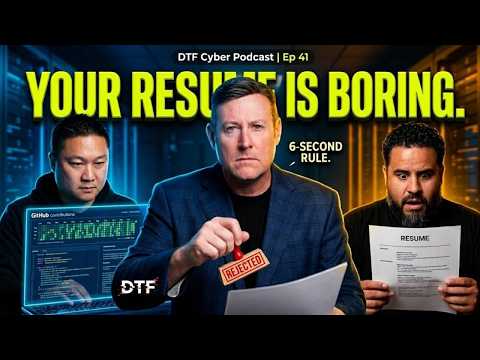
Your Resume is Boring! Here’s Why You’re Still Stuck in Entry Level
0:00So Damian, I have a question for you. How does somebody stand out in today's job market? I mean, I see so many resumes, it's so hard to discern between them. Like, how do you get to the bottom of who's qualified for the role?
Well, you know, Troy, we we've been telling students to get their degrees,
0:17get theirs, and what we're finding is that that may not be the right path to these jobs.
Yeah. I think degrees and certifications, they don't stop breaches, people do. So, how does a person rise above the noise?
So, wait, hang on. What am I supposed to
0:32do once I get my CISSP? Cuz it doesn't sound like that's going to get me a job anymore.
Well, that's what we're discussing on this week's episode, the DTF Cyber Podcast, episode 41. I'm Damian.
This is Troy.
And it's your boy Ferg. Let's go.
0:49[music] Sometimes we make up stories here, sometimes we don't. This story is 100%
1:06true. And I I like to think of it as a tale of two cities, right? Um I'm sure you guys have read the book, right? Good old Charles Dickens. Uh it was the best of times, it was the worst of times. Uh and that's exactly the story that a lot of people go through in the cyber world.
1:21Let me tell you specifically boot camps, cyber boot camps. Everyone buys them, but not everyone gets a job. And I happen to know two people that went to the same boot camp. One went, came out, found a job, is now
1:38working in a GRC role. Another one went, didn't get a job, is in a adjacent field that's not even technically technology from what I understand. I believe it's customer service. Same course, same instructor, everything the
1:55same, same literally in the room next to each other. Still talk to each other. One person got a job, the other one didn't. What's wild to me about that is [clears throat] that is consistent with more than these two people because what I'm finding out
2:13in talking to people is that just because you do a boot camp doesn't mean you can get a job. Well, just because you get a cyber degree also means you don't automatically get a job either.
So when I don't know what the like I
2:28guess this what we'll talk about, right?
Yeah.
What is that path?
And I you're talking about two specific people that you know Fern, I'll tell you. I've dealt with thousands of students, university college students over the past year. I've seen a lot of resumes. I've spoken to a lot of
2:45students. And how do you stand above? I think that's the question a lot of them have been asking.
Yeah.
It's not a thing that right here Damian is uh with AI and everybody's job is you know quoteunquote at risk. We're asking
3:00people to reskill themselves mid-flight. So if you're a sock analyst as an example, you have to now become an AI sock analyst to help empower the AI to do your job more efficiently and be ahead of the curve as it relates to this new AI craze. So, as companies are looking to cut headcount, which is
3:16ridiculous to me, as companies are looking to cut headcount, how do these same folks who have certifications and degrees in cyber security trying to get their foot in the door, compete with people who have just lost their job to AI and are looking to get back into the industry? So now we have again I call
3:31the AI crunch where you're having AI replace humans in some cases or empowering human in other cases but also now you're saying how do we work in a system with fewer jobs for everyone including those trying to get their foot in the door here.
Yeah. And I don't know if there are
3:47necessarily fewer jobs yet. I think yeah, we could we could say potentially a lot fewer jobs on the entry level, but overall I'm not so sure that there's fewer jobs overall.
I think if you look at like Block as an
4:02example, 4,000 jobs cut, Adobe, Microsoft, Google, you're you're hearing in the news thousands of jobs being cut. How can we say there's there's not fewer jobs because there is absolutely fewer.
I No, I I I won't dispute that. I think you're right. But I think what's happening is that those jobs that are
4:18being eliminated are being created on the top side with more AI development. So, you know, having that experience is probably key here because we're not going to lose all those jobs forever. I think it's just a repurpose of of where some of those jobs are. Now, will they come back 100%. Who knows?
4:35Yeah. Well, I mean, like, okay, so I know at least one of you spun up agents before. We won't say how how you're using them, but let me ask you this. Open question to both of you. How much would you have paid someone to do what the agent is doing for you?
4:50Oh, not even I don't even think it would have gotten done.
Okay.
To to be honest, right?
Okay. Perfect example.
All the stuff that I'm building today for for what I want the agents to do,
I don't think it would ever have gotten done. I it just made me get off my ass
5:06and do it to be honest.
Okay. But so that's a really good example of that's essentially creating opportunity like for you to leverage in a situation where you would have had to find someone that may or may not have even been able to do it. So in this example, you didn't necessarily like cut
5:21out a job. You just created opportunity for yourself, right? So that's kind of way I look at it is if people are okay if people are going on chat GPT or Claude or um what's the other one? Gemini, like the main we'll say the top three that most people can name rattle
5:37off and your main goal is to post something on LinkedIn uh about whatever you know things you've learned in B2B sales or learning you know what leadership is like and blah blah blah blah blah like you're using it wrong like if you are creating agents and you
5:53are doing things that essentially give you the ability to free up more of your time because you don't have to do these other things I think that's where the value is at and I think that's what a lot of people are missing when it comes to their resume is there's a lot of people that have certifications, they have they have stories that they can
6:09tell about what they've done, but they don't have the proof, right? They say proof is in the pudding. I like to think of it as the resume is one part, right? Everyone can read a everyone can read a recipe, but not everyone can cook.
6:25Perfect example, my wife never cooks. I won't tell you why, but you guys can come to your own, you know, realization of
It sounds like Fern is a master chef. Chef, I mean, if if Fern's an amazing chef, then yeah, hell no. I wouldn't cook.
Yeah, my kids tell me I should open a food truck and maybe I will one day. But
6:42the thing is is like just because you have a recipe doesn't mean you can cook. Just because you have a certification doesn't mean you know what you're actually doing, right? And I think there's a there's a distinction that a lot of people kind of conflate where they're like, "Well, this person has these things." and then they get in the
6:57job and they don't know, you know, [clears throat] they don't know one side from the other, right? Is maybe a nice way to say it.
Yeah. Know, I think you're you're putting it in a right the right way. Like let's let's back it out. Back out the AI stuff for a minute, right? Just going to school because we know a lot of people are probably in school right now
7:13or just graduated,
literally just graduating this week.
Now, are they able to find jobs
just off of their degree? Hey, I got a degree. Give me a job. The answer is no. Right? And if if that's your attitude and you're only looking for those jobs after you graduate, I think you're
7:30putting yourself at a deficit because you're not you don't have the practical experience.
Now, if you're lucky enough to get an opportunity, whether it's an internship or summer jobs that add to your experience, I think that's going to help.
Yeah.
Mhm.
But if you can't get those, it's not the
7:46end of the world because you can, we just talked about my agent project, right, that I'm working on on my own. A lot of people can probably do that for themselves.
Yeah. [clears throat]
So they can do it by themselves. Yeah.
Right. They they can go and and do their own projects, use AI to show how they're
8:05practically using it in maybe cyber security, maybe scanning for vulnerabilities. These are some easy things that you could do with AI today, whether you have a job or not. And so if I'm looking at a a resume, it's not about whether they have the degree or
8:21they've gone to a boot camp. It's more along the lines of what projects have you done and what did you learn from those. And so if they actually get into an interview, I'm going to focus more on that experience versus, you know, what school did you go to? What did you learn
8:38in school? I mean, maybe that's a what did you learn in school? What did you like? That's common, [snorts] but how have you applied that in independent projects because that shows initiative right?
So to me, that's important.
Damian, one of the things we always say
8:53on this podcast is that AI is not coming for your job. The person who leans into and and excels at AI is coming for your job. And I think that, you know, just to be real, uh we we want to and so many of my peers want to dissuade the the fear, uncertainty, and doubt of AI is coming
9:09for your job. But I can tell you that over the last two years, I've heard board of directors, leadership, CEOs, CFOs demanding the cutting of human capital with the efficiencies gained from automation and AI. So whether we like it or not, there's going to be some
9:25attrition of human jobs for automation and AI. So I think we should prepare ourselves. Don't stick your head in the sand and say that this is just not happening around us. It is happening. So you have to excel at exactly what Damian's talking about setting up your home labs. you know, uh, testing with
9:41AI, building your own bots, doing fun things, you will learn through those processes that that's also going to apply in your your work life as well. Now, let's talk about how we secure that. That's going to be a whole another segment of the the podcast, I hope. But for those who are either trying to get their foot in the door or trying to
9:57maintain and keep their job or those who are trying to move up in the world, the best thing you can do right now is lean into AI. Adopt it, build it, and understand it better than anybody around you. And that's what's going to make you successful. I mean you guys have been you guys have been in the industry way longer than I have, right? So do you
10:12remember when you know cloud first came out, right? I mean obviously I was around for that, right? Both of you guys were around when virtualization came out, right? So there's you we'll call these two different like points in in time where an advancement in technology
10:28led to essentially productivity gains, right? You went from having, you know, one one essentially server running an application to one server running 50 applications. Now it could be hundreds of applications, right? And you went from a situation where you had one person managing the infrastructure to
10:45one managing the systems that were now responsible for multiple uh VMs, right? Same thing with cloud like you have people managing the network on prem but now you have them managing it uh in you know whatever uh hypers scale they use, right? It's kind of as technology moves,
11:00you know, we'll say moves forward, people find opportunities to support that technology, right? So, while there's, you know, we'll say some some trimming on on one side,
I don't think it's safe fair to say that there's no opportunity created. So, it's almost like what gets cut off ends up
11:18and that's essentially what I'm saying, right? I I think
there there will be a loss of jobs. That's we're see we're seeing that now. But I think there will be g a gain of jobs as people adjust to the new norm. I
11:33mean we've seen this with the introduction of the internet.
Okay.
Right. So if we go back to the '90s the dot era and where things started to really take off because everything is now connected.
Yeah. I disagree here because what and
11:49and I've heard this argument from a lot of people where we've gone through these incremental growths and changes in our industry and this is no different. I disagree because we're talking about replacing human uh talent. There are many cases and I'll use the AI sock as
12:04an example where you can have a Shawn or a Claudia working in the AI sock who are exactly as smart and doing the skills and things that a human used to do in cloud going from one server to 50 or 100. You know virtualization is not replacing humans. We are literally
12:22replacing humans here. Human thought, human decision-making, human you know uh actions. This is beyond automation. Now we're talking about intelligence, artificial intelligence, not just artificial automation. So I know people are trying to to downplay the impact here. And I think we've been through
12:37many technological advances over the last 25 years, but this is different, folks. And I can't even tell you what happens when quantum and postquantum encryption comes into play in a couple years where we go from an AI problem to an AI plus quantum problem.
Yeah, I think we're going down a
12:54different rabbit hole, which is totally fine. Look, a lot of the things that an AI sock will be doing with AI, we're not doing today. Let's be honest, right? So, adding AI to that is just going to augment it, make the sock work faster,
13:09be able to um uh address AI coming as an attack. And so, I think that's mandatory. Now, will that lose jobs? It probably lose a little bit, but I don't think you're wiping it out completely. all the humans have to move up the stack
13:25to make sure that these agents are are running optimally and that they're adapting to the attacks fast enough. So I I don't think there's necessarily a net loss in jobs as as we kind of adapt to this. I think it's going to
13:40definitely improve our defenses, but at the end of the day, if we don't, you're you're just going to get attacked, right? We you've said this before, Troy. You don't adapt AI,
what's going to happen to your organization? You're you're just going to be under attack from other AI and
13:57you're going to be at a disadvantage. So that
asymmetric that Fern calls it
balance is going to be even greater.
Yeah. So for today, a human can manage one agent or two agents. You know, we start seeing that the agent well they're pretty good and the the measure of success between a human and an AI bot
14:13becomes closer and closer together to pair e equal. And so as one human can now manage four bots or one human can now manage 10 bots. Those are incrementally jobs that humans used to do. So I'll give you an example, right? So we all love candles. Uh but when electricity came along and we had the
14:28light bulb, it put a lot of candle makers out of business. I don't see a lot of candlemakers going into the light bulb business. Right? So I think that yes, there will be dramatic changes in the workforce. Let's put it that way. You have to be adaptable and flexible and ready to change. Lean into AI. find
14:44your spot because the humans managing the AI are going to be fewer and fewer compared to the number of actual AI bots doing actual things humans used to do. So that exponential growth on the AI bot side and the reduction of humans oversight that's needed on the other side will force change. Now yes those
15:01jobs will pivot to somewhere else. Creativity is going to be first and foremost. Those who can think outside the box and instruct the agents appropriately and be creative about what they do are going to probably win out a lot of times. So, you know, just be thinking about what's next for you. Wherever you are, whatever seat you sit in, whether it's from the beginner's
15:18line or the nearly the finish line like some of us, uh, think about how AI is going to change what you do and how it can empower you to be better at what you do.
Yeah. How you call this old
near the us talking for [clears throat] yourself, not me.
You know, Frank Sinatra said it the
15:34best. You know, the curtain is closing. You know, this is our swan song. But not yet. We got some years left, Damian.
You got Yeah, maybe another decade. So, let me let me ask you this then because this is like not technically. Yeah. Right. Maybe some will bucket it this way, but like self-driving cars, right?
15:51Do you remember when uh you have to go out and you had to call a taxi and get a dispatcher and they would like send someone to you, right? Or like if you're in a certain city, you can kind of like wave your hand in the street like, you know, New York, whatever. Yeah, you come get a taxi. Well, yeah, you you can, right? But then Uber came along, right?
16:06Now all of a sudden you got you got, you know, your next nextdoor neighbor that's doing side work picking you up, right?
Yeah. Yeah. But that that concept actually helps us here,
right? If you go outside the studio and put your hand up, is anyone going to pick you up? Hell no.
We were sitting there for days.
Yeah. But hey, [laughter]
16:23probably die of starvation before anyone gets me. I got I got some time. I could I could last a little bit without eating. Um but so so self-driven cars, right? So question here is you we can see where technology is going, right? We if at least if you either have a Tesla,
16:39you've been in one or you've been to the Whimos. I think
Whimos. Yeah, it's great. Yeah. San Francisco
and the Zuks. Awesome. And the
heard of the Zuks. But people have seen that cars are not driving themselves. So the question is is like do you really think that people that are doing Uber
16:55work today or driving taxis don't expect that at some point they won't have a job?
Right. And because they have to realize this and they have to think about it. So what are they doing to change what they can how they can provide for their family? Are they just waiting for the
17:10you know the guillotine to like fall on them or are they finding other things that they can do to supplement? Right? And I think the answer most people would come to realistically a reasonable person is they're not trying to drive a taxi for the rest of their life. They're trying to say well what else can I do
17:26with my skills or what else what else can I do to provide? They're not just sitting around waiting. And I think if you take that that example and you drop it into security or even like technology, it's like people see where things are going. But are you going to be the Uber or taxi driver that's just
17:42waiting to lose your job or are you going to find a way to upskill, learn more things, become better at your craft so that way when things start shifting, you're prepared? And I think most people would say I would be dumb to never to
17:59expect that I can keep driving a taxi for the rest of my life. You probably could, but yeah, but in this case, right, we're talking about maybe people who haven't really gained any experience yet right?
So, so we do have, you know, I think Troy makes a good point. If you're
18:14coming out thinking, I'm just going to do cyber security and you got a cyber security degree, maybe even some CS right now, if you don't have any AI experience, you're probably not going to stand out to to anyone looking to hire.
18:30And how do you get that? Do you do you go to school and get an AI degree? Probably not, right? That's not realistic. I what I'd like to see is that practical experience of how you're applying what you learned and maybe what you've learned on your own AI using all
18:46these models and all of these different tools
and what have you created during that time and and what have you learned?
So that's a good there's a good there's a good story there that I have for you guys. Um I happen to know someone that works at Paulo that's taking on a
19:01engineering manager role here locally, right? Moved into the valley. have known the guy for we'll say 5 10 years, right? Really good guy and you know he's he's helped me with a lot of things in my career. And he reached out and said, "Hey, you know, I'm looking for talent. Who do you know?" I was like, "Oh, let me put you a couple people in front of
19:17you, right?" And I know a handful of people that are probably very smart. Definitely very smart. They'll run circles around the average person in security, right? And I say, "I got a couple people. Let me let me get their stuff, right?" So I go to one person's LinkedIn, you know, do some searching
19:33because I I know this person's genius, right? I've seen it in person and I've seen it in a public setting like conferences as an example, presentation wise, right? Like this person is very smart. He has his GitHub listed. So I click on that. I'm like, "Oh, let's see
19:49what's going on around here." Right? So I started looking through and it's just pages after pages after pages. And I got to one point and it said over 558,000 lines of code, over 500 submissions to projects. I forget how many commits were made. I
20:05don't even know if it's the right word, but I think it said commits. And I'm like, okay, now we're like, tell me that this person doesn't know what they're doing, right? And I'll, you know, I'll find you water that's not wet right?
Yeah. But that's probably somebody who's been in the in the industry for quite a
20:21while to be able to amass that kind of project work. uh less than eight years. But the the my point is not necessarily that he's been around long enough to get that. It's that there is a proof of record, right? There is a there is a transaction history in a sense that can
20:36be defended, right? Like, hey, like I know what I'm doing. Here's the proof. So, as people are in college, they essentially have four years or four to six years to develop their skills. And instead of just reading a book, taking a test, and then, you know, partying or whatever happens. I never went to any
20:52parties by the way when I went to ASU. Um, if they if they focus on doing certain things, they have a a good window and a runway to build out their project list, to build out their CV, right? So maybe the question is, and maybe this is more on the education
21:08systems is like, hey, what are you what are you doing as an education like system to prepare these people? Not education wise, but kind of like, did you ever learn how to do your taxes when you were in high school? Probably not. you you got sex ad, but you you got driver's ad, you got all those things,
21:25but you never got taxes. Like, I think taxes is infinitely more important than sex ad, right? Maybe. I don't know. But like the the point is is like they prepare you for what's to come? And my question is, you know, are these education systems preparing people and
21:40their students to be aware that like you have to start doing these projects on your own? One thing Fern, I I would jump in there and to say, you know, first of all, to your comment on Whimo, I can't wait for a day when I can just call a Whimo and it shows up to my doorstep. You know, I love the self-driving cars in San Francisco. But number two is, you
21:57know, the thing that's going to differentiate the next generation of cyber warriors is not going to be degrees and certifications because they're going to become so plentiful that everybody has one or or not uh necessarily everybody, but you they have different skill sets. resumes all begin to look the same, especially to AI uh
22:14resume generators and then AI ré readers, right? So, the way you differentiate yourself is soft skills. And I cannot explain enough how important it is to be the person who is reliable, shows up on time, is there when is needed. You know, I'm not saying
22:29don't take time off. Of course, use your time as your you can, but make sure that you're at work when you say you'll be there. You deliver things when you say you'll deliver them. You follow up when you say you'll follow up. those traits you can't teach in a textbook. But the people that have those traits are the ones that you want to keep, retain, and and promote. So, I cannot express enough
22:46that I've talked to some people who think those things don't matter. That they're smart enough that somebody's going to either hire them or promote them because of the things they know and can do. But what I'm thinking and what I'm saying is that the skills level is being becoming a very level playing field. So, you're not going to win on
23:02being the smartest engineer in the room because AI is making everybody equally. That knowledge is lifting. So, you've got to win on being a team player, showing up, being there for the company, being loyal, and doing all the things to be a good teammate. I think one question for you, Troy, though, is if something
23:18somebody's coming out of school,
how do they prove that soft skills? You haven't talked to them. You can't even they can't even get in front of you. They can't get you on the phone.
How how do you how does somebody prove their soft skills to you? That's uh you know for the first interview I think that's where it really comes down to. So
23:34that question is how do you get through the automated systems and that's a great question. We'll talk about that another segment but once you get the opportunity you have to seize it. Walk in there humble. Do not walk in with an ego. If you do you probably be out the other door should be revolving for you cuz ego has no place in our industry. Um walk in
23:50with a humble willing to learn attitude. Bring yourself to to work your authentic self so that you can you know bring value. You know, we need more diversity in this industry. We all know that. And the only way to do that is to allow people to be their true selves and people will embrace that. But as soon as
24:06you become egotistical, you have hubris, it's it's over for you.
Yeah. There's a as one of my friends said this week, there's a fine line between confidence and arrogance.
I tried that line all the time. [laughter]
24:22But I I think with degrees nowadays, I don't know how important they are because we don't know if you've used AI through that entire degree.
So, did you really earn it or did you just use AI to finish your project?
Dude, I I've met so many Damian, you two
24:38probably over the last 30 years, I've met so many books smart people that couldn't boil water. So, sometimes a degree is not the fine line for who you want to hire, right? You have to discern who that person is sitting in the chair across me that you're talking to.
Yeah. And I would even argue you got to
24:53make sure they're actually in front of you where you can like reach over and just like poke them because I've heard so many stories. I heard a story last night about uh can I share? We'll just say that someone was interviewing for a job and there was a CISO interviewing a candidate. Completely bogus candidate
25:08like not who they said they were. They they were
Was it a deep fake or was it a real person?
It was a real person but everything everything about them was a lie.
So and and this person called them out and said, "Hey, like you know essentially everything about you is perfect. It doesn't make any sense. And
25:24so they started asking questions on like, you know, where do you live, right? Oh, I'm I'm in New York was the answer. Like, oh, what's your favorite place? Where's your favorite place to go eat? Oh, I like steak. Was like the response. Like, oh, okay. Well, yeah, I like steak, too. But where what's your favorite restaurant in New York City?
25:40This this place down the street. Like, okay. You said you had kids, right? Yeah. Yeah. Yeah. Where do they go to school, right? Oh, they're around the corner, right? Yeah, they don't know anything.
Yeah, it's like they knew nothing about New York. It turns out they they weren't even in the US, but they were, you know,
25:56remote trying to get a job here. And that's why I said, you know, like at least across from you, right? They could be really smart, but like I mean, they could be really smart from North Korea, right?
Yeah, we did a whole episode on that. I remember that. And and North Korea continues to try to get jobs in the US. And there was recently uh some arrests
26:11made. Department of Justice charged some people out of North Carolina with setting up those laptop farms. Yeah. that allowed the North Korean workers uh to get into the US and appear to be coming from here.
Yeah. Hop through hop through their
the VPN.
Yeah. Their local makes it look like you come from the US.
26:27Little VPN love and like just
ping p right. That's that's pretty wild to me. There was a lady here in Arizona too. Remember she got busted like eight months ago. They had I forget how like 500 computers or something. It was ridiculous. I think she was in Phoenix. But the main thing is is uh what I'm hearing is you have to have a the soft
26:45skills. Soft skills are probably
I mean I think soft skills are probably one of the most important things that like in life in general. You ever talk to someone you're like man like you just need to go back to your dark corner and like never talk to the person again.
Yeah. They're really smart people like that. I have a no as policy. You know that I've said it a 100 times on this
27:01this podcast. And so here's a quick aside that I have an idea for all you entrepreneurs out there. How about an AI that can uh quickly move into an enterprise and tell them all their dependencies because you're afraid to hire fire the administrator because he's been there for 20 years and has all the enterprise secrets. Well, if you can get
27:16an AI to go back and map all the applications and dependencies, you can say goodbye Joe. I actually heard a story last weekend about an employee who filtered every single email in the company, even the even the CEO, and he would only release the ones he wanted to release. So, he was managing the flow of
27:32information in this company. It was a multi- multiund million dollar construction firm and uh you know he was actually filtering out every single email that and he would release them from quarantine if he chose to and so he had the CEO by uh you know by all the
27:47strings for having the knowledge that could shut them down if they fired him.
That takes too much work.
If you actually had an AI that could go in and map out all those dependency on that guy and they could actually fire him, you you'd make a million dollars or more millions. That seems like I mean like did no one catch on like hey I sent
28:03you that email 20 minutes ago like st guy.
Oh they knew they knew he was doing it. That's the problem. They just knew they couldn't do anything about it.
So so he had him in the vice grip.
Mhm.
He had the pair in the vice grip. Okay.
There's nothing you can do about that. I mean there there are always solutions
always. But they were too afraid to do
28:19it. So
yeah that's different.
He had them in a state of fear.
Mhm.
Uh let me ask you this though. So we you talk about soft skills quite a bit. I don't disagree,
but I have come across a lot of interns that are super super introverted.
28:34Mhm.
But they're super smart, get the work done, actually create things that I would have never thought of creating.
Mhm.
So, how do you deal with that? I mean, it's
you can't penalize somebody for being introverted or even potentially
28:50autistic, right? I think we also I don't want people to think, oh, you're, you know, you're autistic, you're never going to get this job cuz your soft skills suck. So, how do you how do you deal with that?
Yeah, there's a whole different category, right? So, being ne neurode divergent and and being able to be different from your co-workers is a
29:07strength, not uh a failure. That's not what we're talking about. We're talking about soft skills. Soft skills means don't be an You know, I mean, no matter how introverted you are or um how neurode divergent you are, you can show up on time to work. You can get your project done on time when you say you will. You can respond to an email
29:23and tell people that you're you'll get back to them. Whatever it is, it doesn't take being extrovert to to do your job well and be accountable and have responsibility and have integrity. You know, those things show up. And this is such a trust industry that we work in. People can see right through uh you
29:40know, fake people very quickly. It's kind of like I I know this different story, different topic, but you ever see the people who pretend to be Navy Seals and then a true Navy Seal goes up to them and like almost beats them to half to death because they prove that they're faking it.
Like stolen valor. Is that
29:56stolen valor? That's the one. Exactly. Stolen valor. Cyber security is very similar in the fact that we can spot fakes pretty quickly. If you're a true cyber security operator or cyber security executive or cyber security person, you can see the people who are trying to to fake their way through this and be inauthentic. So when I say softs
30:12skills, they mean I don't mean uh anything to do with people who are neurode divergent or introverted at all. Those are some of our strongest players in this field. Talking about those people who have egos and who might be doing the stolen valor thing. I I'll flip it around the other way too because I've seen it on the complete opposite
30:28spectrum where somebody's really good at speaking
so much so that they are just complete BS.
They snake oil their way into uh the outcome
or not. Yeah. not not just snake oil their way into the outcome, but be able
30:43to maintain that for years.
Oh yeah, there's a lot of what was there a lot of bullshitters out there. [laughter]
Yeah, no doubt. No doubt. If you I mean there are some good positions for them in this industry,
you know, uh sales or you know, project management outreach,
30:59you know, if you're good at talking to people and you're good at telling a story, right? As long as you're not inauthentic or untruthful, that's a different story. But I mean, for those people who can their way through and and really tell a good story and get people going, they may not know everything about cyber security or all the technical bits and bites, and that's
31:15okay. There's there's roles for you out there. Um, just don't ever lie about it and try to say that you're really great at cyber security when you're not. That's the worst thing you can do.
Or don't ever say you got a project under control when you're not really working on it.
Yeah. So, okay. So, that's that's an
31:30interesting point because then my now my question is is how do you filter for that? Right. So maybe maybe you ask people about some of their projects that they've done and maybe specifically you ask uh not you know what was your favorite project it was like where was a
31:47where was a one project where you failed miserably and like what did you learn from it very similar to um you know I've heard stories about how people when they're hiring for a CISO role they look for someone that's been through an incident or a
breach if you will right not an incident
32:03they've been they've they've they've actually been on the other side uh we'll say a ransomware situation, right?
Yeah.
So there, you know, we'll say a long time ago, maybe 5 10 years ago,
it was looked at negatively. Now it's almost like, well, we'll say like the
32:18Navy Seals, like there's a certain level of valor to the fact that you've been on both sides, right, on on the protecting and then kind of recovery side. Um, so I think it's it's useful to ask people like, you know, tell me don't tell me about your favorite things that you've done. Tell me about the things that
32:34you've done that went like extremely left and sideways to where it blew up in your face.
Yeah.
I think those are real those are key, right? Because there's a lot of things that you you intend for the path to be
32:50and like we're talking about with your career right now, it always takes a turn because technology like AI pops up.
Yeah. And you can't I don't think you can really focus on the wins because if all you do is focus on the wins, what you end up getting is is a list of like uh or not a list but you end up falling
33:05in the category of uh survivorship bias,
right?
Exactly. You know, B uh Fern before I started, you know, in my full-time CISO roles, I had a company in in Vegas here and our special was post ransomware. This was 2015 through 2019. So when ransomware was just becoming famous and
33:21we were doing the whole buy the Bitcoin, help restore services. So, you know, coming in after a breach has a, you know, you learn a lot of things about cyber security that a lot of people don't have access to because they've never been through it. I've also been through two major significant issues in in other CISO roles in the past where
33:37I've actually dealt with it as the sitting CISO, too. So, I think that, as you said, we used to look at that as a negative thing to have gone through something like that. Now it's like the most invaluable part of my history that I've been able to go through massive, you know, uh, encryption events or data excfiltration events or things like that
33:53that you weren't planned for. You went through instant response plan and team worked and your all the tabletop stuff you built up to that moment you executed on with your attorneys, your privacy council and all the stuff through all your companies. Uh, I think that is such a, you know, it's not as fun to go through at the time, but it is one of
34:09the best things you can learn.
You're talking about getting prepared for it and then testing it out. get, you know, I I kind of like that too where if you have enough time to build your program and then you get tested at some point because you your program is going to be tested at some point if you've been there long enough, right?
34:26What what's it like, you know, I think getting into a situation where you know you don't have support and
like budget-wise or like from leadership?
Both.
Right. So I think at at at our level, at the leadership level, I think that's probably like the worst scenario I can
34:42step into an environment where I just don't have the support. I don't have the budget and you're just the sacrificial lamb like you you called it previous episodes Troy.
Mhm. Yeah. I think it's so important to create that relationship with leadership from the from the beginning. And if you're in a role and and this has
34:57evolved after Joe Sullivan and Tim Brown and so on, this whole relationship with leadership has evolved. And so hopefully you've been able to leverage some of that news to create that relationship with your your leadership whether it's a CFO, general counsel, CEO, whatever it may be, your board to understand to get them on your side to see things from
35:14your perspective that you're not a cost center. You're not just there to spend their money. You're there to actually reduce risk. And it's so important to have that risk discussion of how much a breach would cost, how much a ransomware would cost, how much uh other cyber incident would cost you from a reputational operational regulatory
35:30and legal standpoint. You become friends with them and you do these exercises together and they're then invested not financially but morally and ethically and humanitarianly into your program. They become a part of it. And you know it's funny to get a call from the CEO of a massive company and say, "Hey, I have
35:46this fishing email, Troy. What do you think about it? Is this real?" You know, I love to have that relationship. And building those bridges before you're in the fire together is crucial. Um, you know, Damian, there are some companies where CEOs just don't care about cyber security. I've ran into them and uh
36:01thankfully those are the kind of relationships you want to avoid. [snorts]
Yeah. Yeah, that makes sense. I mean, who ever wants to go into a job and just find out that they were the fall guy, right? Or fall woman. I don't know. I mean, that's probably worst situation to even put yourself in, right?
36:17[clears throat] But I guess the other side of that too is like sometimes people take jobs because they have, you know, they have no choice. They have they have to do something, right? Maybe they've been out of work for for so long that they kind of get forced to do something that they wouldn't otherwise. So, it's, you know, I guess there's two
36:34sides to that story. I guess maybe what I'm what I'm wondering then too is like say say you go to a place where you don't get the support. Um, how, you know, how is that any different than like being able to get in in the first place? Because it's almost like the same outcome, right? You you you
36:50can't actually do
it's probably worse, right? I I I would say not getting into a place like that is probably a blessing.
Getting into a place like that and then getting stuck where you don't have the support and you're you know you're being set up. Well, not being set up but
37:06essentially like
potentially, you know, taking the fall
the the meat shield, right? Which is a whole another problem too, right? I don't know. I just I just kind of feel like and I don't mean to make this sound very broad and generic, but I told this to someone last night. I said like if I
37:21was going to be a CISO, I don't want to just work at a security vendor because like culturally like they understand security, right? And I said like the worst place you could probably be where you're getting paid, you know, good money to be a CISO is probably construction because I've run into
37:37people and I know people that work in these two different industries, right? Security versus construction, two separate worlds, right? It's like the construction world is just like, yeah, just whatever, you know, get paperwork done, blah blah blah. we don't we don't care. We're not going to invest any money. Security world is like uh yeah,
37:53what are you doing? Like you no no we don't do that here because of this. Like they you know people in in the security world understand the risk that they put themselves into whereas people in the construction world are like can we just get our material so we can build this house or whatever. It's like two
38:08different um two different environments that look at security completely different. So it's like even if you do get into security like if you are a professional like you almost rather be over here because you're not taking the burden of or even like the potential
38:25risk of being held accountable for something that culturally they don't really value.
Mhm. One of those places I've seen Fern is like in regulated industries especially publicly traded companies as an example where the CISO has to check a box. I mean the CESO, I'm sorry, the CEO
38:41has to check a box and say we hired somebody in this role and they they give you the title, but they don't give you anything else. They don't give you the pay that you need. They don't give you the budget that you need to buy stuff. They don't give you the stuff that you need to actually secure the business. They just want to check a box for compliance purposes. That's probably one
38:57of the places I've seen, Damian, the most disjointed or disconnected security programs. And they won't even because they just want you there.
Yeah. Exactly.
They won't even cover your insurance. So now you're on the hook.
Exactly. Exactly. And here's another problem, Damian, that I've seen recently, too, is with all of the new regulations and the the challenges that
39:14CISOs face, a lot of CISOs are choosing to leave the seat and they're going into either uh field CISO work or going to venture capital or doing consulting on their own, etc. So now what's happening is that you've got these deputy CISOs who may or may not be ready, who think
39:30they're ready or may not be ready or whatever, but they want the title, so they take the risk without thinking about it. So, I really feel worse for the next generation of CISOs because these deputy CISOs are so hungry to get the title and the recognition that they may take on more personal risk than they would otherwise.
39:47Yeah. Well, so I got a crazy story. So, I'm going to ask you guys, right? This is not related to anywhere you work or anywhere that you have worked. This is a personal opinion question from you. How do you guys look at pentest? like not like read them like read the app but
40:03like how do you okay better way do you guys see pentest as commodity or strategic
uh I think it depends
okay [snorts]
so I think they are definitely strategic
40:19are they commodity I think that's where it depends strategically you have to understand where your weaknesses are and so A lot of organizations will have an internal red team and then for compliance you'll have an external team
40:37that is testing without your without your blue team's knowledge at all. So hopefully that's the way it's set up where you're actively doing your own penetration testing internally but then also having a third party cover it for you so that you have that done for
40:53insurance or compliance. There's different regulations that you might have to do it for. So it just depends on your business.
Yeah. Also, I've seen two flavors of this Fern. One is you're doing a pen test because you want to know about your issues and the other is you're doing a pen test because you want to check a
41:08box. So go back to check a box here. Compliance, you know, certain requirements like PCI require you to do pen testing on a cadence. Um, if you're just doing it to check a box, you're not really paying attention to the findings or or actually, you know, focusing on the right areas, let's say, then that's the wrong reasons to do a pentest and
41:24it's really worthless. But the CISOs who lean into this who can do now what Gartner calls continuous testing but you know continuous pen testing and you're actually looking for your external attack surface and what are the things the hackers can use to get into your environment that's much different and then internal pen testing you know running those continuously looking for
41:41real vulnerabilities and prioritizing the fixes I think is absolutely critical as it comes to mythos and some of the zero days that we're going to be facing soon.
Yeah it's a like it's not a simple you can't cover everything but by just saying pentesting. Yeah, I mean there's so many different flavors, right?
41:56You're you're going to have to be doing external scans and attack surface monitoring. So there's there's things that are happening within that realm. And then like Troy pointed out a very good very good part where the continuous testing where it's not just a one-time pen test.
42:12Yeah. So okay. So so the reason I asked you guys is because you guys are both in security, right? Security professionals. This is this is how you view it, right? I was talking to someone probably like a week ago and he was telling me about pentest and you know you just got to get these things done right and I asked a
42:27question I was like have you ever had a good pentest right like did you feel like you got your money's worth and he's like no we just do these things because we have to like I don't even give a like I just need the paperwork to say that I did it and I'm good like
compliance check a box
so but so
42:43someone in you know someone insecurity right my thought there was like culturally that company sees is it differently than how you guys would see it, right? So same same essentially same test potentially like same same uh
43:00idea behind why they do it but different perspectives, right? Both from people in security. So my whole my whole idea there is just like just because someone is in a role doesn't mean that they look at things the same way, right? Um, and when you don't look at things the same
43:16way, you obviously have like your diversity in thought, but you also have like these hiccups that can come up, like these roadblocks, because essentially if if you look at it one way when there's a better way of looking at things, right? You could essentially miss out on either opportunity or sign
43:33yourself up for more risk. So, I guess where I was was going with that is, you know, when you're when you're looking to hire someone, right? There's a lot of people that uh go for, we'll call them yes people. Yes, I think is the official
43:50like term that it's coined for that. And then there's people that look for um like diversity and thought, right? They don't they don't want to fall into this group think, right? So all that long story just to make it longer and say my thought now is when
44:07people are looking to apply for these roles or they're looking to interview or they're looking to find their next role. I think it's important for people to to bring multiple perspectives and multiple sides to the same situation, right? Because at one, it shows that you
44:23understand there's more than one outcome or more than one story to tell, like two sides to the story, but you also kind of walk into a room where you may have someone that is interviewing you that only has one perspective. And by showing them that you could essentially help them avoid a landmine, teach them
44:38something they didn't realize, you kind of set yourself apart. So maybe this is part of like the soft skill part where you can speak more fluently about the technology. But if you can bring multiple perspectives and multiple sides, multiple sides of reasoning for
44:53the same situation, you kind of set yourself apart because now it's like, oh, it wasn't you just didn't agree with me. You brought something up that I hadn't thought about and I value that because that could essentially help me, right? Does that ever like run across your guys' mind? Like you if you're
45:09interviewing someone and they they give you a completely different perspective that you know essentially becomes educational, like doesn't that set someone apart? I think it depends on how non-traditional their answer is.
Okay?
Because it could be non so
45:24non-traditional that it's completely absurd. But not saying that that is wrong
because if you let's say before Tesla was even out and somebody said I have this idea to make self-driving cars
45:40battery operated. A lot of people probably would have said that's absurd, right? Water operated. [laughter] Well, that's hydrogen, right? The hydrogen power kind of
fell apart. But,
you know, I I so I wouldn't necessarily dismiss it if there's good thought
45:56process behind it. But, if there is something as absurd and and I'm not going to
name names.
I I have one for you, Damian, though. I mean, I know
Let me finish this thought, Troy. So, like if somebody came in and said the earth is flat,
46:13what what would you what would you what would you say? Like would you ask him to explain it?
Prove it.
No,
I don't know.
Here we go. Here we go. Joe Rogan, that's a great opener. [laughter]
Have you been in space before? Like, have you been in space? How do you know?
46:30No. Here's the Here's the thing though, I think, damn it, that might expand a little bit better for our industry is that I know people and you know, my wife would attest to this. know a guy who like you cannot convince him that everything open source is not the better way to do something. Replace Microsoft with open source. Replace your firewalls with open source. Replace your endpoint
46:46detection and response with open source. And uh you know everything this engineer wanted to tell us was like how we could do things better with open source technology. Now there are some open source kits that I like and I I use myself. But at a Fortune 500 when you need to have an MSA with a vendor and
47:02constant uh technological updates and innovation, open source has no place.
Yeah.
Uh in that. So this guy was so out there in left field. Uh Fern, I think that kind of struck me as I I would never promote him because everything he's going to want to do from a project perspective is going to be, you know,
47:18jaded that direction. And on top of that, if I gave him a direction to go implement a a major platform, he may, you know, uh sabotage me. uh on that as well. So
so so here I'll say right I I don't disagree with that notion that you can
47:34do a lot of things open source. I think what the challenge that we have is that who is going to support that if you don't have the talent base and how are you going to make sure it's secure in the long run. We are faced with the same problem with AI developed code.
47:52Right? So now if you're asking your teams to go and code their own stuff using AI, spin up their own agents using AI, I think we're at a pivot point where we're saying, how do I support that in the long term?
48:08It's it's very similar to that open source conversation, Troy. H yeah, I I I think you're spot on. I I know people that I've run across in my career that are like, "Oh, yeah, we just open source." Like, you can either you can do this for free or you can spend
48:24$100,000, so I would just do it for free.
Well, I mean, you could you could build your own app. You can build your own agents.
That that's easy. The the question is in the long run, how do you support that?
I don't think you can. I I think I think what it comes down to is money versus time situation. and you either spend the
48:40money and you you buy someone else's time that they've taken to develop it or you take the time to develop it and you save the money. But like there's there's there's no world where you can save all the money and save all the time.
I I don't know if we talked about this on on the podcast, but I know we've we've had this conversation. It's like,
48:57you know, making beer. I think I I've told you I made beer in my kitchen and and it's fun, but I was never consistent at it. It took more time and was probably more expensive than me driving to the store and picking up a six-pack.
Oh, for sure. It's more fun. It's an
49:13experience, but like you it's not sustainable,
right? And I think that's the issue is
doesn't scale. It's not consistent. And so, do I still make beer to this day? No.
No.
Here's here's another thing too for uh that I was thinking is this isn't a
49:29discussion about open source versus proprietary. I mean, I love open source projects. I do. But uh at a Fortune 500 level, your attorneys, most of your privacy and legal attorneys are not going to sign off on you using open source technology because there's no one to hold accountable or liable for
49:44privacy concerns and other legal um liability uh questions. So I think that was a big challenge for me in the for my point was to the yours Damian was the person who won't get on board with what the company's doing and is always the constant sabotur uh and resistor. Those
50:02are the ones that uh stand out in my mind as the ones you don't want to support or promote.
Yeah. And then so just to add on to Damian's point too is I was on a phone call today talking with someone about secrets and how their developers don't
50:17actually use some of the tools that they have, you know, in front of like like a a UI, right? They just avoid it, right? So as they're as they're doing their development, they're just secrets scattered everywhere in the code, right? and and you there's nothing you can do about it because like once you terminate
50:33this person for whatever reason it like the situ the situation persists within the code like it's not it's not
well you I mean that's easy that's an easy fix you can you can use you know different tools to scan your code look for secrets but that's funny that you say that because when I was coding my
50:49agents this this week the AI was automatically hard coding the keys I'm like wait you can't do that and so I had to luckily you know I knew to look out for those things But most people don't.
Well, that's my point is like if if you're using a tool and you don't understand the the security foundation,
51:06the foundational security aspects of writing code, right? You could rely on a tool to do what it is doing and you put yourself in a completely uh worse situation.
I think here I think in the future, right, you just tell the AI to make sure
51:22you follow secure secure coding standards and then feed at the standards and should be good.
Yeah. How many people that are vive coding right now even know what security or how can even spell security right probably interesting percentage but okay well I just thought it was interesting
51:38how you know even like at the at the developer level you can kind of run into these issues and when you mentioned you know AI doing your code things can get a little bit tricky so let me ask you this then we're going to call this the final
51:53verdict right and maybe this is where people can really stand out is pick a tool, break it, rebuild it, document it, and have that
52:10story for anyone that is at any point in their career, right? Because one, it shows interest, right, at the early stages, but it also in the later stages like with with Troy, you know, with his swan song happening, right? It shows that there is curiosity and you know
52:29this you know learning right like I think anyone can do these things except for sales people we can't we didn't expect them to code right um or do things like do you think that maybe something like like for someone listening that's in any part of their
52:44career maybe that's that's an example but like what what would you say people can do moving forward so they at least they have like one like one nugget on their resume that's not a say SSP. It's not something that sounds like the the resume before, you know, I want to I
53:01want to say something that is the cherry on top that's not just extra vanilla into the sundae. Like I want the cherry with the chocolate fudge with the bananas and I don't want vanilla. Like how how do we
53:16distinguish and like make someone stand out?
Stand out. I I think for for me I wanted to see some practical project work. It doesn't have to be an employer. It could be your personal project, but like you said, Fern, if you're you're you're
53:31breaking apart something, you're finding vulnerabilities and breaking it, rebuilding it. I think that's a good project, you know, type of work. But there's other things you can be building. I think with AI today, it makes it a lot easier for you to go and stand up a project.
Yeah. and list that or maybe even a link
53:48to a GitHub repo.
Maybe you have a website with your portfolio of things that you've built. Or even, you know what I see a lot of students do today is spin up a YouTube channel. Everyone thinks they want to be a an influencer, but not necessarily be
54:06an influencer. Just talk about what you're learning or some of the cyber security projects you're working on. I think that goes a long way because it gives an idea of who you are as a person, maybe some of that soft skill that Troy's talking about. And then also
54:21you you get a first uh impression without having to be in that interview. You get to control how you come across.
Yeah. Uh maybe not influencer. I I think of it as a person of influence versus an influencer. You know, it's there's a
54:38there's a slight distinction there. um DTF podcast are people of influence, [laughter] but I do like the idea of even starting a YouTube um there there's someone that I know that just is now doing like side work for EVs. He's he's super passionate
54:55about uh you know EVs and he's only like five or six in his life and you talk to the guy, he's passionate about cars and he actually enjoys helping people pick their next car to purchase that's electric, right? and he made this
55:10announcement on LinkedIn. I said, "Hey, Miley, you should you should really do like a YouTube station, like a YouTube channel." Because have you guys ever like Friday night, Saturday night, it's like 11:00 and you look over, kids are asleep, and you're just on your phone, you're like watching a video of someone chop wood, and it's just like, "What am
55:28I doing here?" Like I tend to find myself uh watching a lot of uh like woodworking videos, custom design type stuff or just like video related like equipment stuff and it's like it's all educational and I'm just like I'm I'm
55:44watching that versus something on Netflix because it's like I get to learn and I would bet that there's someone out there that is five years before where you're at in your role today. Not you guys, but everyone in general. There is someone out there that
56:00is in your shoes that you were in five years ago that wishes that they knew what you know today. But the problem is is that because you've been through that, you just assume that everyone knows these things and that that assumption leads to you not sharing what
56:15you actually have learned in your career. And by just simply looking at it from the lens of if I wanted if I if if I were reverse and go back and what would I want to know about that I know today 5 years ago and if everyone does
56:32that to some extent the there will be someone out there that is exactly in that position that wants to know that you as a listener or like both of you right wishes that they had someone tell them. Well, the unfortunate part is five years ago we didn't know AI.
56:49I mean, you could argue some people like, "Oh, it's been around since the 70s." Like, yeah, man, whatever. Like, that's that's Oh, [clears throat] we've been doing AI for 40 years. Like, okay, buddy, shut up. [laughter] Like, you've been doing something. I don't know if you've been doing what they're doing now. But I think that the point still holds true, right? I think
57:06at a a very generic assumption is that there is something that you know that someone wishes they knew, but you don't see it that way, right? And by getting out there and sharing what you know, whether it's on LinkedIn or YouTube, a podcast, right? There's people that
57:21listen to this. I there's thousands of people that listen. I don't even know who they are, right?
Thank you for listening, by the way.
Yeah, they I don't even know why they listen, right? [laughter]
But I'll tell you why they listen. This is not for me. they listen because they have you guys to kind of give them information and they like my jokes,
57:38right? But if if we don't if we didn't look at it that like that and say, "Oh, we don't have anything to teach anyone or to share and we never started." You know, there's like 5,000 people that listen, right? And easily a few hundred every episode on audio, right? So, [clears throat] it's like at at no point
57:55did we ever say, "Hey, like we shouldn't do it because no one's going to care." We say, "Hey, we're just going to do it anyways and see what happens." And then a year later, 41 episodes.
Uh, yeah. So, I mean, the crazy part is we have this conversation anyways. So, if you guys ever wondered what it's like when the three of us get together,
this is it. I mean, it it doesn't even
58:12nothing's changed.
Yeah, there's probably a few more curse words coming from me at least. But that's I think that's the nice part is like to your point, Damian, like you know, teach like because what they say people that can't do teach, right?
What are you saying? We can't do anyone.
58:28No. No. Is that the phrase? No. What is it? What is the phrase?
That is the phrase, right? Yeah, that's like down. Sorry, I disagree with that because there are a lot of teachers who have a full-time job.
I met one last last actually this week who has to teach on the side, but it's
58:45not because he needs extra money. It's because he he enjoys it. And that's how I started teaching.
Well, I think the phrase refers to grifters. There are a lot of grifters that on LinkedIn we I can I can point if everyone wants to know I'll point you toward towards a grifter. There's a lot
59:00of people that don't know what they're doing in life and they're just like slopping AI on something and saying hey come come buy this for 5,000 or 10,000 and we'll change your life. We'll give you the recipe to
Yeah. Stay away from those garbage online classes.
So that's when I say those that can't do teach is like the the we'll say
59:16grifters. Grifters are different. I'm not saying
that's not real teaching though. I would call that building course content without actually teaching.
Okay. So yeah. So maybe that's a better way. So not teachers, professors obviously, right? But I think for you guys it's
59:33like
maybe if you're not selling a product, maybe that's the the the delineation between if you're selling a service or a product like really because if you can make a million dollars selling stuff on Amazon, why wouldn't you be doing it? Why are you charging me 500 bucks? Right? And we're not selling anything
59:49here. So that's the difference. We're not selling a course. So we're not grifters. We do awesome events. We have one coming up tonight in Vegas. We have another one coming up tomorrow in Phoenix.
1:00:05Yeah. Just like community events, right? So
we'll try to try to get more of the community out. I think I those are great, right? We always talk about how important it is to network and build build relationships because that's the
1:00:21other way to get a job.
Mhm.
Yeah. I'm going to tell you right now, this is this is not when this episode comes out, it will not be a secret. I am shaking the hand of the CEO of Horizon 3 today. When people are listening, we're going to be hanging out with Snigh.
1:00:38You know how that wouldn't have never happened or how that would have never happened? If I stayed at home and did nothing. We got the podcast. We're getting out there. We're talking to people. Um,
by the way, that's not a that's not a sponsored podcast, by the way.
You're just trying to name drop.
1:00:53Yeah, I was just name dropping. I'm just letting you guys know what's going on in my world. Okay. Well, enough name dropping from from my side. I guess maybe then the question then is for for you, Troy, is nothing specific. So we'll say for someone in your role, you get
1:01:12rid of cyber security professional. What are you going to put in the place for that? Right? What how how would you differentiate yourself um at at at your level? Because we talked about entry level.
1:01:27So when you say when you say get rid of cyber security professional, what do you mean like uh if I had to start over or move to somewhere else? No, I think I think what Fern's saying is if there's a like people put the generic
Yeah.
persona that they're trying to get out
1:01:43there and they'll say, "I'm a passionate cyber security professional.
I love this work." [laughter]
Yeah. I'm passionate about this. And
yeah, I don't know if that really necessarily stands out. I mean, it doesn't definitely doesn't stand out to me. You can put that there. Shows that you're interested in cyber security.
1:02:00Mhm. But
honestly, I'd want to see more context to that. Like, are you really interested in building out aic AI agents to defend the the next wave of attacks from AI,
1:02:17right? Something to that effect. And then maybe have a project that kind of backs that up or leveraging AI to look for vulnerabilities and the continuous monitoring of applications. I think a there's a lot of there's a lot more deeper things you can put in versus just saying I'm passionate about cyber
1:02:34security because that's so broad.
Yeah, for sure. Mhm. Absolutely. I think uh you want to see some of their skills, abilities, you know, what what they're building. I think building is crucial because you start seeing sparks of creativity that you can't find elsewhere. That's where they'll stand out.
I have a closing thought. You guys ready
1:02:49for it? This is my This is uh I don't even know what we call it. We'll just call it my final thought. So everything that we talked about today, entry level, mid-career, senior, ways to stick out, things that you can do, GitHub, you
1:03:06know, projects, coding, like all these different things that you could do, right? And I think at the end of the day, when you think about it as there's all these facets that people have access to, the problem isn't that their resume is boring. The problem is they're just
1:03:23not sharing what they know. And when you don't share what you know, people aren't aware of what you're capable of. And if they're not aware of what you're capable of, you don't find yourself in situations to shake hands of CEOs, right? So with that, what I will say is it's not that your resume sucks.
1:03:41It's more so you haven't done enough to put yourself out there to make sure people know how amazing you are and all the cool things that you can do. So, start documenting, start having stories, start putting that on your resume and watch things change.
1:03:57Yeah. I mean, it's as simple as that, right? It's you got to get away from I'm just a piece of paper to, hey, I'm a person. Boom. Mike D. We'll see you next week. Forget the parchment. Forget the seal.
1:04:15You're looking for a job, but you don't look real. [music] Same boot camp, same desk, same line. One gets the check, [music] the other's out of time.
1:04:31It's a tale [music] of two pass. Tell me where you [singing] stand. Are you pushing keys or just a hire in hand? [music] Don't be vanilla. That paper spin. THE AI'S KNOCKING. LET THE builder in. [music] You're more than a piece of paper. Yeah.
1:04:47More than a line on a resin. Yeah. Build it. Break it. [music] Show me what you do. Build it. Break it. Show me [music] what you do. The AI is the mirror. I'm looking at you.
1:05:09[music] Don't be a ghost in the corporate machine. Be the sharpest thing that the boss has ever [music] seen. Create your own agent. Scan for the holes. Not just another diploma [music] chasing corporate goals. Not just another diploma chasing corporate goals.
1:05:25If your five coding secrets with AI today. [music] So open source or propy? [music] I don't give a damn. [singing]
1:05:41Just show me the portfolio of the person that I am. If you can't [music] do, then go ahead and teach. But don't sell the snake oil that's out of [music] your reach.
1:05:58Get on the get hard. Make your own noise. You're not just a player, you're [music] one of the boys. Build it. Build it. Break it. Break it. Show it with [music]
1:06:14not a piece of paper. Not a piece of paper. DTF 41 [music] with [music] Keep your head up. Let's run.