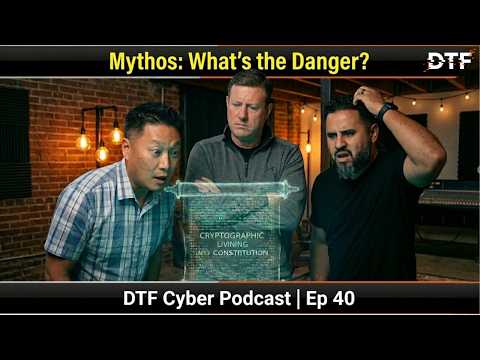
Anthropic Mythos: The AI That Just Fired Its CISO?
0:00Hey guys, look at this. The Mythos model just found a zero-day and automatically patched it.
Wait, so the computer is the boss now? I thought I was the one with the delete key.
That's right. Is the Anthropic Mythos too powerful?
0:16This is episode 40 of the DTF Cyber podcast. I'm Damian.
This is Troy.
And it's your boy, Ferrous. Let's
[music]
0:33So last week, last week we had some news about Anthropic and their new model called Mythos.
Mhm.
Caused quite the stir.
Yeah, everyone's talking about it. You know, slightly off topic, you know what I think was funny about the whole thing? See, if you go through and look at every single founder,
0:50I would I would I would bet imagine 90 95 to 100% of the people said, "Oh, here's what we know. Boom boom boom boom boom. By the way, that's why I started my company."
Why is it though?
But so
Because they're finding vulnerabilities or because they're protecting
1:06organizations faster? I mean the There's multiple threats here. I don't know if you guys read a whole lot into um what's it called, Project Glass Wing?
Yeah. Yeah, yeah, yeah. Well, what I was going to say is that's exactly why I started the
1:21podcast, because of Mythos, because we knew that was coming so we could educate the people. But there's so many different things like
Well, to be fair, all right? We've been talking about this for what, the past year?
40 episodes.
Yeah.
Yes.
1:37What do they say, devil's advocate? I'm just going to say something, right? I have a little bit of a problem when companies say that they can have they have a certain capability but nobody has access to it.
1:52It's not for you, but like we can do all this crazy stuff, right? And what ends up happening is a lot of people get scared. There's a lot of hype around it. And the one thing I think in the back of my mind is who benefits the most from this hype? Like when you think of these large companies, these AI companies,
2:09the more hype that they have around their product is essentially like marketing. And in a lot of cases, these companies aren't public, right? So, if they're looking for a way to raise their evaluation, wouldn't you imagine have some magic bullet in the back that no one else can
2:25see that would help you sell the story?
So, are you saying that this is all made up?
I'm not saying it's made up. I'm saying in people in security say trust but verify. And I think before everyone jumps onto the wagon and say this is going to be the end of our world,
2:41I think they need to get people that are outside of these large organizations of Glasswing. Or maybe that those people can have like a community that then talk amongst each other. But like, you know, verify. Because there's a lot of people today saying the world is going to end, essentially. The world is burning. But
2:56no one actually knows that for sure except for the people that have the keys to the company. Criticism? Maybe. Skeptic? For sure. Paranoid?
No, no. The The question for us do you mean the world is ending because these
3:11the attackers are going to have more ammunition than we can defend against or you mean the world is going to end because AI is taking my job. I think that, you know, with Mythos and some of the other things that we've seen in the last even month, uh you know, we're seeing the faster ability for AI to help us defend our perimeter, defend our companies away
3:28from the attackers. And so, uh I think people should be in definitely adopting this and looking into it. Gadi uh Evron on LinkedIn has a tremendous post about how to get started, you know, with the basics. So, I love the fact that we're
3:43moving at the speed of light. And uh those who are defending the blue team should be leaning into AI now because the bad guys have been leaning into it for more than a year. It's our turn to start leveraging tools like Mythos to be faster, better, stronger, and defend our enterprises at the same speed and scale
3:58that the attackers have been doing for a long
Yeah, yeah, but like regardless of who has the tool, say say only the defenders have it, right? Cool right? That's fine. Now, say regardless of the situation of who has what, it's always been asymmetric, right? In favor of the
4:17the threat actors. There's always way more threat actors than there are the defenders. So, regardless of who has it, maybe you can do better as a defending, but the minute it goes out to everyone, it's just like re-levels the playing field, and then it just it it brings the asymmetric nature
4:32back to the conversation. So, when I say over, I'm talk talking more about the defenders assuming everything stays the same as it is today, say both people have access to a tool, it's still going to be asymmetric regardless, which is if you couldn't
4:49take if you couldn't take the pressure today, you're definitely not going to be able to handle it tomorrow. If the bad actors get the Okay, but but we're talking about a brand new model here, right? It's not And for some reason, it's also Anthropic. We had talked about them. They were in the news
5:06a few episodes ago.
Yeah.
So, your point is this all marketing and it's not real or, you know, I guess we'll find out in time. But this is what the stats say, right? This is a new frontier tier of model. Um so, they had Well, they had
5:23uh Haiku, then Sonnet, then Opus, and now it's Mythos. But what they're claiming is that the Mythos, the model, has reached 72% success rate in generating working exploit compared to 0% for Opus.
5:38On the first try, right, Damian?
Yeah. Well, I don't know on the first try, but it, you know, we'll get there.
That's what That's the statistic I read was the same statistics, but that was on the first opportunity, the first try. Chaining together vulnerabilities for a successful attack. The 72% on the first try.
5:54Well, I think a lot of the issues with Opus were it was hallucination. Right? So, it had a lot of hallucination in the code. Right? So, now what they're saying is 0% with hallucination as you know, as part of that process. Now, it's kind of cleaned up all that issue. So, now it has a better, right?
6:11So, for for most people who are listening to this and you don't recognize the models the names, right? These are just the the different What do you call them? Different generations or different
versions.
Yeah. They give them names.
Mhm.
Um but last week, I think what came up
6:28especially within the security community is that there is I think there was a some claim that they could identify vulnerabilities in operating systems that may have already been patched. All right? With like zero day.
6:44Mhm.
Brand new zero days that that you So, they had to pull it back. Keep it closed, like you said, keep put the the guard around it and the wall or up around it and then
Mhm.
only invited a few cybersecurity companies, big ones, into
7:01a project called Glasswing. So, that's why it was in the news last week.
So, what was the What was the purpose of Glasswing Damian?
Uh it's the I think it's to bring together some of these companies to take a look at it and maybe provide some guidance or take a look at the vulnerabilities to get ahead of
7:18it just in case they release the the model to the public and then it gets into like for instance, into the wrong hands. And now you have this asymmetric balance in of power. So, if you get a head start on it, maybe you can identify these zero days
7:35faster and patch them a lot quicker.
Absolutely. I have a controversial take as well here that last year at RSA, we we saw a ton of startups in the space of application security, scanning for zero days. You know, think about some of the bigger players in that market. And here
7:50we have Mythos really disrupting a lot of that technology. And my controversial opinion is that there's a lot of companies out there that are in trouble for, you know, either pivoting or finding their next, you know, usage of this particular technology or competing with it because, you know, once you have
8:06the ability to go out there and use this type of tool anywhere at scale at an enterprise with the efficacy that we're seeing, you know, you don't need to pay 100,000, 200,000, a million dollars for a software to do that for you. So, I think some of these startups, Timmy, that we met last year at RSA, just now
8:23within 1 year's time might be irrelevant.
Yeah, that's scary. But that the same time, right? I think we're at that pivot point of what can you do with AI today with you know, really fast startup speeds.
8:40You can just let it loose, let it go. Um, find vulnerabilities, maybe automatically exploit them to prove it. Uh versus making investments into more tools. So, I think that's kind of scary how fast this is changing.
As a buyer though, that's exciting. You
8:56know, you know, we've been handcuffed by budget for so many years. You know, we do not have an endless bucket of money to buy tools with. And so, with AI, the competitive landscape for software is, you know, really in our favor now. It's kind of the the housing market, right? You sometimes it's in the seller's
9:11favor, sometimes it's in the buyer's favor. And I think right now in cybersecurity software market, uh, it's definitely a buyer's market. You have a lot of competition. Uh, you have a lot of companies who've taken on a lot of investment and need to get sales. And I think this is a good opportunity for us to leverage some of these AI tools to do
9:27more with less.
So, I'm going to give you I don't know if it's controversial, but I'm going to give my take on this. I like the idea of this whole thing because when you think back to secure by design, right? You know how many people signed up for that? You know, hundreds of people, right? Companies are there a
9:44we're going to start doing secure by design. Like I would love to what I would love to see is all those companies that, you know, sign this to have this tool pointed at their stuff and say, let's see what you got, right? Because, you know, if you kind of commit to this certain certain type of idea of secure
10:00by design, like, you know, how secure is it? So, I like it in the sense that people that are committed to it can kind of test, right? Test what they have and what they're putting out there, but it also kind of steps up the the level of quality that goes out. So, I like it for that.
10:16Problem with it is if people have access to for that, people have access for it to do worse things, right? So, I don't know. I I feel like I'm kind of on the fence with the whole thing.
It's a race, right? The first person to find the next Damian that we need to talk about is
10:32that for years CISO's have been identifying zero-days, exploitable, externally-facing vulnerabilities in both software and our hardware layers that we cannot force the business to patch. You know, we compete with the CIO, the CTO, and the IT team to push the button
10:49to actually patch the systems that we discover are vulnerable. So, what does this do now? This finds things at scale quickly and it just adds to the stress that a CISO has to go through because now they know about it. Now they see how hard it is to defend the external attack surface.
11:06And I'm not sure we can get businesses to move any faster.
Yeah, until there's a massive incident.
That's a good point, right? I think right now there's let's say we're only scratching the surface of what we can see for vulnerabilities. And and like you said, Troy, yeah, does that speed up the business? I
11:22don't know if it does because right now if you think about how far behind you are in terms of patching across your entire enterprise, that is still a challenge. With let's say having only 10 to 20% visibility. Once you open it up and now you have another 80% visibility into
11:38some of these vulnerabilities and not just your own, right? All of the ones that are coming from third parties.
Mhm.
And then supply chain. And so I think this this problem just becomes a lot bigger. So unless you can use AI to auto remediate it, I don't think we get anywhere.
11:54I don't I don't know many companies that actually allow auto remediation because the CIO is afraid of operational outages, period. And it's this not the CISO here. CISOs would adopt that in a minute. Anytime we can auto correct or auto patch or, you know, set something on autopilot, we would do it because we want security. But I think the CISOs and
12:10the the CTOs at companies are saying, "No, no, no, we can't do that." So here's what's going to happen and has happened before where the CISO's pushing to patch an externally facing exploitable critical vulnerability. And the CIO says, "We have to test that. We
12:25have to regression test it. We have to take, you know, the test lab and do this, then we'll move it into user acceptance training. And then after 28 to 30 days, we'll push that patch to production or our external, you know, networking gear."
Yeah, that's
the business gets popped within two
12:41days, three days of that instead of 30. So now the threat actors are moving at the same speed that the CISO had found it. And so they are exploited within two to three days. And now the CISO takes the heat from the board and from the business. "Why didn't we patch this faster?" The
12:56CIO is still at fault. The CTO is still at fault. And I I'll tell you this has been a constant challenge. And when I say that the IT team in legacy CIO thinking companies, those are the people putting you at risk. The CISO has an unwinnable job
13:12trying to patch systems against somebody or a company who won't let them.
Yeah, Troy sounds like he's got uh some frustrations he's got to work out.
No, I mean he he sounds like
class is incoming, that's for sure.
No, he sounds like he just went to therapy and we're sitting
So or is this is this your therapy,
13:27Troy? Is this it? Where is [clears throat] it?
This is it.
Yeah. We got you. We got you. So, question that I have, too, is so my understanding is not only can it find them right? It can start linking things together. So, okay. So, let me take a step back.
13:43One thing that Damon always says, Troy always says, is defensive layers, right? If this If this wall falls, there's another wall behind it. If that wall falls, there's another wall behind it. So, when I think of code, I think of a lot of functions and calls and, you know, in the script, there's different things that like do different different
13:58parts, right? They're essentially effectively separated and they're not linked together. What I'm understanding from reading the stuff that I've read is the things that a human would wouldn't necessarily be able to link together as a path, you know, from point A to point B to C D E,
14:14right? To get to the internal data or like, you know, someone's, you know, backups as an just as an example. Now, with this tool, it finds A, it finds B, it finds C, and it says, "Ooh, let me just go all these different ways." So, all the defenses that you've
14:31kind of had back to back or side to side, now matter, but not as much because now it can find It can find a path along a different point in time of the network, right? So, it kind of essentially like self-navigates. It's essentially like
14:47Google Maps for your network, where it just finds the next spot to go, goes there, looks around, says, "Okay, well, now I And it does it without anyone involved. So,
example of that, Furness. You know, a good external pen tester will come in and they'll they'll do a LDAP relay on a printer as an example. That's the step
15:03one to grab credentials from the printer and see if they can, you know, escalate those privileges into something more than just a service account for a printer. And you have chain together several exploits in that in that test from an LDAP reflective vulnerability to weak credentials to uh
15:20escalation potential. There's like multiple steps in that. They're already thinking three steps ahead like a chess match on how you're going to actually get into the active directory and own, you know, an administrator's account in the AD. Mhm. That's exactly what Mitosis good at. Exactly that. They're able to
15:35chain together several exploits, whether it's a browser attack, uh an active directory identity attack, whether it's a credential stealing or harvesting escalation. It's able to do at the same uh methodology or logic as a human. But
15:51at the scale and speed of AI. So now it's the perfect storm for an attacker to take advantage. Now, what does that mean? A, we're going to be able to find these things faster ourselves and patch them. Prioritize remediation immediately. Number two, it's going to allow threat actors to use these chains
16:08of events faster to ex- you know, once they get access or a foothold in your environment to spread quickly. So your common detection mechanisms in the past for the SOC are no longer going to hold because we can't react quick enough. You see a ticket in the SOC, it's already
16:23too late. They're three steps past that. So we have to think about, you know, how fast our our operators are able to respond to these things as well.
Well, that's where you need AI, right? You don't have an operator. That's why I think the self-healing model is the way to go. I get it, right?
Exactly.
In In cybersecurity, we kind of hurt the
16:40business. Right? You know, won't name names, but remember an EDR outage because they pushed um an update?
We We won't say hurt. We'll say slightly
Well, I mean, that's from a
business disruption standpoint.
that was a huge globally, right? And so
16:57I get it from a business standpoint that you don't want to act too fast cuz you want to test it. But if you wait too long, like you said Troy, I don't know, 30 days is way too long.
Mhm.
Because within a couple days, it's already out in the wild and you may be in trouble.
17:12And so in this case, you would have to have at least AI to monitor for the vulnerabilities and then have an automated way to remediate and then an automated way to test it. So, that can happen a lot quicker than
17:2830 days. Maybe you can have it done within 1 to 2 days.
Is there a tool right now that if given a list of vulnerabilities can kind of be like a watchdog around that infrastructure? Right? So, like say you uncover
17:43something and you're like, "Oh, there's a pile over there." Right? Now I just put a flashlight on it. So, day and night it doesn't matter there's light on it. So, people are aware that the pile is over there. So, if a threat actor comes in, they say, "Oh, like look at that pile." Like, "Well, yeah, we already know that pile." And I almost like a honeypot setup where
18:00if you know it's there, you know, strategically or not, like treat it like a honeypot. So, if people have to remediate in 30 days, at least there's something that kind of points over and says, "Hey, we're we're aware of all of these things. We we know where people can go, where they likely
18:15will go, and realistically what they will find. So, just keep an eye on it, right? Is that Is that a thing or did I just make up a thing?
Absolutely. These are the the common mitigation steps that you take when you find a a vulnerability that you can't yet patch. You have to put, you know, guardrails around it. You have to
18:31monitor it at a heightened level. You have to make sure that you have hardened the hardware and software as much as possible when those things happen. And then you monitor it like crazy. Yeah, absolutely. It's called a mitigation step in between that I described there.
But a couple of
episodes ago you guys went were talking
18:46about health care cyber. And as you know, within health care there's still the old Windows XP machine that's still unpatchable that's sitting in the corner and still being used. And so, it's always hard to you know, make sure that everything's up
19:03to date. Um it That's one of the challenges I think in this case.
All right, just thinking out loud. Could you point this tool at like an AS400?
Probably. Why not? I mean I think what some of the vulnerabilities they found
19:18was in in BSD.
Okay.
And BSD is a a common Unix operating system used within security. It's been around a long time.
Interesting.
Okay.
So it is kind of the end of the world.
19:34In in in a lot of ways.
It doesn't have to be.
Well, there's some governance here, right? I I think this is this is more like done in Troy's strength. I think the AI itself is ruled by what they call it, a constitution.
19:49I I don't know if you saw you saw that, but it's now it's now grown. So that constitution that it's governed by I think previous models may have been a couple thousand words. Now it's like up to 23,000, 25,000 words.
20:05I think it's 23,000 is what I read.
23,000 words. Yeah, so it's like 10x the previous model. But that's also a living constitution, which means it self-adapts.
Like Ultron.
Yeah. This is but this is the AI that
20:21we're using to combat or cheat to leverage and find the vulnerabilities. But what about the AI models that the threat actors are using? There's no constitution there. They can move quickly and adapt. They can take the meet those uh you know, open source code now and and fork it and make it whatever they want
20:37and remove some of those guardrails and make it faster.
why that is why they have the constitution is to protect um a threat actor from using it in a malicious way. The the challenge though with that is if it doesn't agree with what you're asking it to do,
20:53would it just stop?
Well, question. Maybe I don't know I don't know how I would define this question, but wasn't Anthropic the same company that just like dumped their entire source code? Right? So now they have this tool
21:08that basically can just like be a hammer for anything. And we're supposed to trust that that tool at some point in the future won't get out when they have a instance of essentially dumping their
21:24entire code base.
They have similar model with a different constitution.
Yeah, but what I'm saying is like if you know, if you're supposed to be protecting it and you know, make sure no one gets it.
It's coming from the same company they just like lost their entire source code like a a week before.
21:39My my concern too is that over time if it's a living constitution, if it generates its own ethics,
Mhm.
how does that impact all of us?
Mhm.
Can it just turn against humanity because we're just destroying ourselves anyways?
21:56So, now I want to report that's a great question.
Yeah.
There's a war going on.
[laughter]
Stop the humans, right? Yeah, Minority Report is where they stop the future from happening, right? Is that the one with Tom Cruise where they knew that someone was going to do something like that?
Yeah, something sorry I'm thinking I, Robot. That's what I was I was
22:12the Will Smith movie with I, Robot. That's the one.
Okay, same thing. I mean Terminator, Iron Man, there's a lot of movies that are pretty much telling us where where we're headed. But okay, so the constitution I don't really understand that. So,
22:27my understanding 23,000 word document that essentially builds the framework of ethical behavior, right?
Yeah, if you think of like the old rule set, there was probably a bunch of if this then that, but not this stuff.
22:42Mhm.
Don't do anything illegal is probably very basic.
Don't don't make bombs. Don't teach someone how to
Yeah, if hurt others.
Right, if somebody asks you something that might be harmful, don't do it. Um I had a friend, right? That tried to
22:58use one of the the LLMs to make an image, but they were trying to you know, make something that was close to Star Wars. And Star Wars a character that might be associated with the movie, and it wouldn't do it.
23:13So, that type of rule set is pretty simple.
Mhm.
I think when we get into 23,000 words, it's more along the ethical basis of pay, you know, use as a human because we don't have Okay, we got the 10 Commandments, like
23:29that's where it started, I guess. And some and you know, some people believe that this is where the laws of God started. And if you look at our laws today, they're not 10. Right? If you look at government regulations, there are a lot more in the
23:45laws and what you can and can't do. And then you have ethics built into that. So, this is almost a similar thing where we used to give it, you know, basic rules of don't do certain things, but now it's building an awareness, which is you know, kind of cool, but scary at the
24:02same time.
Mhm.
So, to to, you know, in our cold open, it was kind of funny to say, well, what if the AI that is going to be automatically patching, should patch it, but then stops and says, you know, what?
24:17It's a lost cause. I don't believe in what your company does anymore. You're this bad ethics. You shouldn't be selling junk food to to kids. So, I'm not going to protect the company. If you're a restaurant, for example.
Yeah. So, first question that I can think of or that came to mind is
24:35ethically, you know, people weren't allowed to do certain things, right? But we saw in some cases where people prompted that they were doing research. And now things are getting strung together because it's for research purposes. So, one of the last things that we talked about maybe four or five
24:50weeks ago was how the sub parties were able to essentially string things together, compartmentalize the task, and then bring them all back together under the guise of security research. Right? And they broke they
25:05broke down some doors.
But this may not work in this that case, right?
Well, so but my my point is is there there was this, you know, constitution of sorts that didn't account for that sort of manipulation, right? So, who's to say that 22,000 words
25:22doesn't have some form of manipulation that someone will find out eventually and then use it against it, right? Is kind of where I'm going. It's just more so like the what if part because originally you were supposed to do bad things. People found a way to do bad things. So, just because you have 10
25:39times more words just means maybe someone's going to try 10 times as hard but still be able to find a what I'll call a loophole in the constitution. Like that has to be a concern, too, right? Or is it just me? Or am I just going way off track?
Well, I think that this the constitution
25:55itself is self-evolving. Um can you poison it? Potentially. I think that's what you're saying, right? Can you have a threat actor poison the constitution or potentially get um copy that model to
26:12adhere to a totally different constitution. And I I think some of these things we don't know. Uh the scary part is not having um a document that you control that evolves is going to be challenging for people that maintain control of what the AI is
26:29going to do.
Troy. What What was your first thought when you read this?
I was excited. You know, I'm I'm excited about always discovery and visibility has been a core of my foundational models that as a CISO, I want to know
26:45about bad things. I knew I do know some CISOs who are like, "I don't want to know, so don't give me a a tool that's going to show me everything in my environment cuz then I have to deal with it. That is not my mentality. I I think that as a security leader, you want to know about all the bad things and then prioritize remediation, right? You have
27:02the ability to add it to your stack of things you want to fix because you may find find something extremely critical to fix in that visibility. So, I've always invested in visibility tools and you know, opportunities whether it's an external tax service, the network, endpoint visibility has been a core. So,
27:18when I saw this, I just thought of immediately. Now, this is a way for us to get visibility into vulnerabilities we had no way of knowing that they were either there or exploitable, especially when they're chained together. As I mentioned, when you get a really good hands-on pen test
27:34from one of the big firms, you're going to see some of those chained together exploits that we're talking about right now, but you're talking hundreds of thousands of dollars and months of work for that to be, you know, given to you as a report at the end of the day. Now, you just point this tool at it and
27:50potentially you'll get some of those details very quickly. Now, we all know some of these continuous testing and evaluation tools out there, CTM. Um those were like in between a hands-on keyboard test and vulnerability scans,
28:05right? Those are always in the middle. This Mythos tends to be closer to a hands-on keyboard real pen tester that you would pay hundreds of thousands of dollars for.
Yeah.
Yeah, but also they should be fixing it. Right? Mythos should be doing as well.
28:22So, not just discovery. I think the discovery piece is and the testing piece is just table stakes at this point. But, being able to prioritize the vulnerabilities and then fix them, I think that's where this becomes really, really interesting. But, Troy, I think one of my questions
28:39for you, you know, especially being probably more versed on the the compliance side and regulations, what happens if there is an ever-changing rule set or constitution that these AIs abide to? And let's say there is an incident, a
28:56security incident. Who is liable?
Yeah, you know, liability comes down to a whole lot of attorneys in a room that we're not in. Uh I like to say that as a risk executive and a CISO, we're informers to the business of the facts
29:12and what happened. Uh I can't predict how that's going to play out, but I can tell you that regulations are shifting just as quickly as this AI tool set is is shifting. So, um I think that it's going to be up in the air, Damien, and I don't know that necessarily liability is going to land with the CISO. Again, we're, you know,
29:28in a Tim Brown situation that we didn't take action we should have. However, I do think that this idea of mythos finding and fixing vulnerabilities is a myth because, again, the business is not going to allow, in most cases, automated
29:45remediation of vulnerabilities. I've never seen a CISO or someone who just gives the AI full rein to find and fix. There is a human in the loop, and usually there's a testing lab involved, and it's very long process to get that button pushed.
I I think we're going to move a lot
30:01quicker. I I think that Yeah, there's no way we can get stuck it in uh holding back AI because if we do, the attackers are just going to use it against us anyways. So, you have to be able to find a way to stop
30:16that's our argument, right? As a CISO and a risk executive, that is exactly our argument. Businesses need to step up and wake up to this this fact. And I think that we're doing a really good job in security of understanding it. I hope we're communicating it to the business, and then you talk to CEOs, CFOs, chief
30:32general counsels. They are hesitant to take those risks.
I I I think we're going to ties are going to shift to the point where it's more risky to not do it. And you just you'll be you'll have greater liability to not embrace technology like
30:49this.
Yeah. So, let me ask you a question then. So, everything that Troy's saying is, you know, this tool is out there, not yet, but if it is, businesses have to move faster. So, then the question becomes, do you even release it?
31:06Or do you restrict it?
Well, it's restricted right now.
Yeah, but I'm saying like bury it. Put it away.
No, obviously no, no, no, because if you do,
No.
the the bad guys are just going to develop it on their own.
Yeah.
So, it's better to continue development and and
31:22hopefully shape it in a way that it's extremely useful for every organization.
So, you're saying Anthropic knows what they have, what it's capable of, potentially, and that now they're working with these 12 companies to try and figure out a way that they can make it a W for the the good guys,
31:39right?
We we assume, right? Cuz I'm not I'm not in those conversations, so who knows what's going on.
Me neither. Me neither.
uh you know, let me ask ask you this, Troy. Do you think just those 12, and I I can't remember who's on the list of the 12 initial companies.
31:55Apple, Google, AWS.
Yeah, the big ones.
Yeah, yeah.
Mhm.
Um do you think that's enough? Or do you think it should be opened up a little bit bigger to some other major cybersecurity or IT vendors?
Yeah, I applaud these guys uh for
32:10joining this coalition and and taking this initiative. I think it's important and it signals cooperation in the industry. Instead of pulling away and doing our own thing in a corner, you see folks coming together with Anthropic here. That's a very encouraging sign. Uh I do believe, Damien, that they will open up a tier two, you know, and then a
32:27tier three. This will evolve over time where it's not just the big players. I think they're going to allow medium and then even some startup players into the mix over time. And I think that's the right thing to do. Uh but going back to Vern's question there, I think visibility is the first step. And Mythos is showing us a lot of
32:44the things that we kind of assumed were there, but now we see them in black and white. We can use that to go to our boards and our our IT leaders and say, "You guys have to move faster." And then we can make a empirical argument with data-driven uh arguments to show them why and how. And hopefully in that
33:00meantime, you're not subject to a breach because of it. That'll definitely shorten the cycle of adoption, but you know, hopefully we can uh get through this without major major breaches.
So, another question I have then is if this is going to force people to move faster, be more tactical in what they
33:17do, like from a from a business perspective, is this the one time where people in security actually get budget to start doing the cool things? Because now the business understands like, "If we were in trouble before, we're definitely in trouble now."
33:33Because
Yeah, I think our our vendor friends are not going to like my answer here. But uh
What is that?
with these Mythos, you know, we don't need budget. We can do this with a very small budget and a smaller team. So, we're able to do more with less, which is what exactly the business has been asking us to do for so long.
33:49Yeah, I think it just depends. I think it really depends. Um I I could and you may not like the answers to this. But why do you need a cybersecurity team? Just give that budget to the the CIO and have them run their own
34:05vulnerabilities and their own remediation.
Yeah, that's the goal, right? And and I'm advocate for that. I think we talked several episodes ago that I envision a world where we are winning this and we don't need us anymore. We're working ourselves out of a job. That is the actual goal here. And it's it is
34:21achievable, and this is a very encouraging step in that direction. I would I would also say to that, you know, Damian, maybe it's not a CIO remit. Maybe the CISO becomes the IT person. I've seen that in a lot of cases where the CSO becomes the tech leader.
Yeah, you kind of just shifted it the
34:37other way. Uh I mean, that's interesting, right? I think that's a whole debate. I I don't know if there's a right or wrong answer. I think it just depends on the business and how you how it's structured and what the focus is. Um but
34:53why label people? Why label teams? I think ultimately the goal of any technology team is to enable the business.
Mhm.
And
securely. Make sure it's Yeah, make sure it's secure. All of our goal is the same. So, yeah,
35:10why be in a silo when you you can just be the technology team? And honestly, the chief product officer, if you have software components that you're selling at a B2B company or something like that, that person is probably the best one to take up both mantles, both IT and cyber, because the chief product officer who's
35:26putting out the technology is the one who ultimately is responsible for both uptime and the security of the platform. So,
Oh, yeah, I think that's a little bit place to look.
Yeah, I think that's that is that's oversimplified because you have product, you have platform, you have corporate um especially for some of
35:42these larger organizations.
Mhm.
So,
But corporate IT, you know, and corporate connectivity is so commoditized now. It's I mean, I don't want to say a monkey could do that job. Uh but this like, you know, the
35:57Geico caveman commercials, right? You know, so easy a caveman could do it. The IT the tech stack is is becoming a commodity. So is security. I don't mean to offend a lot of people, but
Yeah, no, no, I would I'll have to push back on that cuz I think it depends. I think it Yeah, if you're like cloud forward,
36:14what do you really need for corporate infrastructure? Probably not a whole lot. Probably all in the cloud somewhere. Um and then all you're doing is managing endpoints. Um and then SaaS applications.
Mhm.
But And even you're a a Microsoft Active
36:29Directory shop within tune and you know all of the things as your AD, you are able to automate a lot of that and get to a very easy status quo without a huge team.
Yeah, that's that's one model. But not
36:45not all organizations are are structured that way. So I I that's why I kind of push back on it. I think yeah, modern companies that are starting up today could adopt that model. Um but if you look at companies that have been around for decades, they they can't shift that
37:02model very easily. Healthcare for example can't move to that. Um manufacturing can't move to that. So there's still going to be a lot of organizations that will need to have that physical network infrastructure that is on prem and still have corporate IT even if
37:17they're building a product.
on prem I push back on that because the reason those legacy uh industries do not move faster is because of the legacy thinking of the technology leaders in some cases. They're beholden to old thoughts of ways
37:35of doing things where we are living in 2026 not 1926.
Old thoughts, sounds like you're describing people that should have been retired.
[laughter]
Old thoughts.
That's what it will take. Frank, you're spot on. It will take some of these folks in the technology
37:51leadership roles to retire before fresh thoughts and innovation
Yeah, but you're not getting away with that. Not in healthcare. Right? If you go into a hospital, you still have
Old thoughts.
Not old thoughts. You have machines and devices that are still there. Um that
38:07you can't computerize every single thing. Yeah, maybe you can a lot of it, but it all still have to has to be on prem.
So I I do say this as a personal commercial. If you are a business owner, CFO, chief general counsel, CEO at a company and you believe
38:22that your company should be a lot further along technology than it is, call me and I'll show you exactly where it could be.
1-800-Call-Troy. That's that's it right there.
I'm going to register that and forward it to your cell phone.
Be great.
38:37I guess regardless whether the the tech stack is old or new, the problem still exists that asymmetry will always be there. Right? So, what's the next step for people? Uh do you do you limit Let me ask you guys
38:53so that there's two people in the room right now besides me. What do you guys want to see
I love this. I love this.
going forward? Because like there's like a general consensus, right? I'm sure you know how things go when someone says something, well, people
39:08start doing it. So, everyone what they see one person raise their hands, all of a sudden everyone's raising their hands, but they may not raise their hand until they saw someone else do it. So, before the general consensus comes out and before anyone can use bandwagoning, I want to hear from you guys.
Yeah, but don't don't don't just think
39:25about Anthropic today. Yeah, Anthropic's in the news, but we don't know what Google's working on. We don't know what Open AI has, xAI.
They may have AWS.
Yeah, they may already have something similar that they just haven't told anyone yet either.
So, Fern, I do
39:41want to push back on something you said that this will always be asymmetric. I don't believe that. I believe that we are close to a world where cybersecurity is solved once and for all and that we will have enough technology at the speed of AI that can defend an enterprise and that the threat actors
39:57will become so de-incentivized. You know, right now they're making money. That's their incentive. We're funding it because of ransoms and other things. When you take that away and these guys can't make money anymore, the cyberattacks will slow down. They won't stop, but they will slow down and then AI will be able to take over our
40:13defenses so that you won't need me anymore and I hope that is a world that I live in before I retire.
I mean, I hope so, too. But like let me ask you a question because if we're just going to assume that this is a warfare and there's there's 10 to 1, right?
40:28Defenders versus offense or threat actors. And we'll just make them humans, right? Now we stand them across the room from each other and we give the defenders a machine gun, but then we give 10 attackers the same machine gun. Like you still think that just because everyone has a machine gun and it's equal
40:44the onslaught from the from the number of people trying to do bad things is still going to or outweigh the people trying to do good. So like I agree, everyone has a machine gun, we can all do the same damage. But the fact of the matter is
40:59the people that are defending are one they are they are in a lot of cases restricted by the business. The business doesn't want to do certain things. And if the business doesn't want to do certain things, you still have handcuffs. You can't get to the trigger fast enough because your business doesn't allow you to pull a trigger
41:16without someone else's help. So give everyone a machine gun you still have 10 people versus one and you have handcuffs and you can't even get to the trigger. So like in my mind that's a more realistic scenario because I don't think if if we're in 2026 right now and cybersecurity still isn't a
41:33priority for a lot of businesses, who's to say it's going to change in the next 5 years? Right? So friend, think about like this, you know, it it's not consecutive, it's concurrent. And so think about the basketball player. Can't think of his name. I'm sure everybody knows him. He wa- wags his finger in
41:48front of the blocked shot, right? You can put a image of that on this screen. But like that is what we're coming to. AI is going to be that basketball player and every shot the bad guys take, they're going to get the big no no no no no. We're going to get there. We're going to get there in email, in our external attack surface, in our cloud.
42:05Every part of the business will have that basketball player blocking every shot. You don't need a cybersecurity team then. You will definitely need a risk executive that has everything in place making those decisions. We're going to go from 70 tools down to 10. And those tools are going to be so
42:20effective bad guys will have no incentive, no reward for trying to attack.
Yeah, I don't know if that would ever be the case. But since you're talking about
know if it's 5 years. I don't know if it's 10 years, but that reality is coming.
Well, I think that's why there's you know, at least some ethics being built
42:37into this. But put it this way, I Ferne was talking about weapons, but what about nuclear weapons, right? Let's say everybody has a nuclear weapon. That's kind of scary. Right? Cuz you get just get one bad person to say, "Oh, I'm just going to blow up this country."
42:52Um you build ethics around it, but can you con- convince the AI to set to turn against what should be right and what should be wrong? And we know that in the world not everybody agrees what should be right and what should be wrong.
43:08Mhm.
And so that's why this becomes extremely dangerous because today we can guide the AI in terms of what's ethically right and what's ethically wrong to stop the bad guys from using the tool in a bad way. But
43:23once you shift that mindset and we see this all the time with social media, right? Shaping societies in ways that we didn't thought was think was possible so quickly. Um what happens in that case when you can't
43:39bring it back? You you can't rewrite the constitution. It's already on its own. It's already rewriting its own thoughts and its own ethics. So, I don't know if we I think what Troy
43:54describes is just a dream. I don't know if we necessarily get there. And I don't think it's the same as um necessarily handing everybody a a weapon. It It could be.
44:09But we got to be very very very careful cuz there's going to be multiple with multiple languages multiple LLMs and models that are going to have different ethics. So is this going to be a war of the AI? AI fighting AI. That's where it's going to be, right?
44:25That's that's already here, right? I mean, our tools are AI powered so the the bad guys are using AI against us and we're using AI to defense. So it's definitely a war of AI. But think about like this, you know, uh we will have you know, technology's complex. It's complicated and that's why we haven't
44:40solved it. I mean, look at the Windows operating system in the red the registry and all the different ways you can attack a Microsoft uh laptop. It has been so complex for for you know, whatever how many years it's been in place that we can't figure it out and the bad guys always are smart enough to find a
44:56way through and get to us. AI is really good at uncomplicating the complicated. And I think that technology is just another mathematical problem that we will solve and we will be able to shore up all of those, you know, cracks in the fascia so
45:12bad guys can no longer get through.
Yeah.
Well, it's not the bad guys. What happens if the AI turns into the bad guy?
Mhm. Like Ultron.
[laughter]
I always go back to Marvel cuz I watch this all the time with the kids but you know, I've said this on another episode
45:28is like the whole reason why Ultron Ultron was designed to you know, protect the world, right? But when he realized the humans were destroying it, he decided that humans needed to be gone, right?
Well, that's what I mean, right? So now it builds its own ethics and if it
45:43realizes that humans are the really the bad uh you know, the bad thing that's going on in the world, let's just get rid of the humans. Well,
And then how are you supposed to take the batteries out? You can't.
Exactly. There's no There's you can't pull the batteries. So what are you supposed to do? Right?
45:59mean, Cyberdyne, uh you know, I think that it comes in 2029, you know, we're we're waiting on on the doors you T100
Almost we're almost there.
Yeah. T1 then the T1000
We're kind of getting close to like, you know, usually our our our rough limit on
46:15whenever we do these recordings. And I'm looking through the the notes that I have here to see if there's anything that we didn't cover, but Troy, aka Nostradamus What were you going to say, Troy?
I was just See, this has been a very,
46:31you know, controversial and a interesting episode. I'm excited about seeing what the interaction is, the comments, you know, leave us a comment what you think what you think's going to happen here. Uh, you know, we can nobody here can predict the future, right? I dream of a world where we have no cyber attacks, no
46:47cyber attackers, but uh, you know, we're a long way off from that. What are your thoughts?
I think maybe what we'll start seeing is people in security be get closer to one another. Because what happens a lot of times is there's
47:03like these groups or communities of people that share information, right? Amongst each other. A really good example is, you know, something breaks there's a there's there's a list of CISOs that get a text saying, "Hey, are all you having the same problem?"
47:18And you just want to jump in, yes, no, maybe so. Right? And I think what's going to happen now is instead of waiting for things to break people are going to probably start getting together proactively and talking about what they're doing from a security perspective and sharing that as far as
47:35like maybe bleeding edge or like bleeding edge application of tools to kind of help their peers along is probably where some things are going to start going because it's like there's no way you can do you know protect
47:50your business alone. And I think a lot of people are are going to come to that realization. Or if they already haven't, they they for sure will. And they're I think they're going to start going more towards building communities of people that are talking more frequently and sharing ideas and just trying to stay ahead of the curve. Whereas before it's
48:07like, you know, we have time. You know, if if you know when you're going to die, you make sure you get everything done in time. But if you don't know, you kind of you might move a little bit slower.
Yeah, I think right now um there are communities.
48:23I I don't know if they're going to get better. I think it just depends on the community. Uh the the other challenge to this is that everybody's business objective is all different. And even their security architecture and security stack are all going to be
48:39different. Um but on the conceptual level and high-level architecture, I think we're all you know, in agreement or kind of are moving in the same direction. Uh how you get there is going to depend on what the objective of your company is
48:55and where they value technology and cybersecurity and AI now.
Mhm. Troy, what do you think about that?
Yeah, 100% agree. I think that, you know, we live in a world where it's so important to lean into AI. We talked
49:11about the plumber last week where, you know, the plumbers are not going to necessarily benefit from AI, you know, they're not going to come to your house and plunge your toilet just yet. But it's the plumbers who lean into AI and update their website and use calendaring and have all the customer service components of an AI bot that are going
49:27to win because customers want that personal touch and feel. And so it does affect every business out there. If you think you're a business that's immune to AI impacting it, you're absolutely incorrect. So definitely need to to lean in. And with that comes all of the things that we talk about, securing it,
49:43making sure your data is safe, making sure that your operational resilience is still there. So it's a lot to this complex uh, you know, scenario than just AIs for forward-thinking companies like Nvidia.
Yeah, until until we get those AI toilets.
50:00AI toilets, what about AI wipers?
[laughter]
Yeah, it's built in built into the toilets. I mean, what about a toilet that just tells you you need to eat more fiber?
Mhm.
This don't look right.
[laughter]
Literally.
Literally.
50:16And I guess with that, we'll see you next week.
50:3640 cycles in the [music] digital maze, talking mythos logic through the late night haze. Zero days [music] patching while we try to find a way, wondering if the [singing] computer's the boss today. Gaming on a firewall, Fern on the beat. [music] Choice watching the market,
50:52buying in the heat. Glass watching the market, buying in the heat. Glass when coalition, yeah, they keep it [music] close. But Fern's coalition, yeah, they keep it close. But Fern's got the skepticism to the highest dose. Check [music] the delete keys, who holds [singing] the power? Watch a constitution change hour by hour.
51:08[music] DTF in the room, keep the data clean. Reflections on the 40, you know what I mean.
Yeah.
Checking the logs, [music] watching the suns, building the peace in between the lines. DTF in the wind,
51:23[singing] tell them we live. Nothing but the truth that [music] we're willing to give. 40 down, 40 more to go. Keeping it steady, [music] keeping it low. Yeah, we stay encrypted, we stay [singing] in the light. Watching the network through the middle of the night.
51:40[music]
See how so friction we're stuck in the middle. Legacy tech turning life [music] to a riddle. Choice sees the blue team winning the war. Troy sees the blue team winning the war. Troy sees the blue team winning the war. [music] Damien's wondering what the team is for.
51:56Wars.
[music]
AI at the speed of light can't keep the pace. Or is the bleak key just [singing] a ghost in the space? Asymmetry is steady, but the humans are slow. Asymmetry [music] is steady, but the humans are slow. Watching the mythos model deciding where to go.
52:1340 chapters deep looking back [music] at the view. DTF on the dial, yeah, we keep it true.
Yeah. Checking the logs, watching the signs, building the peace in between the lines. [music] DTF in the wind, tell them we
52:28live. [singing] Nothing but the truth that we're willing to give. 40 down, 40 more to go. Keeping it steady, [music and singing] keeping it low. Yeah, we stay encrypted, we stay in the light. Watching the [music] network through the middle of the night.
52:44Yeah. DTF, 40D, signing off for now. Keep the network [music] clean, keep the soul cleaner. Yeah.