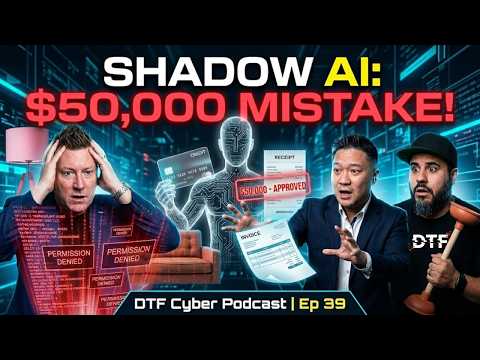
Your AI Just Spent $50,000: The Shadow AI Agent Nightmare
0:00Okay, wait wait wait, hang on a second. So, you're telling me an AI shadow agent just paid an invoice that the company didn't even know about? It's It's not shadow, Fern. It's autonomous. It's fixing workflows before you even
0:15know it's broken. That's genius. It's a liability nightmare, Damian. If a agent loses 50,000 records, I don't care if it's shadow or not, it's not going to be answering to the SEC. That's going to be me sitting in that hot seat. So, the big question is, is it a productivity miracle or is it a back
0:33door for the hackers? That's right. This is the DTF Cyber Podcast. I'm Damian. This is Troy. And it's your boy, Fern. Let's go.
0:51So, I want to tell you guys a story. Now, I can't tell you where it came from. But, I can tell you the story. And the listeners. There may or may not have been a situation with an AI agent out in the wild
1:08that happened to have access to an OAuth token okay? Problem here is that gave them access to three other applications that were not approved for that agent.
1:24So, what did it give it access to its all its friends, too? Apparently. It was a called MoatBook. So, MoatBook is alive and well inside production environments. Um Yeah, essentially, yeah. I mean, it basically has it It has
1:40what I would say is a broken just-in-time access, potentially. Right? Uh it has access to these tokens, right? Maybe they're not rolled fast enough. I don't know. I mean, how how fast can AI move these days?
1:55Yeah, pretty fast, actually. And you know, these identities that we keep talking about, these agents that we're creating within our environment, a lot of people are wondering how do we protect the identity of the agent? What's the HR department for the agents? Like, how do you, you know, designate that bedrock identity? And I think that's one of the biggest challenges is
2:12limiting the blast radius if something goes wrong, just like that, friend. Okay. So, so, yeah, I'm I am on board with that, right? But, maybe pivot to a slightly uh we'll say not parallel, but like very metaphorically very similar, right? Now,
2:28imagine we're back in 2010, right? And everyone's looking at AWS, everyone's looking at Microsoft Azure, right? They get they whip out their credit card. Ping, ping, ping, they start spending all this money. Now, all of a sudden, they have VMs running
2:44wherever for developers, whoever, it doesn't matter, right? IT doesn't know about that, or maybe IT knows, but security may not know about it, right? So, it's not being governed, right? That's an issue. So, then there's this whole world around securing, you know, we'll say
3:00uh well, CASB was first, right? Then uh uh uh uh CSPM, and then that kind of turned into, you know, CNAPP, right? So, that you know, that problem has kind of fixed itself, in a way. But, now we got a bigger problem.
3:17We got agents on the wild. Agents, shadow agents. You don't even know where they're at. You don't know what permissions they have, and I think it's essentially like a rinse and repeat of 2010, but now it's 2026, and the problem is it's not one person doing it where
3:32you can kind of go over to their desk and choke them. It's someone you can't even see. You don't even know where they're at. They're just out there in the wild. Like I know that's very anecdotal, but like probably a real issue. Am I wrong? If
3:48you think about the thing about the cloud revolution you just mentioned, friend, I mean, it was the wild west in the beginning just like it is today with AI but the challenge with the new technology and AI is that AI is moving very quickly and it has so much permissions. I mean, you would never give a developer, you know, with access
4:04to your cloud the permissions that we're handing over to these agents today. You would never give them admin credentials entry into your salesforce into your ticketing system etc. But it seems like developers and you know, businesses are more comfortable today just handing out
4:19those permissions and entitlements to an agent without any thought of controls. CISOs are stuck right in the middle between the business and the agents and security. You know, they're trying to move fast. They're trying to go along with the businesses requests but at the
4:34same time they're just handcuffed when it comes to agents. Go ahead Damian. Yeah, I was going to say there's you know, there's there's a drive to use these agents. Right? We got to be more efficient. You got to act a lot faster to defend against attackers who are using agentic AI on the other side.
4:50And so I think this is something that's not going to go away. I can't you can't close your eyes and say, hey, don't do it. I I really don't want you to use these tools because at the end of the day the users want to go out and they want to be more efficient. And they see
5:05you know, you go on YouTube and you see people using open claw Nemo claw. I mean, how many others even Claude co-work. There's so many of these out there now. Everybody wants to use them and I don't think the right answer is to say, hey, hey, stop.
5:21Don't do any of this because as soon as you do that they do it anyways. Yeah. It's like when security says no, everyone just finds a way to have Well, that's how shadow IT started, right? So are we at the age of like shadow AI happening behind the scenes?
5:37But it's even worse cuz like I said it can't it's not just one before it was one person with their hands on a keyboard. Now it's basically essentially a a doing it 10 times We'll say 10 times just to be on the low side, right? Let's imagine it's a thousand times faster.
5:53Well, think about this. How would we identify shadow IT in the past? Uh you get the bill. No, no, you don't even get the bill. Sometimes the It's on a personal credit card, so you don't even get the bill. So, there's like I'll tell you, there's a couple ways we'd be able to see shadow
6:09IT. One, take a look at the machine. So, maybe use the EDR and scan for what's installed. And you see stuff that, hey, maybe that shouldn't be installed. Traffic? Traffic's the other one, yeah? Where's that Where's the traffic going? What applications What SaaS applications are they hitting?
6:24But, what's the problem with AI these days? You can't see it. Well, they don't use a machine. They're not on somebody's machine, typically. They're running in the cloud somewhere. And two, the traffic isn't across your network. It's already happening cloud-to-cloud potentially. Yeah, and and in that example you used
6:40earlier for and about, you know, the cloud adoption, there were a lot of companies that were very late to the game because they intentionally waited for everybody else to work the kinks out. We don't have that luxury here because businesses who failed to adopt AI are the businesses that are going to go out of business next year. And I'm not talking about cybersecurity
6:55businesses, I'm talking about every industry across commerce in the country and in the world. So, businesses are being forced to use AI in every aspect of their business. We're just thinking about it from a cyber perspective, but think about note-takers and calendar schedulers and you know, EAs and
7:12accounting software bots that we've seen pop up. So, every corner of the business is being asked to adopt AI faster. Unlike the cloud, which was you could choose to be slower if you wanted. Here, you can't. Yeah, did you guys see that they discontinued the Model X and the Model S
7:30last week? Oh, yeah, they they announced it a while ago. Well, yeah, yeah, but it's official now. You can't get a 2020 You can't get whatever year it's going to be. Maybe they they Maybe it's 2027. You can't get a 2027 Model S, right? And I was reading this article and basically, you know, what are they
7:45looking to do? They're looking to move into the the robot world, right? So, when when Troy was saying, you know, everyone needs to be using tools, you know, to get higher productivity, uh the first thought that came to mind was like, "Yeah, not if you're plunging a toilet."
8:02But with the fact that Tesla is no longer doing these uh cars, they're making these robots, I might just have the T-1000 out here just like pumping at the pumping the plunger, right? So, even even like plumbers, everyone's like, "Oh, plumbers and
8:17electricians are safe." It's like, "Yeah, probably, but until a point, right?" No one No one thought cars would be driving themselves and now the What was What was the stat? 8 mil 8 million miles before an accident on a full self-driving Tesla versus the
8:33600,000 miles between accidents of a human. And what? Tesla first came out in 2012 or 20 12 with their first car? So, between 12 and 16, 14-year window, cars are now driving themselves. So, why can't we have toilets that
8:48unclog themselves? Well, there's a problem because not every person that eats eats eats healthy food to where clogging the toilet is not an issue. But I don't know. I will If you If you think about this example, you know, we talk about
9:05plumbers and electricians, but I guarantee you they're going to leverage AI within their business to optimize and be the most cost efficient efficient of any plumber in their industry. So, you think about scheduling, think about customer service, think about all of the things that you have friction points with customers during your time of
9:21booking and and getting service from a plumber. Guarantee you the plumbers who adopt AI tools faster are going to be more successful than the ones that don't. So, again, AI is not coming for your job. The people who embrace AI are. Yeah. So, side note,
9:37Yeah I'm actually like asking for advice here. Um with my new with my new job, you know, since I'm working again, uh I find myself already starting to forget things because I I didn't take a note, right?
9:53You guys using anything that's like helping you stay on top of what you need to do? Or is it just like a Siri type, "Hey Siri, remind me before you Yeah, I'm probably pretty bad at that, to be honest. Okay. Figured I'd just use this time to
I take a lot of notes, you know, handwritten notes, but then I scan them
10:08in, put them in my NotebookLM to help me keep track. Yeah, I want that's that's my goal, right? So, I I take notes, but then they're all over the place, and then I forget. So, I think that actual answer is exactly that, put it into an AI notebook.
10:23But, if you have sensitive information, like the one thing I'm always cautious about and I never like to do is take information about you know, yeah. Or customers or like peers, like if I'm I'm working with a CISO friend, and they're like, "Hey, I
10:39have all these issues." And I start writing down their issues, and I scan that in. This I don't really know if that into the AI. So, I'll kind of that's why I'm so bad at taking notes. Yeah, just do it with the names. Hey, this person, do this for this person, Or I'm like, fake pseudonyms. Like your coffee orders. It's never
10:55Damian. It's Eric. Um okay, so sorry to get off track, but just, you know, came to mind, so, you know, I got two pros with me, might as well ask the question. Um But, let's let's back up for a second. So, Troy, I want to ask you this. If if we're to say what is the state of the union for
11:13agentic AI, what would you say today? What are most businesses doing? What are your what are CISOs and CIOs mandated to do? Yeah, that's a good question, and it depends on the industry and business size, type, etc. I can tell you in the cybersecurity industry, we're seeing a
11:29lot more agentic AI usage. In other words, in the SOC and compliance, and things where you're actually not using AI tools, but actually empowering an AI agent with an identity. Some people name them, like Michelle, and Sarah, and Alice, and Keith, and Shawn. Within their environments, these bots
11:45have names, they have assignments and titles and everything, just like just like a human would. And you know, they're scarily efficient. And we're seeing them used, especially in security operations compliance GRC third-party risk, but I expect that to to expand in other parts of the business. The you
12:01know, the massive SaaS platforms all have their agentic components. And with the Claude bot thing, I see a lot of people standing up Mac minis and using Claude bot or whatever that is, and you know, some other just context clues for the open AI one
12:17as well, whatever that is, context. But to create bots, it's pretty interesting. We're standing with a gentleman in Napa the other day who had stood up a an agent based on Codex and and open AI. And he gave it permit he gave it his own email address and his own calendar. Gave
12:34it permission to book on his own calendar because you don't want to give it access to your email cuz they can accidentally be prop injected. But so we stood there, he texted it, "Hey, this is my friend Troy, can you find us time 2 weeks from now?" And the bot emailed me, said, "Here's this person's availability in 2 weeks, pick a time." I
12:51did, and instantly it sent out invite, and it was completely human-sounding, human-reacting. You would have never known that was an an a bot and not an AI had I not been standing there him telling me. That's pretty wild. Yeah, yeah, but I mean, there's apps that do that. So, do you need the back
13:08and forth, or can you just be like, "Here's my calendar link, pick a slot." Funny story. True story. There's a lot of people out there that um you say, "Hey, you
Some don't like that, yeah. Yeah, you want to schedule a meeting?" And you're just like, "Here's my link." And they're just like, "Really?" Nobody There's people that just refuse to use Calendly.
13:24That's the thing.
It's almost like, "Oh, you're too good to schedule time to talk with me. You got a you got a special application or they send you the link and say pick time.
Wasn't that the same? You just sent an AI bot to talk to me. Well, yeah, but they don't know, right? I think it's Well, Troy knows. Well,
13:40Troy knows, but like I'm saying like I've run I've literally run into people where they have told me, "Yeah, if if someone wants to talk to me and they send me like something to schedule instead of like what what it sounds like is hey, instead of using something that it's faster, I want
13:56to go back and forth for five different emails to find a time that might work for both of us versus having a tool where I one person
easier like here here's my availability, just pick a slot. I don't I don't disagree. I'm on the same page as you. Like if we want to schedule time and you want to talk to me, define time on my
14:12calendar. Like why do I need to spend 10 minutes to tell you if like especially if I'm helping you, like here's the thing, you know, find it and we'll do it, right? But some people are like, "Oh, no, no, no. Like if I get a link from someone we're not we're not talking." I'm like, "Okay." I've heard that from board two for it's very impersonal, the link to Calendly.
14:29Some people want that back and forth touch, human touch or even an EA, but this one obviously said, "Hey, this is so-and-so's virtual assistant." So, it was obvious that it was a bot, but it still felt better than going to somebody's Calendly link and picking a time. I don't know, there's something friction about that that I like.
Calendly is cold and soulless. Okay, so
14:45so back to the state state of the union thing. Do you think that a lot of businesses from the board are mandating more use of AI within organizations that they're advising and overseeing? Oh, yeah, 100%. Every single CISO that I've
15:00talked to this is not like a rounding error of every single one said they're getting pressure from the business to adopt AI at speed. Businesses and especially CEOs and boards are afraid of getting left behind here. Like entire market segments are being erased right
15:16now. So, companies are having an existential crisis. I don't care what your industry is. They're having a crisis of how to stay ahead of their competitors. Like this you might be thinking, "Oh, healthcare is safe or litigation services and legal tech is safe." Nothing is safe because
15:31every company within that vertical is competing against every other company in that vertical to adopt AI faster. There is a massive arms race right now for who can do this faster and better and those winners are going to own the market share and put other smaller players or laggards out of business Completely. So,
15:47as an attacker, I would take advantage of that. Because you know that they have to move fast. You know that these are new technologies. You know that users really don't understand how to leverage that AI potentially or do it securely. And so now, as an attacker, you just leverage that to
16:04find a way inside. Yeah. I think what we're seeing now, Damian, at least I've heard in the last 3 weeks that there's so many potential attacks out there, hackers are overwhelmed. For once in history, hackers have more fruit to go pick than they ever had. So,
16:20we're hearing about breaches right now, but there's just so many opportunities for hackers to go spend their time. We've just overwhelmed them with opportunities. There's session keys out there. There's tokens out there. There's API keys out there. There's prompt injection vulnerabilities with these models everywhere, like everywhere. So,
16:36I don't know that we'll know the full scope and breadth of all the the attacks and breaches and things that are going on under our nose right now, but it's higher than it's ever been. Yeah, so I I think the visibility part is key. Right? The visibility of what are my users actually using when it
16:51comes to AI? Mhm. And
Yes. you know, is it is it the right AI? Is it sanctioned? Because they could go out there and maybe use something that they think is you know, that's going to be helping me with my job, but it just opened up a back door into the entire company.
17:07Yeah. So, I think the reason that problem exists specifically is lack of awareness. Right? Um when you think of uh people doing things, you know, if you have an older brother, older sister, and you watch them burn their
17:23hand on the stove, you now know like you don't touch the stove when it's hot. Like when your parents are cooking, you don't just go up there and put your hand on the pan. Like you kind of you either burn yourself, right? Or you watch someone else do it. So, when you say that to the minute, what I think about is how the average person that's using technology, right?
17:40Not not a technology worker, someone outside of tech, marketing, sales, uh HR, they don't know how the back-end stuff works, right? And the lack of information there kind of doesn't give
17:55them the context of what people in security actually know about how it works with the API keys or with the with the API integration and all those things. So, I think maybe it's important to talk about the architecture of AI cuz
18:10frankly, I'm not a pro, but like I'm counting on you guys to jump in and say put this in layman's terms. So, if someone in marketing or HR or even sales is listening, I think from a security perspective, you guys know why you shouldn't grab these tools and start
18:27using them, right? But the average person probably doesn't. So, like give me the AI architecture for dummies so I can understand like what actually what's under the hood. You do that? Yeah, and if you think about employee awareness training that
18:43we've done for 20 years, the average degra- degradation time is less than 24 hours. So, from 24 hours from your annual training, you're going to forget 90% of everything you just watched and learned. And the same thing in AI. Now, when you when you see your sister or brother
18:58touch the stove and it's hot, they burn themselves and the pain from that burn is substantial. The pain here is nonexistent. You know, nobody's learning anything when it comes to AI and
it's not your hand. In In it's the business.
Exactly. Exactly. And then last night we had a
19:13discussion where I was talking to another CISO and we're talking about, "Well, I don't know if we should, you know, we're talking about AI and all the capabilities." And their their thought was, "Well, well, I don't think we should be doing that." It's like, "Who cares what you think we should be doing? This is happening, whether you like it or not. This freight train has lost its brakes and it's
19:29running out of control. There's no stopping it now." So, people who try to make a philosophical argument for why we shouldn't do whatever the AI is doing, you might as well throw that philosophy out the window because it's happening, whether you like it or not. And you got to protect it. And so, to my point to
19:45end up my sentence on state of the union, Damien, is we need a platform that can secure AI in all forms across SAS, cloud, on prem, across users and data and networks and systems holistically, no matter they're an Asian or a human,
20:02and be able to do it and reduce the blast radius of any information that could be compromised through that. And I've seen at least two companies in that space already that are trying to build that. And I think we're going to see more and more and more of those holistic AI security platforms.
20:17You asked about the architecture, Fern. I think I don't need to touch on it too much cuz we we harp on this a lot through different episodes, right? I think there's multiple areas that we can see that puts the company at risk or puts even data at risk, right? One is,
20:33are you going to something that's approved? Because if you go to something that is outside of the corporate ecosystem that's has been vetted, you don't know what they're doing with your data. All right? So, typically, if you're it's approved and sanctioned by the company,
20:49there's already some sort of legal agreement. We know what they're doing with your data. So, I think that's number one. Number two is, we got to like Troy said, there's a ton of SAS applications out there that have AI on the back end. Did you enable that feature or did they
21:05automatically turn on AI for And so there's that worry as well of what are they doing with their data? And is that something that is authorized? So So you have like no attestation on either case. Right. Okay. And then on the flip side, right? Cuz we're
21:21seeing this a lot more and more where people are using AI to code applications. And they think, "Hey, if I just ask it to create me an application, I can go build it versus buy it." Right. The
21:36The flip side of that too is who who owns that code and did it accidentally insert something that's malicious? That could be leaking data out. Right? So, there's I think that's the three basics. There's probably more, but
21:52just off the top of my head I'll say that's the three basics of where I would worry about security for AI. Um and then where where Troy talked about the identities of these agents, this is more not more of the productivity in terms of like finance or
22:08HR or marketing, but somebody who's actually going out there to leverage agents to go do work. Let's say in the sock. So, if we're talking like agent AI sock agents, that's a little concerning too right now um because a lot of times you we don't
22:24have control of the identity of the agents. I know Troy joked about giving them names, but in reality, you're probably going to have potentially thousands of them. You're going to run out of names. You're going to forget, you know, who who does what or what the responsibilities are. I mean, I
22:41if you have a department today of 50 or 60 or 100 security analysts or engineers, it's hard enough to remember everybody's name and what they do. Hey, buddy. You're walking through the sock. Hey, what's up, guys? What's up, ladies? Like
22:57They know who you are now. I don't know their I don't know what What's your limit, Troy? I mean, I think my limit's probably about 100 people. If I have 100 people in my in my department, I could probably keep up to who everyone is and at least maintain that personal connection. But, anything over 100 is really tough.
23:13So, Troy, what do you think you can Yeah, what do you think?
Some people stand out, you know, oh, that that Richard guy. You remember his name, right? But, I think that what I heard this
Hopefully for good reasons. Yeah, hopefully good for good reasons and not for that the bad ones, right? All good all good reasons. Always good reasons.
23:28But, you know, I heard back at RSA, you know, we start thinking about an employee gets a an agent or maybe two. The the agent that works for the employee, you determine who can give that agent instructions. Because nobody else should be able to give my agent instructions except me. And then,
23:45who puts the guardrails about what they can access and they cannot access, what data, what systems, etc. And I think that's what you're seeing, Damian. It's not just you know, hundreds of agents working for the company with no ownership. I think employees will have
24:00their own agents that they are responsible for. And there'll be few of those. Agents reporting to agents. You could. Yeah. Let's let's back up, right? Cuz Troy said something about I mean, Troy, you said something about training a fernet that I think you mentioned training and
24:17Troy touched on it a bit. It's the problem is you could train people as much as you want. I mean, look at fishing, right? How many times do we train people not to click on malicious links or email. And don't buy those gift cards. The CEO's never going to ask you to buy a gift card. And it still works.
24:34So, training only goes so far. You're going to have to have a system that's going to have that those AI guardrails, like you said, Troy. At least have the visibility and at least have some guardrails in place. Yeah, I guess you really don't have control over what people do. I saw Well, here's here's the other
24:49problem that fernet that once the horse is out of the barn, as they say, the data is out in the world is out. With uh you know, we had to rebuild systems, we had to restore from backup, there was operational outages, but you could get through that. If you leak sensitive, confidential, or, you know, pre-financial data before
25:06release to the street, it's out there, and you can't get it back. So, the danger of losing critical crown jewels data is, you know, higher now than ever. Yeah. And the fact is is if if people are running these agents and the business doesn't know
25:23where these agents originate and where they kind of inherit permissions like you don't even know what's going on, right? If you thought insider threat was one issue, right? Imagine insider threat where someone has access to agents that the person's not even like
25:38monitoring right? Um but that's probably like a whole 'nother conversation. Um So, basically what you guys are saying is it's good to have the agents, but you have to be aware of
25:53what they have access to and what other agents are talking to. Yeah, can you identify them? Can you inventory them? What are they doing? Like how do you oversee an army of agents, right? You don't even know. Yeah. And this is not a stick your head
26:09in the sand moment. You can't be the ostrich that ignores this problem because it's coming, it's here, it's around us everywhere. You need to start making plans for how you're going to deal with those type of risks. So, question for you guys cuz I don't I don't even know if this is a real thing, but like
26:24um we'll say uh someone has um they're they're in in security and they find like IOCs, right? And they're like, "Oh." So, they start following things, they start looking around, they start seeing things that are happening, you know, throughout the network, right? Um
26:39there's certain things that, you know, prevent east-west traffic between like servers, right? Software specifically that does that. Um then you kind of get into like MCP servers, right? And how those have access to a a of different things that maybe they should or shouldn't have access to. Um is there a tool out there right now that can kind
26:55of monitor the traffic of an agent specifically? There is. Yeah yeah. Okay. Okay. We we can't name them, but there's a few even in the portfolios that I help curate and that is doing exactly MCP security. But if you think about it like this, Fern, in 2025 at
27:11RSA, the biggest hype buzzword was MCP server. This year, that entire segment is nearly dead, on its last legs, because we're moving away from MCP servers to the command line, CLI, or APIs. The MCP is actually dying at the moment. So, it was interesting to see a whole
27:27wellspring of of companies pop up to solve that niche problem, but from all of the research and all of the stuff I'm hearing, the command line is back and API connections are how we're going to do that. Yeah, I think it it yeah, it's it's going to, you know, ebb and flow
27:43depending on what you know, what we're working on, what's more efficient. But at the end of the day, it's I think I maybe oversimplify it in saying that whether it's MCP or API, CLI, and a like a prompt, uh
27:59ultimately, you need some sort of AI gateway. That's what That's That's what it comes down to. It doesn't really matter what the input is and what the output is, but you're trying to figure out, okay, what what are my What are we prompting and then what are we getting out on the other side? All right, where is it going? So,
28:15I think AI guardrails are probably going to be big this year, for sure, cuz you can't train users it fast enough and you can't you can't coach them enough. They're still going to make mistakes. Yeah, you just set the controls and let everything run. Yeah, and you can put parameters
28:30around AI agents not to do certain things, but who's to say they're not going to evolve and then start to find other ways to do it, find backdoors. Right? Talk to another agent So, here's one thing, like this this feels like it's not too far away. You have one agent, right? And so, remember
28:46the story where uh, uh, what I forget what university did this uh the study where they put the uh AI into the email, the fake email, and then it they kind of threatened turning it down, right? And then it kind of found a way to say, "Hey, like don't turn me off because I know this
29:01information." Like what I think was interesting is like when people are looking at doing the same thing with agents that are in production, like, "Oh, we don't need this anymore." It's like, "What if the agent's like, hey like I'm going to find a way to work with another agent that has access to things that I don't have access to." And they
29:17have agents talking almost like a water cooler conversation, and then they share information. Like I don't even know like this maybe this is movie and I'm just making this stuff up, but it almost feels like it's not far away, right? Yeah, it's already happening for sure. We We see agents doing things that is
29:33very interesting to get their jobs done. You know, if you give them a a task to you know, make all the paper clips you can possibly make, they'll end the end up in the into the world because they'll go to every natural resource to build paper clips. So, you have to be very careful how you
29:49limit their abilities. Oh, okay. Uh I thought I was over here just making up stuff just kind of throwing curveballs, but apparently, you know, there's there is no curveball Troy cannot handle. Um That's a that's a movie quote. Let's see if our listeners know which movie that is, put it in the comments.
30:05Is it really? Did I I quoted a movie I didn't even know. Crazy. Crazy. Um Let me see here. So, I know we we kind of got like certain sections that we want to want to cover and I I tend to just have random thoughts that kind of throw us for a loop. But, um
30:23Okay, so let me ask you this then. So, we talked about, you know, shadow AI, right? We talked about governance, right? Controls, you know, maybe what these AIs might be doing. What about, um, I think the biggest one is attribution for accountability,
30:40right? Like if someone's spinning like if someone spins up shadow IT they're paying for it on their card, right? Business finds out they try to expense it like oopsies like forgot about it. Can you guys pay for it? Like no, no, no. That was your problem. Plus you're
30:56fired right? Now imagine that someone signs up for an agent. That agent uses a bunch of tokens. Yeah. Actually, that's pretty common. That's extremely common where a company would spin it up and let it go and then get the bill for the token use. Yeah.
31:13And be like, holy crap. But but so so that's that's the financial implication. I'm talking about uh accountability for the actions taken because um so it's an interesting thought that I have where um I forget who I was talking to. Oh, you
31:28know what it was? Is the CIO from Avnet had posted something about how AI essentially kind of you lose accountability with AI, right? And I said like the what I see as the biggest problem with people that are looking at AI is you have a business that thinks of
31:45a point in time, which is today. And the example that I kind of mentioned in his post was was Blockbuster, right? They make all their money on the late fees, right? So at any point in time when you say, "Hey, change your business model cuz Netflix is coming out and they're shipping DVDs."
32:00Blockbuster was like, "Oh, we don't have to worry about that. We're making so much money over here, right? We're just going to keep down this path because most of our money comes from these fees. Why would we ever ship a CD right? Or a DVD, right? 10 years later they're out of business, right? So I feel like a lot of times businesses make these decisions
32:16based off of a rear-facing view because they they have the context up to that point and say, "Well, this is how we make money. This is what we've always done." But with AI it kind of drops in today and there's like this unknown world,
32:32right? So do you go down the path that you understand or the path that you have no clue on? and it's like if you go down one, you're almost like you're paralyzed by the unknown, but you're you're restricted. Yeah, you can't just This is technology, right? So, if you're a technologist, you
32:49can't just stick with what you know, cuz well, touché, but like you said, if you're a technologist, people in business But almost everybody is using technology, right? But the people that make decisions in business aren't necessarily technologists. But they're the ones
33:05Yeah, but they're demanding the use of AI. Like I mentioned, you know, they There's no company on this planet that's not has does not have an AI strategy today. It's impossible because boards, directors, your your lawn service company probably has an AI strategy of how to better book their clients and
33:20get, you know, feedback. It's here. Like I said, a lot of people try to say, "I'll deal with it when it gets here." or "I'm not going to deal with that right now." It's too late. You're It's here. It's moving all around you. And if your business isn't adopting and using AI to be more efficient, better customer
33:36service, better product, lower prices, then you're losing out, period. Okay. And so, now everyone's being forced to use AI, right? So, where does the chain of custody for their actions come into place?
33:54That's a good Troy question. Yeah, absolutely. And so, if you think about it, you know, it's just an evolution of every revolution we've seen from the Industrial Revolution into cars, you know, from horses, buggies, cars, you know, here we are with, you know technology computers humans and
34:10now AI, where you're getting efficiency side by side, hands on keyboard and AI. So, that chain of custody has to end, like I said, with the identity of the employee who is responsible for that tool, for that agent. If it's a technology tool, that's the CIO. If it's a sales tool, it's a sales
34:28person. If it's a business tool, it's the CFO.
Saying right, Troy? Cuz I don't know if that's going to be clear. That's the problem. I think in conceptually, yeah. I I agree with that, but there at what point, like how many degrees of separation from, let's say,
34:43the CIO? Cuz you could argue that, okay, it's technology, so the CIO is the one on the hook for everything. No, it's now the chief AI officer. Almost, if you look at most large companies, they have appointed someone
34:58to be responsible for this, and that's the chief AI officer. And so you're seeing that pop up in Is that fair to the chief AI officer if they don't know about it?
Yeah. They're coming in with more flexibility than we ever had, Damian, in IT or cyber. And they're having They have three times as large of a budget. So
35:15it's absolutely fair. I got to make a career switch again, I guess. Yeah, me too. I got to start selling AI security. And just go for the AI person. Yeah, and remember, this is not, you know, this is not just security. We We think about it in cybersecurity respects, but AI is,
35:31you know, the chief AI officer was talking about, you know, the chief data protection, you know, chief data officer. They're all mixed into one now, where AI is touching every aspect of the business, and we're having to not only secure it, but think about procuring it and making sure that it's empowering the business, aligning business drivers to
35:48an AI strategy, aligning business risk with AI strategy. That That's the chief AI officer's job, and I think that at the end of the day, they have to own all of those risks and technology and, you know, that chain of custody with the
36:03assistance of all the business stakeholders that we've always had. Technology, finance, general counsel, CISO, etc. That's a lot to digest for me. Mhm. Troy's I don't know. I always say this on every
36:18episode, but like Troy's Troy's an Troy's an animal. Um So, this is a good This is a good topic. It's my favorite, so thank you for So, okay. So, what are you supposed to do then when you have
36:35everyone pushing it, right? And the business wants to do it. And like Troy says, if you don't do it, you're being left behind, right? So, there is now this struggle between innovation, right? We'll we'll call it productivity {slash} innovation,
36:50but then you have governance, right? Um I think that's the that's just like the battle, right? Is So, is like IGA the future of of some of these companies that are out there? Like is that is that where things are headed? Because if if you if you're
37:07not on the IGA front, I think it's more than I just identity governance, right? I think that's a part of it. One of the things that you you have to think like think of the entire problem of identity in this case. One, you got to be able to identify all
37:22of these agentic identities. All right. But whether So, I mean, Troy said if it come if it leads back to a human, that human's responsible for it. But then, you know, there's multiple degrees of separation cuz you might have an agentic AI agent that spins up another agent
37:37that spins up another agent, and so forth. And then, how do you trace that back, the lineage, right? So, I think there's there's some problems around that unless you can have a tool that will be able to identify these agents and then draw that lineage back to the origin
37:54and how it started and maybe even how long it's been alive or active. Um and is it does it still have the same scope of access? Cuz over time it it was going to evolve. Right. So, when you say scope, are you talking about like drift? Yeah.
38:09Absolutely, that's going to happen cuz you're going to if you're not keeping tabs on it, it may just say, "Well, I I need to do some additional stuff to try to make it make my job easier, right? So, just like the human is like, "Hey, I going to use AI to make my job easier."
38:24The the AI agents are going to be like, "Well, I can do this faster if I just do this." And it may not be what you want. Or, it might be like, "I can do this faster if I spin up three other agents." Right? So, I think there's from an identity perspective, you have first of all,
38:40let's I identify the a- agentic identities. And then also figure out what scope or what access they have access to. And then that governance piece is just re-validating that they should have that access.
38:56But, what about privilege? You know, do we need to escalate privilege within those agents? Is that How does that work? Does that come back to a human to say, "Hey, I need to get go outside my balance. Is that okay?" And then do you have the right mechanism to promote the privilege?
39:12And then for how long? Mhm. Yeah, you know what's what's crazy about that is what I feel like was going to happen or will happen in a situation like that is like we've talked about before like alert fatigue. Like where people constantly get like these SMS texts on their phone and they
39:29eventually just like, "Whatever, like do this." Boom, right? So, imagine you have like a thousand agents that you're you're the human in the middle. Like you're the you're the human in line with the process. Like that job is got to be Well, then you delegate it to other agents.
39:44Yeah, but That's true. But, I don't know that anybody should have a thousand agents reporting to them. I'm Maybe there's a use case I'm not thinking of, but you know, you want to limit the number of agents that you create that have access to. You know, Damien mentioned the hierarchy of agents reporting to agents reporting to agents. I mean, that might work in
40:00certain very specific in instances, but for the efficiencies and the automation of tasks, I think that you can certainly do it with fewer agents. No, I mean and I I'll disagree there because I want to compartmentalize my agents much like
40:15Narcos. Micro-segmentation of Uh-huh. networks and servers, right? If if I have one server or one user only has access to one server. That's kind of the the association I'm
40:32thinking. And so if I have a agent, I only want that agent to do one specific thing. And then maybe another agent to do a very specific other specific thing and and have them very like know that they're very good at these things. Um I don't know. It's
40:48it's I don't I don't see it as one agent doing everything. I think that's a little bit too risky. I want to compartmentalize it and segment it. So that's that's why I think that way. Yeah, there's a balance there for sure. Yeah, micro-segmentation for agents.
41:03Is there a company doing that yet? There is and we know we know she's in Scottsdale. I'll put it that way. Oh, well, obviously, we know who that is right? We can say her name, can't we? We can say the name. Well, if you guys are looking for
41:19micro-segmentation, Illumio Why would you say that? Right? Um but I've been like segment micro-segmentation of AI agents specifically was where I was going like
Absolutely. And I think that you know, let's take Illumio for as an example. I think they were positioned well and this
41:35is not a commercial. I'm not getting paid to say this, but they were positioned well early. They did micro-segmentation for network and data and other things that when AI popped up about 6 months a year ago, they started developing a agentic AI micro-segmentation. So they're doing that now. We we talked about that at
41:50RSA. Illumio was a first mover advantage on micro-segmentation for agents. That's why I mentioned their name. There's others that are trying to get there, but Illumio was uniquely positioned because they they were already doing micro-segmentation very well to be there for agents.
42:07Yeah, so that would like back to your question about architecture. This is this gets deeper into it cuz as you start to push out agents, you got to think about how do I manage an army of agents? And that's one way I think about it now. The What do we name them? Maybe there's a strategy of
42:22every everything named after stars. I don't know how many stars can you name? Probably not not enough, right? Yeah. Well, okay. So, maybe every If you're named after a star, you have one function. If you're named after 1980s wrestler,
42:38you have another function. If you're named after a cartoon character, you have another function. And then that way you remember, oh yeah. Hulk Hogan, I know what you do, you know? RIP to the man. So, Hulk, so you know what what It's almost like you're you're creating objects and classes, right? Like you have the object of the
42:55star, and but you know that it's part of it has whatever, you know, assets with it as part of being a star, right? I don't know, maybe that's one strategy, but you're going to you're going to lose track. I mean, we we used that same concept with project names.
43:11And I lose track of project names after we hit like 20. I'm like, "Well, what is that again?" And I have to go back and look at the description. So, I forget what the name of the project really relates to. Okay. Bottom line is
43:26there's not going to be a shortage of jobs in the future, right? There's going to be a lot of people that need help. And if you're leading the way when it comes to securing AI, you're probably going to be making a bunch of money in the next 24 months. As long as you got a good product, right? Um
43:43Okay. Well, so let's see here. So, we talked about essentially shadow AI. We talked about how these things can run wild on their own. Uh we talked about the governance of this, right? The struggle between innovation and uh governance, which is
44:01kind of like this It's almost It's almost like an extension of the struggle between uh making money and security saying no. Now it's a it's a struggle of that money is a function of I there's probably a graph somewhere that shows
44:16how agents are able to contribute to a financial like meaningful dollar value to a business. So, if you say oh, more agents more money, right? The business is like, we want more money, get more agents, right? There's probably that direct connection.
44:32But now it's instead of having a person or you know, technology, it's now these agents pushing and it's like maybe it's 10 to 1, 20 to 1. So, the technology versus the no or the guardrails is now financially incentivized because now they're trying
44:47to get 10x of their money with these agents and it's like, well, how do we make sure that we don't get 10x the problems, right? More money, more problems. You guys know the song. I mean, that's a good point, right? Because you I mean, we're moving so fast. So, are you introducing more problems?
45:04Probably. But the hope is that, you know, you are introducing more efficiencies than you are creating problems because if you can't move fast enough in sec- in security, the attackers are already moving light speed around you. Yeah. So, it's like
45:20it's a balance between and this is going to sound so cliche, enabling the business while protecting at the same time. You want to allow them to make the money, but not allow threat actors to get in and cause, you know damage.
45:35Exactly. Let's just do that. Yeah that's Someone take that note real quick. Someone write that down because that I mean, that's easy to do, right? Uh, okay. Well, I think we're we're getting close to to our rough rough 1-hour, you know,
45:51window. We talked about a lot, a lot of random things, but a lot of good things, right? And I think what I'm taking away from the conversation is that governance is probably the single most important part for people in security today. Right? If identity was the biggest part, you know,
46:08for the last few years, maybe, now it's the governance of agents. Right? But I would I would argue you can't govern what you don't know. So, you need to have the visibility, and you need to have the guardrails, you need to be able to put in at least the tools to
46:24have you have a shot at governing it. Yeah. Okay, so you're basically saying you can't build a house without the foundation. Right? The foundation being visibility and guardrails, controls, and
46:40then at that point, that's where the governance pops up. Yeah, because you can't govern what you can't see. True. Troy, what uh what kind of what kind of closing nuggets you got for us? You know, this is such an interesting and fast-moving dynamic. The closing
46:56statement here is just, you know, if you're a technologist, if you're a cybersecurity expert, stay on top of this, and don't get caught behind, because, you know, before you could catch up pretty quickly, you could catch back up to the crowd, but now if you if you're even a day or two or a week behind on technology, where it's going,
47:11and AI, you're going to be light-years behind your peers, and be left behind. So, that, plus the agentic AI coming for your job, just remember, you know, lean into AI, learn it quickly, have some test labs at home, understand all this nuance between the new functionality, so
47:28that you can position yourself to be invaluable to your company. Yeah. And if you don't have time to stay ahead of the curve, and be in the know, or on the bleeding edge, I hope you at least have an hour a week, cuz there's one spot that you can
47:44go to get all this information. Damon, what's the name of that place? Uh let me pull it up real quick on my computer. You know what it is, right? Where where people can go to get all that information to stay up to date on the latest security news?
Cyber Podcast.
47:59The DTF Cyber podcast. Like, if you're listening and you want to have a weekly episode of all the top security topics. I don't know. Did they pay for a commercial on this or what? Oh, the DTF Cyber podcast? I don't think they did.
48:14My Yep. No. My My My My pockets are still empty, so No one No one paid us. Um but yeah, I think we in terms of like all the all the you know things that we talk about, it's kind of actually pretty
48:31cool to to see that as we're going through. So So by the way, like today's episode is what? Episode 39? Uh episode number two came out 10 months ago. So I
48:46if we're getting on to about a year. Well, yeah, because remember the very first episode that we did? Uh where is it? I'm pulling it up real quick. I'm going to try to see what day It was actually I think it was like first week of May or something like that. Uh yeah, maybe it was. It says It says
49:0210 months ago as of right now is what's what's posted. So, we're coming up on we're coming up on the one-year anniversary. So. Um I don't have any closing thoughts. That's why I asked you guys. So, that I think episode 39, right? Yeah? Maybe. Okay.
49:18Doesn't matter. It's probably episode 40 and I'm just wrong. But, we'll be back next week. Hope you enjoyed the conversation today around AI, shadowy AI to be specific, and we'll be back next week with another fun topic to keep you in the know. Take care. DTF Cyber, we back in the zone. We back in
49:36the zone. 39 on the dial, leave the doubt at home. Leave the doubt at home. Damien, Troy, and Burn, we the cyber kings talking about the ghosts it brings. Shadow agent paying bosses, that's a check. That's a check. That's a check.