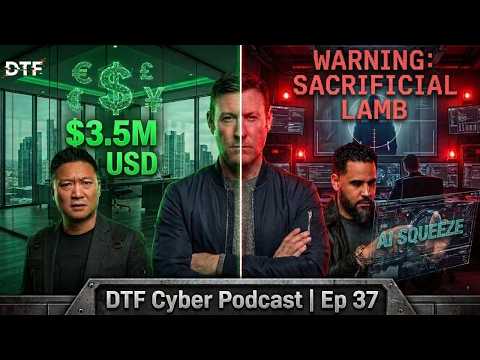
Cybersecurity Salaries 2026 The AI Squeeze is Here
0:00All right, it's 2026 and everybody I know wants 300k salaries, but nobody wants the SEC wells notice that comes with it.
Yeah, you know, Fern, if you're a CISO in 2026 and you're not negotiating your
0:16directors and officers DNO insurance, you're not really an executive. You're more like a sacrificial lamb.
And if you're still prompting AI instead of building it, you're probably already obsolete. This is the 2026 salary showdown. The DTF Cyber Podcast. I'm Damian.
0:31This is Troy.
And it's your boy Fern. Let's go. So, let's start off with a personal story that both of you guys are very
0:48much well aware of. I would say over the last month or two, I've been I've been putting in some applications right? I couldn't tell you how many applications I've submitted. It was probably less than 50. Every single one
1:04that I applied for denied like either
what were you applying for? Not obviously not McDonald's or Costco.
No, no, no. So, I was applying for sales roles. Um, and
cyber specific or anything?
I try to focus on cyber because I was like a lot of people that I know are in cyber so I would be like an idiot to try
1:21and find something outside of that, right? Um, so most yeah, mostly predominantly cyber. There were a couple that were like infrastructure like uh storage just to be specific. Um I even had people that worked at these companies submit a referral for me. The
1:40only time times that I had a actual conversation with a person was when someone that knew me referred me. Every other thing that I've submitted denied. There was one role I I appi it Friday night. I got a
1:56LinkedIn notification that said, "Hey, this role is open. Just posted." All right, cool. I'm going to be the first applicant. Click it. It's a It's Friday night. Like, who's submitting jobs on Friday night? It's like 10:00, by the way, as well. Submit it. Wake up in the morning, denied. And not even just
2:12denied. It said, "This role's already been filled." And that to me was the nice way of saying not interested.
That was fast, though.
And then two weeks later, reposted the job. So I'm like, all right, I don't want to say who who that was, but I will say they are doing poor.
2:29Yeah, if you think about it, do you there's a lot of people starting their cyber careers and they're just shooting out like 50 resumes, 50 applications.
I mean, flooding the application process and not getting one single response.
No. And so this this might sound bad,
2:47but I don't care because it's the truth. I get to hang out with you guys, right? I get to hang out with a bunch of CISOs. I like I know a lot of security people that people would pay money people literally pay money to sit across from them. I can't even find a job. Like how
3:04ridiculous is that? Like
yeah, I think we've talked about this on past episodes where you know that that warm intro is absolutely crucial. You know, we're trying to encourage the next generation of cyber warriors or people getting into cyber security, but without that warm intro, it's nearly impossible because you're competing with the AI
3:20application readers and you have the people like Demi was just talking about who are creating their applications with AI to match the AI intake from the company. And this is just a world that we live in where folks like yourself, myself, Damian, we could apply at a 100 jobs and never receive a call until
3:36somebody says you, "Hey guys, you should talk to Troy or Damian or Fern because these guys know their stuff and they'd be a great fit for this role." Then you get a call back. But I think we're living in a world where we've said to young folks and also in the middle of your career, network, network, network. Go to these networking events, meet
3:51people, expand your your network horizons because that's how you're going to have opportunities uh in the near future. Yeah, that's exactly how I found my job. Right. When this episode comes out, the truth the the world will know, right? Um
4:07so you can't really announce it.
No, I I mean I can we'll just do it same day. It's the same thing to me. Um
so Damian said, "Hey, you should talk to these people, right? They do really good work. I've used them, right? Great company."
4:22Puts me in touch with some someone. I just pick up the phone. The guy calls me. I'm literally at the grocery store shopping talking to him for like an hour and a half. I didn't know who he was. Turns out he was a CEO. I don't I don't think I ever sent him a
4:39resume. We talked long enough to where he knew like what I knew and we talked about the things that I've done in the past and kind of what I've done with in all this stuff or just in life in general. And then uh a few weeks later, you know, done deal, right? Um no, from what I remember, no resume that I sent
4:55him. uh wasn't an application. It was, "Hey, you should go talk to this person or more so Damian saying, hey, you should talk to Fern." And then Damian telling me, "Hey, don't be don't be dumb. You should talk to these people. They're really good at what they do and their security, right?" Um, so
5:11interesting how that worked out. Obviously, uh, wasn't what I was expecting. I was thinking I was going to submit an application, right? So when I when I see that this is a topic today, it's like near and dear to my heart literally cuz like this is what I've been dealing with for the last few
5:27weeks. But um so I think it's ridiculous how the system works, right? Because clearly like outside of paper if I were to meet someone in person or we talked about the podcast or things that we've done you collectively or just me as an individual, I think a lot of people be
5:42like, "Oh, like Fern, you know, Fern's a good person to know. Fern can help us out." People literally call me saying, "Hey, can you help me get a meeting with this person?" I'm like turning people down because it's like, "I don't know if they're interested." Right. But yet, when I submit the application, the bots that are reading my application are
5:58saying, "No." So, that's it's not just happening to me. Like, I happen to be like, "Well, yeah, that's that's one one problem, right? Just getting your foot in the door to have that conversation."
Um, but today's episode's all about the salaries. So,
you know, I think it's this is a good
6:14time to talk about,
you know, how much money we're seeing. I think there's some research that we probably pulled up for 2026 and obviously the introduction of AI cuz in your case, AI scanning your resume or your application and saying yes or no
6:30immediately. Yeah. Not qualified, right? Um or maybe I'm just poor at writing resumes, but it's not just me. It's a lot of these people there cyber security uh shortage, right? Skills gap, right? Is I mean now I being firsthand the situation, my first thought is like is
6:46there really a skills gap or is just just is it bots denying people left and right?
Well, how important is that resume? Like Troy, how many times a great
How many times you look at a resume, an actual resume?
Mhm.
When I'm hiring for a role or recently, you know, I get some candidates from my HR or my recruitment team and I re
7:03review them. They've already been through several rounds of processing before I ever see them and they've already vetted out some folks. But I think one thing I want to go back to with Fern was that people are making a lot of assumptions based on your resume. You got to make sure that it communicates your value proposition very clearly because people when I was
7:18looking for jobs after my last role uh and applying at jobs, everybody assumed immediately that I was overqualified that I would not be interested in that role. And but I want to say to hiring managers, there's a lot more motivations than just money or experience or size of company for a CISO, right? We like to
7:34build things. We like to create strategy road maps. We like to build a culture. We like to hire and foster new talent. And so I think that, you know, as hiring managers, they just automatically have all these assumptions from your history that they take into account and they may discount you and not even call you back or say they've hired somebody else.
7:51Yeah. Um I'm not calling you back because of that because you're too expensive or you look you seem to be too expensive. That happened to me literally. Someone told uh someone told our friend here, Damen, that there's no way they could ever afford me. They didn't even have a phone call. They didn't even pick up the phone to call me. I've heard that a lot. Absolutely.
8:08That's the thing. People were afraid to even give me a call. They're like, "We could never afford this guy." And it's like, "No, have a conversation." There's a lot more reward for CISOs than just the dollars.
I think that's for most people who are probably senior in their career. I don't know if you could say the same thing for
8:24somebody starting. I I mean maybe right you you want to you don't want to get paid minimum wage to be doing a sock analyst job
but you also want to get the experience so it's not always about the money I agree
but so analyst roles right now uh entry level was 0 to2 years uh according to
8:41this uh statistic that I'm looking at is anywhere between 70 and $95,000 a year right which is pretty good when I got out of college with an engineering degree um My first job that I had was making I think
8:5745 or 50 and this was like 20 years 15 20 years ago. Yeah, 15 years ago. Um but after a few years I was up to 75. So this is actually pretty good. I mean obviously relative to the time but yeah I think a lot of schools kind of sell
9:13cyber security as you know a highpaying profession and I'm not saying that's wrong but you just saw what it took to get your foot in the door to get that call back.
Mhm. Right? How many people are graduating with cyber degrees or even development degrees
9:29nowadays? They're learning how to build their own AI, not just
prompted.
So, we'll talk about that in a second.
But what does that really give you in terms of starting salary and should you worry about it? Because $70,000 as a starting salary for a sock analyst,
9:45that's pretty good coming out of school.
It is.
Yeah. I've got a great story on that one, Damian. And I have a friend here locally that asked me to talk to his nephew up in Washington State who had just graduated from college last year. And he was told and led to believe that as soon as he walked out of college with
10:00that degree, there was a skills gap. He'd be making six figures right out of college.
And the brutal honesty of it has hit him and he has not been able to find a job. Even in that 85, 90 and you know, he keeps going down that track and he's being humbled somewhat. So, I want to say to this younger generation, you
10:16know, you're not going to walk out of college and instantly be handed a job. You're going to have to work hard for it. You're going to have to differentiate yourself from other talent, especially with the AI pressure of taking folks jobs and reducing staff. But we'll get to that later. But I think you should just be smart and reasonable
10:31about what your expectations are out of college. Take that $70,000 job and show your worth and within a year or two, you will be moving up into that six figure range. But you can't expect just to be handed something out of college.
Yeah. I would even say like what about if somebody under bids, right, and says,
10:47"Oh,
here's 60,000."
That people will take it probably because they're just
Well, somebody will take it.
Yeah. Some there's always someone that's going to do it for cheaper, right? Um
where's that? I mean, this is this is a supply and demand. What if they came in and said, "Hey, we'll give you 50,000."
11:04Depends on how what I guess it depends on the person's situation, right? It might just be like, "Whatever, I'll take it."
Yeah. as your first career job in cyber. I I think weigh all the opportunities.
You could you could do that for a year or two and then move move on to other things with the experience.
11:20Yeah. Or and but here's the the flip side of that is a lot of times people might get uh not under bid but like they'll get kind of like a lower salary. So they'll get the job and then they're still looking for a job that pays more, right? And then in 3 months they might be out the door. So it's like
11:37even though
Yeah. But I'd caution on that. If you're jumping jobs like that, to me as a hiring manager, that's a concern.
What's going on there? Something's going on where
maybe you're not a good culture fit wherever you go
and you you hop jobs.
Yeah.
Once they figure out, okay, you're really not that good.
11:53Okay. Okay. Well, I was just thinking out loud, I guess. Um I've seen that happen where people get a job and they're like, I'm just here for the check and then they'll sit around for 6 months. And apparently 6 months on LinkedIn is like the magic window to have uh recruiters reach out to you. So
12:08it's like six months.
So if you start working at a place and you're there for six months, recruiters hit you up.
Yeah, I've heard that from multiple people. Yeah. Interesting. It's like the not you get nothing before the six months. As soon as you have 6 months, it's like 10 15 people are reaching out to you or like at least twice a week is what I've been told. So like 6 months is
12:25kind of like the the litmus test on oh this person's able to keep a job. Maybe we can sell them. You know, not sell them, but like
this reminds me of the conversation of Fern. We talked about this the other day. When you get a job, a new job, you're about to start, you get 10 other calls for jobs, right? It's the same
12:40thing when you're dating the hot girl in high school. Now, all of a sudden, you're dating this hot girl and you have everybody come out of the woodwork, wants to date you, right? It's this really unique phenomenon, but I would go with Damian on this one. Caution you, you know, don't just jump for$5 or $10,000. That may sound like a lot of money today, but if you're jumping into
12:57from the frying pan into the fire, poor culture, you don't like that job and it's going to be you're going to suffer while you're there. That$5 or $10,000 is absolutely not worth it. Um, plus keep your options open and try to find that passion as we mentioned and and follow that path.
Yeah. Funny how that works. I signed the
13:13paperwork uh I forget what uh morning it was. It was um early morning maybe like Monday or Tuesday. Literally that same day, two phone calls from people saying, "Hey, I got a job for you." Like where were you for the last like two months? Um so there is hope, right? But it is
13:30interesting that it does work that way where you know you're looking and nothing really comes up. you find something and then all of a sudden everyone else wants to call you up uh without even understanding that like you've even signed anything, right? Um
no, we're talking base salaries and this is for United States. So if you're in a different country, might be a different
13:46currency and different cost of living.
Mhm.
So in addition to the base salary, there's probably bonuses or equity. You work for a publicly traded company.
Mhm.
Uh there's other stuff that you have to take into consideration.
14:03Mhm. Yeah. The vacation, PTO, sick days, all that good stuff. How much of your PTO transfers?
Uh,
how much you like the CEO?
Is this true?
I mean, if you you spoke to the CEO for an hour and a half and he didn't even know he was the CEO. That's
14:18No.
Would you would you have uh acted differently?
Probably not. Nah. But I was just I was just honest. I was just myself like how I am here is just like if someone meets me in person, the person that they listen to or or watch with this is the
14:34exact same person they're going to get. And usually I stick my foot in my mouth a lot of times. Um there was a text that went out last night that I said something that uh it didn't really like backfire. I'll tell you guys about it later, but um I was like, "Oh man, I probably shouldn't have said that cuz it's like eh I don't know." So I'm very
14:51much unfiltered, right? Um, but I would have been the same with him or anyone else because it's like the way I look at it is if you don't like me when I'm just myself, then that's perfectly fine. We don't have to do anything together. But
15:07if I have to pretend to be someone else just for people to like me, like that makes my life more difficult. And I'm I feel like I'm getting old. Like I just want to be myself.
I think that goes for young people, too,
you know? Like don't pretend to be something you're not.
Yeah. Don't be a chameleon. just like
15:22actually be whoever you are
and you'll find the people that like you for that, right? And then you don't have to be different around certain people. Um, but I guess let's get back into like some of the segments that we had listed here because the the main thing that I
15:40have on the list here is how there are all these entrylevel jobs that people may or may not be able to get. That's one part of it. The other part is a lot of those entry- level jobs are being taken over by tools. And I'll give you a
15:56really good example. Tier one sock analyst role.
A lot of that is turning into AI uh triage and just AI maybe not remediation, but now where sock analysts are moving into a different tier.
16:12They're being more prescriptive in the things that they do. Right. And I think Damian has been a part of these conversations. I'm sure Troy, you've been a part of these conversations where people are looking at for their organizations, how can they transition from a level one sock analyst to be
16:27fully uh using AI tools and then repurposing those people for more like engineering or like remediation or incident response, right?
Well, let's let's back up for a second. So, Troy, do you think
16:43a sock analyst is an entry-level job? Not at all. I mean, if you become an analyst, most people transition there from like the help desk or some other part of the business, but I'm not sure that a sock tier one analyst is necessarily entry level. But I would say
16:58this, as much as we're looking at AI automating a lot of that process for triage and all the filtering, which I am totally an advocate for, I don't think that those people go away because we need this path to build talent. Usually,
17:14we hire folks who are interns. They work in some type of function either in operations or governance and then they work their way up into the more granular sock levels tier 2, three, and tier four. We can't stop that pipeline. We can't cut out level ones because that's
17:31a learning phase of the people that we're trying to push through this knowledge learning process. Yeah, I think um it's tricky because I think a sock analyst level one can be entry level, but it's starting to get harder
17:49because of AI.
Mhm.
So, I don't think um you know the days of where we used to have people sitting in front of a screen waiting for alerts to fire off and responding to that, that's gone,
right? I I think it still exists because there's some stuff that we haven't
18:05automated or we haven't gotten AI to address just yet, but on the horizon that whole level one sock triage probably gone
the process maybe not the person.
Yeah. Yeah. Yeah. The
well the person the person will be will
18:21have to like you said Troy move up the stack. And so now they're u I'll give a perfect example. I was looking at within my team how efficiently we're using AI in the sock and one of the questions was where where are we seeing the efficiency right that's a common business question
18:38so wait you said you're using AI and you want to see where the
yeah where's the efficiency like if if you're using AI any business leader is going to say well the cost us money
okay
right
so
how much is it saving the the whole process in time in time
18:54okay
or can it do it time in terms of length of time and then speed.
So this is already deployed in use. Now do the calculation post purchase.
But if you just think about the basic stuff like an alert fires off now an analyst doesn't actually have to go and
19:11look at it and investigate and triage it. An AI kicks off full automation triage and then comes back and says, "Hey, this alert fired and by the way, I did all the prep work for you and this is what I think happened." that
I think we're going to live in a in a day where the tier one operation of
19:27doing all that manual work and correlating the you know how bad is this threat, who do owns the domain, all the telemetry around it. We won't even remember that that existed. We won't even know that that was a job. And back in the early 1900s, there used to be a function called the vice vice president of electricity whose job was to manage
19:44the incoming and the production of electricity to support the factory or the plant or whatever it was. That's not a job anymore because we've just moved into a new future. And I think that uh in the coming years, we won't even really remember how the sock was run 2 to 5 years ago. It'll just be natural that the people who were what we call
20:01tier one today are doing something much more elevated and upskilled than they were 5 years ago.
Yeah. Remember the telephone operator,
the one that had to actually patch the phone calls.
Do you remember commercials on TV?
Do you remember TV? Do you remember t Do
20:17you remember to the way the way to get around and then streaming funny story like sidetrack or yeah we'll say sidetrack you know what do you think my kids favorite thing to watch is on TV right now
20:32the commercials.
Oh no way
because they've never seen them like they they've grown up watching whatever they want on demand like on Disney Plus or like Netflix or Hulu or whatever they're watching. No ads, right? And recently,
hint hint hint. You're the dad. You're,
20:48you know, you're being a great dad and you're removing all the ads. Our kids still have ads on Hulu and all the other stuff because we're not paying the exor fees for all these services.
Has the baller package. Yeah, he's got the baller package with commercial.
Got the got the big money package. Uh, no, this was like a few years ago when
21:04none like when Disney Plus never had ads inside of it. Now you watch it and it's like pops up or you like pause it and it's an ad. So, oh no, no, we don't we don't pay for the uh we have them. We don't pay for the primo primo, but uh it's interesting cuz like now my kids
21:19like they enjoy making their own commercials like they like they do their own ads with each other like in front of us like they're like acting out and it's like what what kind of ad is this again?
What you're trying to get me to buy?
Yeah. They're like they do weird like medicines that just make up stories. But
21:36um I do think it's interesting how you know for them they're not used to something, right? And we look at it like, oh, I remember back in the day when we used to change a channel and then hope that we came back in time for when the series started up again.
And for them, it's like
are cool.
And and that's a problem with, you know,
21:52let's we just start with the sock.
If we lose that entry level, where do we get people started training because they have to understand what's happening at that layer in order to take the next level,
right?
Yeah. You have to be good at it. But here's a here's the other side of the
22:08coin for that one is I've met plenty of people in either executive roles or leadership roles that refuse to hire someone with zero experience in in the sock for a sock role, right? Um because they look at that as a
22:24business risk issue, right? They're they're essentially hiring potentially hiring someone that could drop the ball, oversee something or have an oversight to certain things, not see something happen, end up in compromising situation. Right.
Well, I think AI helps that because now
22:41you're able to cover everything
and then at some point ask the human, hey, I just saw this. Do you want to make just double check?
It's like Tesla FSD, right? The car drives itself, but you still have to be there.
Yeah. But it it kind of reminds me it
22:56does drive yourself and maybe this is a bad analogy, but like I know the whole calculator and tool analogy is like very overused with AI, but it's like if you don't understand how to do the math, a calculator isn't going to help you, right? You have to kind of understand the basics.
23:12I don't know if I agree with that. You know, if if AI gives me the answer to the problem at my fingertips and I don't have to go do the underlying calculus and algebraic formula.
Yeah, but how do you know it's not hallucinating? Yeah, I was going to say you're you're assuming that it's right or you're assuming that the input was
23:27correct because think of it like this. I don't know if you guys have ever used any of the engineering software um like mat lab or mat lab where you have to actually enter in the function and do it. If you do it wrong or you put the parenthesy in the wrong place, it does it does the equation incorrectly. Like so there are there are properties in
23:43math where things have to be done a certain way or a certain order and if you enter it incorrectly like say you're doing uh some sort of integration or you're doing some sort of like calculus problem where you're figuring out like uh dissolving fluids into other fluids
23:59like a mixed system differential equations like if you put the wrong input in you're going to get the wrong answer out. So, you have to at least understand how you're using the tool and what you're submitting to it because assuming that it's going to be right
24:14100% of the time. It's kind of like a miscalculation and then all of a sudden, you know, bridges collapse and people get hurt. Um,
I think that, you know, we certainly don't want to let AI just take over and run our sock for us. I think, you know, that human in the loop is so important. They have to know how we got to this
24:29point. The AI can shortcut that by researching the domain, getting the threat level. Here's what I saw in your your EDR logs. just what I saw in your firewall logs and and tell you what that story is. Get it all the way to the point of um make a decision human. You know, I suggest you block this at the
24:47firewall. Uh and then the human has to push the button to say yes, please do that automation. And of course, the AI goes off and does it. There has to be a human in the loop. And you're exactly right. We can't get rid of the humans understanding why the AI got to that point in every step of that enrichment process and telemetry to push the button
25:02to take action. The human has to still know that. That's a great way of learning on the job. You have mentors, you have seniors that are teaching the new people how they understand all of that process. But I really think the AI is going to change the way we do business in the sock.
And we're going to get to a point that
25:17it's going to be just automated all the way to uh completion
potentially. But I I think here here's the differentiator from doing that entry level to the next level in your career.
You can't just learn how to prompt the AI, right? I think that's table stakes
25:34for everybody everyone now. If you're not using
AI, you can't prompt it, you don't know how to use it, just asking basic questions, you're already behind
where you have to be is how building really those mechanisms where we're automating the agentic AI um tasks,
25:52right? Mhm.
Because that's the next step and you have to be able to evolve yourself and if you don't like if we didn't go out and you know research openclaw and other things that are happening in in the industry we just fall behind.
Yeah. Or you wouldn't be aware of it.
26:07Right. So then there
well I mean you just be ignorant if you're I mean it's out there in the news.
You haven't paid attention. You haven't figured out how this is going to potentially change the world. Mhm.
Although the time Damian I quote you all the time as saying you know AI is not
26:22coming for your job. The person who has embraced and is fluent in AI is coming for your job.
Yeah. So I know we did an episode on on OpenClaw and some of the you know
two weeks ago
issues to to watch out for.
Um that's those are just cautions today. In the future
all that stuff's going to be locked down
26:39and secured.
Mhm.
Yeah. So it'll be locked down and secured and then then part of the struggle then is like businesses justifying the people or not not the people but justifying paying people the higher salaries as as they go up the stack because I think Damian said it you
26:56know if you can get a 10x uh efficiency right on the work that someone does now that you have this tool that's doing a lot of this work are you are you paying that person more or you paying them less if they're relying on these tools that you have to pay for as well. So that's
27:11kind of like the next thing is um the pay gap that kind of is a result of all this automation, all of this uh integration with with AI tools is
do you guys feel that there might even be like a trap
for people?
Yeah, I think I think from we're going
27:28to see an AI squeeze. I think we're going to see a squeeze where two things are happening at the same time. Number one, jobs are going to become a little more scarce. So scarcity in jobs is going to continue to rise because companies are looking for ways to reduce headcount with AI whether it's justified
27:44or not. Look at the recent uh you know half of the company at Block was it Jack Dorsey's company that laid off 4,000 people out of uh just under 10,000. So you're going to continue to see companies demanding less headcount because of AI. And at the same time
27:59you're going to see salaries dropping because those competing for those fewer jobs, the companies are in control. they can say, "We're not going to pay you exorbitant amounts of money because we have 50 people who need a job and they will take much less than you." So, I think you're going to see that squeeze
28:14on the salaries and I don't think you're going to see just these enormous numbers in cyber security anymore. It's probably going to go down.
Yeah. You You know what they can't take away though? The people that are working for free like we are right now.
That's right.
Oh, you want to take
Give you your money back if you don't
28:30like it.
You got to take away 100% of what I make on this show. Zero dollars.
Which is why Hey, they got a real job. Yeah, podcasting doesn't pay any money. Like, what was I thinking? Like, where did I take my life? Um, but I agree with Troy. I think he's 100% spot on where
28:46the leverage becomes uh goes in favor of the organizations because as more people are looking for work, people are more willing to do things for less um or just to be able to make ends meet, right? So,
29:02I don't I think there's a there's a lot of uh scary things around the corner. Not sure when. Um have you guys seen the people going around asking AI if if based I think the wording is something like based on what you know about me will my am I going to be replaced by AI?
29:19Like that's a question people are actually asking and there's people that are actually getting answers like yeah in six eight months you're going to be out of a job.
Yeah. I mean let's look let's I mean call it what it is, right? I'm not paying $70,000 for an analyst to just sit there and look at a screen anymore
because AI I I could just have it auto
29:36automate it, wait there for the alert and fire off might cost me pennies and and be a lot quicker or like $200 a year or $200 a month like a licensing cost, right? Um maybe even on the high side, that's probably where it's at. $200 a month, right? Per per user type license.
29:54So yeah, 70,000 just a stereo screen doesn't make too much sense.
Yeah, I wonder how many sock entry sock jobs now say you need AI as a skill set.
It's a good question, but I would say to anybody listening to this, if you are in
30:10cyber security, you need to embrace AI. So that means get certifications, become, you know, have your own home lab as we've talked about before, get a little Mac mini, run your own, you know, bots doing certain things with your email and your LinkedIn, not because you have to, but just because you need to learn that process. And I think that
30:25those people who do that are going to put themselves in a better position to keep their job or to move into other positions.
You could be looking to make anywhere between 79,000 as an analyst, right? But let's just say you take the initiative, maybe you have the curiosity and you end up learning Python, right? and you take that and you turn that into other
30:42things. Um, like you start automating things, right? You now have the skill set versus looking at something and trying to figure it out. You have a ski skill set in like scripting or like doing these other uh uh programming, if you will, right? Um, that's going to pay
30:58you a lot more than being able to look at a screen for 70 grand. So, I think part of the the onus is on the people to to take the initiative to improve their skill set. And whether it's with an AI tool or not doesn't matter.
I would argue, you know, maybe you can use AI to do the Python scripting these
31:14days.
Anthropic claude is great for that.
So I don't even know where that's going to go. But I I do think you need to have that base understanding of how to script. I mean that's how I started my career. I did I used to write a lot of scripts.
31:29I still like doing it.
But how often do you do it on your own manually? If so, let me ask you this. If you had to do something today, would you go back to the old school way like metaphorically busting out the pen and paper or would you use tools?
31:46Yeah. Nobody does that anymore.
Right. Okay. So, not at all.
That's the thing is like so most people aren't even doing that. So, like if you understand how to do it, you're still not even nowadays you're not doing it the way you used to, right? So, there's like this shifting of how people
32:01actually perform their work. Like the skill set's still there, but people are shifting how they actually accomplish it. It kind of reminds me of like cutting grass. I have no grass to cut in my house for a reason.
But have you ever seen the old lawnmowers where it's just a blades on
32:16the wheel and you just push it?
Then they have one.
Yeah. The We had one when I was a kid. I used to have fun like running around doing that. Like seven years old cutting grass for fun. My parents obviously conned me into that. But I was cutting grass with this like push uh push mower.
32:33Then there's the gas ones, you know, start doing that. Now they have something that just it's like a little it's like a little uh
Roomba,
like a little Roomba. You pop it down, it has like GPS and it has like all these other uh capabilities. Just runs around and cut your grass for you,
right?
32:48It's like the Jetsons we're living in the future now. But uh my 11-year-old daughter's using Clawude to Code Roblox games. She's got three going. They're pretty popular. People play them, you know. She understands the code well enough to troubleshoot it at 11, you know. So I think there's something to be said. Damian for using these coding
33:04agents and learning that language um as you go along.
Yeah, my kids play Roblox. Damian's kids or not D Troy's kids uh write the games.
There's
just the just the young she's she loves that stuff. But honestly, um, I think
33:20it's really important that, you know, speaking of coders and developers, there's a whole another existential crisis for if you're a software developer, if you're if you're a coder today for your work, used to be the golden goose for the company. Now you're like wondering if you're even going to
33:35have a job next year. And so I think cyber is protected from that because we're not going to have a lack of threat actors trying to attack our companies. But you have to be flexible to the new future, as I call it. Yeah. And then go back to, you know,
33:50getting that first job or getting a job as a hiring manager. I would rather somebody say, "Here, meet so and so as a warm intro because then I know they're not just using AI to generate their their uh resume
34:06or using deep fake and telling me the answers I want to hear. So, I think that's is it fair to say that Damian, in the age of AI, personal connection is going to matter the most? I think so. I think there is there there has to be you can't have a a cold transaction,
34:22especially when it comes to some of these roles,
especially as the dollar figures go higher, right? Because I think the other side of that too is like Damian said, he's not going to pay some someone 70 grand to sit and stare at a screen. Like as a business, people are looking at how their money is being spent. Like how
34:37their budget is essentially being consumed by either full-time employees, contractors, people are looking at, you know, criticizing how every dollar is spent. Not because, you know, they're like micromanaging it, but they want to, you know, they're people. They want to make sure they're getting they're getting their fair share of their money's worth. Um, so if I go back to
34:55the salaries, let's see here. Security engineer, uh, with minimal experience. I mean, it says 0 to two years. U, but that probably comes with a few years prior experience outside of that specific role. Anywhere between 90 to
35:11120,000. um pentesting just under 110,000 uh cloud security specialists just under 130 right and as you go on you know 3 to 5 years 7 years plus like the cloud engineers are making you know 190 to
35:28200,000
yeah you got to I mean you got to be smart about it right if you're going to map out your career
Mhm. Um, I don't know how many people would actually say, "I'm going to go into security and just manage physical firewalls anymore."
35:44I don't know.
Right. It's
I remember a time when that was that was it, right? Get your CCIE from Cisco and that you you're set.
Yeah. Get that C get the CCNA, get the CCIE, get all that.
But maybe in a lot of ways, some people look at the CISSP the same way. You
36:00know, it's like once I have the certification, like I'm qualified. I know plenty of people with CISSPs that can't find a job or looking, right? And it's just a piece of paper to some people, right? And then when it comes down to the hiring decision, it's like whoever tapped the hiring manager on the
36:16shoulder.
Well, it's not a lock because all that tells me is that you can take a test.
Yeah.
Doesn't mean you're any good at cyber security.
Yeah. You you could just be really good at test taking. And there's a lot of people that are like that, too. Um, I've never taken the CISSP, but I imagine
36:32it's not like some of these tests in high school where there's obviously like two very wrong answers, right?
I don't um So, I've I've had mine for
like 10 years, right?
15 years.
Mhm.
Um, a long time. I And when I did it, it
36:48was on the bubble sheet with a pencil.
I think it's all electronic now.
You're a Scantron kid.
I remember sitting there for four hours thinking, when is this going to end?
It's definitely changing. And I think SS are good, but searchs can only get you so far. And doing good work that people
37:06that you've worked with can vouch for. I think that's another thing, too, is like if if you're looking for a role, I think a big part of that is having people vouch for you as a person or you your skill set. So, you might have like a one of those personalities that doesn't get along with very many people, but you do
37:22really good work, right? There's plenty of those people.
I don't know. That's that's a tricky one. I know a
toxic employee. We want to avoid that. But I do think that there's a lot of introverts listening to our podcast, folks who are not comfortable going out and just meeting new people on their own. I highly recommend trying to get in some of your local networking groups because it's so important that warm
37:38human connection when you are looking for a job. We have a lot of folks that are really good at their job but just afraid to speak up. And I think that is where they get held back where somebody who's louder and more braggadocious of themselves are going to uh fare better. So you you mentioned some of the
37:55different jobs moving up right into the middle part of your career.
I think it's important for you to
think about um where you want your career to go because you like I like I mentioned, you don't want to get stuck um managing legacy
38:12technology whether it's software or hardware. Um, I would say early in my career, uh, one of my jobs wanted me to learn AS400.
Good thing you administrator
dinosaur
and, uh, I just couldn't I couldn't do
38:28it.
No.
So, so I end up leaving that place, but could you imagine? I mean, maybe these days, yeah, there's still a lot of banks that use AS400. You can't find people to maintain them.
So, maybe I made the wrong choice.
No, no,
you made the right choice.
You made You made the right choice. Um,
38:46but that's, you know what that's like? It reminds me of like Pokemon cards. Everyone had them. Not very many people saved them. And if you happen to have them now, they're worth a lot of money. So, it's it's very few things that kind of come in and go and come back that are more valuable. I think at some point
39:01people expect the AS400 to fall off, but maybe the cost to to modernize whatever application that the core system that that runs just outweighs the the benefit, right? So people just like kick it down the road. Um I don't think that's going to happen
39:16with security. I don't I don't think people are going to be kicking uh firewalls down the road. They're going to say, "Hey, like do something more, do something better, right? Use these tools." Um so perfect example is a lot of roles that are specialized in AI and
39:34machine learning, they're actually getting a 15 to 20% salary premium over the traditional role. So you think of like firewall or network security engineer um and something around I don't know what the alternative would be but something that focuses on a IML
39:51technologies or like use cases is paying almost 20% more. So, you're already you're already seeing it now where the premiums are being paid for people that are competent with these extra skill sets from what we'll just call uh legacy
40:07skills, firewalls for example.
Yeah. Because you're bringing right from the very beginning, you're bringing more efficiency hopefully.
Yeah. Yeah. Exactly. You're bringing the efficiency. Um, but it's the same story that people saw seven or eight years ago
40:24when AWS uh less so GCP, Azure came onto the scene where companies were moving everything to the cloud. Who was the most paid person on that stack? Right? The cloud engineer. It was always a cloud engineer that got paid more than the networking engineer. Right? Now
40:41you're kind of seeing the same shift where people that are using security and more specifically AI tools in security are getting paid a premium. Like I don't think a cloud engineer is getting paid premiums anymore. Maybe they are.
No, but I mean I think that's being
40:56pulled back too. A lot of companies are realizing that they can't control spend in the cloud anymore
and so they're going back to hybrid.
Yeah. So it's like you know es and flows, right? Things shift. Um
let me see here. And the other thing that might be worth mentioning is
41:12clearance bumps. So if you're happen to work in government or defense contracts, um those people are seeing anywhere between 20,000 20 to $30,000 a year in a bump in salary for private sector roles with without compar Yeah. With a current
41:30clearance.
Yeah. So clearance versus non-clarance. Um about $30,000 a year. You know what? When you're earlier in your career and you're younger, it's easier to go get that clearance, especially if you
you're working in the government.
Later in your career, it's so much more difficult.
41:45Well, it's probably easier to get it younger because you can make less terrible decisions.
You don't you don't have 15 years of potentially bad decisions, right, when you're 40 um as you do when you're 21. Um
I don't know. There some 21 year olds that make some really bad decisions, too.
42:01I think if I were going to make any mistakes, it would probably be that stage in my life.
Well, that's what I'm saying. like if if you if you nip it in the bud first where you don't have a chance to do it like you have a better odds cuz you know you haven't had crazy stories I'm sure if uh
42:16so I mean that's a that's a good point. So if you do have clearance
um there is value for that out in the in the private sector
not just in the government. Yeah, there I mean,
but not everybody listening can really go through a clearance process or find a
42:32government contractor that would would get them clear, but if you have one, that's definitely worth some money. I would also say, you know, when you mentioned the CISO salaries between 2 and 400,000, there are some industries that pay much more than that. So, if you are working for a B2B SAS company, as an example, and you need to help secure the
42:48product that you sell, those can go into the one plus million range. I know several um CISOs making one and a half to $2 million. And as you get into financial services, especially the big banks anywhere from two to three.5 million per year for a CISO salary. So
43:05it just depends on really your uh remitt how much you're responsible for and what industry that you're in. Okay. So let me ask you this, Troy. Um the people that are making million and a half, are they in a role that has a potential liability against them? Are they demanding a
43:21higher pay because of the risk involved? We always talk about risk.
I'll pay you a lot because you have a potential to go to jail.
Yeah. You might just take the fall, right? Is that
I I think Joe Sullivan and Tim Brown have shown us that we are all at risk for whether it's criminal or civil, but
43:36I don't think the folks in those positions like uh in financial services or u you know some of the bigger banks and technology companies are getting that salary because they're at more risk. is because they're responsible for more in the company and the company is more at risk if there's a major cyber breach. So I think that's where the risk
43:53is.
Okay. But okay, so I've never signed up for ENO insurance, right?
Mhm.
That I'm aware of.
I don't think so. Maybe I have something with all I don't know. I got a bunch of stuff like umbrella whatever, right? Um is probably maybe it's part of the
44:08packet. Probably not. Who knows? Um, but when you guys like assign for these roles, isn't that like a big part of the negotiation? Because I I'll give you an example. I know people that strategically ask for more money because that's not part of their compensation,
44:24right? Or or the way that they have their pay structured as a CISO, um, the business doesn't want to take on the liability. So, they purposely pay these people more to cover policies outside of their uh internal policies, right?
44:39Because like think of it like if you have um homeowners insurance, right, and something happens, your rate's going to go up. But if you offset that to like a I don't know, we'll call like a chub policy for uh nice watches as an example
44:54and something happens, your home insurance doesn't go up. And so from what I've seen, people are organizations are doing that too. So I'm just kind of curious like since we're talking about money um
Mhm.
are people like how how is that negotiated? I 100%. Good question. And
45:10so there's a difference between errors and omissions, which is more of a general insurance for companies if they submit forms with errors or or omissions in them. And directors and officers insurance, which is protecting the directors of the company. And that's where CISOs have really been trying to get added as a name director in the
45:27company. So we have a sea level title, chief information security officer, like a chief financial officer, but it's not really a director as a in the corporate documents or the operating agreement that the company has. So, you're really asking the company to add you as a named director because then if you get sued by
45:44the federal government or any other party, you're covered under the company's DNO insurance and they will cover you. And so, that's what we've been negotiating. And I would love to say that we've had a lot of success with that. I do know some CISOs after Tim Brown who were added to the DNO, but it's not as many as we would like. And
46:00honestly, I know a lot of CISOs who have negotiated for that in their comp package and just not been successful. So, I don't know if they're getting paid more money to go out and get their own insurance, but um I can tell you that there's not been as many actually successful in being named as a director by the company. And what happens
46:15normally is a general counselor or somebody come back and say, "Well, you're covered. We got you. You're part of the business. We will cover you if anything happens. We're not going to add you as a named director, but you have coverage." And and if you ask your own personal attorney, which I would highly recommend, how far you want to push that
46:31uh to get some type of writing and something in writing, etc. But when the chips are down, the company's going to protect the company, you know, whether no matter what happens. And you know how HR is always your friend until they're not. And same thing with the company. So I highly recommend if you're negotiating for that and you get denied, talk to your personal attorney and see how far
46:47you want to take that risk.
So Troy, you mentioned something about being the sacrificial lamb in the open.
How do you know you're not jumping into a situation where yeah, you are taking a fall?
That's why we have insurance. You never know. You never know what the company's going to be like in that moment. Um, and
47:03for years, companies have always scapegoed the CISO and just you're fired and you're done and you're on your own. Once you're fired, by the way, you're no longer covered by the company's insurance. They can choose not to cover you. Sometimes they choose to cover you anyway because it's in their best interest. They want you telling a very positive story about what happened, but
47:19they don't always do that. So, I think that it's really important for you to protect yourself. Get your own insurance. Talk to your attorney, uh, personal attorney that's not your company attorney, and make sure you cover yourself in a way that makes sense for your family and your your situation. is always different.
Okay, let me ask you this question
47:34though because this is a true story. Actually, a couple true stories. I I know of a situation where someone was a CISO, left the role, went to we'll just say another job. I don't want to say where they went cuz then it would give away who I'm talking about. Left the role as a CISO and before they
47:52were officially done, they had to backfill the role. Right? I want you guys to guess what the title of that role was. when the first person was the CISO.
What do you mean like a level?
Yeah. The So the person that was
48:07replacing this the the outgoing CISO, what do you think the job requisition listed as the title for the role?
Infosc director.
Exactly. Infosc director. And what the outgoing one was VP?
If you want to be specific.
48:25VP CISO. Yeah. Absolutely. Sometimes you see companies want to take that away, want to put them back under the CIO. It's a big mistake in my opinion. I think companies should embrace the CISO and we always talk about where should they report into the CIO or into somewhere else. I highly recommend the CISO do not report into the CIO because
48:41you're competing for budget on projects and a lot of times you're you're um not aligned on what you want to do from a security perspective. The CIO has a very important remitt of keep the lights on, make sure we don't have an operational outage, etc. where the CISO says we need to secure our systems. Sometimes CIOS
48:58make the choice of not investing in security technology because it might impact other digital transformation project that they're working on. So the timelines don't align. The budget doesn't align. The personnel doesn't align. I think the CIO is absolutely the wrong place for the CISO to report. Now you're asking me where they should report. It could be the CFO, could be
49:14the chief general counsel, could be the chief risk officer, could be a lot of things, but I don't believe that they should report to the CIO.
Yeah. I think so. Here's one of the things that we talked about earlier, right, was the supply and demand for entry-le analysts. The same thing applies at this level. There's a supply
49:31and demand. Somebody's going to want that title
and we'll take less pay for it. And so if the organization's saying, "Hey, I just need a I need an executive at this level. Maybe we don't give them an executive title, but we give them the CISO title. Pay them lower because they
49:47don't have the experience." That happens quite a bit as well.
Yeah. But is is that also like risk mitigation on the business's side? Because now instead of having a potential director on their policy or part of like the the DNO, I believe is what it's called. Now they just have a
50:02director, right? Or like an actual like not a not like a a sea level like managing part.
I don't think they ask, right? They just ask who's your CISO.
Yeah. or or that's another one too is like there's a lot of situations that I'm aware of where someone is
50:18technically a CISO on paper, you know, on reporting like filings like SEC filings, but they're technically not a CISO in the org chart, right? So, that happens as well. Um, I don't know. I I
50:33just feel like businesses are doing things to protect themselves, which is obviously you can't fault them because
well, you're just proving that every CISA role is not created equal. We How many friends do we know that are struggling with just the org structure
for their for the security department?
50:49We have a lot of those friends
who have the CISO title, but they don't have as much control as they think they should
or they don't make the decisions
or they're they're may not even be at the conversation. They're just more so like an adviser. It's like, "Thanks for your opinion. We're we're still going to
51:05go do this instead." Right. Um so like like I think it's just a function of what Troy said. Um who was it that said this? Actually, even if I knew, I wouldn't say who it was, but they a common I wish I could remember exactly
51:21the worry that they said, but it was um something about what pet project are you struggling with for your CIO? Right? It's like, what pet project are you stuck with trying to fix as a security professional for your CIO? And the
51:38entire room started laughing, right? Because all these people in these security roles can like um I guess relate where they feel like they're doing stuff for other people and they don't get to focus on the things that they want to do. Um, man, I wish I could
51:54remember the phrase, but it's it's a way for CISOs to bond is like, you know, what what pet project for your CIO is keeping you up at night. It's like
I'll say this Fern, if you are a CFO, chief general counsel, a CEO, or any other director on a board of directors
52:10of a company, and your CISO reports into your CIO, you are missing hidden risk because the CIO is never going to elevate security challenges that contradict with his strategy. And that happens in every single company, not
52:25just my past companies. Every company that I talk to, the CISO that reports into the CIO, when there's something unflattering that the CIO is doing, do you think they're going to take it on to report that up to leadership, to the board, to the CFO, chief general counsel? Absolutely not. I highly recommend you move that CISO out into
52:40somewhere else. Give them a direct reporting line into someone who has authority over the CIO so that the CIO and Ceso are equals. You will start finding so much hidden risk in your business you had no idea about. If you actually want to do your fiduciary
52:56responsibility and surface real risk in the business, move the CISO out from under the CIO. Biggest thing you can do to impact your risk profile.
Question for you, yes or no?
Mhm.
If the CISO is under the CIO,
is that more or less security theater?
53:13It depends on the relationship. I had a very good relationship with my CEO in previous roles. Mhm.
Um I worked with some autonomy, but there were times when there was a conflict and guess who didn't find out about that risk? The board, the CFO, the chief general counsel, the CEO. It was
53:30all kept under wraps. So I I think that, you know, it depends on the dynamic of every relationship between the CISO and the CEO. And honestly, um there's every bit of that that gauge between the two. So I think that the way to solve that is to move them out.
53:45I don't think you're the only one that thinks that. I think I think
if so that's for Damian. If you were to choose or guess what percentage of executive leadership insecurity wish that they were out from under the CIO assuming that they are
54:00all of them
all 100%.
Yeah.
Just straight. It is absolutely a conflict of interest for the CISO to be under the CIO because when there's a digital transformation project on the CIO's plate and a security risk, the
54:16CISO has to choose, do I want to upset my boss and push the security agenda or do I just go along because I don't want to get fired.
Yeah. The IT side, they're focused on uh connectivity.
Yeah.
Right. User experience,
uptime.
Yeah. uptime latency.
54:33So they don't want to put any additional steps in between that's going to slow down that whole connection
because the user experience is going to drop and then your metrics as IT leader
goes down. So the argument is well every time
54:50security says we need another tool, we need to get better visibility, add more controls, it slows that down. And so you naturally are tugging at different responsibilities, different goals.
And let me let me restate this in a different way that might make more sense is that I had a great relationship and I
55:06have highest respect for some of my previous bosses. They were probably some of the most influential people in my career. And we still had conflict. We still had disagreements where risk and cyber risk were greater than the IT risk. and the IT risk would never be and
55:22the cyber risk would never be surfaced to leadership be held down because the CIO didn't want to look bad. They don't want to they don't want people shining a light in the closet or in the shadows where they weren't doing their job and so they would keep that down and it would never get addressed and so you know no matter how great that relationship is there's always risk
55:38that's out there that you don't know about. So then in that case, Troy, do you take less salary to get a better structure or if they were paying you to to be in a bad structure? Um, would you say what's
what's the value there? Right.
Yeah, I think that that's a personal
55:54decision and I have made that personal decision in the past that, uh, I don't want to, you know, sit on my laurels and do nothing when there's cyberk. And there are options you have. You can go around your boss, you can talk to the board, you can do things, but your days are numbered when it happens. And uh,
56:10you know, I always choose the side of right rather than easy. And uh, you know, I'm never afraid to say the truth when it's necessary.
Yeah. I think there's a lot of people in security that are like that, right? That's kind of why you're in security, right? Like that's it's kind of like
I could I could see why Troy interviews
56:27really well.
Yeah.
Yeah.
I I was telling someone about Troy earlier today. Oh, actually, yeah. I I was at I was at this thing up in Tempe just before I came here and uh they were asking about the podcast and I go, "Yeah, this this Troy guy like have you
56:43ever met someone when they when they talk it just feels like they know it so well that they don't even have to think about it and it's like I have to like sometimes I have to rehearse stuff. I usually just kind of like spit it out and just like boom like I swag it, you know, stream it from uh stream of
56:59consciousness. But I was describing Troy and I said, you know, Troy is like the guy where it feels like he's practiced this for like years and years and he's just so good at like telling you the answer that it feels like it's like scripted, but it's not.
I appreciate that. Yeah. Sometimes I
57:15think I'm rambling, but yeah, I'm passionate. That's the word I would use.
Oh, it means it means you have so many reps that it's just like muscle memory, right?
Wait, wait. How many podcasts have you been on, Troy?
No, it's not a podcasting thing. This is my first and uh glad we were able to get it together. But I I think that when you
57:32have a passion about something, you just continually learn like Damen said with AI, you have to be continually learning on that front because technology will leave you behind if you don't.
So technical skills, right? Talking to the board. Um
57:47understanding how the board sees security, right? And like Damen mentioned like the pay part, like do you take less? uh knowing that you're going to have more autonomy or if you take more knowing that it's kind of like
I don't know if hush money is the right word maybe.
58:03Well, I mean also the the culture, right? I mean last episode we talked about the the human ROI.
I think the culture within the organization also plays a role because maybe you take less money if it's a really outstanding
company.
Yeah, absolutely. or or if you make it
58:21so difficult for people to want like Dom's story with the help desk situation where uh the CEO wasn't taking out the CIO to like a lunch and it was because I don't think he attributed 100% to help desk but like he had said like the customer experience for the help desk
58:37was so bad that like no one liked people in tech. So like if you're in security are are are you making it so difficult for people to want to even like interface with you? uh like does that become a liability? I don't know. I think there's a lot of things to talk or
58:53to consider uh when it comes down to how much you're making.
Yeah, that's why we we've always said it's not really about how much you're making
because there's so many things that play into that factor of what's going to keep you happy and what's going to keep your career moving.
59:08Yeah. So maybe are so do you think security's gone to the point where people are are looking for the paycheck or they're looking to do the right thing?
No, I think everybody needs a paycheck, right?
59:23We wouldn't if you if you were getting paid, would you do the job? That's a big question. I think a lot of people would say, "Well, why would I do the job if I was getting paid? Mhm.
I can be doing something else, going to the beach,
traveling,
but then you can't afford those stuff, right? If you don't have money.
59:40So, I think there's a balance. Um I think we're at a spot where, okay, you'll probably get a good balance of where your salary is going to be versus how much you need to live off of.
Mhm.
But there's so much more to life. It's not just money driven.
59:56Mhm.
It is a motivator, don't get me wrong, right? Who wouldn't want to make an extra $20,000? But at some point you might look back on your career and say, "You know what? It wasn't worth it."
Yeah.
You know how many jet skis you could buy with 20,000?
1:00:11No. Two, maybe.
I don't know.
I don't know. I've never bought a jet ski.
Me either. That's what I'm wondering.
14,000 depending on how many people you want to put on it.
Of course Troy does.
I one. There's no water here in Vegas. Unfortunately, I have to go to Lake Me and there's not that, you know.
1:00:27Long story short, I do want to jet ski. So, remember the whole jet ski for bonus thing? Don't take that.
I could see Troy riding it back and forth in his pool.
Oh, no. It it wasn't it wasn't a jet ski for a bonus. It was jet ski for a PO.
There's a difference.
There there there was and this
1:00:43particular story was I don't know if it's bribe
or if it's just a really nice thank you present,
but
there are stories out there of people getting
I mean it's both, right? It can't be can't be a thank you for doing business with here's a jet ski.
Well, on a smaller scale it's like thank
1:00:59you for taking the meeting. Here's a $200 gift card.
What's the difference?
We're going to get back into this episode. Okay,
before we get too far down the the rabbit hole of gifting, I just I just want to say as a closing thought, right, if you're listening to this podcast, you're wondering how you're going to, you know, move into the next generation
1:01:15of cyber security in the age of AI, I think you really have to focus on yourself. Focus on the soft skills that make you who you are. As Damian said, come in and show up and be present uh with all of who you are. Don't try to be something that you're not. And people will love you for that. but also make
1:01:31sure that you're flexible and amendable to AI because you've got to learn it. You have to embrace it. It's already here. It's not coming. It's already here. And those folks who resist it will be left behind. So, please do me a favor. Go study something, create um you know, some bots and understand AI so
1:01:48that you can move forward in this career.
Yeah. If you entered cyber security thinking you didn't have to learn anymore, you were mistaken. This This is one of those steps where you're just going to have to keep up and and keep learning.
They tell me I can't just like prompt Claude and Gemini and like have them all
1:02:03work together and do my job for me.
That's not possible.
I'd like to see you try it.
What's the point of it? Yeah. If I can't, you know, have it do my job for me. According to Elon Musk, everyone's going to be out of a job in I think he said eight years. So, I don't know. Are
1:02:19we Are we doomed?
No, you can't. You can't be out of a job. No. Okay. I was worried they're adapt.
Yeah, you just got to adapt.
Is there anything that we didn't cover? I don't I think we covered most of the the things that we had listed. So,
1:02:35yeah. I think the bottom line is does money really matter?
Probably not. I mean, it does play a role,
but the salary ranges are so large. Like you said, entry level 70 to 90,000 US. It's a that's a pretty big range.
1:02:51Mhm.
Yeah. But you basically get to the bottom end after Uncle Sam comes knocking, right? So, you know,
oh, I mean, that's
standard.
That's normal, right? You're going to have to pay your taxes,
pay your dues. Uncle Sam wants
depending on what state you're in, pay more. But
Mhm.
that's your choice.
1:03:07Mhm. Yeah. I think money is important, but like you said, it's it's dependent on the people, their situation, and maybe even their skill set, because I I would be willing to bet either you or Troy um would look at a job posting and
1:03:24say, "I've spent way too much time doing this. I'm not taking it for less." Right. I think there's there's a level of experience that people aren't willing to sacrifice. Yeah. For
I think it depends too because if you're actively looking, you might be more desperate. If you're not actively
1:03:40looking, you already have a job, you might not
That's right.
You know, you're not going to be jumping unless it's something really exciting,
you're not going to leave your existing company. Or if you really hate your existing company and you're looking for something new,
yeah, you might you might jump. But if you if you have nothing and you're
1:03:55looking for a job,
you know,
just take it.
Yeah. You might
just take it.
Take it and then you get like
two other people asking if you're interested.
Take it. Get the experience and then figure it out afterwards. Um, what about you, Troy? Anything that you wanted to
1:04:11add on here?
No, I'm just excited about what the future holds. We can't predict, but I will give one prediction to you Fern and Damian is that we're going to see what I call the AI squeeze talked about earlier. Salaries are going to start shrinking because there's just going to be so many people out there looking for
1:04:26roles. So, don't focus on the money. Focus on the fit and the passion. Find something you love and just stick with it. We can't promise that the salaries are not going to decrease. Um, but you got to be ready for that if it's going to happen and position yourself well. Don't be a hold out because you might find yourself holding out for the rest
1:04:42of your career.
Well, yeah, that's a that's a good point. Um because if you don't have a like a job is better than having no job. But I'll be totally honest with you, you don't necessarily need to go find a job with AI today. You can make your own
1:04:57job.
Oh, like like the guy from uh Open Claw, one man team, one person.
Well, we're all sitting here. We're not on Only Fans. If we were, we certainly wouldn't be sitting here talking about cyber. We'd be on an island somewhere drinking a cocktail. So, there's a lot of things you can do to to make money in
1:05:14this new world. And there I won't even get into that. But if you plan on staying in cyber, be ready.
Be ready. Put in the time. Put in the effort um to make the money or at the very least find the experience. Get that and then take it to the next level. So I
1:05:30don't have anything else to say. Um so I guess that's going to be it for today. We'll check you out next week. Bots are YOUR 925. Got to hustle hard if you want to feel alive. So build the
1:05:46code. Don't be a sacrificial lamb. This is DTF Cyber. Understand? We'll help you secure the bag. DON'T LET YOUR FIREWALLS LAG. Don't let your firewalls lag.