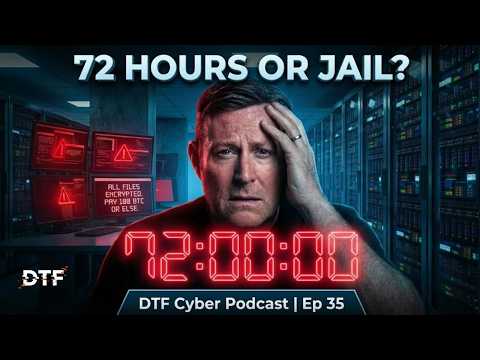
72 Hours to Report or Else: The New Compliance Nightmare
0:00Imagine your sock is melting down and it's 3:00 a.m. and you're staring at a ransom note and in exactly 72 hours is all you have to tell the government everything that happened. 72 hours,
0:15Fern, it takes longer than that for my IR team to pick out the toppings they want on their pizza, much less map out a fullcale exfiltration.
Yeah, that that's the the challenge right now. Damian CISA is in full-blown 2026 tour of town halls because the
0:33industry is officially in revolt.
That's right. This is episode 35 of the DTF Cyber Podcast. It's the Feds versus the firewalls. I'm Damian.
This is Troy.
And it's your boy Ferg. Let's go.
0:55My first thought when I read this is h how do like people even know like okay if you see a car crash like what do you do like if a car starts rolling right you go try and help someone you get out your car you go try and save a life car
1:12blows up in flames you hope you're not near it you hope you pull everyone out everyone's safe right I'm not really thinking about calling 911 at the time Right. And that to me is kind of what this feels like is when something happens, CISA is now saying 72 hours you
1:28have to let everybody know. But it's like there's more important things than telling someone what's going on. Someone else can call 911. I got to go save someone. Pull I got to go save this body out of a burning car. Like how accurate
1:45is that analogy? Yeah, I think it's pretty accurate for but I think uh it's important to note that this is for critical infrastructure to start with 72 hours. I know that's a big field where you're talking about telecoms, energy, gas, power, all this stuff. But at the same time, you know,
2:01we have been getting hit from foreign nations and adversaries for years and maybe some of that's going under reportported. So this visibility may give CISA the opportunity to help us fight back even stronger. So the concern there Troy is is it really just critical infrastructure today? Um we know that
2:19sometimes these kind can you know grow into private industry and other organizations as well. So I guess there's a concern there that you're setting a precedent that you got to do all this paperwork within 72 hours versus attend to the the immediate threat.
2:34Yeah, absolutely. And then I think this also has a 24-hour clock on ransomware once you know that you have a ransomware. I've worked through several major incidents, we'll call them, through my career, and I can tell you that, you know, when does that clock start ticking for that 72 hours? Is it when you and your legal team declare an
2:50incident becomes something significant? Um, or is it from the time of the first detection? So, I think there's a lot of ambiguity there. And also, who gets to decide what's a significant incident because that may be different to me and to you.
Yeah, just quick clarification there. It's 24 hours if you pay the ransomware.
3:09Okay. So, if you don't pay it, no one else.
Well, we've talked about this on Yeah. Should should you be even paying it, right? We've talked about that. So, maybe this is a way to try to limit that.
Well, random question. How many companies What percentage of companies
3:24that have an incident actually pay? Would you guess?
No idea.
No, because I it's hard to say if they would even admit it.
But now, if they have to like if you Okay. Pure speculation. If you were to throw a dart at a dart board, that's a
3:42bad one. If you were just to guess a number, oh, if it was an over under bet, what is the number that you think is the percentage of companies that would have to report within 24 hours if they had an incident assuming this were to be in
3:58place?
Well, right now this is critical infrastructure, so you know, definitely not zero.
Yeah. Okay, that counts as an answer. It's not a very good answer. I wanted a number. Um,
yeah, and if you think about critical infrastructure, we have a lot of
4:13regulations there. Nerk and FK and some of the other, you know, regulations where cyber security is forefront. You know, if you think about banking as well, financial services, you have all these regulations. So, it makes sense that there's a reporting structure in there that gives you a timeline to report because you can't just be
4:29indefinite or never. you know, it's important that we know about these things, especially when it comes to national defense because if you think about critical infrastructure, again, these are uh, you know, national defense systems that if they go down, our population will suffer, perhaps die. And so when life and death happens, I do agree with you, Damian, though, if this
4:45translates into the private sector, we definitely need to talk more about those timelines. So Fern, to back to your question, if I threw a dart at a dart board, I'd say 85% or better of critical infrastructure have been reporting this stuff because they are heavily heavily regulated and they face stiff fines penalties and even having to testify
5:02before Congress as to what they did or didn't do. So very high number probably on critical infrastructure. Private business, I would say that number is less than 25% depending on and we may never know because they don't report. They want to keep that, you know, brand recognition uh and reputation in good
5:17check.
Yeah. But I think most people are up in arms because of the 72hour, you know, limit or where you have to report it within that time frame. That's very very short, right? Like like I said in the open, that takes it takes a long time just to figure out what's going on.
5:33And so 72 hours could go by really really quick.
Agreed. And it depends on when you call it, you know, when you call it from uh you know, my legal team, privacy teams, we always used to have this, you know, when do we call it an an incident? And because at the beginning you don't know
5:49if it's an incident. You're you're investigating it. You're looking for hands-on keyboard type of uh behaviors and their logs. And so there has to be a time that you actually the clock starts ticking as we call it. And that's really once you brief leadership and you start giving your uh board and CEO updates and stuff like that, it's kind of a signal
6:05that it's now escalated into an incident and maybe the clock starts there. 72 hours. If you think about it, when national security is on the line and we're talking about a a gas pipeline, a telecommunications back hole or something along those lines, satellite dishes, those things are super critical
6:20and if we just let it go more than 70 yards, I think we have a big problem.
Yeah. But that's that's almost like along the lines like Fern's open on you see an accident. Do you, you know, spend the minutes that you have to call for
6:35help or I don't, in this case, it's not even calling for help. It's just reporting that this happened.
Yeah.
Or do you spend the time to go and potentially save a life? And I think in this this situation, that's the dilemma here. It's like, okay, do I is it when's
6:51that 72 hours start? Does it start as soon as you realize, hey, there's a significant incident? I don't know. we still have to define significant u or do you report it right away just to be safe and then if you report it right away the
7:08the question is are you making your situation worse because now you're letting the attackers know that hey they were successful and this is how we're dealing with it hopefully the you know the folks you're reporting to such as FBI or the uh
7:23internet crimes center is not alerting the hackers that you've let them know but so if you think about an incident usually you have multiple teams working. So you have your technical team in the sock working on the the bits and the bites. You have an executive war room open. So you got a SWAT call going on your tech side. You got an executive war
7:38room going where your leadership may have uh an executive war room going. They're getting updates. They're providing updates to investors, investor relations, and the board. Um somebody has to have that role. Uh in our company, it was usually privacy attorney to look at client contracts. What is
7:53your um client contract? Say you have to notify your clients. Like that's even more important. Usually our client contracts is 72 hours or less as well. So just adding to their checklist of who people who they have to notify in that 72 hours adding into that the FBI which we always did anyway as part of our
8:09checklist I think is very reasonable. You know I think somebody has that onus and that's part of their job to not notify them. We actually had uh pre-anned and approved communications for incidents internally facing what do we tell employees if they can't get on the local what do we tell clients
8:24externally facing what do we tell investor relations? where we tell our investors in Wall Street. Um, so there's multiple paths here, but I think you have something prepared and someone whose responsibility is not technical, not to focus on something other than the incident, but somebody whose job is communications to these parties.
8:40Yeah. So, I guess the question is what does it mean to report? Is it just notify somebody? Um, so I could see the the argument that okay, we're having an issue. We don't know yet if it's a full-blown incident. And I've got 72
8:55hours to maybe have somebody from the FBI to sit in on our incident response call just as a precaution. Right. That covers covers me as a, you know, as a CISO, but then also lets the government know that we potentially have an issue.
9:14Internet crimes usually cross state lines, so they always fall into the FBI's purview for jurisdiction. And so we had a great relationship with our local FBI team and uh when we did have to report something to them, it's usually just what's happening, what do you know so far? And u they basically they don't get involved. They never join
9:29your SWAT calls. They never jump into the incident unless you need them to of course, but they just want to know what you're doing, what you're working on. They can provide feedback like this threat actor, we know about them. Here's what their tendencies are. Um this is nation state x y or z fancy bear, you know, a28, etc. um a lot of great intel
9:46from our partners at the FBI. Uh but they don't never they never get in the way of the investigation. They never want to join your calls and such. They just want to stay updated on what you're doing, what the impact is, um and and so on. Yeah. I'm just more concerned about how much work extra work that causes, right? So if it's something that's
10:02really easy and it's just, hey, I submit a ticket, done, what do I need to put in there? you know, I because if you take away resources to go and summarize it to hopefully be correct because we don't know what we don't know. We just we're
10:18we're trying to really figure this out in that moment. And like any other incident response team or leader, you may go through an incident and you haven't slept for 2 or 3 days because you're trying to figure it out and you're under a lot of pressure. And so trying to write that up at that moment
10:35is um kind of difficult, right, with when when you're not really focused on writing a report, you're just trying to figure out what's going on. Yeah. Well, so here's something that's part of it as well. So in the EU, they have what's
10:51called the NIS2. Same notification guidelines, but they're going to add in a early warning within 24 hours. So add on in in within the 72-hour window of notification, there's an early warning requirement to
11:07notify. So it's even worse in the EU. Just for context, but figured I want to throw that in there real quick. You ever had your car broken into?
11:22I don't think so.
No. So, I had my car broken into one time and I called the police, try to report it. I had to wait like eight hours so they'll show up just to do the report. You know why? I just saw a recipe that said donuts could take eight
11:38hours to cook. Maybe we'll cut that out. Nah, that's actually kind of funny.
So, so that's I mean my my point is right. It's not not that we don't want to report it. The the point is what's
11:54the urgency to get there? And and Troy, I get it, right? You're you're saying, "Hey, there's some national security blah blah blah. You got to notify more people." But in that moment, I think there's there's just a lot going on
12:09where I don't want to have to worry about making sure my report is accurate because I don't necessarily know. So, I think that's why there's there's this push back
right now. and now they're doing town halls. So, I don't know where this what the
12:26right balance is. I'm not saying it's it's bad to report it. I'm just worried about the 72-hour time frame. Yeah. So, I think you made an important point is it's a it's a strain on your resources, right? So, if
12:42you were to ask most people in cyber today how they feel about their resource availability, they would say it's pretty tight. there's not much time to, you know, go off and do side projects. If something happens, they need all hands on deck. So now, if something happens, you know, go write a report and send it
12:58off, right? It's like people should be focused on recovering, right? Getting out of the issue, kind of getting through it versus having to spend time trying to send something off to someone that honestly. So, okay, let me ask you this. I mean, this is for Troy, too.
13:16We're just going to assume that power plant had an issue, right? You now notify whoever you need to notify. What does it actually do other than just like let them like draw some sort of um uh not not a um maybe like connect the dots
13:33if there's multiple things happening at the same time within a 7-hour window outside of them correlating different um infrastructure um we'll say groups as being under attack potentially what does it actually do like for me
13:50like now now now we know everyone's being attacked but I think we knew that when all the lights shut off, right?
Exactly. I think you're spot on, Fern. That's the major concern is like how do we put the dots together because right now, let's think about an attack. Fancy bears hitting our critical infrastructure. They're using the same
14:07attack when the same TTPs in a 100 different places and you have a 100 different incident responses running. We don't know that they're all running in synchrony. And so what happens is once you start putting those dot together, you can look at IP addresses, you know, tactics and techniques and different
14:22malware types that they're using and you solve it once rather than a hundred times individually. And so by being able to correlate those things faster or share that intelligence, um, it's going to be able to eradicate the threat faster and and prevent it down the road.
Troy, does does CISA have that ability though? I mean, can we just
14:39differentiate? Is this the FBI is not CISA and they operate differently? So if I report it to the FBI, does that count as a CISA report or do I need to report to the FBI and then also turn around and report it to CISA? So you see where I'm going with this. It's like how much
14:55paperwork do I need to do? How many people do I need to notify and then to furn what you're saying? What good does that get me in that situation under pressure?
Yeah. Or if you
It's the same reporting mechanism in the IC3, right? So the IC3 is a reporting
15:10mechanism goes to CISA and FBI. They do share intelligence and actually there's an NSA uh and FBI and CIA person sitting within CISA who is doing the corroboration of this data. I've actually met those folks doing it. Um and they they look at it from all agencies whether it's foreign or or
15:26domestic and they correlate that. Now FBI is responsible for building a case a criminal case. They're going to take these people to court. They're going to try to extradite them and such like that. However, CISA is that agency that can protect the critical infrastructure, help the people uh eradicate the threat
15:42actor faster, maybe even send resources to be hands- on keyboard, let's say if it's at a power plant to help them if necessary on the OT side, the IT side. So, there is a huge partnership and we call it the public private partnership with the government and I know um you know it sounds like it's very disjointed
15:58and siloed, but what we're trying to do here CIS is trying to break those walls down and actually share intelligence more smartly across the US. Okay. I don't I'm not sure is it's that clear though. Have they published that this is the requirement and this is how you submit a notification.
16:15I haven't seen the the report necessarily. Just saw the headlines where we're talking about reporting requirements sending people into a frenzy. So I know people are up in arms but you know we have some good folks. Sean Planky at CISA is doing a great job trying to get the word out continuing on Jen Easterly's success there of really
16:31uh bringing the message to the folks. So um hopefully they'll put out something. I'll if not I'll I'll poke them as well and see if they can't make this a lot more
Well, I think that's the point of the town halls though, right? Have the conversations. Yeah. Well, not or get the word out, right? Let me ask you this though, Troy.
16:48Uh I have an I have an incident. I report it, right? What's the one thing everyone always wants to know? What's in it for me? Like, what do I get out of this? Like not only do I have to report it like I'm telling them like you know tattling on like a little brother,
17:04little sister. Now I have to take the time to do that but like notifying these governing bodies. Okay, they might be able to help me, right? They might send some resources but like what's the benefit to the people? Because like when you think
17:19about like oh say obviously public sector is different than private. But if I say private it extends into private what do they care about right? Money making money staying open. So
and not going to jail.
Yeah. So like what what's the benefit
17:35for a private company to to do it or take the time and and take resources they may or may not have to even notify someone that may it may not even matter because it's not public infrastructure. Right. So I guess I'm going beyond where it's at today. But I think the um
17:52presumption is if it goes well they may just extend it and then what happens there like when you set the precedent what happens as it as the line moves right and when you think of private sector versus public the main thing that matters is ROI and money if you don't
18:08talk that like doesn't matter to most people make making those decisions. So like if if it goes to private like what is the benefit is there? I don't think there is.
Yeah, good question. And I think that you know we're really extending our
18:23reach if we say that this is going to extend into private because as you think about it the private sector has their own regulations whether it's sock or sorry uh HIPPA or one of those other type of regulations where they have mandatory reporting guidelines. U but let's say you're a private company you're not publicly traded. You have no
18:38PCI requirement. you have no healthcare data, you have no regulations, and I know a lot of business owners in that space, right? Um I cannot see our federal government or anybody else, you know, poking and proddding into those areas demanding they report things um
18:53today. I mean, that would be a huge stretch, a huge leap. I think what we're seeing here is a reaction to a lot of foreign adversaries who have been attacking critical infrastructure and the US trying to get ahead of that and support it. We saw, you know, hydroelectric dams under attack. We saw a water system in Florida that was
19:09compromised by a foreign adversary across their, you know, team viewer. Uh, so we've seen tremendous amounts of interest from foreign nationals trying to get into our, you know, critical infrastructure. I do not see this ever going into the private sector without significant debate legislation and our
19:24Congress and Senate having a voice in that as well.
Okay. So, it might not, but according to my my notes, here is the controversy, right? So CISA's broad definition includes 30,000 entities
19:41because they exceeds the SBA size threshold whether or not they're critical. So I think that's a that's a important nuance. A distinction there is like a midsize furniture furniture company is now on the hook just like a power plant or nuclear power plant.
19:56we'll say that because of their size and how they how they're outside of the SBA um guidelines for sizing, right? So that's that's part of it as well. And that's I think that's really the issue at hand is why
20:12so does it does go beyond just critical infrastructure is what you're saying.
Yeah, it's it's it they list it as a co or a covered entity, right? So covered entities qualify in this case. So if they are beyond the Small Business Administration size, what's that? What
20:27what's that size? Uh let me check. I can find it real quick.
It's very interesting if it's um company size put you in a critical infrastructure domain because as you know there are 16 segments of critical infrastructure that the FBI is tracking from nuclear to to uh telecom, energy,
20:44gas, etc. Um just because you have 50,000 employees does not mean your critical infrastructure by definition of um for what I'm familiar with.
Um okay. So I I did a search on that too. The sectors were water and
21:00wastewater. So I get that energy, uh financial services, healthc care, and then I see in here tech and cloud MSPs. CISO wants to report on upstream open
21:16source flaws and that yeah I think it's it's interesting uh because maybe this does reach beyond just critical infrastructure I think there's probably uh we talk about this
21:31all the time third party risk that would be supporting critical infrastructure anyways
yeah so I'm looking at I'm looking at the uh the notes here so the sizing the limitation is from 100 to,500 employees, right? Or
21:48um 2 and 3/4 or 2.75 million to 47 million in annual receipts.
It has to be above that to be outside the SBA.
Yeah. Over 2.75 million, right? So basically between we'll just call it three 3 to 50ish, right? So those are
22:07the numbers. So how many
Yeah, I'm going to challenge that one for on reporting requirements. Um, I'd love to get some clarity from CISA on what defines critical infrastructure, but I can't see a a 1500 person, you know, company, yeah, that has 5 million in revenue having to report as critical
22:23infrastructure. It just doesn't match my understanding of what this is intended to do. But, um, to go back to what we're trying to do here is again to, uh, bring knowledge and intelligence to those who are fighting the, you know, the bad guys on a daily basis. I think we've seen a
22:38very big under reporting, especially as it affects things that are important to our daily life.
I No, I I agree with the under reporting piece, right? That's it's terrible not to not to report it, but I'm not challenging that. I I think for the the greater good of the community, we'd like to know when these
22:55incidents happen so we can break them down, right? Right? Because I always talk about look at past incidents and then reverse engineer that to make sure that your organization doesn't have the same problem or fall victim to the same methods of attack or just awareness,
23:12right? Like you see a bunch of cop cars, you know, don't go. If you look on the news and there's someone doing some robbing a bank, right? Don't don't decide it's time to go withdraw money or deposit money at that same branch, right? Like I think awareness is important because perfect example uh
23:30when was this? This was uh just before Christmas. I was with my daughter and we were at Target down the road here. Literally just like down the road and I heard gunshots, right? Like and I'm just walking there. I'm walk by the we're by
23:45the door. I'm like, "Okay." Like I'm ready to go. Right. I look around and I see a bunch of like teenage kids just walking, having fun, doing Tik Toks, whatever they're doing, like shooting videos down aisles. I see other people just walking like they didn't hear anything. Like, do these people not
24:01realize what a gun sounds like when it goes off? Right? So, I'm sitting here. I go check out. I'm looking out the doors like literally with my oldest daughter. I'm just like looking around. Get to the car, go home, right? I get home and the next day I look into it.
24:18there was a shooting just behind the target uh in a neighborhood, right? I was aware these people weren't. So, I was prepared if in case, you know, I need to get like throw down, right? I was ready. I didn't have a gun on me, but I had a knife in my pocket. I was
24:33ready to start, you know, chopping. But the thing is, I was aware, so I was prepared. So I can understand that aspect of you know the awareness part but like outside of being aware and like avoiding it or just you know being a
24:49breast to what's happening I don't really know if there's much benefit personally my thoughts
I don't know it's a little bit it's a little different because what's the vicinity in the online world
25:06click away I mean it's pretty I mean the world kind of collapses on just like a few milliseconds, right?
Yeah.
So I So there it's important, right? Um just like physically, you know, being aware of what's your surroundings is important, but I don't know, maybe maybe
25:22I'm just looking at it from the wrong lens. Um again, I guess
I think there's a balance here, right? I think there is a a need for the right you know critical infrastructure companies to report these things when they happen so that we can prevent you know any loss of human life or uh
25:38anything of that but also there has to be a line that it's like you know not these companies because they're not necessarily critical infrastructure I don't know where that line is defined I have to look that up exactly
well the other thing we need to define is what's considered a significant incident
25:55oh like what's what they what counts as measurable I think is the term that most most lawyers
ask ask a 100 attorneys, you'll get 1500 answers. That's true.
Um, meaningful. Let me see here. So, well, I mean, so I know that if you look
26:13at violations for HIPPA and and the HHS for example, you know, they they break it down by number of patient records that are lost.
Okay? But a lot of times you don't even know within 72 hours how many records
26:29have been affected. That's that's a tough one.
Yeah. And then if you if you report incorrectly and they find out after you like a final report, like what happens then?
Well, that's what I'm worried about. Right. So if you think about it, you're a CISO, head of security for one of
26:45these organizations and you go to report it, but you only know what you know in 72 hours. What if you're wrong? And what are the repercussions if you are wrong?
Oh, so here here's an interesting aspect
27:00of it. So yes, you have to report what you are aware of and what is known at the time of the incident, but what you have to preserve and retain what they're calling uh minimal telemetry. So you can actually support what you provided at a later date. So it's kind of like, hey,
27:17we just got robbed, but we don't know how much they stole, right? Um, if someone broke into your house, right? Hey, we had an incident, but we don't know that we don't know the extent of the damage. But then you have to actually provide that.
Okay. So, I like I like that analogy like your house just got broken into
27:33when you call the police.
In this case,
what are most incidents, cyber security incidents caused by
somebody leaving the door open?
Right. So, yeah. Or a user and somebody who's inside let somebody in by
27:49accident. So you don't necessarily know if you've been robbed yet.
You just know you have indicators, right?
Think that yeah, maybe you had an intruder, but you're not sure. And so a lot of times that's how it starts off. So at what point does that 72-hour clock start ticking?
28:06I don't know, like when you see damage. I don't know. I think it's probably something they got to consider, right? They obviously they have they have this you know three-day window or one day if you're in the in the EU but um they are saying there is a the initial report
28:23must have a minimum viable content right so according to the framework um it has to be credible but it doesn't have to be perfect it just you just have to provide reasonably what you're what you're aware of and then supplement it later. So, it
28:40seems like there's somewhat of a um tolerance, if you will, on what you provide versus what is actually accurate. But I think when you have something like that, what ends up happening is just like, oh, hey, you know, we're having an issue. We don't
28:55know. And it's just like fire it off and then 4 days later you actually provide the work. So maybe maybe the issue of like resources and constraint is less of an issue if you just like hit like you know like have have some sort of framework internally like I know Troy mentioned in the past whenever there's an incident you always have the the
29:11incident uh response plan printed right you have a physical copy of it so maybe people just like set up where they just notify these different bodies and say hey you know click goes and then we'll figure it out later right maybe that's the workaround but um yeah they're
29:28they're defining it as minimum viable content. So something not 100% accurate, but it doesn't have to be.
Yeah, because we know incidents change all the time, right? The facts are not going to be the same as within your report. So you need IP addresses, dates and times, and you know, just a basic
29:43description of, you know, what the event was that caused it. But again, going back to significant incident, most incident response plans have some kind of threshold that makes it significant to them when they start reporting up to leadership or something that there may be a better definition from this paperwork that we haven't seen yet. But,
30:00um, I think that there should be somebody in charge of that communication and have some pre-anned forms. Um, there's even software out there that I know that enters into like, uh, the breach response that can shoot off stuff automatically to all the stakeholders and keep everybody informed. pretty cool
30:17um software. But yeah, so I think it should be
well, you know, with that Troy comes somebody's going to leak it.
Yeah,
but that's always the case, right? And you're sending it out mass communication. Hey, this energy company
30:32is having an issue and you broadcast that across all critical infrastructure. Well, somebody in there is going to leak it.
Yeah, I was referring to like there's an automation. So, it goes to your privacy council, goes to your CIO, your CEO, you know, depending on who you add to your group. Internal, not external.
30:48Oh, internal, not external. Yeah.
Yeah. Yeah. Yeah. Yeah. But you can automate it to go to uh law enforcement if you want. You can add that in as an option.
Yeah. I don't know about that.
No, never. Troy's over there like,
I want I want to make sure I want to
31:03know what's going probably wants to know what's going out.
Yeah. before we could ever release to law enforcement. Um, we always had to have legal counsel sign off on our general counsel because, um, you don't want to open the door if you don't have to. And I don't know how, you know, you
31:19go around that legally, but you know, once you open that door and they have a vision in, they can say, "Oh, well, you weren't prepared. You didn't have this checkbox. You didn't have this done." You know, and now you're looking at uh into the face of
That's what I'm worried about. Right. It's not like So, if I get pulled over and the cops say, "Hey, can we take a
31:36look in your car?" Well,
no.
Yeah. Like I got nothing to hide, but I'm not consenting to a search. So, it's not like I'm trying to hide anything, but I'm also not trying to let people rummage through our business if if they don't have to. Right.
Yeah. It's kind of like um when they
31:51read you or before they read you like your rights, right? A lot of times they'll say, "Hey, like do you mind if we do this? You know, do you do this? Do you can we do this?" And it's like, "Um, don't say anything, right? I need a lawyer, right? Give me a lawyer. What's
32:06your name, sir? Give me a lawyer. Right? Because what do they say? Uh part of the Miranda is anything you say can and will be used against you. Like it's not it's not to your benefit to speak. Right? So in this way, it's a lot very similar where it's not necessarily in an organization's benefit to just like
32:22spill the beans of what they have. It's kind of like um I don't maybe I don't know the right term but like least privilege access to this information is probably the best way to keep it because even though it's technically the government it it kind of reminds me of like HR teams like they're not really
32:38there for you. They're kind of there for the company, right? Like making sure nothing bad happens.
Um
yeah,
or so I've heard.
And and then no then it goes to well if they take the information how do you know that they're protecting it? Right. Right? So when we do third party risk, we always ask the vendors, you know,
32:54what do you do with our data? What do you do with it after you don't need it anymore? Do you destroy it? Are is it encrypted while you have while you have it? So I think there's a lot of questions there with, you know, CISA. What are they doing with it? How are they handling our data once we submit it to them? I think there's a lot of questions there that probably need to be
33:10answered. But maybe the one thing that they can do is at least operationalize it right internally if if it ends up getting approved is people just have some sort of like framework where there's like a list like a bundle.
Well, think about it this way too. I mean in any sock we're always worried
33:25about getting too many alerts.
How many false positives are there? We can't keep up with them.
What happens in this case, right? Are they even structured in a way where they have team members always looking at these and what if they get too many alerts and they can't investigate them?
33:41I think it's just copy. I mean, this might be very like anecdotal, but just copy paste. Just set aside a partition on your sand and just like dump everything and say, "Well, that's for that. We'll we'll get to it later." Like,
well, that's what I mean, right? So, they're they're saying you need to give us the ad information in 72 hours, but by the way, we'll we'll review it over
33:57the next two years.
Well, we'll give you a final uh print out of your report. Uh but just make sure you get it to us. No, I mean
yeah, I think the challenge here that CISA is really trying to overcome is exactly what we're talking about here. Everybody's so worried about letting stuff out to the government that it won't be taken care of or that and so we
34:14end up fighting fires one by one a thousand times a day that you know these bad guys are just have taking us to lunch. You know, they're eating our lunch because we're we're running in silos. We're not sharing anything with anybody. We're like protecting our own little thftdom. And uh you know if we could just learn how to collaborate
34:30better. You know like we always talk about the hackers share information freely and they're making money every single day. We're all sitting here in our little you know offices going I can't tell anybody about this because it's my kingdom and I don't want people to appear in here. There's a balance between those two things and I can promise you that. I don't think the
34:45government's coming in to try to you know put you on the spot for not doing something you should have or you didn't have the right protections in place. But at the same time, I think it is on CISA to do these town halls and get people comfortable with the fact of information sharing, you know, make to build those walls down. So, it's a it's a tough road they have.
35:01Yeah. Well, I think um when you when you think of it from that context, like just maybe doing it is good. It's good for context. It's good for like awareness. Um so, just I mean try I'm sure you know this, right? Um because you know a lot about the banking
35:16world, right? So, in the banking world, they have to report to the SEC, FBI, and Treasury. So, now let's just add the seesaw on there, right? What's if we're already doing three, what's the fourth one going to like? What's the issue with the fourth one? Um, so I don't know. I
35:32think it just to me it just feels like um you guys remember Office Space when they're like, "Hey, do you guys TPS report a uh where's
you forgot the cover letter on the cover page? Don't you know that you supposed to put a cover page on your TPS?"
Yeah. And then like this almost feels
35:48like the Bobs like showing up and hey what are you guys doing like what do you do here right it's like oh
collect flare or whatever they say in the movie I mean that's that's the the problem here right I'm not saying that it's bad to collaborate and share
36:04information I think when it's mandated from the government it people kind of get their you know their wall up because we already have industry verticals or industry organizations Right. Let's take the ISACS for example. There's one the ISAC. So there's health
36:21ISAC, there's FISAC for the financial, right? There's IT IsAC. There's um so we already have these industry verticals where we can do knowledge sharing right in between and we already have
confidentiality agreements,
threat sharing, stuff like that.
36:38It's when it's mandated on you and those are all optional. So your organization doesn't have to if you're in healthcare you don't have to be part of the health ISAC right you you sign up and you pay a membership fee and you become part of that group and you can you now you're
36:53amongst people that think in the same way and want to share information I think when it comes to the government telling you you have to do it that's when people are like whoa whoa wait a second here
no one likes to be controlled right or told what to do like we're adults here
37:09right um But when you were saying like these different bodies that people can be a part of um I was thinking what about um Infrogard isn't that like their whole thing right I mean
that's like a private public private um
37:25collaboration with the FBI
so public private not just uh critical infrastructure only but critical infrastructure falls within that domain doesn't it u be one of the 16 I think you have to be one of the uh domains to be a part of FBI
37:42infrogard. Yeah, they focus on those 16.
Yeah.
So why can't they just like have infogard like manage it? Like infrogard is already collecting information
because they're all they're also segmented
and they're voluntary too. Yeah.
Yeah. And they're voluntary as well. So I mean that's another example, right? So you may you may do that. That might be
37:57another group that you participate in and share information with.
The fifth group.
The problem is that voluntary is exactly that, right? Some groups are going to be really great like FS Isac is the best ISAC in my opinion. Um but then some are going to be terrible at information
38:13sharing. So you're going to miss a lot of stuff. I'm not saying that we should go to regulation. Not not at all. But I do think that we do need to have a better standard. Maybe there is a better standard that we have for information sharing across all segments that is somehow um you know matched up for quality and consistency.
38:29Yeah. Make it consistent. I agree with that. I just don't know how I feel about all these reports. Right. But I think
Yeah. And if and like you mentioned earlier, if you're reporting to the FBI and the SEC and to CISA, I think all that's all one place. I'm hoping that you know I know FBI and CE are the same
38:45place as I I see three. Um SEC might be a little bit different because they have their own rules and regulations and such from the Treasury side. Um yeah, but we got to simplify the reporting requirements.
Yeah, either simplify the reporting requirements or just make it easier for
39:00people to just package it up and just like
send something. So, so here's my thought is when you force people to do something, you get the bare minimum effort, right? If it's not voluntary, like they don't actually
minimum number of flare. How many number of flare do you have?
You're a minimum flare kind of guy, huh?
39:17It's like, so here's a requirement. It's like, all right, cool. Like, I got flare. And maybe you just start reporting like the the least amount of information. Like, how valuable is it? I don't know. Maybe it's useful, but like you don't actually care. You're just kind of doing it because you're being told. It's like, I have kids. go clean
39:34your room. All the clothes that are in their room are now stuffed in a pile in their closet. They're not washed. They're not put away. Nothing's been vacuumed. It just looks good. But like they didn't actually clean their room and it annoys me so much if the I mean sometimes they the kids listen. So this
39:49is for you guys. This is for you girls.
Clean your room. But
how many times have we talked about your kids closets on this show? I love that
a lot because it it really annoys me. But it's the same kind of thing. It's like if someone's telling you to do something and you don't actively want to do it, like what's the what's the
40:07probability that you're going to do 100% effort as if it was something that you wanted to do? Like a lot of times people want to go snowboarding or skiing, right? They'll put all their time and effort saving money to go out and do this, but you tell them to go to the gym
40:22and they're like, "Oh no, I'm not going to go to the gym." Right? Maybe that's me. But it's like minimum effort when it's when it's being asked of you, maximum effort when you want to do it on your own. I don't think I'm wrong there. But maybe there's room for nuance. I don't know.
40:39Has anybody here ever done an IC3 report? By the way, Damian, have you done that?
Yeah. Yeah, I have. I've submitted on the uh on the through the online.
It's absolutely cumbersome and takes forever. They have to simplify that process because if that is the process, nobody's going to sit through that after
40:55page two of of 10, you're like, I'm done. This is too much.
Yeah. So, I I know a lot of people, and I won't say who uh will just text somebody they know
in the FBI and say, hey, this is going on, you know, can you is there something
41:10you guys know that's going on or should I report this?
And the response back is like, oh yeah, yeah, no, no, no worries. We kind of know that's already happening. Or in the odd case, it'd be like, "Here, fill out fill out the uh the form and get that ticket submitted.
Give us a little give us a little juice."
And then you try to milk them on, "Hey,
41:27what do you know?" And they're like, "Just submit ticket.
Submit the TPS report real quick."
Or, you know, I am a silver lining kind of guy. There's a business opportunity here for a company to come out with an AI tool that just does this for
41:43everyone.
Like,
I don't know. That's probably worse. Yeah probably
the AI will just turn it against you and use it and extort you.
Yeah,
bot.
Yeah. Or or OpenClaw, right? So, OpenClaw now has this new feature, new module. It's like, are you reporting to
41:58uh CISA? Yeah. Like, click here. $50,000. Uh, okay. So, we talked about the minimum telemetry. We talked about the fact that like if something's a burden, right, people probably aren't necessarily going to do
42:14it. Um the next part is
Well, no, they're going to do it.
Well, yeah, they're going to do it, but like to what extent? And if
Well, because if you don't, you're going to get fined.
Yeah.
Or I don't know if there's like even jail time potentially.
But does it become minimum effort or like maximum value for the the the
42:31governing body that's requesting it? So, it's like kids in the room in the closet, right? It's just like
Right. It's just like you're you're probably going to have to not only write it up, but give it to your general counsel.
Mhm.
Right.
Mhm. Well, you're for sure giving them a lot more than you're giving the government right?
42:47Oh, I don't know.
Speculation. I think legal counsel should know everything because they're the ones that are kind of there to protect the business, right? So,
I mean, there's there's cases in the past where the CISO has gone to legal
43:02counsel and
the CISO has still been charged.
Troy knows those people.
Joe Sullivan,
I was going to say. Yeah.
Sorry. We love you, Joe. Thank God that went the way he did. But
yeah.
Um, so I don't know. I think it's I think it's tough to say, but the one
43:20part that everyone knows that is part of an incident is the ransom, right? Maybe it's 4:00 a.m., maybe it's not 3:00 a.m. Um, the 24-hour rule. So, if you pay, you have one day to tell CISO.
43:37Quick question, like why does that matter? Like I like maybe Troy would know like
well okay if you pay you have 24 hours to tell them.
Yeah
but
you would already you would have already known. So you already CIS would already
43:53have to know because you have to report that you had an incident.
Well so they know you have an incident but like are they like keeping score of like who paid who didn't? like what's I if the well we've talked about before is you know just the general rule of thumb is just don't pay right you shouldn't
44:08have to pay if you have everything if all your ducks are in order ideally right if you have this defense in layers right as we always talk about um and something happens you should have enough things we'll say protection wise to get
44:24you through it without having to pay so if you end up paying something broke down at some point along the way So whether someone pays or not, like what does it matter? Like the I feel like right, so just based off of that statement that I just made, what I feel
44:40like is if people do pay, what they're doing is they're opening the door to let pe other bodies know that they weren't able to fully recover without paying. And then that becomes an issue with insurance companies because now if insurance companies know that you paid,
44:55they're also aware that you couldn't fully recover on your own, right? and what happens to your premiums at that point. So, it's like paying this bill or paying this ransom isn't in your best interest, but if you have to like maybe just get it done, right? I don't I don't
45:10know. I don't know the process for paying. So, you just pay, hey, we got to get our stuff back. Like, get back online. But now all of a sudden, now you report this to CISA and they're like, hey, you know, look what these guys had to pay. And the insurance company's like, oh, no, no, no. That's premiums just went up, buddy. Like is that
45:28obviously I just made that up. Is that pure speculation or is that like is that reasonable?
No. I think there's a lot of organizations that probably can't recover on their own. That's the reality of it, right? They're just not um they don't have the right tools or they're not
45:43designed in a way to recover from an incident like that.
But who benefits the most by knowing that? Assuming assuming like there uh you're in custody for a crime whether you committed it or not the minute you speak that's being used against you right so as you speak that benefit
45:59becomes more so a liability or speaking is to the benefit of the like the governing body like the police office right so now if you say in business by speaking about it now there are parties that are aware of it that have an
46:16incentive to to know Well, what Troy is saying is that you're reporting it to CISA, so it's confidential within the government,
but is it?
Yeah, that that was my question, right?
We have to we have to take some leaps of faith there. I think uh you know, they they should protect our data as much as
46:32possible. But and to your other question, firming with insurance companies, you know, if you do pay a ransom, of course, you have to divulge that in your insurance writer every year and uh they have you questionnaires and stuff. They'll know in between insurance companies. They share that data.
That's usually a question.
That's usually a question. Have you had
46:48any incidents? Have you
It's like it's like getting a a traffic collision. You know, your insurance is going to go up. They're going to share the information about that on the DMV. It's going to go on your license, etc. So, uh, yes, your insurance may go up. The the answer is to pay or not to pay. I was hoping regulations would actually
47:03go a little farther here. Well, now that sounds crazy. Don't don't hold me. I wish we had a law like Australia does where you cannot pay a ransom. If we stop paying ransoms, period, the the stuff would stop, I think. And so, um, we're not even close to going to that level. Uh, but I would love to see us
47:20get a lot more strict on paying the rent. So, 24 hours after you pay that, I think is reasonable because you've already divulged something about an incident within that 72-hour window. Now, you've paid. So, I think it's very reasonable to to let them know that.
For the most part, I I agree with that, right? We probably should stop the
47:36payments. But I wonder about, you know, let's put a healthcare organization for example, where there's patient lives at risk and there's just no way this hospital can recover from it, right? It it's and their only option is to pay to
47:52to hopefully get back the systems online. I I you know, that's a tough one because I don't want to say don't pay and then you've got let's say 100 lives that are dependent on these systems. Um it's even if you outlaw it, I don't
48:07think that organization will have enough money to go and rightsize their systems to make sure that it's not, you know, not being hit by ransomware or they can restore properly from a ransomware incident.
48:22Yeah, agreed.
So, I don't know the right answer, but I'm with you. I'm like I would lean more towards don't pay but I know that there's times where you you just don't have a choice. So I can't really fault those organizations for making that decision. So
we we live I mean one of the things
48:39about United States is hey this is a free country.
You can let people businesses make those decisions what's right for their organization.
Um so maybe that is a the way we're kind of approaching it in the United States and not like Australia. Um, but I I'm on
48:57that side a little bit more of hey, I can't really fault a business for making a business decision.
The problem on the greater good though, what you're saying, Troy, is if the attackers know they're never going to get paid, they wouldn't do it.
Exactly. They were stopped. But here's
49:12another thing, you know, if and this goes out to all the companies listening here. If you invest in backup solutions and some basic cyber security hygiene, you could prevent 90% of these things from being successful or to take you to the point that you would have to pay a ransom and not be able to back uh
49:27recover from backup. So, you know, just a little pre-planning and spending goes a long way to, you know, instead of being rolled over a barrel, having to pay millions of dollars uh in a time of crisis.
Yeah. Speaking of backup companies, perfect timing for our very first
49:43sponsor. Just kidding. No one's paying us for this. Um, that would have been a good one. Like if we had like a company paying us for backup and recovery services. Yeah.
Boom. Right there.
So, if you're listening, you haven't worked at these companies. What is the
49:58email? Is it
DTF?
DTF cyberpodcast.net.
Yeah.
Your ad could have been right here. Perfect timing. It could have been right here, but you didn't know. Now you know. Give us a ring. Um,
50:13okay. I think, uh, let me see here where we're at on time. Probably a little bit longer. Um, the deadline, May 2026. I didn't realize it was so close. Right almost at the end of
50:28February.
Uh, so do you think they're doing these town halls for awareness or maybe getting feedback? Mhm.
Um I think everything we talked about here is probably going to be discussed at the town halls and maybe more. Uh I don't know if I'll be able to go to or
50:45be invited to a town hall. Not part part of any critical infrastructure I don't think. Uh Troy, do you think you'd be able to make one of those? It'd be interesting to
Yeah, I'm I'm going to actually look at the schedule and see if I can crash one and listen in because I'd love to see that.
Is it only open to critical infrastructure or is it open to the public?
51:01I I don't know. I'll have to do some research on that. I am still part of the FBI Infard here in Las Vegas. So, I'm sure that if they have one locally or on the West Coast, I could find a way in, but I would love to hear, you know, from CISA what they're up to.
Yeah. So, this uh my notes are basically
51:16saying that the whole point of the town halls is to uh deconlict like whatever ruling that they end up coming out with.
Yeah. Because I think there's a lot of still a lot of questions. Uh May Yeah, May is very quick.
Yeah, it's like just a few months away, so there's not much time. So, it's kind
51:33of like you either get with the program or you don't or you just, you know, whatever happens happens and you just got to deal with it afterwards, right? Um, yeah, I have a I'll check the schedule to see. Obviously, I'm not part of any of that, but I'm sure there's a lot of people here in Arizona that that would be part of that. Like, especially
51:49with like the infrogard team, like Frank and um his whole group of people that he knows from the infrogard. I'm sure they're going to be in some of those meetings. So maybe we just ping Frank and say, "Hey, like what's the latest?" Right.
Yeah. Or we get somebody on here to talk
52:05about it in more detail once they get through the town halls.
Yeah.
Yeah. I think this is this is a different topic and episode that we've dealt with. We haven't really covered compliance requirements to this level. Um, a lot of people who obviously tune
52:21in to our podcast, they're starting their careers and they a lot of them want to be pentesters and they or they want to be in the sock, but they don't think about what the implications are in terms of requirements for government reporting.
52:36Mhm.
Well, it's part of the job, right? Yeah.
It's part of the um well, well, how many pillars are there of cyber security 16, right? Okay.
Oh, so 12 pillars of cyber. Oh, you're 16 on the critical infrastructure right?
Mhm. Yeah.
52:53Damn, that's a lot. That's a lot of different areas, but GRC is a very important one. It just doesn't get as much uh as much love as the offensive side.
Well, I mean, look, here's here's the problem, right? We we already are under
53:08a lot of pressure and stress and especially when you're trying to figure out an incident
TPS report.
Yeah. Do you really want to
figure out what can I write down? And again, not give away too too much information, but at least do the the
53:24minimum that doesn't get me in trouble.
Yeah. Right. Just just the bare minimum, right?
Yeah.
I do that a lot in my life. My wife's like, "Hey, can you do this?" I'm like, "Okay." I do just enough not to get in trouble,
53:39but enough to where it's like it's not like a burden, right? So that's why you know
but it's not here's the thing though it's not that one time report because it's initial report and then as you learn more you probably have to give more information and then more
53:56and then more and so until you have a final report that's a lot of paperwork.
Yeah. It's like when the honeydew list is one thing and you start doing that and oh by the way just add more work just more more more done. I got to go I'm on vacation. Right. I guess I can
54:13say how it's important. I think it's important for um so when I talked with Frank probably like a year ago, he was telling me how Infrogard is kind of like um uh not necessarily guerilla warfare, but it's a an evolution of warfare,
54:29right? And at some point it becomes a network of networks versus a network of networks, you know, instead of how it is. Um you know,
yeah, but so most people outside of Arizona won't know Frank. So Frank Grimman,
he's a legend here in Arizona.
So when I talked with him, he was
54:45telling me how the whole idea with ACTRA, right, was a network of networks where where public and private can come together. Infrared is, you know, kind of part of that. Um, but with ACTRA, it's kind of like the sharing of information,
55:01uh, anonymized information, right? So I can see the value in that. But then again like so um I know of of a situation where someone was dealing with something and they reported it to the acture team, the actor group and then
55:17those people collectively came together and they had a meeting with a bunch of different people, bunch of different organizations sharing that information. And it has something to do with like a remote desktop hack that organizations were affected by because they all use the same software, right? I'm not going
55:33to name the software, but they were all using the same software. So, everyone was made aware of it. They kind of did the things to make sure that they weren't in the same situation or not in the situation, but vulnerable. We'll say they weren't vulnerable. I see the value in that.
Yeah. But see, that information is also
55:49shared across the Isax.
Mhm.
Right. So, they are talking about different tools or potential vulnerabilities. Um, I mean, I'm sure Troy, you have this too. We have I have a group of CISOs that talk about things that uh you know
56:07they they won't discuss publicly and we won't name names
uh but if they see something they they mention it to the group
and ask you know is is this something that you guys are seeing as well and so there are these informal networks as well that's already collaborating. Yeah,
56:22100%.
That's gonna happen, right? But like what does a paperwork actually get me is what I'm thinking.
What gets you to stay out of jail and stop paying fines.
Yeah, exactly. Um, you know, as Chattam House rules, we go to so many meetings, Damian, with CISOs and we talk about the
56:38realities of what's hitting us and that's a great way for information sharing and so much stuff bubbles up in there that helps me in my career. So uh imagine if we could do that at scale and I think that's what CE is trying to do and I know how difficult it is to break down some of these walls of trust and just understanding really it's really about understanding the true impact of
56:54this information. So hopefully they can do that.
Yeah, I I'm not against it. I know some of the things that I say makes it sound like I'm just was like this dude's not even a ceiling here.
57:09I know not to ask you to search your car. That's that's what I learned on this podcast. Exactly. It's I think but it's just more so like
general thoughts like average fern thoughts right?
Um maybe if anything is a different perspective and the opinion of that
57:25perspective is like oh yeah like this guy's actually right 90% of or what is it? What is uh the Panther thing is like it's works 60% of the time every time. You know what I'm talking about from anchor man.
Yeah.
Exactly. Yes. 60% of the time it works every time.
57:40That's me. 60% of the time I'm I'm right every time. Um, and maybe it's just because I I'm not in the same shoes as you guys, but outsider perspective is probably maybe what I'll just chalk it up to. And to me, when I take that of
57:56what is kind of being put together and I I kind of like mirror that or draw parallels to like my own personal life, it's like, dude, like this is
Well, that's why this discussion is is interesting because I knew obviously Troy with his experience and being on
58:13the side of, hey, you know, the government's trying to do right by by everybody. And I I get that. And then you got me who's a little more skeptical like, "Hey, I I see it, but I don't want to like just open up everything for the government."
And I'm like the cooling man just
58:29bursting through the wall,
you know? So, we all we're not all on the same page. We have different ideas on this. And I think that's common when they get to these town halls. You'll probably have people are are, you know, they get it. They they want this to happen. Uh, and then on the other end of it, you're going to have people
58:45questioning, well, what how much more work is this for me?
Yeah, I think it's it's it's it's good. It's valuable, but at what cost, right? Can I justify the expense? Do I see the ROI in the time and resources of my
59:01already constrained team being sent to do this, right? or is there a way to operationalize it? But how much time is that going to take away from things that actually, you know, we deal with on a on a daily basis? Or we could just say things that matter, right, to us as a
59:16business for our business, right? Making money. Um, I don't know. I think Troy, you definitely have to get into one of these meetings uh
and let us know what what happens because I think maybe we have another follow-up episode towards the middle of
59:31the year.
We should. I think we should after we go to these and we hear from our peers as well, maybe have a follow-up on this one
and have a guest come on.
Yeah.
Um maybe that guy uh Brett I think was his name.
Brent.
Brent.
Brent Watkins.
So So I guess we're going to close out
59:47the episode on this just came this idea just came to me. Top predictions for what actually gets written versus speculation. So we're going to speculate today.
I don't know. I think it's already written. Oh,
okay. But I mean it's not like 100%
1:00:02right. Like there's room for I mean why are they going around talking about if they're not gonna it's not like written in stone. It's just like written on paper.
Yeah. But I don't see them saying oh yeah sorry our mistake. We're not going to do that again.
So So no uh neither one of you guys want
1:00:19to speculate on line in the sand. I think that CISA is probably going out to try to um get people on board with the new uh directive, whatever it may be written. I don't think it's going to change like Damian said. So, my my expectation is that they're going to try to get people to uh adhere to it. And I
1:00:36think as we go through the year, we're going to hear a lot of cases where somebody didn't follow the rules and there was some action. And once that precedence is set, then you're going to have privacy councils and legal counsels looking at that going, "Oh crap, we have to do this." You know, so hopefully, you know, don't be the first. Don't be the
1:00:52first one to be on the bad side of CISA on this regulation. So that' be my only advice.
Yeah. So then the question is who who takes the penalty? Is it the business?
Is it you know other executives or is it the CISO or is it levels below the CISO
1:01:11like does it go down to analysts? Right. So
yeah no I don't think they could ever do that. I pray that they don't hold the CISO accountable directly. it should go against whatever company. But uh that would be a great question to ask because if you ask Tim Brown who just you know got out of his uh wells notice that
1:01:29would be a great topic of of understanding especially if you imagine being a CISO and and it does point to you directly. Who would take that risk? They would be looking for a role outside of critical infrastructure which would leave us with a vacuum of leadership
or you instruct your IR team to don't tell you until they're sure.
1:01:46Yeah. Then something comes from that too, right? Like, oh, now you can't do that. It's like an amendment to it. Um,
do you think uh one of the we one of these days we can get Tim Brown on?
That would be pretty cool.
Um, last week I'm sure he would come on.
1:02:01He's uh Yeah, I think he would be amendable.
He was just like Cruise Con, right? So,
he was. Yeah,
that's where you were at. So, we got a Let's get Tim Brown on. I'm going to put that out there. The year 2026 is the year Tim Brown comes on the DCF cyber podcast.
1:02:17Tim, you'll get your invitation soon if next time I talk to you.
Whether he's in person or uh remote.
Mhm.
You guys speak into existence, boys. Um okay. Well, I think we we pretty much covered everything. Um got all the way
1:02:32through roughly an hour, so perfect timing. Um
bare minimum.
Yeah, bare minimum. Bare minimum. Just the right amount of flare for today.
1 hour and we're good. Uh but these town halls are in March. So March 9th is the
1:02:49kickoff for the energy and water sector. So if you are in energy like SRP, APS, Tucson Electric, Envy Energy, those are the ones I can think of that are around our area. So jump in, be a part of the conversation, send us a message, let us
1:03:06know what you hear. Troy, he's on the hook for joining one of these and reporting back and giving us the info. And then middle of the year, May, June, probably have another episode talk about it. Anything that we didn't cover that you guys wanted to add?
No, great topic.
1:03:22Great topic.
All right, that's it. We'll see you next week. Take care.
1:03:42Heat. Hey, Heat.