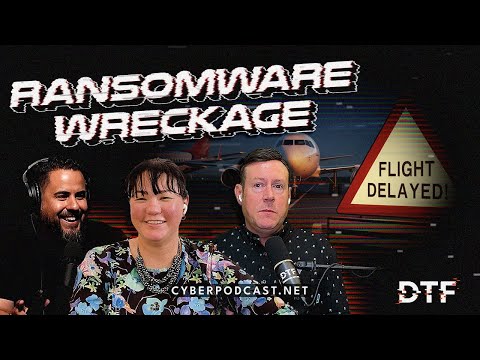
Wings Clipped: Ransomware Hits Europe's Airports – Travel Cyber Survival Guide! — with guest Shannon Wilkinson
0:00All right. So, today is Monday, October 6th, and today we're talking ransomware in the airports. What happens when the bad actors get in and shut down major airports in Europe, but it could happen in the US. We're talking about that today and anything that you need to know
0:15to protect yourself while on the ground, pre-flight, or in the sky or when you land. All that today and more with a special guest.
All right, it is the 21st episode of the DTF podcast. Damian is out today. This is Troy
and it's your boy Fern. Let's go
0:36[Music] from the command center of Finley Auto. She's the double belt reigning champion CIO and CISO.
0:53Because it wasn't enough, she now protects Finn Leo from the security perspective as well, which means she doesn't sleep. All day she is working and all night she's in a hacker's nightmares. There's nothing they can do
1:09to stop her. When they step in the ring, she slams them down with zero trust. Pins them to the mat without time. Nothing they do can't be stopped by her fury. She's the one. She's the only
1:27Shannon Wilson. [Music]
Let's go, Shannon.
And if it wasn't very clear, Shannon's actually married to Troy.
Yes.
So, this is actually
1:43double bonus.
Yeah. So, not to be mistaken, this is this is the DTF cyber podcast. This is not a Fern couples therapy, right?
Well, you never know. We might have some type of conversation. Maybe we can bond over ransomware or airlines. We'll see.
1:59So, so what is a dinner like? So, actually this so I know this because I sat with both of you in the kitchen uh during Black Hat and there was little to no security conversation while at the
2:14dinner table, right? But I'm kind of wondering like every night when you guys sit down and eat dinner together, is there do you guys purposely not talk about security or or tech or it or like work in general because both you guys are in security
2:30and technology? Uh or is that like a is it like table stakes where every dinner is something to do with work?
I would say it's pretty table stakes. And it's probably rare that we didn't talk about cyber or technology while you were here during Black Hat cuz it's a
2:46constant in our household. I mean, uh, I guess Troy, when I was in threat intelligence, you know, I would send you reports like all day long while you were working and we we like to joke I would send him something and just from behind the door in the office, I would just hear, "Damn it, Shannon." You know,
3:04ruin my day with the zeroact. Well, all you know, the the vulnerabilities and stuff you got to patch always hit on Friday, you know, when you're trying to go for the weekend. So,
um yeah, but yeah, that that was probably a rare occurrence that we
3:19didn't talk cyber or technology in our house.
Yeah, we talk about breach fatigue, but it's real. You know, there's something in the news every day. So, usually we're we're like, you know, who's the first one to bring up the the newest breach or how it happened. But, um I think it's good for our kids. You know, they get to see us talking about they ask questions.
3:35And now my my daughter is taking cyber security classes in ninth grade and she's really ahead of the class obviously, but uh she understands a lot of the vernacular the teacher's using to try to teach them about these, you know, new concepts I'd say for for kids in nth grade going in. I remember high school. I don't remember these kind of things
3:51coming up, but uh it would have been cool to have a class on cyber security in high school. But
you know what's going to be even cooler is when they have uh bring your parents to school day
and they take and and and they have that in the cyber security class.
4:06And both of you both of you show up because you guys are both technically uh well obviously both of the parents and but both of you would be in IT and security and I think it'll make all the other parents jealous. They actually they might actually just leave um
4:24because who if you guys were to go first I mean I wouldn't want to follow up with that.
Do they do that anymore? I haven't been invited to one of those. My kids are in ninth grade now and I have two other kids. I've never been invited to a come speak at the school day, but that'd be fun.
Yeah, I I've done career day at the
4:40school one time, but it Yeah, it wasn't a bring your bring your parent to school day.
Okay, for sure.
Yeah, I mean I've been out of school for uh 20 plus years and my kids are,
you know, aging ourselves. But yeah,
and and my other issue is uh both of our
4:55kids are homeschooled. So, uh my my kids get to bring their parents to school every day. Uh,
that's fun
cuz they're in the same house as us.
But, um, today we're talking about travel, but more specifically a
5:11ransomware attack that hit in Europe back on the evening of the 19th um, morning of the 20th, right? And so, if you're not familiar, what that was is specifically uh, Collins Aerospace. Some of their software is used in a number of airports and for for checking in uh
5:28electronic related type things and kind of we'll call it like process um improvement from a manual you know by hand type of situation. And so they they had some issues. We don't say the B- word around here, but they had an incident where their systems went
5:44offline and uh consequently affected a number of airlines uh specifically in Heathrow, Brussels, and Berlin. So I think the total number was something around 63 flights were cancelled. The lines to get on your plane were easily
6:00two to three, even hitting four hours in some situations. And of course, you have a number of frustrated travelers. So that's the main topic that we're talking about today. Shannon, do you want to kind of maybe give a breakdown of what happened with uh with Collins?
6:17Yeah, sure. So, from what I understand, uh there were some um things detected by Collins Aerospace and their Muse software, which is used for the the check-in process at airports on the evening of the 19th. um proceeding into
6:35the morning of the 20th then uh they started taking systems offline or those systems became unavailable because of the incident and then downstream effect to the airports. You know they had to manually start checking people in which led to all the delays and the
6:52cancellations and nightmare and actually the incident continued through the weekend. So if you think about it basically at the three airports they had to manually check everybody in for the entire weekend. One of the interesting things that I saw about this incident is around the 24th
7:09of September, they actually arrested somebody in the UK in conjunction with the investigation of this incident. So I that might actually be a first where like they arrest somebody within a week related to the incident. I was kind of
7:24shocked to actually see that they had moved so quickly and identified somebody behind the attack.
Another thing that I read Oh yeah, sorry. Go ahead.
I was just going to say, you know, is it u this is, you know, reminiscent a little bit of last year with the crowd strike outage that affected Delta
7:40Airlines and some other airlines pretty significantly, right? So, it's a it's a view into the world of our, you know, the transportation,
you know, infrastructure, but also,
you know, how dependent we are on technology and third parties here. Like just this simple check-in software could
7:56take down and pretty much disrupt the entire weekend for European travelers. It's crazy to me that we have that kind of dependency on these third parties, but it seems like we do.
No, absolutely. And I think that's partly due to as the world has become
8:11more connected, we've also become more reliant on the efficiencies that technology bring that almost I would say probably people new to an industry or new new to the workforce don't even know what it's like or how to go back to pen
8:28and paper when you might have to manually check in people or like if in a hospital and you're doing paper charts and stuff like that. So, our our workforce now is very dependent on the technology and the systems to operate businesses. Um, and when those systems
8:44no longer become available or go offline and there's nothing to replace it, it just almost like the business collapses, I mean, it's pandemonium.
Well, it just made me think of something else is that we're rushing to automate everything with AI. Uh, I've heard about
9:00AI and Agentic agents this week again at a very deep level of how this is going to automate some of those mundane business processes. But at the same time, doesn't it seem like here, you know, if something gets gummed up in the works, those automated processes fail, there's not enough staff around anymore
9:17perhaps to fail back to the manual services to help people no matter what the company is. you know, there's this real,
you know, threat of we're going to automate things and reduce our workforce, but then when when things like this happen, you won't have enough people to really help your customers. I
9:32think we're setting ourselves up for a huge huge failure here. There's things that people have to do on a daily basis that could be automated, right? And when you think of it, like in some ways it's kind of hit the fast food industry because when when I was in high school,
9:47I worked at a Wendy's and specifically I worked at the register and I always had fun when people would would make an order and you know back then they would pay with cash and in my head I would always figure out the change before I typed it in the machine. Uh because you
10:03know you had to type it into the machine what they gave you and it would obviously tell you the change to give them back. And then it turned into the machines that give you the change automatically, right? Then it turned into there's not even a person at the register anymore. It's uh a kiosk, right? And they don't even usually they
10:18don't accept cash in some of these places. They just take um your card. But if there's an issue with the order, it's a pain to get help because there's no one working in the front anymore. Like there's not a person that you can really walk up to and say, "Hey, like you added tomatoes to my my burger." And they're
10:34like, "Oh, you forgot to say no tomatoes now, right?" And it's like, oh you're right. But it's sometimes these applications aren't very intuitive and you it's really hard to kind of make your custom order as it as or it's a lot harder to do that than the ease of
10:50telling someone, hey, you'd like no tomatoes, please. Right? So when these issues happen, it customer service takes a hit, right? And when customer service takes a hit at an organization overall like um uh what's the word? the the way
11:05that people think about the organization, their their feelings towards buying
culture maybe.
No, no, no. From as from a consumer perspective,
like their um the way that they feel about going back, right? Their sentiment of purchasing from that organization again
11:21uh essentially goes down and then you end up losing more business. So, one person can turn into a bad review, uh, which can turn into less business, which can turn into, uh, issues downstream, all because there just wasn't a person in there or there wasn't a person in line. And
11:37this whole situation with the the airline, it it specifically affected the kiosk, right, which is very similar to the or not online ordering, but the in-person kiosk ordering at fast food. That could have issues. But when that goes down and
11:52like Troy said, there's not someone at the register or at a register like dedicated to it, it kind of makes you not want to go back because well, if that happens again, it's just a huge waste of time, right? So, I think that's an interesting spin on it as well is how
12:07does this automation affect consumer sentiment towards coming back and being a repeat customer? And I would say too along that lines, you know, one of the things that I've always hated in cyber security with the um onset of AI or
12:24technology and everything are are vendors that actually come in and tell you, hey, with our software or our platform, you know, you can get rid of some of your employees. And I've always been, and I think Troy, you would agree of the mindset, you know, hey, I don't want to get rid of my employees. I want
12:40to make them more effective in their jobs. and maybe help them um do things faster or investigate better or faster. So, you know, not not I'm going to buy your technology and get rid of my people. So, I've kind of always hated that sentiment. But like also what you
12:58were saying, uh Fern, I I think you know, are we also forgetting like the younger generations that are used to technology um you know, the old school way? And like I could just see my mom or Troy's mom walking into a restaurant and
13:13having to deal with a a kiosk and absolute chaos breaking loose because they don't know how to order anything and you know this new fangled technology where is the person at the counter kind of thing. So we're kind of maybe shoving technology on people that aren't quite
13:30ready to use these automated things and features. And you know, honestly, also with online check-in, if my mom was traveling by herself, I don't know if she'd be able to use, you know, a check-in at, you know, an airline and
13:45check her baggage herself, she would be very uncomfortable with it
or leaving some people behind like that, right? I think we maybe we're alienating the older generation who may not be techsavvy
by all these modern conveniences. And and we think of it so, you know, uh, straightforward as like it's easier.
14:00It's it's so intuitive. It's so easy. But, you know, folks, like you said, there's a demographic that perhaps doesn't think it is so easy and they want to go back to human touch and human interaction. So, they're used to and I understand that. Absolutely. And I think that as we have these more of these third parties that are supporting our uh
14:16infrastructure, like I don't think it was British Airways or Air France or something else that had the issue. It was a third party software that managed the kiosks. So, the more dependence we have on our third parties, what's our backup and resilience plan for when these things go down with our third
14:31parties? We can't trust, we can't manage, we can't, you know, have any say on how they do their systems. So, what do we do when their systems fail?
Yeah. So, I So, so as as as both of you were kind of talking, I had I had a couple questions for you. Um cuz I know
14:47Shannon, like I said in your in your awesome intro, right? CIO and and CISO, right? Um so, you have you have both, right? But what's not in there is CFO, right? And unless unless maybe I I I don't know, but if you maybe you've had
15:03a CFO role in the past, but um I think like what you said is
you don't want to get rid of your people. You want to make them more efficient. But is that necessarily the perspective that a CFO or a CEO would have um when they're looking at the money part of this of the equation? Um,
15:21and I'm curious just from hearing you say that like does that is that typically in a board conversation or do people kind of lean into that more so than they're they're making it clear to the other team members that as a
15:37business they're trying to find ways to kind of eliminate um having people involved and saying, "Hey, we can just be more efficient." But people in tech are saying no, like we're already trying to do more with less. like we can't we can't then you know cut out people because then that kind of puts us in a
15:53situation right does that come up or am I just like making up stories right now
well so in the business there's definitely questions and discussions about hey how can we you know do things more effectively how can we do better faster
16:09as the song lyric goes um with technology and in in some cases yeah I I know that there have been discussions about whether or not technology can replace certain kind of entry level positions like hey instead of having somebody answering the phone can we use
16:25one of these new automated IVR systems and stuff like that. So um but when it comes to like my help desk team or my cyber security team I don't want to say you know I already have a small team that you know I can get rid of any of the employees by implementing
16:42technology. um you know my discussions are always centered around well by deploying this technology or having this AI capability I definitely will have a more efficient uh team and we can better protect the organization. Um I will
16:58however share a recent experience where that I had where um I was pitched a software that had AI capabilities where I actually went wow your software platform it costs so much to the organization for this new you know AI
17:15efficiency um that I could actually probably go hire three or four people for what you're asking me to do. Um, and basically what it was, it was um an AI help desk agent that would, you know, supposedly automatically take in tickets from um our our user base and then be
17:33able to help reset passwords and everything like that. But the way that the company had priced it, it was uh per employee per month. And then all of a sudden I was looking at for this AI help desk agent, you know, a $300,000 bill per year. And I'm like, that's way
17:49more than I'd pay for, you know, three or four analysts or or help desk technicians. So,
yeah,
technology is not always the solution.
No, I think that the CFO's role is to create and derive business value for their shareholders and stakeholders. And
18:05I think that there is certainly a discussion in the boardroom about can we use technology to automate certain things. But I think that there's always a discussion about what the right use of technology and automation is so that you are you know upskilling your people doing more uh you know work that is
18:20intellectual property driven or you know where they're going to be more effective rather than you know we're going to take this tool and and remove 10 people. I just don't see that across the whole industry not just with Shannon but across all my peers. You know we are very reluctant to let go of human talent
18:35because it's so hard to to attract and to retain top talent. And so we're always protecting our people, I think. And I believe that technology is just another way to allow them to do more with what they already have, that skill set that we talked about, building skills in and improving their own
18:51skills. And I think as AI comes around, people are very fearful that it's coming for their job. And I continue to say this on this podcast and other places that lean into AI, learn as much about it, be a part of the revolution or the industrial revolution that is now the AI
19:07revolution. uh and you will be able to find a place to use your skills in your own company and it's going to protect your job. You know, those who are going to be left behind are those who are very resistant to AI and to technology. Those who throw their hands up and say they don't want to learn something new or don't want to adapt or be flexible. I
19:23see those folks, you know, having a really hard time not just in the job that they're in, they'll lose that, but also in finding a new job. I think that the whole industry is shifting and we have to shift with it.
Yeah, absolutely. And Troy, you know, of course, you know, AI and its use in the business is near and dear
19:40to my heart. I happen to write a book about it, but you know, you like you said, using AI to enhance um and then I would say caveat to that, you know, using AI without giving our critical thinking skills and our knowledge building um activities over to AI. So
19:57using AI without losing yourself in it.
Yeah. And you know, I I've seen a lot of this too cuz um in like customer service roles or or like client support type of things um you know essentially like think of like call center contact center
20:13uh work. There's a lot of people saying hey you know these roles are going to be eliminated soon. You know there there there was automated phone systems and now the you know one step further. Um, but one thing I I've seen more recently is uh the sentiment that AI is not going
20:29to take your job. A person that uses AI effectively will, right? And I think that kind of u is tied into what Troy had mentioned is where you have to lean into it because the people that are resistant um may not have a job soon,
20:46but it's not because of AI. is maybe tangentally because they haven't been able to implement it to find these efficiencies that businesses are looking for. And like you said, Shannon is you're not looking to get rid of people. You're looking to improve their efficiency. And by doing that, they're
21:04using more AI and AI related tools, but you're not necessarily getting rid of the people. You're just kind of doubling down on the people that happen to use those tools because of the efficiencies that it drives for the business, right? So, it's less of it's going to take your job. It's more of you're going to lose
21:20your job if you don't learn to use it.
One of the things interesting for about this case with the airports is that this Collins uh aerospace, it's a it's a provider. It's a platform for airlines and airports to connect and have these different services. It reminds me a lot
21:35of CDK and those of you who don't know CDK is an automotive services platform that was at a ransomware last year. uh it affected hundreds of dealerships across the US and you know the uh the CDK platform comes with you know all the different software packages that you can get depending on what you need and I
21:52think Collins is very similar where it's like a ERP system for airlines or for airports and personnel to manage these things and so as you look at these platforms like CDK and now Collins it just appears to me that hackers are really targeting these platforms because
22:07they know uh how integrated they are but also how big of a blast blast radius they can create in a very short period of time, you know. So, we have to protect against that. We have to limit the blast radius for our companies and our third parties. But I think hackers are finally catching on and going after
22:22those big fish that have the tentacles in a lot of companies. What do you think Bern?
Yeah, and you know what? I think I think we happen to have a expert on the CDK story Shannon.
Yeah, I had to laugh there. So, actually
22:38Troy, uh, it wasn't hundreds of dealership. Well, maybe it was 100 dealership groups, but like dealerships, I think there were 17,000 between Canada and the US that were affected by the CDK outage uh following their attack. So, it was massive. And for those that aren't
22:54aware of what CDK is, it's it's basically a dealer management system. And it does kind of a toz everything that you need to sell a car, to service a car, to order parts for cars, you know, and and they do sell it as kind of it's the one-stop shop for everything
23:10your dealership needs to be able to operate as a business. You know, you process payments from it or through it and then you you you do, you know, loans and all your customer information goes into it and everything like that. So not having that system available um all of a
23:27sudden um was really impactful for the businesses that relied on it and it was a critical business system and probably up until the time that that that CDK went offline. I would say probably not a lot of automotive dealerships thought
23:43about hey what happens if this critical business system all of a sudden goes offline and becomes unavailable to us. Um the other bad thing about the CDK outage is that um it was ongoing as CDK was going through the recovery. It took them three three and a half weeks to
23:59come back online. So if you think about it, if you're a business and manufacturer or something like that or like with CDK in the automotive industry, you know, you've got your core business software not available to you for three, three and a half weeks. What
24:14is that going to do to your revenue, your profits to the organization? And it was it was very very impactful.
That's an interesting question. I have a question for you on that one.
Yeah.
Because I was asked a question before and I don't know how to answer it honestly. It's like okay so you have CDK
24:29it goes down. So if you're a business and you have the BCDR you know business continuity disaster recovery plans in place. You've got your time to recovery your your point objectives all the stuff in place. You you've done your homework. You've done the failover. What happens when let's say Microsoft no nothing against Microsoft is an example. What if
24:45Microsoft goes down right? Do you have a backup email system? How are you going to receive and send emails? What if what if Microsoft takes a hard hit and they're down for a day or two or three or a week? You know, could your business survive without receiving business email, without being able to communicate on Teams with clients and client teams
25:01and so on. So, as you look at BCDR, it's not just about your servers in a data center somewhere and how quickly you can recover them. It's not about your website and how fast you can get that ported over to a a site in Chicago. It's about your third parties and what those reliances are and how quickly can you
25:18respond. Also, this is something most people don't realize until you're going through it. Uh when when your company is hit or your e 0365 tenant is down because of a ransomware or breach, uh you you can't, you know, reach out to people on teens, you can't email them. And most of the time, we don't know our
25:34employees phone numbers. We don't have them in our phones handily. So, it's like, how do I even get in touch with Joe from, you know, disaster recovery? I I don't know the answer to that because we can't hit them on Teams, we can't hit them on Yeah. U you know, email. So maybe Slack, maybe some other instant messenger, have a backup, have a phone
25:51tree that's on paper and printed out. One of the most important things, sorry to go longwinded here, but one of the most important things that I I found out during incident response that people don't normally have is their incident response plan. It's on my computer. What happens if you can't get to your computer? What's on the network? What if you can't get to the network? You know,
26:07so having a printed copy in your home office like I do here or wherever your office is of your incident response plan of your backup recovery of your phone tree is super important. Do you have your CEO's phone number saved in your phone? Do you have your CIO, CISO, all the leadership? Do you have their phone
26:23numbers in your phone in case of an emergency? And this could be not just cyber, which could be natural disaster. We had a tornado touchdown where our main data center was and we couldn't get in touch with employees because everything was out. So again, disaster recovery is is more than just a data
26:38center and a website. Think about it about your third parties, your physical security, and all those other things. I'll uh stop belaboring that, Shannon, but that's what you reminded me of.
No, actually, and and you know the story too, Troy, is um you know, when I was working for the United Nations, 911 hit
26:54and we evacuated the United Nations building um the headquarters in New York City and we ran into that exact case. We sent everybody home and then um the next week when we wanted to call everybody back to the office, we were like, "We
27:09don't know how to get in touch with about half of the employees to tell them, okay, everything is open back up. You can come back." So I actually built like an emergency communication system for the for the UN so that we could, you know, get in contact with people and let
27:25let them know that it was okay.
That's wild. I I hadn't even thought about like, you know, if you have a 5,000 employee organization or even more, right? Um and and everyone goes home or something happens where they they can't get online and they're you
27:42know, say a large portion of the employees are work from home, right? Like what are you supposed to do? You
you only talk to probably a handful of people on a day-to-day basis, right? So maybe there's like some first first degree second degree type of conversations you can like kind of get
27:58through, but it's really it's going to be really difficult to get a hold of everyone that you need to cuz like Troy said, you can't go online and just like type in in the chat uh who you're trying to get a hold of and tell them something specifically.
Mhm.
But you know what this does remind me of is um I believe it's called uh BIA,
28:16business uh impact analysis. Uh so you know one of the things that came to mind when I was reading the article about Collins was specifically for the airlines and the companies that use their software or even like for the automotive groups that or dealerships um
28:32or maybe both that use the software the CDK software is is a BIA report something that these type of organizations should do and if they if they've done it is it safe to say they would have been aware of this risk?
28:48or is not everything kind of taken to that level or is it maybe an enterpriseon type of thing? Like I guess I I've never been in a situation where I've had to do a BIA uh personally. So I don't know like if there's a cut off on revenue or if there's a cut off on um
29:04maybe revenue is probably the the the best way to do it. But is it done in in the obviously in the enterprise but in the in the smaller mediumsiz businesses or is that something that they were aware of and then this just happened and it
29:20was kind of what they would have expected to happen.
Great question for the reason I say that is we've been talking in my peer groups about this exact you know question in the realm of governance risk and compliance GRC the BIA is something that we rarely hear talked about. You hear
29:37about threat modeling in cyber, you know, you do a threat modeling for your website or for your applications to see what would a cyber attack would look like if it hit that particular uh application, but I think that BAS are super important to to think of and to really incorporate into your governance
29:53and risk framework. Uh and what I mean by that is, you know, there is no revenue cut off. You know, I I used to have a rule that if we had a logical connection to a company or a third party, like if they have an access into our network, uh via VPN, IP sec tunnel, whatever it is, um or even a tiein to
30:09one of our APIs into a SAS application with that had our data in it that we owned. I wanted to do a BIA on that particular third party. Now, when you have thousands and thousands of third parties, which a lot of large companies do, it's hard to prioritize those. But I think that if you start rank stacking
30:25them with are they connected to my network and data, what data do they have access to? Prioritize it with most critical data, most critical systems first. Start there. Start somewhere and get that motion going so that you can really model out what would happen if that third party had a breach. We always
30:42use the example of a rogue admin, right? So third party connected to our systems. What if they had a rogue admin that wanted to steal data from us? What would it look like? what would it happen to us and how can we not only mitigate it but what how can we detect it and can we put
30:58a dollar figure around what that would cost the company and we had a really great relationship with our privacy attorneys who would look at that and you know they were very concerned about any type of uh unauthorized access to data so they would jump in help us you know put the you know fair model math to
31:14those risk dollars and really quantify what that would cost a company if we had an impact but it is a it's laborious I think it's very necessary I think we should do more of it.
Yeah. And and thinking along these lines too, you know, with what happened with Finley with CDK and of course what's
31:31happened to the airports in in Europe as well, you know, even if there was a business impact analysis and stuff like that, what do you do? I mean, you you can't not do business. And I don't know if you want to build your own systems that would, you know, do these things or
31:46automate these these business processes yourself, but you know, there's not really anything you can do as a business to avoid these situations. I mean, you you got to trust your third parties are going to be resilient and kind of, I
32:03guess, trust that these things are going to happen. But like honestly I I don't think I'd ever recommend to Finley, you know, hey, we should sign a contract with another third party in case CDK goes out or something just because it's not economically feasible. So, you know,
32:19I guess that does raise the question as well is like, okay, we'll do an imp business impact analysis, you know, we we'll talk about what happens, but like what if something does happen? What what do we do? Is there any recourse or or are we just kind of in the stuck in the
32:35water? floating around until their systems come back online.
Yeah, I think that also goes back to your master services agreement with that vendor. You know, that's why negotiating those MSAs are so crucial. You know, if you're just accepting blindly the MSA from the vendor or if you're just accepting the terms online, that's uh
32:51you should be looking at those. You should be reviewing the terms, what are the privacy requirements, what are the not breach notification laws that are applicable on that particular, you know, is it 72 hours and what constitutes it? So there's so many of those clauses inside of an MSA that need to be reviewed. Liability, you know, who's uh
33:08liable.
So that's where you really have your leverage on those third party. But you're right, Shannon, you can't stop doing business in an interconnected world. We don't live in a bubble. So we have to trust our third party, but we have to also do our diligence on the relationship up front so that you can hold them accountable if there is a problem.
33:24Yeah. Yeah.
So, I got a question for you, Troy, cuz you said it. Um, and I I I might be paraphrasing here, but I think what I heard was you said in your peer groups, BIA is is becoming more of a topic, right? Is that what you said? Like,
yeah, absolutely. I think we were
33:39talking under the u umbrella of there should be more technology solutions out there that can assist with BAS because right now it's very manual, spreadsheets, Excel documents usually. Um, and we were talking about there needs to be innovation around them so that it can be, you know, automated. And I think there are some uh thirdparty
33:56risk platforms out there and I'm not going to name any names. We know who they are, the big players uh or the GRC platforms that are working these in to be more automated so that it doesn't take an army of folks to do it and spreadsheets in an Excel document in a work one drive folder.
34:11Yeah. You know what I read uh uh I think uh last week mid midweek like Tuesday or Wednesday was I saw the Cyber Starts um just raised almost $400 million uh for their next round. Um, I wonder if they're looking into anything BIA. Not
34:26say I mean not to say that they are, but I mean like you said that's that's an area of the space that
not necessarily neglected, but what I find interesting in um BIA specifically is, you know, we're we tend to be cyber focused uh on this podcast and most
34:42people that listen or in some way or another, they're definitely in tech, right? Unless they're my kids. my kids. Uh, funny story is um I was talking to my daughter a couple weeks ago and she said, "Hang on a second. I got to go on YouTube." And I said, "For what?" Like, "What are you doing?" She said, "I have
34:57to go on and like your video cuz there was a video I saw." And I like, "What do you mean?" She's like, "Oh, I like all of your videos. Every single time you have a video that comes up, I like it." And I go, "Oh, that's cool." So now I know at least one like on every video that we have uh comes from my oldest daughter, right? Um, but the so she she
35:17might be the only person that's not in cyber or tech that listens or at least shows some love online, but majority of people are in cyber or technology, right? And one of the things that always comes up is maybe the best way to describe it is
35:33uh translating security into terms that the business can understand, right? And a a lot of the issues, at least from some of the circles that I've I've run around in, is that not necessarily everyone in security, um, has a good way
35:48of kind of demonstrating the risk of certain actions to people that aren't in security. Maybe they're in in the financial side of the business. Uh, maybe they're in the marketing side. Um even though security is kind of like a
36:04shared problem throughout the organization, not everyone understands security the way that you know a cyber professional does. So my first thought is why is there not more that's being done around BIA? Because that puts a lot of this risk in terms financially that
36:21everyone understands. Like if you say I have $10 in my checking account, everyone knows what that means, right? If you say I can only afford this meal, that everyone knows what that means. It's like, well, you can't afford anything else because of the financial situation. So like to me money is a
36:37common denominator in our economy and everyone that's you know part of it but are these reports maybe are they not that they're lacking but if more people were focused on a BIA um and understanding the risk to the business
36:53and having those reports do you think it'd be easier for security professionals to kind of get the story across?
I don't think that the BIA itself is a silver bullet. I do think that CISOs who tell a good story and can translate risk into dollars and you know fiduciary
37:10responsibility go farther than other CESOs especially in the boardroom where most of your uh directors on the board come from different walks of life they may not have any technology experience at all. So my board decks always have to be something that can be understood by the nontechnical and the technical as well. And so I think facts and figures,
37:27metrics that matter and risk, you know, explain that in amount of risk. Now, you don't want to come in with FUD, which is fear, uncertainty, and doubt and say the sky is falling, give me all this money. You really want to articulate your ask to what you're going to solve and and
37:43save the company from some type of damage that could be done through a cyber attack. It's just like insurance. You have to prove that there are legitimate forest fires out there that take homes and you're going to fireproof the house or try to fireproof it as much as possible so that you don't have that
37:58kind of catastrophic loss. And what I think I think happened over the years was that companies thought the cyber attacks were just this never going to happen to me. It's you know the myth. But what we found is with every single day, vendor after vendor after vendor
38:14are having breaches and and some of the biggest names in the household that you may love and know have had cyber cyber attacks and successful breaches, successful ransomware attacks. So, no one is immune. If you're a business owner and you just think you're going to win the lottery and not be a target, then you should definitely u hire
38:30somebody to look at this for you because that's not the case. Hackers are looking for that lowhanging fruit. those who people who have not put in protections, those who don't have a team to look at the lights at night, they're the first ones that are going to fall.
Yeah. And and here maybe to to add on to that is not necessarily even if you're
38:46an enterprise organization and you spend millions or hundreds of millions of dollars, Collins Aerospace is a perfect example of an airline uh that uses their software that was affected negatively because of an incident. Right? So it's not necessarily that your business won't
39:02be impacted if you're like an enterprise organization because you know you have the funding potentially that a small business may not have. I think the the the part to consider too is that the third party risk is another um another layer that people should always consider. uh like like in this specific
39:19example with Collins is they were affected and then that effect kind of toppled into the business continuity of the airlines being able to get planes off the ground. Right. So I think exactly what you said Troy is that it's
39:34and it sounds terrible whenever people say it's not a matter of if but when right um but it in a lot of ways it's true because even in these in in this stories from today is maybe these airlines have everything and and it's harder for for threat actors to do
39:52anything with the airlines specifically but they just go for an easier target and if you believe that your business is immune um being maybe a small business or medium-sized business because nobody cares right about that business. Well, I think the idea is well the people that
40:08you do business with might be a target and by nature like tangentally again is that business may be at risk because or your business may be at risk because of the people that you do business with. And I think maybe there's a big part of
40:23that that most people don't think about is yeah maybe they don't want me but they want the people that we sell to. And I have a question for you Shane on this exact topic. Right. So in my career I've commanded I've I've had budgets of for cyber security in the hundreds of millions of dollars and progressively
40:40larger companies progressively larger budgets hundreds of millions of dollars. I have a friend who works in New York who has a two plus billion dollar cyber security budget. So that's the kind of numbers that these companies are deploying for cyber security solutions. Right? The question is how much is
40:55enough and how do you articulate that to your leadership because you know if $2 billion is an overspend and you have too much protections too many people that that's a big problem. Uh but if $2 billion is not even scratching the bottom of the bucket for what you
41:11actually need to protect that business that's another side of that coin and problem. So everything is objective depending on the business and business size. But how do you how do you justify how much cyber security spending is enough for your organization?
I I honestly it's a hard hard to answer
41:27because there's no you know silver bullet. There's no single answer. But um you know the unfortunate thing for protecting organizations is like you kind of have to protect everything that you can whereas an attacker they only have to get you know find one tiny
41:43little hole that they can get in. They only have to be right once and and you're breached or oh, I used the b word. Sorry. Don't do it. Don't do it.
$5 in the pot.
Oh, no. Oh, no. But um you know, I I think it's about prioritizing like figuring out what what
42:01you can be what your attack surface is and what you can do to re reduce that attack surface. And then you know also I'm I'm sure the organizations that are spending billions of dollars on cyber security also have extremely large employee bases and cyber security
42:18solutions are often priced based on employee count. So of course if they got hundreds of thousand employees are spending a lot more than an organization that like Finley that only has you know 3,000 employees. So, um I think it is a little bit subjective to the size of the
42:33organization, how many employees that they have and everything like that, but it's just I guess honestly I don't have a good answer, but it's really just about doing your best trying to figure out, you know, what are the entry points, what is my attack surface, what can I do? Um,
42:50and another thing, you know, at Finley coming in post post Border, um, is, um, taking time to do things that don't cost money like communicating and and trying to educate the employees and, you know,
43:07one of the things that I did when I came into the organization is just, you know, hey, you might see this kind of attack or or, hey, here's an article that about some cyber security topic that you may be interested in. not necessarily having to do with the business but having to do with even your personal life or
43:24something like that like you know when email providers have been breached or something like that or you know there there's something to do with something that would affect their their daily lives just communicating that and opening a channel so we're not just you know the IT and cyber people hiding in a
43:40dark room with servers or something like that we're we're actually seeing now as an integral part of the business and a true partner to the business so that we can also have those discussions about business impact and risk where, you know, I like to say where the IT and
43:57cyber security departments moved up from the kids table at Thanksgiving to be in the boardrooms instead of the adult table with with the rest of the executives. And I think that's probably a phenomenon that has happened more like in the past 10 years or so as as it has
44:14started being seen as a true business partner rather than just you know the IT problem the people that fix the printers and that kind of stuff.
I can't say enough about company culture. I mean and specifically around cyber security and IT, you know, creating a culture where not only do do
44:30your employees want to stay and be a part of that, but also that the employees feel, you know, that they are a huge part of stopping breaches and attacks because actually the frontline employee is the one who, you know, is the person who stops fishing attacks or stops the cyber attacks they hit. So absolutely, I think that's super
44:46important for me on determining the right budget size. always always go back to a framework you know using miss and miter to map to make sure that I have the right coverage of the right things at the right places you know you can certainly uh as you know overspend in this this industry everybody's selling
45:02you their shiniest new widget
oh my gosh there's so many shiny new toys that you be like that is really cool I'd love to have that but do I really have a business need for it
exactly so uh being able to put dollars to risk and being able to you know find
45:17a place that you need to deploy capital that's smart and has return for your business is so important. Being able to articulate that out to the board is also just as important.
Troy knows that the the phrase employees are your weakest link has always driven me up a absolute wall. Um I I hate that
45:35saying with a passion because you know my thing was always like yeah employees and the people in your organization may be one of your um entry points to the business but if you take the time to educate and communicate with them they also I think can become your strongest
45:50defense against attacks.
Yeah. So maybe not necessarily people are the weakest link but untrained people are the weakest link right?
Yeah absolutely. Um because yeah, I've seen that too. Like uh there's a lot of companies out there that do like fishing simulation and things like that. Like
46:05their entire business is making or crafting these emails for you know it leaders to just click the button send and all of a sudden you know you click on the wrong thing and you get a popup saying well you failed. Uh you know kind of puts people in in a terrible mood in most cases. Um, and then for the people
46:23that never read their emails, they're just like they're like the the rock stars, but they never even saw the email to begin with, right? So,
it's funny, too, even even in our organization, we, you know, we we try to send out these communications and stuff like that, and we we actually get, you
46:39know, our our cyber security bulletins that we try to send out to the user base reported as fishing emails when we try to communicate information out to the employees. It's kind of funny
with all the involvement that I've had with like security conversations and
46:54things like that and the the squishing I think is what it's called or the vishing and there's all these different types of things that people
Yeah. So through through texting, right? So one of the things that I always find funny is um when I forget to pay a bill.
47:12So, like sometimes uh like our internet for Cox, I'll get a text that says, "Hey, like you know, you've used 90% of your thing or 80% of your uh space." Um, but I always love the ones that come and say, "Hey, he forgot to pay your bill." Or like, "Hey, a good way for you to pay your bill is this." And it's like, "Oh,
47:27yeah, that's right. I need to go do that." But there are a lot of times where I'll get something and it's like, "Your bill is late." I'm like, "I don't know about that. I'm pretty sure I paid it." So, I think one of the easiest ways that people are getting caught is
47:42by having finances tied to the outcome of of the message because for me it's like oh wait now I have to go back and double check like did I forget to do that or something and um I always find it interesting because like you know people one of the ways that they do is
47:58like with a package oh your package or your order. Um, but I've always thought to myself like what would happen if I just became 100% paranoid that every text that I got was in some way a scam and I just like didn't pay my bill or if I forgot and then they said, "Hey, you
48:14forgot." I'm like, "No, no, no. You guys are trying to get me. You're not going to get me today." Um, and then like my internet shuts off and then, you know, we can't do a podcast or whatever. But, um, there's like two extremes, right? you you click on everything and you you're at fault or you just don't click
48:30on anything because you're paranoid of, you know, it being a scam and then that has implications as well.
Well, or or there's the happy medium in the middle where if you get the the text or something from Bank of America or Wells Fargo or something like that, you
48:45don't you don't click on anything in the link. to actually go to their website on your computer, type it in, and then go check the message there on that platform and see, you know, hey, did I miss the bill or something like that?
Yeah. Yeah. But even like I want to say maybe six or seven episodes back that
49:02happened where the application was actually um compromised, right? So the people were going into their application and then even in the application is where they were getting, you know, proper messaging from the improper source, right? So
there's always risk, but um that kind of
49:19makes me think of maybe some of the other topics is, you know, the main one is is uh the story with Collins Aerospace specifically, and we kind of we've been on that for, you know, maybe 30 35 minutes or so. And some of the other things is more so around security while traveling, right? So I know you
49:37guys uh over the weekend had a you know, a trip. I won't say where you went but there was there was travel involved for the entire family and as as as business leaders and and executives working in you know the technology space I think
49:54that comes up a lot for business travel you obviously co is what 5 years we're 5 years removed from co right now uh or close to it and there's a there's a noticeable difference in what businesses are choosing to do now with travel versus what they were doing in you know
50:10October of 2020. 20. So, I'm kind of curious too on some of these things that businesses are doing now that travel has increased for a lot of their employees. Um, you know, some of the things that we had written down were like VPNs. Um,
50:27but I've seen a lot of things kind of hinting that VPN is like a a dinosaur and that identity is kind of where people are focusing now. So I don't know maybe maybe the next topic is more so a curiosity on as a a business executive
50:43some of the things that have been put in place specifically either at your current organizations or past ones where you take into account people traveling and securing the business while those people are traveling.
Yeah. And just to be, you know, slicing
51:00hairs here, but the VPN, like I on my personal laptop, I use a private VPN if I'm traveling, especially in a coffee shop, an airport, any public place. Um, but what we were mentioning on the zero trust side, so if your company employs zero trust, and anytime you get on the internet, you're automatically connected
51:15via some proxy or VPN back to the home office, let's say. You know, in those cases, you're sort of protected from that local internet, what we call the dirty side of the internet, uh, coffee shops, airports, etc. And so if you have one of those zero trust mechanisms on
51:30your computer, that's great. But if you do not, or if you're traveling as a consumer off time, your personal phone, personal laptop, make sure that you have a very good VPN product on those devices so that when you connect public Wi-Fi, you can immediately switch on the VPN so that you are protected from local spies.
51:47You know, the most important thing that uh hackers do in an airport or a coffee shop is they sit there with a little listener, like a Wi-Fi pineapple, and they can be that man in the middle. they can actually create this network where you're actually talking to them that you think you're talking to uh your bank and they're just sitting in the middle
52:03listening to all that traffic unless you have a VPN that creates an encrypted tunnel to your destination. So uh I would highly recommend having that VPN having that. Now um Shannon perhaps maybe on your remote employees or as they travel you have much different uh
52:18answers to that question.
No, we we've employed a zero trust framework. So uh yeah. Yeah. VPN um um also geoloccation um policies and stuff like that that
52:33allow access from certain locations. Um as well as uh one thing that I really liked uh previously Troy that I I saw that you had done was the impossible traveler rules. So looking at seeing where people are logging in from and and saying okay well you know they were at
52:49the home office here in Las Vegas um you know this morning they're not in China by 2:00 in the afternoon and then in Romania and you know a whole bunch of crazy locations. So um you know having that kind of detection alerting I think
53:05is also um pretty good for organizations. Um, you know, for me when I travel, one of the things if I don't have to connect to a public Wi-Fi in a coffee shop or something like that and I can just use the data on my phone with like a VPN on
53:21my phone or something like that, that is much more preferred to me than them possibly opening myself up to um any sorts of attacks, especially like if I'm, you know, checking my balance of my banking app or something like that.
Yeah. So would you recommend um for
53:38people that travel or maybe uh employees that might be targeted for them to have their own kind of hot spot from like a a cell phone provider or is that is that just like something that no one does anymore?
We used to think that cell phone u you
53:54know devices were more secure or secure. They have recently come out with devices for the attackers and hackers to intercept those as well. So you may have like a Wi-Fi or something that gets you on the internet. It's a hot spot from the provider, but there are now powerful
54:10devices that can actually intercept that cell signal as well. Um, so just depends on what type of role you're in. If you are in a highly complex role with confidential data that you have access to or CUI and the government, etc., likely you'll just want to have a VPN on
54:26your device that immediately encrypts that connection from the device to your source. And then also I I would caution, you know, with VPNs a little bit also, you get what you pay for. So there's a gazillion of those free VPN um you know,
54:41apps and stuff like that that are out there. I would just caution everybody to do their research and see exactly who the um who's providing the VPN service because there's lots of VPN services out of those no countries that will gladly accept your traffic through their
54:56servers.
Yeah. And they'll do it for free. Exactly.
Yeah. Right. Uh this is something we touched on a while back where you can get a VPN service for free, but it's like, oh yeah, um it's whatever random company out of like the AP pack region,
55:12right? And you're like, well, hang on a second. Um what do you what is this company getting access to and what are they seeing?
It's like, well, I just, you know, I just want to, you know, hide my traffic. It's like, yeah, but you're not you're hiding your traffic, but you're giving it to the wrong people, right?
Yeah. Exactly. You're hiding your
55:29traffic through the servers of the people you want to hide your traffic from.
Yeah. And but you know, it's a it's a really good example of like risk analysis uh or the impact that the things the decisions that you make could have, right? Businesses do this all the time, right? like we mentioned earlier
55:44with the BIA, but from a personal perspective, um maybe a PIA, um it's like if you can't spend $20 a month on a legitimate service or you don't want to, you choose not to and you decide to use
56:00something that is $5 or even free, well, it might just cost you your life savings potentially, right? So there, you know, there's always a trade-off and there's always a risk. And I guess it's really more so the appetite or the impact that that risk would have on the decision
56:15that you make. And hopefully, you know, if people are listening and they're they're getting a free VPN service, maybe the one thing you can always do is look into that service, where it's coming from, and who has access to that because nothing free. What they say there's no such thing as a
56:31free lunch.
Yeah, that's right.
Right. Or or what is the one where they talked about the internet where the internet is free but you're the you're the product or something like that.
Yeah. If the service you're using is free then you're the you're the product.
Yeah. Exactly. You know either
56:47advertising you know views or something like that. You know they're making money off you somehow.
Yeah. At some at some point or another your information is is the they say data is like the new gold or data is the new oil. Um, in a lot of ways, people's
57:02personal data is kind of or is used in some way in terms of like marketing to um, well, I forget the word that they use, but like re not necessarily remarket, but like re or retarget I think is the actual term of
57:20people get retargeted through ads and things like that because of the data that they share. Um,
so so that's one thing, right? And I always find it I don't know if it's funny or interesting. It's probably both, but I know I mentioned this to you both of you earlier is juice jacking,
57:38right?
Um so I avoid the juice jacking because I bought a um I think it's called an anchor and it's a 30 30,000 milliamp device. I got at Target and I I think I heard Shannon make a noise like it
57:54wasn't a good buy.
Some of those are in her recall. Yeah, we have them. And so like two of the power banks that we have uh have been recalled because of possible fire/exlosion risks. So when you just said that, I was
58:10like, "Oh, I hope it's not one of the ones that is under recall." I love them.
It's in my car right now.
I honestly think those those devices are like the best.
Well, so the one that I bought is like a brick. Literally, it's the size of a brick and I throw it in my backpack
58:25because it can charge my phone like four or five times from 100% to zero um on the battery itself. So, if my phone is dead, it can charge the battery at least three to four times. Or my laptop, I think it pumps out at 140 watts any
58:41single time. So, I can run my laptop, I can recharge my laptop, I believe once, possibly one time and a half. So, like I love this battery, right? And I'm never I'm never going to have a juice jacking situation to to ever worry about at the
58:57airport. One, because I don't travel very much, but two, because I got this battery. But I am curious to to hear like, so if the I think the battery was like 100 or 130 bucks, maybe around that price. U not necessarily everyone is
59:12willing to spend that kind of money on a battery. And you know, with for both of you, you've had employees travel. Um, can we just like dispel the myth of juiceing or can we talk about
59:27how or the potential risk there because I I feel like I've heard varying sides to the story and I just I need an expert to just sit me down real quick and tell me, hey, like this is a problem or no, this is the actual situation. I put this one in the category of, you know, it
59:44could happen. It's very unlikely that you'll get to a USB port in an airport that has been compromised because it's physical security at the airport. They have to actually physically manipulate the USB port to put some type of a
59:59listening device on there or you know stripe reader. But I think that it happens. You know, absolutely. We see articles all the time that they find one in an airport. Um, it's like a credit card skimmer that you find at 7-Eleven. We know that it happens and you check the devices when you if you ever swipe.
1:00:16But, uh, it's very rare. What I'm saying by this is I'm saying I'm always cautious. I use the little brick that you plug into the wall, put my USB into that so that I do not ever plug my naked USB port into a USB port at the airport just because I don't want to take that
1:00:31chance. So, it does happen. It's extremely rare that it happens. Uh, and just to be cautious, use the USB power brick that you can plug your cord into. It's not a charger. Comes with your Apple device usually. Uh, or you can buy one very cheap. Just use the brick plug in and that'll save you from getting
1:00:47juice jacked if you are that one in a million person that actually plugs into the wrong USB port.
Yeah. I mean, you know, if you want to talk about cyber security, there's all sorts of things that make you want to put your tinfoil hat on and stuff like that. like you know the researchers that are able to you know figure out what's
1:01:03being written to computer disc using the sound waves or or the noise that the disc makes when it spins and stuff like that. So there's all sorts of you know possibilities out there of like things that could theoretically happen but you know in in practice and you know
1:01:21practicality as well as you know how frequent it happens probably not very often.
Okay. Not as much as Hollywood and TV shows might make you want to think.
So Hollywood is a big movie that we
1:01:37shouldn't trust
or exactly things. Yeah.
Yeah. I wouldn't blanket statement that one, but I did see an episode of one of these CSIs that they took juice to the whole next level with sensationalization and Oh, yeah.
bring bringing the airplane down. It was
1:01:53crazy. That's you know,
that's Hollywood for you, but it happens.
Yeah. I mean, yeah, it it's out there. It could happen. And um you know, just if you're worried about it, there are definitely precautions that you can take to avoid it.
Yeah. Like just charge your stuff before
1:02:09you leave.
Yeah.
Or
or have your own charging device or don't plug into USB ports that aren't yours.
Or the cheapest hack might actually be just carry a book with you and instead of scrolling, you know, Tik Tok or
1:02:25Instagram or
doom scrolling. Yeah.
Yeah. instead of doing scrolling just you know I what what I find interesting is you
you I've seen a lot more people so when I do travel I've seen a lot more younger people with books and
I actually like it because like I kind of feel like sometimes when you're stuck
1:02:41doom scrolling uh obviously you're not productive but if you're sitting there reading you're getting something out of it and typ obviously if it's a book um hopefully a Shannon's u most recent book
that you're learning from because
1:02:57specifically what it talks about is is AI in in the current world, right? And I'll be honest with you, I haven't gone through the entire book, but I want to take this time for you to tell the listeners specifically kind of maybe the
1:03:13motivation for the book um and how well it's gone, the recession that you've gotten. And maybe we can end the episode on on where people can go to to find a copy of it. Uh maybe maybe even a signed copy uh if they're lucky like I was and
1:03:30uh and we can kind of end it there.
No, absolutely. So, um Troy and I went to an AI conference in in New York. I I think it was probably back in April, Troy, right? Something like that. February, April. Um, and I I had been
1:03:47turnurning this idea around in my mind for for a while about AI and you know its onset and everything that we're doing with it. And honestly, I mean, I'm a daily AI user. I I use it to help me, you know, in in my job
1:04:03make make things better, make ask questions so that I could find things faster and everything like that. Um but one of the things that I saw from a leadership perspective and then also from the perspective of a parent of children who are growing up in the AI
1:04:19age is that now the leaders that are growing up in our or coming up in our organizations and the employees as well as our kids are having a tendency rather than using AI to supplement um instead of doing that
1:04:35they're using AI to replace. So I wrote it as a little bit of a cautionary tale of what happens if we don't really use AI responsibly but we turn over crit critical thinking to AI. Uh we no longer gain knowledge by doing things like
1:04:52reading or you know struggling through problems and stuff like that and you know what what that can mean for an organization as a culture and what that also means for um the generation that is growing up in the age of AI. So, the book is called Prompted Not Present. Um,
1:05:08you can find it on Amazon really easily. I'm happy to provide signed copies to anybody that is um interested in it, but uh it's a little bit of a passion project and like I said, it's written from the perspective of somebody in technology and a leader in an
1:05:23organization um as well as, you know, as a parent with with kids in this AI age and and what it means for them.
Awesome, Shannon. And how do people get in touch with you if they do want that signed copy? uh they can get in touch uh via LinkedIn I think is probably the
1:05:38easiest thing um to or um you know Troy I think we we set up a Facebook page at some point in time I don't know not very active on that so LinkedIn probably is the best way
so random question that I I thought of
1:05:54um because I've seen a lot of this where um I've got friends that you know that run security departments in in large organizations and something that come up recently is the amount of uh drop offs that people are getting. Um where either
1:06:11a sales rep or some in some form or another a sales company has a person like a representative stop by an organization to drop off like cupcakes, pizza, different things, you know, as a way to just meet and greet um without
1:06:29having an actual calendar invite, right? And that's like one tactic that a lot of people use and you know just out of curiosity. Have any salespeople purchased your book and then read it and then asked or sent you a message saying
1:06:45hey I love this part of the book like as a way to try and broker conversations or has I mean has that come up because I feel like that's going to happen at some point if it hasn't already. No, I No, I don't
1:07:03think I've had anybody use that tactic yet. Please don't use it. I already get enough spam in my in my LinkedIn inbox and stuff like that, but
Okay. We uh Well, I I it just came to mind because I like when we started the podcast um for for Damian specifically,
1:07:20you know, he had a lot more of cold outreach that that kind of um uh pointed to the podcast saying, "Hey, you know, you said this on the podcast." So, just more so out of curiosity because of some of the the stuff that that we've heard, right? Um,
I don't know other people's feelings
1:07:36about the whole like random come to the office and drop up food, but I don't know what Damian's uh outtake that that honestly I don't know that creeps me out a little bit because I'm like, you're a stranger with food. We've never met or anything like that. I didn't tell you to
1:07:51come to my office. I'm like, uh, I don't know how I feel about that. Well, I will tell you that what you just described is not the first time that I've heard that. So, if anyone's listening and they're in sales, and we happen to know a few people that work uh on the sales side, like the vendor side
1:08:07that listen to the podcast, dropping off food is an absolute nogo. Okay. So, we'll unsolicited food dropping is like
kind of it would freak me out. I I do
1:08:22want to say, Shen, there was a very good friend of ours who was a vendor at the time uh with your first book, which was uh you know, encouraging the next generation of girls in stem rolls,
uh who ended up buying a bunch of your books and giving them away to at at a charity event to girls getting into stem
1:08:39rolls. So, I thought that was pretty interesting to see a vendor take the initiative to go out buy a bunch of your books, have you sign them, and take them to that uh I don't think it was a charity event, it was a educational event for young girls. I thought that was really awesome. So that was a great that that was with your first book. So that was pretty ingenuative.
1:08:56Yeah. Well, and then uh there have been a few companies that have done that with the second book as well. So um you know I appreciate them and and their support and everything like that. So
it's been cool and always like at those events, you know, if I'm there or
1:09:11whatever, I'm happy to sign any books that that were purchased and, you know, customize it with a little message and stuff like that.
Okay. Well, perfect. I know it's kind of a random question, but that's typically how my brain works is just random things that come up. So, I apologize uh for the
1:09:28randomness
like deep thoughts referred.
Yeah, it's uh yeah, if you had to play connect the dots with my head or with my thoughts, uh you'd probably just get a giant scribble. Um but I get you know with that so if you're if you're
1:09:43interested in learning about um AI in the modern day and maybe more so people's dependency on it versus uh taking a step back and thinking critically for themselves and uh as you say being present in either in the
1:09:58conversations or in their thought process. Um, the book is online.
Prompted, not present.
Um, it's online on Amazon. You can buy a copy and if you want a signed copy, all you have to do is message Shannon on LinkedIn, right? Or on Facebook and
1:10:16we'll get you that copy. So, with that, is there anything that we didn't cover that either of you would like to touch on before we go? So Troy, you showed me an absolutely awesome video the other day about um kids and social
1:10:34media and everything that we ask of our kids when we give them mobile devices and you know iPads and stuff like that. And I just it was so powerful and and I you know I don't know if we could you could drop a link to the video or
1:10:51something like that in in the comments um after this goes live but I mean there's just like it was so good and I was just like yes that is exactly what all parents need to know about technology today and and kids having devices.
1:11:07Yeah. So we'll drop that link in the chat uh of the episode. It was so amazing and honestly Shann and I are both very passionate about keeping kids safe online and so I know she does a lot of public speaking on that. We do a lot of internal family speaking about that with our three girls, young girls. So, you know, the way that society has, you
1:11:23know, just evolved with social media and what we're sharing online, it's very dangerous for young people. And uh so just be thoughtful about what we allow our kids to have access to at such young ages. I'll let you watch the video. It's pretty interesting, but uh always interested in having those conversations and talking publicly about that as well.
1:11:39So Bern, thank you so much. Shannon, I want to thank you for coming on and and being with us today. Finally, episode 21. We got you to come on and join us. I love that. Glad to have you. Thank you so much.
And with that,
so happy.
Oh, no. You you can close us out, Shannon. Tell us tell us.
I was going to say, no, thanks so much
1:11:54for having me on and so happy to join you guys. I mean, you know, may maybe I think I can't say every single episode was liked by me, but almost all of them have been.
Well, you know, that's a simple fix. All you have to do is go on your phone right now
or
I'm gonna find out which I'm gonna find
1:12:10out which episode wasn't liked by her and find out why. That's the question now. Tonight it's dinner talk right there.
Yeah. Go uh what do they call that? Uh Oent, right? Um go at the dinner table, pull out the phone, go to cyberpodcast.net.
1:12:25It'll take you straight to the YouTube YouTube page and we're going to we're going to check on that phone for us or check on the phone for us uh Troy and uh report back. But every single video we're gonna we're gonna need a like there. We're gonna we're gonna need more than my 12-year-old kid doing that for
1:12:42us. And um and I guess with that, we'll see you next Monday. Um till then everyone, stay safe. [Music]