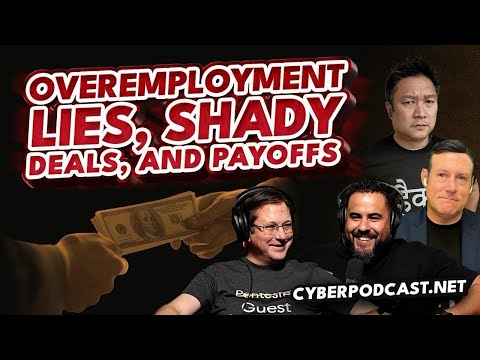
Why Did the DOJ Go After a Ransomware Negotiator? — with guest Mike Manrod
0:00So, today's Monday, July 14th, and we've got some interesting topics again this week, plus a special guest. Today, we're talking about Google has been ordered to pay 314 million dollars for misusing your
0:15cellular data in California. The second one is Department of Justice is actually investigating an ex-ransomware negotiator over extortion kickbacks. So, they're getting paid by two people. Good stuff. Not really good. The third
0:33story is overemployment. People with multiple jobs that are remote. Maybe that's why so many people want to go back to the office. They got to make sure people aren't overemployed. All right. And with our special guest, this is the DTF Cyber Podcast. I'm Damian. This is Troy. And
0:50it's your boy, Fern. Let's go. Very special person in the studio today.
1:05I know him as Double M. That's his code name. He doesn't know that, but now he does. It's the one. It's the only Mike Manrod. Say hi, Mike. Hi Mike. I'm I'm really really glad to be here, Fern.
1:20Thanks for inviting me. Yeah. You know, you were actually the first guest on the other podcast. So, it only made sense that you were the first guest on this podcast. Um and the reason we have you is because we have room. Damian's he's
1:36out of out of the country right now. So, we said, you know, we have to start bringing in some experts. We have to start bringing in some people. It's not just the same three of us. So, you are the not the inaugural. I don't even know what the right word is, but you're the
1:51you're the you're the first guest. So, for the people that don't know who you are, maybe they're not in Arizona. Maybe they haven't heard of Double M, Mike Manrod. You go ahead and tell them who you are, what you do, or keep it a secret. It's up to you.
2:07I'd rather keep it a secret. Sounds mysterious. Uh thanks. So, Mike Manrod, aka Crude Solutions, and I wear a few hats. I am CISO for Grand Canyon Education and and by proxy for GCU. I
2:22teach malware analysis. And then I co-founded and and helped teach and lead the Threat Intelligence Support Unit, aka TISU, and also support the actor community. But, I think what I'm most passionate about in all that, obviously
2:38the teaching, but really the research. Um Yeah, Ezra Woods, aka Shama Woods, and I and a lot of our friends have been working on, you know, different research projects and different opportunities to study what adversaries are doing, emulate their tactics, and create
2:55testing frameworks to see, "Hey, how do our tools and environments hold up against really realistic testing?" So, that's been a huge part of what I've been focused on lately. Okay. What I like about Mike and in the community is that you're so involved in the
3:10development of the next generation talent pipeline here in Arizona. So, thanks for everything you do. And again, thanks for joining us on, you know, our as our first guest on this podcast. Yeah. And what I was going to add is if you're going to be at Def Con,
3:28at Black Hat, Mike will be there signing jerseys, signing anything that you want to bring to him. You just have to bring the Sharpie. And make sure it's I think is blue the official one that they always have you sign with because you can't like replicate it. I think there's
3:43a certain there's a certain Sharpie color. So, you'll be there presenting on some of the recent exploits that you guys have been working on, right? Uh we we don't have a date yet, but we do know you will be there. You will be presenting with Ezra. So, if anyone listening is going to be at Black Hat,
4:00be sure to check out the schedule, look for Mike Manrod, Ezra Woods, and go go support their discussion, right? And quick clarification, we'll be presenting at Def Con Demo Labs, not actually Black Hat, but Def Con Demo Labs will be
4:15presenting over the weekend, like Friday, Saturday time frame. But, yeah. I'm I'm excited. Come out, say hi. Got about 600 stickers from a few of our frameworks printed, and I'll be giving away a lot of stickers out there. Yeah, and for the record, Fern, I don't think you've ever been to
4:31a B-Sides, Black Hat, Def Con in Vegas, hacker summer camp, right? No, it's going to be my first one, and it's going to get crazy, uh I hope. I hope. Yeah, I was going to actually say, thanks, Mike, for clarifying, because there's so much going on that week. When you're here, you got Black Hat early on, you have
4:47some events now, it's actually extending into the previous weekend. So, I saw a couple of things going on Sunday, Monday, Tuesday, and then as we transition into Def Con, you have B-Sides, you have the different villages at Def Con, so you know, if you're going to find Mike, make sure you know he's in the demo village. All right. And I guess with that, we'll
5:03get into the first article. Google. I use it. You probably definitely use it. Probably use it a lot less if you're using Chat GPT, like myself. But, this is interesting, because in California, a jury found that Google was
5:21transmitting Android user data on network, and over the cellular network, rather, right? So, what's interesting about this is they were just like sending telemetry data on
5:36without people realizing it. And for me, the context that I thought was interesting about the article was that the plaintiffs in the argument said the traffic could have been deferred until there was Wi-Fi. So, I don't know if it was the deciding factor about this
5:53being it was done with the cellular data and that's what caused the burn. But, they're being Well, I guess a They have an appeal now. But, they were ordered to pay $314 million.
6:09I don't have $314 million, but I know they do. But, I know the people that are claiming
the concern the concern would be for people who may pay for their data on cellular network. There's additional charges, right? So, I don't I don't know how much data that is. If it's like, you know, 10 or 50 meg
6:26per day of telemetry data being sent over the cellular network. If you think about this, if you're charged by the gig, by the meg for cellular data access, that adds up. So, I think that's where they're coming after Google. Now, the the bigger question is,
6:42you know, is our privacy concern here, even if they're sending it over Wi-Fi? I think we're all we all know we're being tracked. We know there's a lot of data you know, Google's collecting about us, what we're searching, where we're going. You know, I think even in Google tells you how busy certain locations are
6:58based off of some of this traffic. Oh, for sure.
Yeah, for sure. Well, let me ask you guys, cuz all of you have worked in the corporate space, right? The enterprise, you know, businesses and you guys all run security programs either today or at some point.
7:14As an outsider right? For me, what I think is interesting is what if those devices were corporate devices? Right? Not just a personal cell phone. So, like everyone has a personal cell phone and what they choose to do with that is up to them. And, you know,
7:30having an issue with Google is one thing. But, when it comes down to an organization that might have uh devices, not your not bring your own device, but they actually have corporate issued devices. Um what happens there? because now these businesses are being charged
7:46realistically, right? But more than more so than that, their data is being sent, right? So, are businesses at the mercy of the the T's and C's of Google? Or is there some sort of recourse that businesses have? I don't know. So, I'm
8:01going to ask the pros. Yeah so the first thing that I laugh about when you hear like Google find 314 million and before we like zoom back to your question, Fern is who's getting the 314
8:16million? Like if it was my data plan, are are they going to cut me a check personally for some of that? 50 cents.
yeah.
Yeah, $2. It's probably exactly a dollar a person. 50 cents a person. But but no, I mean, I think it's a really good point and I think sometimes it's it really
8:32comes down to the details, Fern. I mean, if we look at it I think it would matter a lot to know what data was sent and I think I'd have to know that to give an answer of whether I was concerned from a corporate perspective. But let's face it, whether we're talking Google, Meta,
8:48X, any of these platforms, that it's it's no secret that they're all gathering a tremendous amount of telemetry about us and then using that and you've all know a Harari you know, talked about the notion of hey, what happens when our algorithms
9:04know us better than we know ourselves? And when either the algorithms themselves or the people controlling the algorithms use that to manipulate us for our own gain. And as I look out at Prime Day and the suggestions and all of that, I mean, I think we all can see that's
9:20happening from a privacy perspective. Well, let's simplify that this a little bit more, right? I know these are big tech companies and we know they're collecting data about us, but what about your employers, right? So, if you are a security department, do you track where
9:37all of your employees are? And are you worried if there's a regional threat? So, right now I'm traveling if the city I'm in has an earthquake or there's some political you know
9:52I What is What do we do? What Are you worried about the interruption to your business? And Troy, I don't know if this is something that you you've worked with or or how you deal with in the past with business continuity and understanding where your users are. Do you need to know where all those users are?
10:08And do they consent to it? Yeah, there's there's definitely a company that I love and we usually don't call out company names here just for, you know, not to show bias or preference, but this one's unique because DataMiner is a company that's been doing this for almost 15 years and I'll use the Saudi Aramco
10:23example when the Saudi Aramco oil field got bombed by a drone attack. And I'm talking about not military drones, commercial drones. And so basically a Twitter user saw these lights in the sky and was, you know, filming and look at these beautiful stars are very you know, interesting. Well, DataMiner's
10:39algorithm was able to hear the sound of a drone, saw that they were heading towards the Saudi Aramco fields and they kind of put two and two together through their intelligence network and say, you know, we predict this is going to be, you know, something bad for Saudi Aramco. They actually knew about that attack 30 minutes prior to CNN. And so I think that is kind of what
10:55you're talking about, Damian. There are companies out there that are listening to all the public information on social media networks and, you know, news networks and so on and stitching together those type of things. And companies like that can show you, you know, if there is a natural disaster in a city, you know, where all your users
11:11are, what they should be aware of and quickly alert them. Like the Texas floods as an example. Or, you know, you know, if you have an executive traveling overseas like you said, Damian, you know, you want to make sure there's no protest going on, there's no, you know, animosity. You know, make sure that uh your executives are safe. So,
11:27there are companies out there that do that. So, there are there are there are but the problem the problem, Troy is that a lot of employees users do not opt in or don't want to opt in for location tracking. So, I don't know what point do we have like it's mandatory that you you
11:43you alert the company where when you're traveling where you're traveling to. Yeah, so that's goes back to the it's only as good as the amount of information you give it, right? So, you if you don't know that I'm in Taiwan, you you're not going to alert me that there's unrest there, right? So, exactly, so true. And it goes back to
11:58the whole monetization here. You know, you ever see the you know, commercials where it says text and data rates may apply? You know, this is we hear this so often we actually forget about it. We ignore it because we've heard it so many times over the years, but that's kind of the case here when you start to sending all that data over the cellular network.
12:14Those little roaming charges or those data charges start adding up under under the covers. And so, I think that was the big part of this case, but when you talk about individuals privacy and how much information that they are storing about us and how they're tracking our preferences and where we are and what we do,
12:29there's a 60 Minutes episode that showed even if you turn your cell your cell phone off, if you completely turn it off, it still records location data. And so, you turn it off, turn it back on an hour later, it's going to send all that data where you were for the last hour up to Google's servers to track your
12:44preferences. Now, that data is not exactly you know, available to your spouse or your your your loved ones, you know, for tracking you in those kind of ways, but it is able to track you for showing you preferences shopping restaurants and so on. So, that's a little bit scary as
13:00we look at that, but as you mentioned, I think we are just getting used to the fact that our entire world is connected and we need to understand this data that's being concerted about us. Yeah, but back to the the article, this was a lawsuit because of the cellular data use.
13:16Uh I think we can go down a a rabbit hole of, you know, what what what are information being collected about us and I I think we're we're all in agreement that there's there's probably a lot, right? I don't know, Mike, have you Do you ever think about going off grid completely and disconnecting and trying to
13:31not have your data being sent to you know, all these providers? It You'd have to go pretty far off grid. I mean, okay, so you can't be anywhere where there's traffic cameras. Right? Like, you can't be anywhere where Basically, you can't have any situation
13:46where you drive, go anywhere, pay for anything. So, I mean, I I pretty much cave cave people. Like, that's that's about the I I got a solution.
Hey, let me borrow Let me borrow your car Mike. There you go. That's hilarious, Damian.
14:02I don't know. As a we'll say as a consumer, I don't necessarily care, right? Cuz I know they're going to get it anyways. Like, when you when you When I think of Google, I don't necessarily think of GCP, right? If I was a Okay, we're hang on. Let's take a half
14:18step back, right? As an average Joe, so as an average Fern, not in tech, not knowing anything about security, if I have a phone, if I have an Android, and I'm using Google, like, I don't think anyone ever
14:33And you guys I can I can see you all in the eyes right now. I know you guys don't read the T's and C's. You can People can say that they do, but most people just skim it. And I think for the majority of people, they're never reading. They're just like scrolling until the continue button highlights, and they're clicking it again. So, when it comes to this, it's
14:51is it Is it There's always going to be a trade-off on privacy versus security, right? And I would say Oh, I would even argue a majority of the the average Ferns out there, the average Joes, don't necessarily think about these things, right? So,
15:08is it a problem? Maybe. Do people care about it? Maybe sometimes. But, is is it Is it more important for businesses to consider these trade-offs versus the consumer because of how it affects the business or is it just more so well they
15:25just got caught with their hand in the cookie jar and it's just
Well, I think this is the the question is do they have the rights to use your cellular data without your knowledge? I think that's what this particular article is all about not the actual data that they're collecting.
15:41In some countries, I know in the United States we have unlimited data plans so maybe it's not such a big deal. But there are other countries where you're paying per gig. You're on a plan where you have a limited amount of data. And in those cases I don't think it's right for a company to force uploads of this
15:58telemetry data that may or may not benefit the consumer but it's going to cost the consumer additional charges for the data to be transferred. Yeah, and if you I don't know a single person who actually reads the T's and C's and you know, we we're in tech, right? Imagine the average
16:14consumer but I know my peers I don't know anybody who has said I read every T and C that I sign up and agree to. You may be out there but I haven't met you yet. But my point is that if you ever have stopped to read the terms and conditions it it's like reading the King James 1611 Bible. Thee, thou shalt beget, this,
16:31that. I can't understand it and I'm a very well educated on MSAs and legal documentation. Like if you read this you get confused, you get you know, it's not easy to read it. It's not like saying we're going to use your data to do this. It's very confusing for the end user. I really wish we had a way to simplify
16:47that in in legal in language that is not legalese as I call it. Yeah, but you're we're not necessarily reading them because we have in in business we always have a legal department or a contracts person that looks through it. Um any good CISO or CIO will have that
17:05contracts person that knows all the T's and C's. So you can ask them what what are my obligations and what are the obligations of the vendor for certain situations and they'll know or they'll look through it and and let you know. Oh yeah, sorry. I want to be clear on this one. I read every terms and
17:20condition MSA that I sign for business. That's not what I'm saying here at all. You have to read those with a fine-tooth comb. I'm talking about the consumer ones for Google or Facebook or meta or X or whatever it is. If you look at those as a consumer, I look at those and I'm like, I don't know what you're selling me. I I just don't understand. I click accept. I don't even know what I've just
17:36given you the access or the rights to do with my data because it's so confusing. But for business apps, absolutely. You have to read those.
there a crossover because we do use personal devices for business? Mhm. And I think that's where the rubber meets the road and where it gets really gray. And it's funny because like I
17:53think all of us here, I review a lot of contracts as well as part of my job. And it seems like if it's a hundred thousand or million-dollar piece of technology, it's 20 pages, 12-point double-space font in a Word doc.
18:08If you download a free copy of PuTTY, it's like a hundred pages of four-point font single-spaced and you're paying nothing for it. So, all right. Who reads every million-dollar contract they sign? You might You might get some pretty good
18:26nods in a room full of of tech exacts. Who reads the fine print of every single free download, every single subscription service? Probably none of us. I certainly don't. Can't you just load it into GenAI and ask it, "Hey, what does it say? Can you
18:42give me all the fine print?" And have it spit it out for
I've started doing that, actually. Even when I'm going to read a whole contract, I'll I'll load it into GenAI, get a summary, and then I know what to really focus in on versus what to skim. And I actually I do a better job. I miss less.
18:59Hm. So, you've actually fed a contract or snippets of a contract The whole thing. I've also vibe generated entire 20-page contracts where I give a a nine-sentence prompt, put it in a deep reasoning model, it asked me several follow-up questions. I
19:16walk away for 10 minutes and then just review it and tweak it, and it would have taken me like a day and it's done in 15 minutes of work. It's kind of amazing. So, you're a vibe contract writer? I I try not to write contracts at all, and I always send them to counsel. But,
19:33if for some reason that falls to me, yeah, I am definitely using the AI. Interesting. Interesting. I don't know. I will So, So, we talked about on the personal devices, right? Well, so do do you guys care if it was on a corporate device? Or
19:49maybe maybe more specifically, how do you audit third-party companies that potentially might be sending telemetry data of the business, right? Hot take here, Fern. I actually really don't care. Because like when I really zoom out and
20:04I look at the risk of like users that could pick weak passwords, I look at the risk of, you know, supply chain attacks, I look at the risk of, you know, dependency libraries that have flaws. Like, just zooming out, I look at all the things that could cause us a bad
20:21day, and even third-party risk, a a cloud provider leaking all the data or being breached. If you start stacking all those risks and then you look at where Google uploading telemetry data fits in that risk model, it it won't
20:37even make the top 100 list of problems and things that stress me out. So, as a consumer, like I'm a little worried, but as a corporate corporate security program, I'm not too stressed. Hot take. No, I think the only time it matters is if you have a VIP where their physical
20:53location is a safety issue. And so, for example, if you have a high-ranking officer that you don't necessarily want most of the public to know where they're at, you don't even want Google to know where they're at. In that in those cases, you know, I I would be concerned. Yeah,
21:10like a United Health type organization where Right.
might be relevant. This is true. You know, people knew where they were at. Where he was at, right? So, I don't know. It's interesting and I
21:25But that wasn't even that wasn't even telemetry data. That was just like public information that was out there. People usually aren't going to do something super super complex and advanced if it's possible to just Google or Google the answer. And I'm sure that was
21:42a case where you could just Google where he was going to be that day. Yeah, or at least be aware because of board meetings, right? Earnings and things like that, right? So, I don't know. I guess it was a pretty hot take. I feel a little gassy right now. Like I got a burp. I got a burp as It was a little bit
21:58spicy, Mike. So, before we before we jump into the next one, I think any any hot takes from either you, Damian, or or Troy? You got anything spicier than that? Or are you guys kind of in the same boat? No, I think Mike summed it up. I totally agree with him. You know, there's
22:14there's much more pressing issues that we spend our time on than this this one. It's interesting, for sure, but it's not going to be the top thing I work on today at work. Yeah, totally agree. I mean, like I said, if there's a VIP that we have to keep their location under wraps
22:30for whatever reason. For example, we don't want Let's say there was two companies that were going to do a merger and you see meetings, right? CEOs meeting with other CEOs. You don't want anyone to know that they're meeting at at maybe a a partner's office or a competitor's office. That spins off
22:45rumors. And so, in in those cases, yeah, we try to keep location and and metadata under wraps. But for the most part, personally, I don't I really I see the value, right? I I like when Google tells me, "Hey, traffic going home is increased.
23:01Maybe you want to wait a few minutes before you drive home. In that case, I I don't care. I I I like convenience. And I agree, Damien and Fern, just to add some cool avocado sauce to that spicy take. I feel that way a lot of things, right? Like people are obsessed
23:16about quantum cryptography right now. I'm like I'm I mean, let's just patch and get our domain controllers set up correctly before we worry about quantum cryp- cryptography, right? There's I feel like there's a whole lot of things that get a lot of attention. But then,
23:31if we just stack rank our risk, we most of our problems are much simpler. Yeah, so you're you're back to the basics. Get the Get the basics right and worry about the other things as they come. Yeah. Yeah, exactly.
Mike Mike Manrod is dropping truth bombs on the DTF podcast. That is absolutely
23:47one of our biggest challenges in this industry. I call it the shiny object effect. Everybody's chasing a shiny object, the newest thing. We got to get our assets under control. We have to do our basic block and tackle. We have to patch our things. We have to fix our user
24:03privileges and over privileges. So many things to focus on. Quantum cryptography is not the thing that's going to cause a breach at your company today. Nah. But you tell that's that's tomorrow. That's tomorrow. Let's There's a lot of easier stuff today.
24:18That's for sure.
Love it. Well, now let's just imagine we're all working at a company that gets popped. Gets hacked, right? So, who are we going to call? We're going to call Digital Mint in this case. Which happens to be the company involved
24:34in the next article. And we're going to call Digital Mint, and they're going to help us because we're being extorted. Now, just imagine you have to pay some money, right? To these threat actors.
24:50You send a bunch of money out. So, apparently, Digital Mint has done over 2,000 ransomware responses since 2017. Now, imagine you you call these guys, hire them for the job, and you find out not only did you pay
25:05them for their services, but they got paid by the hackers. A little something something off the top. They got skimmed a few bucks. Simply, well, I don't know I don't want to put any words in anyone's mouths, but
25:20there was an employee there has since been fired on the suspicion that they arranged ransom deals with cyber criminals. So, double dipping? For sure, but for me, I think the the first thing that I think of is
25:37should there be any sort of due diligence or oversight on firms acting as intermediaries in these cases, right? There's there's always like there there're always groups of people that have oversight into certain areas of security.
25:54Is the ransomware negotiation part something that should be looked into for things like this because I've said this before and I'll say it again, if you show me the incentive, and by the way, this isn't my phrase, right? If you show me the incentive, I'll show you the outcome.
26:10Right? I I believe it was the gentleman from Berkshire that's a true that that's attributed to that phrase. But yeah, you show me the incentive, I'll show you the outcome. And in this case, the incentive is getting paid, and we can clearly see that people are taking advantage of both
26:25sides. So, Yeah, I I don't know for any of this is really a case of the incentive versus the outcome because, you know, this is a criminal. This this I'm not talking about the right ransomware. I'm talking about the employee a gentleman who's taking money from
26:41criminal organizations on the back end. I mean, this is just a crime. This is not somebody who's trying to, you know, fix their life for the better or, you know, do good and and have two jobs. Or we're going to talk about overemployment later, but but this is somebody who is taking advantage of somebody who's already been victimized.
26:56This guy should be put under the jail, I think. You know, we see this a lot. Imagine a different scenario. You have a human who's kidnapped and being held ransom somewhere, and your negotiator is taking kickbacks from the kidnappers to, you know, get the price right with the
27:11vic- I mean, come on. This is absolutely, you know, despicable, in my opinion, and this guy should be held to account. And it is a criminal act. He if they I think they'll go to jail for that, but you know, the funniest thing was today, in the news, a Russian basketball player who plays for the
27:27University of Pennsylvania was just arrested for the same thing. So, we're talking about two cases of somebody acting as an intermediary and taking kickbacks from the ransomware group on the back end to negotiate ransomware payments. So, I'll give you the link to that story here after the the podcast. That just
27:43came in today. Well, I would say negotiating even negotiating to pay the ransom, I think we we've been saying in previous episodes, you know, don't pay it. But, I know there's always there's always a case where businesses feel like they need to get that data as
27:59soon as possible and they'll need to pay some sort of ransom to unlock it. Uh but, I think, you know, negotiating and paying puts you in the spotlight even more, right? They'll target you even more cuz they know you're going to pay. So, just be careful there.
28:15But, yeah, I I I agree, right? If you're going to opt to take a third-party negotiator, the hope is that you trust them and they're going to be acting in your best interest, not trying to take money on on the opposite side. Well, you're paying them for their services, so they're taking money on
28:31both sides. I I think this is, you know, this is quite common. Let's Let's just look at kickbacks in our industry to begin with. Right? What about technology leaders that take a kickback off of a purchase of a tool or product? I think that's a
28:48huge ethical problem if it if it happens that you know, never should have occurred in the first place. No one should ever consider that, but it does happen. Absolutely. We see it all the time and we hear stories about it. I know the FTC and the federal government's looking
29:03into the several cases that and that payment can it's not always cash. It could be stock, it could be options, it could be equity, it could be fancy trips, you know, we've even seen boats and cars, believe it or not. This is crazy that that can happen in our industry, but it's happening. And I want
29:19to just clarify one thing here. Digital mint, you know, this is not a reflection of that company. This is one person who made these decisions on his own. You know, unless we hear more that Digital mint was somehow involved in this. I want to make sure that the company, you know, is an incident response firm and has done years and years and years of
29:34good service. This is one specific person on that team and has been fired immediately. There's no indication that the firm Digital mint was involved in this at all. I got a question for you, Mike. What what's your policy for for where you work in terms of taking gifts from
29:50vendors or you know, obviously you can't take kickbacks, but like Troy said, there's other forms. There's trips, there's you know, I don't know. I've I've been offered a car one time and I I turned them This is like 10 years ago. They said we'll we'll give you a car and I I
30:06just declined and and walked away from that. But yeah, what what are your policies at your organization? Well, tell them about the dinners. Tell them about the dinners, Mike. Or not not the dinners that they bought. Is there a limit? Like I mean, there dinners are are one thing, but you know, if you're going to a really super fancy
30:23dinner, that that might be questionable. So, I think Burns is alerting alluding to a negotiation approach I have and I'll circle back to that in a second, but you know, I think like it when I get these emails that say, "Hey, if you take
30:38a meeting with us, we'll send you a gift card or buy you some Nikes or something. I have like a templated reply I always send to those that hey, this is your one warning. If you're caught doing that again, we'll block your entire domain from our entire company.
30:54Like your entire email sending domain of of like that vendor. So, I give like one warning on that and then we just block them. If I found out it biased an employee's like decision-making, I would that would definitely be a big problem.
31:10Some My general thing for things like a dinner or something like that would be if it's a well-established relationship and it's clearly not biasing anything, I think it's fine for a vendor to pick up the tab. On the flip side, if you have a
31:25huge fancy dinner 3 weeks before a first-time PO is about to get cut or something major is about to be renegotiated, that's problematic and it shouldn't occur. So, I think there's some nuance and discretion there. But, Fern brought up something funny. When
31:41I'm actually doing vendor negotiation, if I think it's like really going to get contentious and a vendor invites me out to dinner, I don't do this all the time, but sometimes I will invite them over to my house as the counteroffer. I will cook.
31:57I'll make it like a five-star, you know, get like get like a a really good Wagyu steak and a nice bottle of wine and make it just like you'd get at a really fancy place. And it's a little bit of social engineering, but then they're kind of walking away. It it kind of flips the
32:13hey, they wanted to take you out so that you're subliminally beholden. So, cook a meal and it kind of has the reverse effect. Makes it what? So, you get a better deal? Is that I don't know that it really does, but it's certainly nobody's ever going to call it improper if somebody wants to have dinner with
32:30you the week before a big deal. And again, if if you go to a sports bar and who picks up the tab for a couple beers and some wings, doesn't matter. But it's more a matter of, you know, if there's like there's definitely a line where
32:45you know, any sort of gift or benefit could be questionable. And then obviously the extreme cases that you and Troy brought up are are are spot-on for that. But I mean, I think we just need to have discretion, be good stewards. And I agree, Troy,
33:01this is one bad person who clearly was a criminal and should be treated as such. Like that's fraud. Mhm. Absolutely. And I would say it it does matter if that that bar is the Hard Rock in Yankee Stadium and you're sitting in front row eating your chicken wings and having your two beers.
33:17Right, exactly. Yeah. It all depends on the atmosphere. I only had popcorn, but it was at the Super Bowl. Okay, well Yeah, there you go. You got What do they Not center line, what do they call it? Midfield? Like the 50-yard line tickets and you had free popcorn. You just
33:32I was just enjoying the game. at the Super Bowl. We just all need to be good stewards as an industry and and there's going to be bad apples, but I think people usually try to do the right thing. Absolutely. You know, I think that we we really I think folks like us we just
33:49believe in the good in everybody and we think the whole industry is doing the right thing all the time. And then you hear these stories and you're like, oh my god, you're shaking your head. So we talk about getting into cybersecurity and careers in cyber. So I'll give this nugget of truth out there. If you are advancing in your career in cybersecurity,
34:05know that people are looking, okay? If you make an ethically questionable decision about whether to take a gift or take a fancy dinner or something that's kind of questionable, that that's noticed and if it happens a multiple times it becomes a pattern. If that pattern continues to increase, people may think something negative
34:20about you. So, you know, if you're going to really try to maintain a career in cybersecurity, it's about trust and integrity. Make sure that you maintain both throughout the entirety of your career. Yeah, one of the places I worked at, they used to have a a limit on gifts. And so you couldn't take anything more
34:36than like $50 or $75. And and typically what I did was I I'd take the gift, but then I'd you know, save it for the team and then either raffle it off or give it away to the rest of the team. I never personally kept anything. And so I'm always conscious as as well
34:52if I'm meeting with someone, if I'm going to pick up the tab, just make sure I know what what's acceptable for for their organization. But even myself as a customer, you know, I I'm not very comfortable with you know, anything that's super expensive. Although I've never been invited to the Super Bowl, so
35:07I I'd be an interesting problem to have. You just got to spend enough. You spend enough, you get anything. And and and that that summarizes exactly the problem and and and the situation's relative. Like you mentioned $50, Damian. We're all
35:23going to be out in Vegas soon. I'm pretty sure you can pay up to $20 or something for a bottle of water there. So, like if you have a $200 meal tab in, you know, Oklahoma City, that's very different than a $200 meal tab in Vegas.
35:40That might have been for like ramen and one plate of sushi. Yeah. That was just true. But so, I mean, I'm not an expert in this field. But I will say one thing. You know how whenever there's an event coming up, like Waste Management or a
35:57concert or things like that, those tickets aren't just randomly I guess handed out, right? Those tickets go through an approval process. And typically the question that's being asked is, is there an opportunity on the table right now?
36:13How much are they spending with us? And is is this going to help us push opportunities further along the line? So, regardless of if it's ethically okay or not, on the sales side, a lot of times these decisions on
36:28what is being handed out and to whom is dependent on the business, right? And that's why when Damien said he's never been offered certain things is I, you know, kind of jokingly says cuz you don't spend enough is because there's a lot of times where, you know, even even here when the Super Bowl was held in
36:44Arizona, everyone had tickets. A lot of pe- a lot of vendor partners had tickets. They spent a lot of money and I trust me, they weren't handing it out to the people that don't pick up the phone, right? They were handing it out to the people that spend millions of dollars consistently or have the potential to
37:00spend hundreds of millions of dollars, right? And I think that's kind of where it's a fine line for the people that are on your side to think about it is could it be could it be perceived as unethical, right? So,
Absolutely. Yeah, absolutely. And I know in in my past jobs we had very strict
37:17limits on the dollar amounts, but you have to remember that, you know, multiple nice dinners can add up to greatly exceed that acceptable dollar amount. It could be four, five, six hundred dollars I think was the the usually the threshold in my previous roles. But if you work in federal
37:32government, state government, that's much less or you can't even take anything at all even a dinner or coffee. So, I think it really comes down to, you know, what's reasonable and acceptable to your company, but you have to remember to yourself like these people are not buying you dinner because you're a nice person. They're trying to get your attention, your time, and
37:48eventually a PO, right? But that's, you know, it's it's about the relationship that you have with your vendors. I think it's a good thing to spend time with them to get to know what, you know, the problems are. I was going to ask Mike because we talked about this in one of our first episodes was you know, people aren't picking up the phone anymore. After COVID it's been so
38:04tough to get a vent customer's attention. And so we saw a lot of these very unique events, whether it's whiskey tasting virtually on the phone where they send you a bottle of whiskey or chef that comes on and cooks with you in your home, a pair of AirPods as you mentioned, Mike, or a gift card like,
38:20you know, I think vendors are really just trying to find a way to get back in front of their customers after COVID. It's very difficult for them. So, I kind of see both sides of that coin. Yeah, it it's a good point, Troy, and that that's why I think we need a balanced approach, right? Like I think it it benefits defenders to socialize,
38:37to network, and to share. Um we we have a some circles of us that do actually get out and do it on our own, but that's only because we met originally at events that probably were sponsored indirectly or directly by vendors. So, I I do think there's a
38:54balance to it, Troy, and I think if we went to like zero tolerance across the board on that kind of thing, I think it would create an unhealthy dynamic. And then biasing decision making, I think is also an unhealthy dynamic. So, I think there's this balance, but I I think a
39:10huge part of it is where are you in the sales cycle? Like if if it's if it's if you're on a 3-year deal and it's 1 year into it and a vendor takes you out to dinner, you probably shouldn't worry too much. If it's the month before the next 3-year deal, you should probably be
39:27watching it really really closely what what's happening and why and how. Yeah, you just touched on something very interesting. Sorry, I was just going to say you touched on something very interesting there that I didn't even think about is that, you know, some of the best knowledge transfers that I get with my
39:43peers are at group dinners that, you know, like the ones we had in Scottsdale or here in Vegas where you get 20 CISOs together in a room with one vendor. It's a nice dinner, but the knowledge transfer in that Chatham House rules kind of environment that you can talk about real breaches and real issues that
39:58have been seen in your own local community. I think that is priceless and I think that is something that we do need more of. So, good point, Mike. Yeah, I think I think those networking events where it's not like sales heavy, but just to build the relationships, those are are great. Um but I was going
40:15to say to your point, Mike, you know, if you're in an active RFP and you're testing out multiple products, it's probably not the best time to be wine and dine by, you know, everybody who's trying to get your business.
40:30Yeah, this is true. But I've been in situations where there's been a lot of money on the line, and trust me, I'm fighting to get in front of people. Dinner on a Friday?
So So, let me ask you this, Mike, what's the best gift you've ever gotten? You know, the time and attention of people
40:47that I enjoy chatting with. Oh, yeah, that's so that's that's so politically, yeah, I know.
with you guys, this is the best gift ever. But no, it's So, there's there's actually a legitimate Yeah, I'm going to temporarily dodge that question for a second, but I I think that
41:06what Fern, you brought up a really interesting point, which is I I think that when we look at this, if there's there's no reasonable situation that would have me go out for a happy hour at 10:00 p.m. when, you
41:23know, tonight for example, except for the fact that I'm already in 12 to 14-hour meetings, and one of my vendors wants an hour with me, and they know that if they pick somewhere with a decent Manhattan, they'll get me out at 11:00 p.m. or 10:00 p.m. to catch them.
41:39Right? So, I do think that sometimes as we're giving people time that we should give them, and we're taking it out of our own schedule, I think picking up a tab, picking up the tab for that's reasonable. Although, I always offer to
41:54split it, or I always offer to pick it up even in those situations, right? Yeah, and I I don't I think it I think it has more to do with the mindset. In terms of gifts, I think the best gift I ever got was that Red Ryder BB gun when
42:10I was like 8 years old, Damian. It was just so cool and being able to shoot that like wooden barrel of wire and, you know, hear it plink when it hit the other end. Like, that's probably the best gift ever. Yeah, grandfather and I had
one of my teams we used to have Nerf wars in the office.
42:27I I won't mention the employer cuz I don't want to get anyone in trouble. But any of anyone on my team we we know 40 people with Nerf guns. One of our vendors found out they were in our office when a war broke out. The very next day they they dropped off a couple of branded Nerf
42:43guns. Damn. I was I thought that was pretty cool. That is cool. Yeah. And like, what do you do with that? Like, do you you have like 20 cheering employees out there in the cube floor? Do you take those and walk them out to the dumpster and throw them away? That probably wouldn't be a very
42:59effective manager. But, you know, is that a gift from a vendor? Yeah. So, like, how do you how do we I mean, I know I know we're running long on this topic, but I I think we could talk about this one all night cuz it really is a a a difficult challenge for our industry.
43:15I'll tell you one one crazy story that I had heard in my career. You know, I was working with someone. I won't say their role, where they worked, or their name. But I will tell you that I was having a conversation. We were doing we were in an RFP. And
43:31in that RFP, the remark was made of, "Well, you're just going to have to get my boss a jet ski or better." And I said, "What? How am I supposed to do that?" And I was like, "I was just It's more so a joke." Like, "Well, why would you say a jet
43:46ski?" And the person he or she may have said, "Well, because the rumor is that this person has received that in the past for purchases." And so, my question was like, "So, you're telling me
44:01the manager of this organization in this department, the employees at this company think or believe that they had received a jet ski in in not necessarily in exchange for a purchase, but as like a say a thank you
44:17gift. Um and the answer was yeah. Right? And there was there was no way to ever prove it, but it would it's it's always been a running joke between myself and this other person where I will always say something about like, you know, have you ever gotten a jet
44:32ski? Right? And it's just like we just laugh about it, but yeah, these things happen. And then if they do happen and the employees are aware of it, it just kind of creates like a a weird cultural dynamic, right? So, bottom line is if you're in tech and someone offers you anything, just
44:48don't accept it. Chances are you're making really good money on your own. Realistically, if you've been in the industry for a few years, maybe 5 plus years, you're probably making 100,000. You can afford AirPods, right? You can afford your own $70 of Angel's Envy
45:05whiskey rye, right? The good stuff at Costco. You can afford all these nice gifts. You might as well just buy it for yourself and eliminate any sort of conflict or potential that people would assume that you're involved in stuff that could ruin your reputation, right? And I think with that, we can
45:21move on to the next one. Unless you guys wanted to add anything else. Just keep the ethics high for our our, you know, our industry. That's That's what we're trying to do. But, that takes us to the next one. Are you ethically a bad person if you work multiple jobs?
45:38Now, in this is specific example, there are people that are considered over employed, right? A lot of them are Korean. You know, working for North Korea, but we're not necessarily counting out those people. Sorry, I thought that was
45:54totally something else there. No, Oh, no, no, no. I I was referring to the North Korean scams that we've talked about in previous weeks, but so overemployed, people that take images and kind of alter them and multiple aliases, right? But there's also cases
46:09where people are remote, fully remote. And
and I think that this specific topic, friend, I think that let's let's forget about the North Korean guys for a minute. We've talked about that till it's dead in the, you know. Yeah. Let's talk about real Americans. I know people. I know people specifically right now that have three jobs. Three?
46:26remote. And three. And they have mouse jigglers and they are present on the right calls at the right times. I'm talking about regular everyday people that you and I would know in this community are working multiple multiple jobs. So let's forget about the the hacks and the fakes and
46:42the, you know, poor intentions from overseas. Let's talk about just people in America who are working three jobs and are overemployed. I don't know. I would say I'm overemployed at my one employer. You know, just trying to keep up with what I need to do on a daily basis is I feel like I'm over overemployed. I
46:57couldn't imagine keeping a second employer, another whole another job. How do they even manage that? Are they just undertasked where they have time to go and take on another full-time job? I think that they're, you know, they're positioning themselves to have
47:12deliverables and outcomes rather than being measured by how much time they're, you know, physically on meetings and they're able to knock out those objectives pretty quickly with AI and they can work three jobs, right? Now, here's the catch. If you have three jobs and your employers know it and they'll allow you to moonlight, God bless you
47:28because you're working hard and you're making the money you deserve to be paid. But if you are working three jobs and your three employers don't know that and they assume that you're working full-time for them, that's something you should think about. Yeah, I and I think that really sums it up nicely, Troy, and
47:44as somebody who like encourages my whole team, as many people as possible to work two jobs, like it can be done ethically. Like I encourage everybody I run across to become adjunct faculty in cyber. if not for GCU, at a community college. So,
48:01like I think there's lots of ways you can do it ethically. I'd say a lot of the people we know are on one or more board of director roles, right? Like you might have a day job and you might be on three different boards. I think that's fine. I think the key is to go to your
48:16boss, disclose what you're doing. A good IT leader will probably have you notify general counsel to at least once. Everybody will talk about it and if it's above board and ethical and disclosed, I think it's fine, but I think from the
48:31article you're referencing is talking more about people, like again, back to the mouse jigglers, the the generative AI, the hey, maybe every deliverable is like a C-minus work, just good enough to not get fired, but spread across
48:46multiple and none of them know. I mean, I I think that's bordering on fraud, right? So, I think again, it's it's similar to some of the other ethical topics we've touched on. If it's ethical, if it's above board, if it's disclosed and everybody approves it, I
49:02think that's that's a very different thing than if you have four employers and you're trying to keep all of them from finding out and you're you're using technology that's not authorized to do that, like they they give you a process and a procedure
49:17and you violate that so you can have multiple jobs. Mhm. Well, then then that's very unethical. Yeah, I think most of most of these people who do it probably feel like they're doing nothing wrong because they're obviously doing what's required of each employer. I I think that's probably the way they
49:33think about it. Now, if you can't go to those employers and disclose to them that you're doing a second job, then I think that's where the ethics comes in as, "Okay, maybe I'm doing something wrong here." So, if you're you can't be open about it and you're you're not sure,
49:49then yeah, that's not ethical. Is there a way to automate this? You know, if I have a job that's my primary job and I get an invite for a meeting, but I have a second job that I need to make sure I don't get double booked,
50:04right? Is there software for that? Just out of curiosity.
Absolutely. It's funny. I laugh because you said, "Is there a way to automate this?" It's like exactly what they're doing. They have three jobs cuz they can just automate all of them with AI. It's the point. So, I have something booked into my calendar that when one when one
50:21invite gets accepted, it automatically re- re-books that time and schedules a personal meeting for me at my other job. And then I have both blocked off, one legitimate, one actual like work thing, but when the boss looks at my calendar, he's like, "Oh, he's busy, right? Oh,
50:37he's got something to do." Really, I'm just on a call for another company. Yeah, but shouldn't your boss know what meetings you're in? Where we like where your effort is going, what meetings you're in? Because what if you had half your calendar blocked off for personal meetings? Wouldn't that seem kind of fishy? Hey, my kid's sick. I don't know. It's but
50:54but that's the person like that person ironically is going to be sabotaged in each of those jobs. Now, I I think you were alluding to this, Damian. It's bad management if you don't know what your people are doing, how quality how much quality it is. There's no KPIs, there's
51:10no there's no way not to fake it. Now, there is a very ethical pathway for that person who really wants to automate the work and who who wants to get their job down to eight hours and then do other more
51:25fun, more creative things. And it's to do it all with that employer and then to get promoted until they're they like they'll they'll earn the money of the four jobs at the one job because they've revolutionized the workplace, they've invented new processes, they've they've changed the
51:42business. So, I'd say like if somebody's watching this that's like working four jobs or is thinking of doing that the unethical path, channel all that attention into getting a good job with a good company, and then really thriving there, and then use that to get that
51:58extra income and opportunity. I I so I I just want to play the opposite. I just want to ask you guys a question. Like so on the opposite end, if you have an employee who's performing at or above expectations, but they're also working a second job,
52:13do you care as a a manager or leader? Does that bother you? You You do because there's potential conflicts of interest. Right? I mean, again, as Mike said, they have to notify you. You have to have your legal counsel sign off on it that there's no conflict. You might be working for a competitor. You might be
52:28accidentally giving your brain power, which is intellectual property to your first employer, to the second. So there's a lot of conflicts that you have to, you know, work out. Um but I think this is a symptom of the world we live in. I think this is going to increase
52:46because, you know, we are, you know, humans are very smart and agile, and you know, this is another revolution of the, you know, industrial area. Now we're in the digital and the AI area. So it's like this is a symptom of the fact that we are trying to figure out what the new face of work looks like. And I think
53:02that it's going to be a growing pain, but employers will realize that employees are much more effective during their time, and they'll repurpose them hopefully for higher purposes, and and they won't be able to get their whole job done in eight hours. They're going to take a whole week to do it 40 hours, which is what they're paying them for.
53:18So I think this is a symptom of the changing world that we live in. I think we'll adjust pretty well. Yeah, and by the way, I've been part of investigations where HR has suspected employees of working second jobs. So there's much more than just the mouse trickler and and meetings and things
53:34like that. I I I obviously won't disclose them here, but there's other ways to see if if an employee is actually working. Mhm. Yeah, there's and it's funny you mention that Damian because I spend a lot of like it's difficult as CISOs to define
53:50you know, how much is our role performance management or how much of our role is cybersecurity and stopping cyber threats and it it gets gray. I always try to stay out of the performance management business to the to the max of my ability, but sometimes
54:07we all get sucked into it, right? It it happens. There's an easy fix and I'm going to tell you guys what it is. Everyone just go back to the office. Let's just all have to drive in. Frank, you want subscribers and listeners,
54:22don't you? I'm just saying. Our audience would probably disagree with that. I think I see the unsubscribes dropping now. Yeah, yeah, I know. It's more of a joke. And so I was actually talking to someone earlier today that works at a company here locally and when they were first employed, there was no requirement to be
54:38in the office, right? And then they happen to be a manager in in their department. And the what I found interesting was if you live for this person's specific situation, if you live outside of a 45-mi radius from the corporate office, you are
54:54I I believe you're not you're required to come in. If you are not if you're an individual contributor. So if you live with outside a 45-mi radius, you don't have to come in. So if you're an an admin or if you're a an analyst or you're something that is not
55:10in a leadership role specifically, you can stay home 5 days a week, I believe. I I I don't have the policy, so I can't say definitively, but if you're in a leadership role, management or anything like an executive role, you're required to go in once a week.
55:25And this person doesn't live in the city. They live in non-Phoenix metro. So we're talking a 2-hour commute one way for this specific person. And it's all because they're in a leadership role.
55:41Um that seems ridiculous to me, but that's just my opinion.
in some cases, right? I've seen this where employees move like let's say you're getting paid a high salary because you live in California, so the cost of living is higher, and then you move to a a much
55:57lower cost of living state, and you don't even tell HR, right? So, are they supposed to give you an updated wage, lower your wage because you're moving to a lower you know, lower cost of living. There's also taxes you got to worry about. The
56:13company has to pay their fair share of taxes to that state. But not even just in the United States, let's say you go to Mexico, and you work from Mexico City, and you're getting paid the American wage. Your cost of living is way lower, and you didn't tell HR, right? So, there's I think there's all these dynamics that
56:29you'd still ethically are you allowed to move? And maybe your job was temporarily remote because of COVID. But nowadays, I I see a lot of people going back into the office, and not because of mandates so much. Uh a lot of
56:44people really miss the human interaction and the face-to-face conversations. Mhm. Okay. Well, I could see that. I mean it does get lonely sitting at home all day with like kids running around, right? Or being stuck with screaming kids. I So, I
56:59actually know a guy that would purposely go into the office even though he could work from home because he had five boys at home, and he just didn't want to be home with that, right? So, there's the opposite case of where you just don't want to be home, so you go into the office. But there's a lot of people that don't have that many kids. They might
57:15not have any, and they just want to wake up, roll out of bed, and turn on their laptop from their pajamas, right? I don't know. It's a tough situation, but I do see that with a lot more people going back to the office. There's some people that kind of I don't want to say hate it, but they
57:32definitely don't appreciate it as much as the flexibility of staying home 100% of the time. Yeah, we were talking last night at dinner about this very subject about the return to office dynamics and what we're seeing across the industry is top talent like top performers are moving jobs if
57:49they're being required to come back in. So, companies are taking a huge risk in mandating this return to office policy. I do believe the world has changed after COVID and I think that we're going to continue to see hybrid environments and dynamics where it's not a 100% mandate for anything where we're going to find
58:05out where people like to work the best and where they're most productive, most creative and we're going to adapt to that. It's kind of a new face of work in my opinion, but you know, this whole mandate to return to office is not working. If you are an independent contributor and you don't have to
58:20collaborate with anyone, I I don't see the problem in that. But, if you need to stand in front of a whiteboard and hash things out, it's hard to do that online, all right? There's nothing better than sitting, you know, standing right here and drawing it out on the whiteboard in front of three or four
58:37people and having everyone collaborate together. I think it's much more efficient with people in the same room.
Yeah. Even pre-COVID, we were, you know, a 3 days in the office a week, so Monday and Friday at home. And you know, those extra 2 days meant a lot to a lot of people. You know, it it helped with the
58:53work-life balance. There's hours of the day that you're not stuck in traffic. And so, I think that there is a balance. 100% believe that there's a balance here. And every company has a different dynamic and every role has a different dynamic. So, I think that we just have to be smart about it and understand that things have changed and we can't just
59:09look at it through a single lens anymore. Yeah, and I I think it's interesting cuz I'm that whiteboard guy Damian and like I always talked about like how much I love the whiteboarding session. But, I haven't gotten less effective and the last time I touched a whiteboard
59:25with a marker, I think I've maybe done I mean I think I've maybe picked up a marker and tip touched it to a whiteboard twice in the past 2 years. And I didn't I didn't get any less effective. I just used different tools for those same things.
59:42Yeah, I just the one thing I can't do is you can't get people's reactions or you can't see their faces. So I we talked about like adjunct teaching. Obviously I done off your my fair share of that. Teaching students on a webinar is a lot harder because you can't you can't see
59:58who's paying attention. You can't see who's who's actively engaged and and ask them questions if you're you know just on the screen. I think just as controversial is the hybrid versus mandatory back to work versus remote debate is the on camera
1:00:13off camera debate, right? And cuz cuz that even makes a difference on online engagement. And are you teaching or are you working? A senior engineer, I don't need to see on camera or be in the office with to be able to solve a problem with. A brand new student who's
1:00:30looking at their first executable in in in IDA, yeah, I kind of would like to see them look over their shoulder at their screen. Look at what they're typing on their keyboard. I I'd like to turn my camera on in Zoom meetings. I I just want
1:00:47people to see me. I feel like I'm there. And I encourage my team to turn it on, but there's some times you just can't. Right? I I mean I'm I travel all types of time zones, and there's sometimes I'm doing a a meeting at 11:00 p.m. I might be in bed, all right? I can't just turn on my camera. Or I may be just rolling
1:01:04out of bed like like Furness saying and just trying to get on the call because it's so early. Uh but you mentioned something about working 8-hour days, Mike. What what's a normal I mean, I know you put in a ton of hours. What How many hours do you Just for people who are starting their
1:01:20career, I don't want people to think that a cybersecurity is a 9-5 job. So, how many hours do you think you put into your career your your job and everything you do in a day? I mean, it varies a lot with how crazy this work
1:01:36is. Like, in an incident or the week before getting ready for like Def Con or Cactus Con or that 2 weeks, you know, well upwards of 100 sometimes. But, a more common sustainable number, I think it cycles between 50 and 75 if I were to
1:01:51guess. Like, my typical day is 7, sometime between 7:00 and 8:00, checks some emails, drive, you know, usually a couple earlier meetings, a break in meetings usually around 9:00 a.m. to miss traffic to drive in,
1:02:07then in-person meetings or Zoom meetings from the office till like 4:00, 4:00 or 5:00, drive home, sometimes have dinner with the kids, sometimes a dinner meeting, and then usually work until about 1:00 a.m., right? Like, that's kind of
1:02:22midnight, 1:00 a.m., and then start it again at 7:00, 8:00 the next morning. That's just like a normal Monday through Thursday, and then Friday I try to try to cut off a a little early, and then, you know, work less on the weekends. But, I mean, I don't know what all that adds up to, but it's definitely
1:02:38not an 8-5 job. Yeah, and I and just to be clear, Mike's a machine. All right, I I know he goes pretty hard. I would I tell him, you know, I tell people, if I'm awake, I'm available to work. And most times, you know, I'll go to I got to be online when other
1:02:54people have meetings, and I have to join those. And then the the times that I have a lull in my schedule, I got I got to do actual real work. And actually, you know, do stuff that I have to I have deliverables on. Uh so, yeah, it's never
1:03:099-5 or 8-5. Sometimes they I my meetings start at 6:00 a.m., and sometimes they end at midnight. Yeah, and I like to quote Shannon, my wife, that always says, "If you find the job that you love, you never work another day in your life." I think that we all do this for some of the passion that we have for it, right? There are definitely blocks of
1:03:25hours during the day that you have to sit down and focus. I like to to use focus music while I do those tasks that are very heavily gray matter centric. But, what we're talking about here in the morning hours before work or the afternoon hours after work, you know, that stuff is things that you really are passionate about and care about and you
1:03:41want to get done. You know, being able to advise startups, talk to venture capitalist, you know, solve real problems in your own company, you know, mentor a new person in the industry. There's so many things that we actually spend our time on that are passion projects and not necessarily work. So,
1:03:57there is a balance there and I think that every person is different and can find that balance in this industry, which is why I love it so much. Yeah, and one of the one of the myths I want to I want to clear up, everybody who starts out in cyber security says, "I want to I want to get to the top. I want to be CISO so I can tell people
1:04:13what to do." I guarantee you none of none of us here tell anybody what to do. We may suggest stuff, but actually my team tells me what they need to do. It also is not an easy job of just sitting there and telling people what to do. So, I want to just clear that up right now.
1:04:30Yeah, I'm so glad you said that. Go ahead, Troy. If you're blessed enough to build a team that you trust and does their job, it's a beautiful work of art. You know, it's all about the people. Cyber security is a people sport. And when you build that
1:04:46team of people who know what they're doing, who love what they do as much as you do, and you all have this mission in mind, like a football team, you're going after the goal together, concertedly in the same direction, it is magic and it's something that, you know, I will you know, you'll never forget.
1:05:02I love it, Troy, and I mean, like when I look at why I I don't think I plan to stay in the job I'm in, you know, more than 8 years later now. The reason I'm here eight like eight years later and if things work out I could see myself in this job in another eight years
1:05:18is because of the people, right? Like I've been blessed to you know, grow with a team and they're people that I hope to continue to work with for a long time and and and and that's really what that the the people are what excites me about the job and the cool things I get to work on
1:05:35with the people are are why I work until midnight or 1:00 in the morning as as Damian pointed it out, right? So, build a team that you want to stay with. Sounds like a marriage. Marry someone that you want to be with. But if it doesn't work out, you stay
1:05:50friends, right? I guess. I don't know. Yeah, I just don't have don't have multiple jobs or multiple spouses, right? Yeah, yeah, there you go. There's a correlation here. So, work hard, do the right thing, and you'll be on the right path. And then maybe one day you
1:06:08won't have to worry about telling people what to do cuz you've got to a point where they know the right thing to do based on the leadership you've and guidance you've provided. So, I think that kind of puts us towards the end here. I think we're going on just a little bit over an hour. So,
1:06:24covered some interesting things today. Overemployed, Brian was the most recent one. The one before that was the ransomware a person like as Troy pointed out, not the company, but a person that worked for a company doing some things that they shouldn't be doing. Um
1:06:40double dipping and then of course Google doing some things that maybe might not be as big of a deal as as it came out and maybe the only people that wanted that case were the lawyers, not the people. So, I don't know. Anything else that we want to touch on today
1:06:55for for you guys? No, I think we're good. A lot of ethics ethics ethics this week in different forms, but I just want to say thank you Mike for joining us as our very first guest. This is episode number 11. We had
1:07:11held off on the first 10 episodes before we brought in the guest in. But, thank you for sticking with the format and and keeping us in flow. Yeah, thank you so much, Damian, Troy, and Fern for having me here. It's been wonderful. Love the conversation. Hey, you even did that in order, too. DTF.
1:07:27Yes.
This the DTF Cyber Podcast with a side of double M today. So, with that, we'll see you next week. Next Monday. If you have any questions, let us know. Email is dtfscyberpodcast.net.
1:07:44There's topics you want to hear about, discussions you want to have, or things you want to hear more specific to maybe things that you're interested in, reach out, let us know. The email is live, and maybe we can start structuring some conversations around things that people are interested in hearing outside of,
1:08:00you know, weekly the weekly articles that we review. So, with that, see you all next Monday. Thanks for listening.