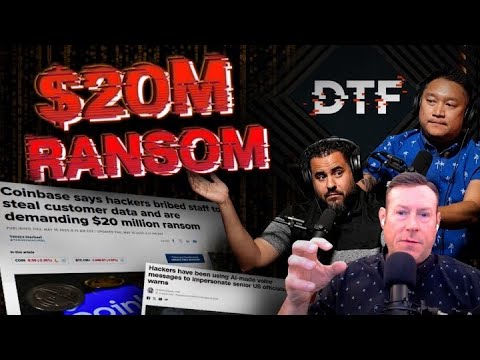
Coinbase Data Exfiltrated: $20M Hacker Bounty. AI is changing cyber careers
0:00Monday, May 19th, big stories. Coinbase, was it ransom? Was it extortion? Tell you what, it's got a lot of security issues that we're going to talk about today. Uh, we're also talking about FBI's warnings about people being
0:18impersonated, government officials specifically, but that doesn't mean it can't be you or your CEO that needs you to wire the money. This is the DTF cyber podcast. I'm Damian. That's a D. There's Troy. There's Troy. That's a T. And I
0:36put the F in DTF. F. Let's [Music] go. Thanks for joining today.
0:55interesting stories. Uh the most prevalent one was all over LinkedIn last week. There's a lot of people jumping in with opinions about the Coinbase I'll say in uh quotations
1:11ransom. Yeah, I don't I like to say we'll just say incident. I don't like to use the B- word. I don't know, Troy, if you like to use the B word. I don't like to use No, I think breach is a bit much, but you know, definitely the is is it ransom or extortion question? you know, I think they're pretty synonymous, right? It's a, you know, trying to extort them for a ransom for, you know,
1:29giving their information back and not releasing it to the public. I love the response here. I'm a big fan. We should do like a Yeah, let's do overview of what happened because people may not heard of it. So, so I read through a few different things, right? So, we'll just assume that I'm the common person. The common person on LinkedIn doesn't
1:45necessarily have hands on a keyboard for security related things all day. Um, definitely not reading a bunch of articles all day, right? But from what I understand, tell me if I'm right. So, I'm going to I'm going to maybe we should call this section the burning fern. And I need you
2:01guys to be like water and contain me. Okay. So, here's what I what I believe I understand as a lay person. um some bad actors found people overseas
2:17in customer support and offered them money said, "Hey, what happens if we give you a little bit of extra dough? What kind of information can you give us?" And the plan was to use that information to reach out to actual Coinbase
2:32users, validate the information that they know is good, and trick these people to send them money. That was a scheme. That's what happened. Then they tried to extort Coinbase for 20 million bucks. And Coinbase said, "All right, guys. You know what? No. What we're
2:50going to do is we're going to pay people $20 million to find out who the hell you guys are or women. It might be maybe it's both. Maybe it's a dog. I don't know. And we're going to come after you." So very similar to in certain countries where uh they offer a bounty
3:07on someone's head and then all of a sudden hackers want money, the bad actors want money, so they ride out their friends and all of a sudden, you know, those guys get extradited. Um so that's kind of what I would say is a broad overview. A lot of people are saying there was a ransom. I disagree. I
3:25think it was a failed attempt at extortion. Um but everyone says the response is great. Um, so yeah, I think that's Did I Did I Did I burn more than I should have? Yeah, I think I think you got it. But my question is, what's the
3:40difference between extortion and a ransom? I think the act of extorting someone for money is in fact a ransom. So they're they're pretty much the same thing, right? Is what's the difference in your mind? Uh, for me, I I I think I don't think they actually encrypted the data, right? So traditional ransomware would be encrypt only going to give it
3:57back to you if you pay the ransom. So they're holding the data ransom in this case. I I do think it's more of an extortion because I think is out there, right? Ju just to play devil's advocate. I think ransomware is like a software malware that you know is a particular technique. But you know if uh if you
4:14kidnap someone and you hold them hostage and you extort their family for a ransom, you know, that's where ransomware came from that the meaning of the word it's a malware that uh they extort you for money. So it's a ransom. Yeah. But ransomware. So in this case it is a ransom but it's just not ransomware
4:29that was used to block anything. Definitely not ransomware cuz there was no malicious software. Yeah. Or insiders. But are they holding the data ransom? Is this data that Coinbase does not have access to anymore? And I don't
4:45think so. Right. I think it it is their data. There's a copy out there and it was said pay us money and we'll delete it. Yeah. So, if we're going to convert this to regular people terms, right? Other stories in the news. Diddy. Diddy had all these parties, right? Oh, you're
5:02going to get me in trouble. Okay. So, we won't say anything about that. But what we will say is there are alleged stories, right? And apparently allegedly things happen there where there's proof of things happening,
5:18right? But nothing was ever released. So maybe what's a good way to describe this? If we can't talk about Diddy, we can talk about um Oh, this actually happens a lot. Um it's actually another scam and we haven't really covered it. Um sex
5:35tortion happens a lot to teenagers, right? where um the number of teenagers committing suicide because of bad actors, getting them to send certain pictures and then saying, "Hey, we're going to show your friends and family.
5:51We know who they are. Give us money." Very similar, right? It wasn't like they said, "Hey, we have your bank account. We have uh your keys to your car. We have your entire life wrapped up. Give us money and you'll get it all back." It's more so, hey, we have embarrassing
6:07stuff of you. If you don't pay us, um, we're gonna release it. And to me, Coinbase feels more so like, hey, we have embarrassing information of we got in information from people that are your employees and we were able to
6:24essentially scam your clients. Well, I don't know if they they didn't say they got it from inside employees. From what I understand, actually Coinbase may have already caught that these employees may have been ex excfiltrating data earlier. Oh, okay. So, that that would be things
6:40they shouldn't. Yeah. Yeah. But yeah, so in my mind, when I think of ransom, I think of, hey, um, we just took the engine out of your car. You either pay us the money and we'll put the engine back and you can go on your way, but you're never going to drive your car. And if when in business terms, if they
6:57encrypt your entire storage array, you can't get access to database, you can't make any sales, that is holding your business ransom. Um, Coinbase was not in that situation. So, from my optics, they weren't being held for ransom or their
7:13data wasn't being held ransom. It was more so, hey, we have some information. We're going to do bad things with it. Pay us or otherwise. So to me it seems like two different things because business is still operating. No one knew that there was any sort of issue until they released their 8K um and then
7:30publicly announced what was happening. Whereas if you think of your favorite retail chain that is held for ransom, you can't buy what you want. Their entire systems are down. Business is interrupted. So to me doesn't feel like ransom. But then again, maybe I'm wrong.
7:48Yeah, I agree. Yeah. I think to Damian to your point when you said I think it's a really good delineation if they're holding something that you're going to get back that maybe is a ransom like you know if you're ransoming a kidnapped person you pay a ransom to get them back right so I think in this case you're exactly right it is extortion because
8:03the company still had that data and access to that data they didn't lose access to the data so they didn't lose anything that the they were trying to get back they were just trying to stop the attackers from uh releasing it to the public and obviously they they turned the script here and I think the the reason this is such a big story is
8:19really like how the CEO of Coinbase came out very transparent. Again, this is how you handle these situations. You come out very quickly. You become you're very transparent and I love the fact that they've reimbursed the victims if there were any victims of social engineering. Uh they've gone and and reimbursed them
8:34directly. Um and then there's a place on their website if you were a victim, you were already notified. So that was great. and then, you know, turning flipping the script and saying, you know, we're not going to pay this $20 million ransom, but we're going to put this $20 million up as a reward for information leading to your arrest. I think that's a great a great move.
8:51That's like um it reminds me of like if you have kids, it's like everyone's having fun until somebody gets hurt. Like everyone's just running around laughing and like the kids like are spraying water all over the concrete and then all of a sudden one of them slips and busts her head and you're like, "Hey, like it was fun until you got
9:07caught or until you slipped." And this kind of feels like that where they're out there doing these things, getting this information, trying to socially engineer people, probably getting some form of payment, and then when they say, "Hey, we want more." It's like, "No, no, no, no, no. We're just going to come
9:22after you instead." And it's like, "Oh, man." Cuz it reminds you of like a like a Star Wars, right? Because where they have the bounties like the Mandalorian, like they get paid to hunt people down, right? And then in the show, uh, recently, I forget who the character
9:37was, you know, Mando was going after someone and they said, "Hey, we'll pay you more if you don't get me. Like, I'll pay you double for you not to arrest me and bring me back in." But, uh, these criminals probably don't have 40 million, right, to avoid the the people
9:54coming after them. So, to me, it's interesting. Um, well, here's the thing. I This is what I would say, right? I I don't think and I don't know if there's any statistics on this. Maybe we can go find it. How many organizations actually pay an extortion or a ransomware fee?
10:11Obviously, it does happen. Otherwise, these criminals would not go and try to get millions of dollars in a in a ransomware, right? So, if we if no one ever paid, I don't think they would they would have any profits in it. But there are some organizations might look at
10:27this and say, "Hey, if it cost me a million dollars to get my data my data unlocked so I can keep doing business, I'm going to pay that." But the downside to that is now they know you're going to pay. So, are you going to make yourself a victim a second and a third time?
10:43Yeah. And Damian, I was having dinner with one of our uh mutual friends last week. They were talking about Australia solved this problem by passing a law that made it illegal to pay a ransom. Illegal for companies or individuals to pay a ransom. you know what there's no more ransomware attacks in I'll show you because people are forbidden to pay. So
11:00you know it seems like a very easy fix if you forbid people from paying and I think the FBI originally came out and said do not pay the ransom you know but then as you mentioned there are companies who say I need that critical business data back then make a decision business decision to to pay that ransom and uh again if we stopped paying these
11:16guys it would stop the uh stop the attacks but um I just think there's critical data that people need. what what role do you think the CISO plays in that decision? So uh personal experience and you know it's probably different in every company
11:32every different industries depending what you're doing but I think the CISO is a an informer to people like legal to the CEO and to the board you know informing how you know widespread it is how bad the damage is how bad the operational outage is going to be
11:47working closely with the IT team the CIO I think that uh those folks need to inform the decision makers but it has to come from the top the CEO of any company needs to be the one that says whether you pay or don't pay and I think the board sometimes needs to be involved and informed before that decision is made um
12:03because it could have very negative effects both ways whether you pay or if you don't pay could have very negative public effects, reputational effects, operational effects. So, it's a it's a pretty big deal. I do love the fact that Coinbase came out so quickly and so transparently and so directly and I
12:19think that's what people want. I mean, we have breach fatigue happens all the time. You see a new breach in the news every day. U but very rarely do you get somebody to stand up like this and and call these folks out. It was really fast too. I think this all happened within what two or 3 weeks.
12:36Uh yeah, I think and you know what's interesting? The video that I saw was looked like it was shot on a cell phone. Like it wasn't anything highly produced. It wasn't anything done in a studio. Um it looked like it might have been an iPhone 14. definitely wasn't as clear as
12:51some of the newer uh cameras out there, but um I thought that was interesting that instead of them putting an entire marketing team behind it or a PR team, it was like, hey, this guy just pulled out a cell phone and he's talking to the people from you couldn't really tell
13:07where he was at, but it was like a room obviously like with a white wall behind him. Um so to me that was even interesting too from a delivery of to the public of Yeah, it's just we just did this right now. like it it almost felt like the way that it was presented made
13:23it feel like to me that hey we have to hurry up and get something out there. Doesn't matter how we get it. Let's just do it and send it. Uh okay, grab your phone. Let's just go right. It didn't feel like here's the legal ease terms that you have to say. Uh you know, we're
13:39trying to avoid being sued down the line. There's all these things that you can't say because we're concerned about our image. It was just, hey, talk to the people, tell them what happened, and then we'll go from there. Which is probably the first time I've seen
13:55something like that. Uh maybe at this sometimes you you'll get information saying, "Okay, we had an incident," but they don't give you any details. No. And if you do get something in writing, it's usually written by a lawyer that really hard to understand for the average
14:10person that doesn't read legal contracts all the time. Um, so this felt more like a like a person-toperson communication and because most of the people that probably use Coinbase aren't necessarily we'll say technologists. Well, I think it's the same lawyers are probably
14:27cringing right now. I don't know what their legal counsel, you know, they approved it or not, but it's it's it's a challenging thing to, you know, just go out there and give a lot of information. Mhm. Um because if we go backwards, let's just go backwards and say, well, how did this even get started? Was the
14:45company at fault? Did they not have the right controls in place? Did they, you know, hire the wrong people? We we're starting to to talk about insider threat. And every organization has insider threat in different different
15:01ways, right? But this is an ideal situation of insider threat where somebody who's already inside has access to the systems and took that data, copied it and moved it outside the organization. Yeah. Yeah. Yeah. Damian, I don't know if you remember the CASA
15:17ransomware a few years ago. CASSA is a remote management tool for, you know, managed service providers. Um, and they were very quick, the CEO was very quick to come out and and transparently talk about what happened, what they were doing to fix it, and how they're going to prevent it in the future. Very clean,
15:34very very uh quick and transparent. I think that people really like that, and it helped them get through that with the least amount of uh, you know, trust being broken. Um, I would like to say again the the Crowd Strike outage, which was not a cyber attack. this was an outage. But the fact that George Curts
15:51came out on the news uh the very next morning, I don't think he had even slept the night through the night and he's on CNBC or or what MSNBC, whatever it was, and he's telling people what happened and what they were doing to fix it. And you know, they actually gave some Falcon Flex credits and they were, you know,
16:08making sure their customers were aware of the situation and how they were going to prevent it going forward. I think those things go a long long way to you know solidifying trust in your in your customer base and and you know really in the industry. I think it goes back to just like how you approach your clients uh or people
16:24that you know purchase your service or products. Um, and so here's like another interesting thing too is uh somewhat adjacent is a lot of personal branding you see online like some of the CEOs of the largest companies have a larger following than the companies that they
16:41represent. I think a big part of that is people care about the person versus the organization. And there's I think there's more of like a connection when you watch George, for example, talk about what happened and what they're doing to fix it versus if a statement came out from the company's profile, you
16:58know, like LinkedIn page for example. Uh because you can see the person, you know who they are, you know what they're saying, and it's just it's a it's a persontoerson, you know, communication. So I think overall it's probably the best route for these to go. Will we see a lot more of that in the future
17:13potentially? I don't know. But it definitely feels like the the way people respond to it is much better than they would if it just came as a email. I I just want to add one more thing because I'm so passionate about this exact subject and I'll give you an example. I
17:30will not name the vendor, but we have a very opposite effect where uh it's a publicly traded cyber security company that had a breach and they were not as transparent as people wanted them to be. They had to recant a couple of things that they had put out into the news that
17:46were not exactly true. The breach was bigger than they let on it to be months later. And so every time there was new information that came out that you know conflicted with what they had said before that trust was lost and eroded. It took them probably 18 to 24 months to
18:03recover uh their share price their market cap all the things with their stock because you know customers had lost trust and and this is a trust industry. Cyber security is all about trust and uh that transparency is is absolutely critical to you know giving
18:19trust back to the folks who are going to be using your security products. So I mean the question now though is like okay we got the response but looking backwards I mean one of the things I like to do especially coming from an incident response sock security operations
18:35center looking at this event and saying well how did it happen and what controls could we put in as an organization to prevent the insider threat and and I think today that's not that difficult because there's so many different um
18:51technologies and uh methods that you could use to be making sure that your data is not leaving your organization. Um I mean DLP has been around for a long time, but now we have we have a lot of more technologies that are out there that could just identify where your data
19:08is and where it's going, you know, especially in that cloud world today. I think this is a tale as old as time, right? I mean, bribing people to to do something that you want them to do against their employer, right? Uh we we remember the Tesla employee here in
19:23Nevada that was arrested for uh being bribed a million dollars u to put ransomware on the on the system. In fact, I don't think they were arrested. I think they cooperated with law enforcement. So my point is like there are people out there making so much money in ransomware and crypto scams and
19:39things. They have money to burn. And paying somebody 10 to50 to $100,000 to get your foot in the door at a place that's going to return you several million dollars in ransom is a good investment. So, you know, uh I think we need to be looking at the people's side
19:55of this no matter what side of the world you're on. I know this happened in outside the US, but this could happen right here in our backyard. But we before we get into into the offshoring, because I know Fern had a question about, you know, does the location matter? Uh before you get there though,
20:10you know, there are there are guard rails. I think in this case, if data is your, you know, what's really important to your company, you better know where all your data is. You better know who's using it, touching it. It's like a bank vault. You should know who is walking
20:26into that bank vault and what are they leaving with, right? So I I mean when I was a when I was a teenager, I used to work at the uh Nike uh warehouse and yeah, I used to pack, you know, shoes and do inventory, ship them out to the stores,
20:42but as when you walked out, you know, there's security guard there making sure you're not walking out with any merchandise. And if you're wearing merchandise, you better have a receipt for it. Uh because, you know, obviously you get an employee discount at the employee store and so people are wearing
20:57latest merchandise. Uh, but there's that check, right? You're you're checking who's going in into the building. You're checking who's coming out and what are they carrying when they come out. So, I think the same concept has to apply when you're dealing with data. Who is accessing that data? When are they
21:12accessing it? And then if they're taking it with them or moving it off of a company controlled device, that needs to be noted as well or observed at least. Yeah, I agree. And then you know the one thing that uh I found very fascinating was that they didn't have access to any
21:28of the financial data no tokens no master passwords anything like that. This was just customer service data names date of births you know uh addresses etc. All that stuff can be put together uh to create a social engineering attack by these attackers. And so you know these customer service
21:44representatives needed access to you know customers information to help them. And so that was uh you know one way that they were able to get this data out. But you know, how do you limit, you know, access to data that you need to do your job? That's a good question. So, well,
21:59you can access that data, right? But as soon as you try to take it off a controlled device, that that should already be some sort of, you know, some sort of um red flag, right? Whether you're copying it to a USB, let's let's walk through this. You're you're a
22:16customer support person. You have access to all this data. Great. Now, if you download it locally to your hopefully a work machine, right? Get a copy. So, you got a copy on your work machine. Then, how do you get it off your work machine? USB. Well, we got USB controls. You can
22:33lock it down or you can put USB on DLP. Um, upload to a private cloud repository browser. What type of sure like Google Drive, even, you know, your own personal AWS S3 bucket. Uh but we have visibility
22:49into that too because you have you you can see data going into uh repositories that don't belong to the organization. Yep. Right. Screen scrapers. You got uh cell phones taking a picture of the screen. You know, it's
23:04hard to detect that as well. You know, Yeah. That one's a tougher one. Yeah. So, so this is like a 20-year-old story, by the way. Okay. I'm going to tell you guys a 20-year-old story. Um I used to do telemarketing. I used to work at MCI and I was the 1999 long-distance dialer,
23:22right? Go in at 4:00 in after high school, go in at 4:00, smile and dial, call two 300 people and get them to convert their phone plans to MCI long distance for whatever. All right. In the back of the MCI building, which is off of Dobson and
23:38Williamsfield, which is now a Safe Lake building, if you go to the back, off to the right, they had what was called the um uh the relay team. Relay team is for people that are deaf. So there's a special group of
23:54people that pick up the phone that essentially type out the message for them to communicate with someone else to be able to receive. And one of the controls they had in place was there are no personal cell phones beyond this door
24:10because what they were doing is the people that would call in for the relay service would typically have their credit card information, their banking information, uh any other information that they had to make some sort of online payment because this was like 20 years ago, right? This was before like you could just hop on a computer easily
24:26and pay for stuff. Um, so the people that worked there, the relay team would tell us these stories about how you could never get a hold of them during their business hours because they didn't have a cell phone. And the reason for that was because MCI at the time knew if
24:43people have access to someone's debit card, credit card, it becomes a risk to their business because if someone scams a person by taking their information, we're going to be held accountable for that, right? So, no cell phones. So, now if you take that story and fast forward
24:5920 years, what how would you do that in a customer service environment where you lock down the USB ports? Do you just take away the ability for people to have their cell phones? Does that become an issue for people? Because realistically, everyone has access to systems that have sensitive information
25:15and everyone has a cell phone. The ease of just pulling out your cell phone and snapping a picture and sending that through a text, through Signal, WhatsApp. Yeah, but that I think you're limited to what that screen can display. So, how many pictures are you going to take in order to to get, you know,
25:31millions of records? I don't know how many records were in in this case, but even thousands. It's hard, right, to to take pictures and then Yeah. scrape that. That's a lot more work than just downloading it and then copying that data off digitally. Yeah. Yeah. So, it
25:47would be a lot of work for someone, but the the ease of use is there, right? And I think it's very um low barrier of entry regardless of where you live, right? Um so just maybe some food for thought if you guys have anything to add to that. I I don't know what I would say, but yeah. Yeah, I think we talked
26:05about it in a previous episode about uh data loss prevention tools and uh insider threat. I think there are there's a lot of technology out there that can help you detect anomalous activity by employees and you know prevent you know data loss. Exactly. And so I think that we have the means to do
26:21it. I'm glad to see Coinbase making changes. They even said they're they're moving some of their customer support people into different, you know, regions. So we'll talk about that in a minute with Fern, but you know, I just think that this holistic approach of protecting data and and remembering that sometimes the biggest threat is inside. You know, companies and CISOs listening
26:37to this need to think about that. You know, what's the threat if if my guys, you know, look at the crown jewels and and take that data out? You know, how am I going to know if they did that? Another great example of insider thread is like uh when somebody leaves and goes to a new company, they take all their their customer information with them.
26:53They download their Salesforce data. They download, you know, the the sales pitch deck from this company. Now they're going to a competitor. So these kind of things are very important that you're keeping an eye on what's leaving your bit your four walls as Damen said. You know what's interesting too from with the sales world? Um most people
27:10that are in sales have clearly a cell phone and usually if they're working with people, they keep that phone number in their cell phone, right? So it doesn't matter where you go, you've always got that person's contact information in your cell phone. Um so yeah, major DLP risk there. But um one
27:27interesting thing that I just thought about like you know while we're talking about this is um if you're looking at preventing these things from happening right you might be looking for certain products but we don't name products here unless they sponsor the show. So, anyone
27:45out there hint hint hint if you are a vendor that wants to get a little 30 secondond popup or maybe right here behind me right on the green screen that's going to say the company where our logo is. Yeah, right where the logo is right here. Swap it out. If you want your brand there because you can support
28:01customers pro or progressing through their journey, let us know. What's the email for us? Uh Damian dtfcyberpodcast.net. That's where you go because right now this is for
28:17charity. We're not we're not making any for this. But um I guess switching switching gears back to what are the best ways or not necessarily best ways but the fact that the people that were involved on the insider threat were
28:33overseas. And the first thing that comes to mind for me is there are a lot of businesses that offshore nearshore for competitive uh costs, right? It's much cheaper or maybe cheaper is not it's not
28:51that the quality is worse. It's much more cost effective to pay people in different countries. Well, the cost of living is a lot lower in some of these countries. But but you're right, the talent is not any less. Yeah. Yeah. So, I I want to make sure it doesn't it doesn't seem like we're saying that
29:06we're getting lower quality for a lower price. No, no. We're getting just as good quality, but in some of these areas, a cart of eggs isn't $20. Here, if you go to Sprouts or some of these other places, you walk out $100 every
29:22single grocery trip and you look in your bag and you got a loaf of bread and some turkey. Um, so cost, like you said, cost of living is much lower. And my thought is like there's a reason why people go to these other countries, right, to to find talent, but is that becoming a risk
29:40and that should that be something people consider? Do we do we know specifically what country this happened in? I don't know if I saw it anywhere. They said, okay, but they did say it was Yeah. international. Well, I mean, so there's a few things, right? I built out an international team. Uh the reason the number one
29:57reason was to cover 24/7 and not have to have people in the United States work 24/7, 7 days a week. So follow follow the sun model um was the number one reason. Uh number two reason was yeah
30:12it's a little bit cheaper to have resources in these countries with lower cost cost of living. Um, and there was a lot of available talent or a a lot of younger talent that was coming up that we could uh train into the the thought
30:29process that we already had. So, is that a risk? I mean, I think that exists anywhere, right? I don't know if there's any difference from somebody being overseas versus being in United States, but obviously the money goes a lot
30:46further. So, if you we're paying them less, their their cost of living is less. Then, you know, you think about $100,000, I don't know, that's a lot of money. Here in the United States, that is a hell of a lot of money in somewhere that's uh like India or the Philippines.
31:03Yeah. You could live like a king, right? So, and so it's it's less of well, they're overseas, so it's going to cost us less to do the same amount of damage. I don't think that's that's not what I'm getting at. I think what I'm getting at is Troy said 50,000 100,000 earlier and
31:18you just said 100,000. So, we're just going to stick with 100,000. Well, remember the first episode that we did was on corporate corporate espionage and that person was being paid what 60 grand a year. Uh I think five grand a month. It was like Yeah, it was less than six grand a month and they were in the
31:34United States. No, I think they were uh so many stories. I think they might have been in the UK, but we could we could it's basically almost equivalent, right? Um or more expensive in some cases, but yeah. So, it's it's interesting to think
31:50like if if someone said, "Hey, I'm going to give you $100,000 today to go do this interesting proposition." Right? Now, if that 100,000 in another country can get me like a McMansion, becomes way more appealing,
32:06right? So it's almost like the equivalent of a million dollars in another country in some of these cases. So if you have a budget and you're trying to stick within budget, where do you get the most output? Probably not from people in the US because the money doesn't go as far. And I think it's the
32:23incentive exist. So it's so you're saying it's more cost effective for us to put resources there, but the downside is it's also more cost effective for the bad guys to bribe them. Exactly. because of the disparity in cost of living. Not that the people are any different, not
32:39that there's any sort of discrimination against the people or their skills or anything. It's just the simple fact of a loaf of bread there costs way less than a loaf of bread here. So the dollar for-doll normalization between the two countries turns into I can get a lot
32:55more over here. Yeah. Your bribe money goes further. Yeah. Did you do you guys see the statistic that cyber crime is now the third largest GDP in the world behind the United States and and uh whomever else is second? So $100,000 is a drop in the bucket to these guys
33:10especially with the return on investment of millions of dollars for that. So I mean the money is going to be a problem. Bribery is going to continue to be a problem. You got to make sure you're you're doing background checks on your employees and that you're holding them accountable and making sure that you're, you know, being safe with the crown
33:26jewels. As Damen said, you know, we talked about the balance between uh overreach of, you know, monitoring tools and the employees as well as, you know, building a culture where people want to come to work, but you have to protect your data and your crown jewels from being siphoned off like this. It could
33:42be catastrophic for someone like Coinbase, you know, for their customers to lose that data. You know what's interesting is so this is now officially episode 4, right? And the Coinbase story actually carries a lot of tied parallels to some of the
33:57stories that we've covered in the past and it's almost like they were kind of building up to the Coinbase story. So I don't know about next week to see what happens in the news, but it feels like every week we keep adding more context to these situations and how they relate
34:14to the latest. So now it's insider threat, you know, DLP, corporate espionage, AI is coming for my job. Yeah, that's good. That's that's that's another one, right? Um well, I I would um you know, it's yeah, common themes, but the one
34:32thing I would recommend everybody out there if you're in cyber security, just read these articles, but don't just read them to to see what happened, right? read them to figure out what would you do for your organization to maybe put other controls in place. I I think it's
34:48important to learn from these incidents, right? It's there's no shame in in any organization admitting that they had an issue or an incident uh because I think it helps us as a as an industry to go back and figure out how do we make our
35:04own organizations better. Yeah. So that it's kind of related, but I think both of you guys have a really good experience with this. And it's this fact that being wrong is okay, especially in security, right? Because the faster you
35:20fail, the quicker you can prevail. Yeah, I just made that up. Um but the reality is is like even in the other podcast when I talk to people they say hey you know we like to build a culture of inclus inclusivity or inclusion right um
35:38and and rewarding failure because what it allows us to do is understand where the gaps exist and what we can do to fix it to avoid potential disaster down the line. But in security that's very common or at least it seems to me that's very common. But outside of security, the
35:54idea of being wrong, failing, losing something, uh, having an incident is almost frowned upon. Well, there's a there's a pretty big impact, right? You have, um, healthcare organizations that go through a ransomware incident that could
36:11cost them tens of millions of dollars in damages. Mhm. Right. So, what do you do? Do you the if you go backwards and say, "How did this happen?" And let's say somebody made a mistake. I don't know, we talked about last week leaving an S3
36:26bucket open. Yep. Maybe there was one person that accidentally left it open or ran a script that opened it up and forgot to close it. Do you if you were that person, would you expect to be fired? I think it depends on the company you work for. I think certain people would
36:43say this is a this is a this is a good learning lesson for us as a team, not a punishment session for you. Yeah. Right. or not for you specifically but for like the person that was involved and I think that's where culturally companies uh are different where some will reward or not
36:59say reward but they'll use it as an opportunity to coach develop help their people be better and other places will say here's your box pack it up you got to go right um but which which situation is better well I mean I would say it's
37:16not only that person that left it open like sure we left the door open. There's a whole team of people that should have had monitoring place to say, "Hey, you left the door open." Yeah. Yeah. Exactly. And then on top of that, if you think about I'll use the patching and vulnerability management side of the
37:31house, you know, you you have these critical exploitable vulnerabilities on your external attack surface and you know, the patching regimen is not fast enough and there's reasons why we can't patch, there's just conflict, we can't test it, all the things. So now you have
37:46this window open to the attackers for an extended period of time. If they take advantage of that, whose fault is that? I think that you really should look with retrospection on how quickly we can patch because with AI now and the ability to uh reverse engineer patches
38:03and and updates, the attackers are uh crafting exploits so quickly and uh so you have to be able to patch faster. So whose fault is it? the person who fails to patch timely and leaves that door open, you know, or is it, you know, just oops, we we need to be better. I think
38:19there is a balance there, but you got to strike this, you know, sense of urgency with your teams that if you guys don't do your job quickly and well, that you could leave us all open for massive impacts, including loss of jobs, loss of
38:34revenue, loss of reputation. So, it's just something I really harp on. I I did I want to rewind a little bit because I noticed that you said you got this news or you heard about this being talked about on LinkedIn. Is that where you normally get your cyber security news?
38:51I do. Yeah. Yeah. Yeah. No, I I definitely watch the the LinkedIns and also the uh you know I have a whole feed of like RSS feeds that I see in the morning to to catch up on those. I don't know if you that was for Fern, but for me, I have a whole feed that I look at first thing in the morning with my Well,
39:08yeah, it was for Fern because Troy, you have a whole business on threat intelligence. So, I'm not wasn't going to ask you all about that. No, no. This this is this is why I'm I'm the lay person around here, right? I'm just the average Joe, right? That's doing my best to understand the world around me. Um,
39:24so you're right. A lot of it comes on LinkedIn, right? Um, a lot of it comes I follow a lot of security, we'll call them influencers, whether or not their pedigree can, you know, line up with that or their experience. I think it
39:40does in a lot of case like Marcus Hutchkins is one of the guys that I follow and he talks about a bunch of different things that I'm like, "Oh, that's interesting." So, someone like him, of course. Now, there's people out there that do a bunch of Tik Toks and put it on LinkedIn and say it's about security, not necessarily following that
39:56as often. I'll see it, but I don't necessarily think twice about it. Um, so there's a lot of people that I I follow in the security world. Um, and then when they talk about these things, I kind of get some perspective. Uh, one of them
40:11actually, you guys might actually know him, is uh, Ira Winkler. Are you guys familiar with the the name? So, I he's okay. He's like my probably my favorite guy on LinkedIn. And I'll tell you why. because he doesn't hold back. He just
40:27says what he thinks and why he believes it to be so. And there's a lot of curse words in there. There's a lot of beliefs in his videos, but I know he's coming from a place of uh, you know, experience
40:43and thoughtfulness on his answers because he's he's been like in the most recent one that I heard, he was the main principal architect for Walmart. So, he's got a lot of experience in the retail world and securing Walmart, for example. Um, but I really like listening to his stuff because there's really no
40:59BS where a lot of other people, it's very LinkedIn washed. So, yeah, there's a few people on LinkedIn that I follow. Ira, he's not listening. But if he is, just know that your boyfriend's he's
41:14listening along. Um, yeah. So, so Fern on that one, Ira has a uh a group that he's put together called Cruisecon, which is uh the cyber security cruise where you can hear phenomenal speakers bringing like the world class and uh Ira uh brings that together some amazing speakers uh and you should just follow
41:32him on LinkedIn and you can go on a cruise and get some cyber security knowledge at the same time. So, we have we happen to have some friends that are presenting. So, I was at a dinner what's today? Monday? Last week. I was at a dinner last week on like Tuesday or Wednesday with a bunch of CISOs and one
41:49of them is actually speaking at Cruise Con West in October. And so, yes, Cruise Con, he has Cruise Con. There's this is now the second one. And then they're also doing another one I think in uh Mexico where
42:04it's not a cruise. So, we're doing a lot of talking about Cruise Con, and I know I know IRA is not paying us for this, but uh for if you're in cyber security, and you know, it's so I don't need to be paid to say this, but I listened to one
42:20of his podcasts where he talks about the reason why he does it. And I really liked it because um he he points out that a lot of these events are paytoplay. If you're not an executive at a Fortune 500 company or a
42:35Fortune 150, you may not get invited to the special events, if you don't know the right people, you're just a what he called a pip. You're not a VIP. You're a previously important person, right? And so what I liked about this story that he
42:52told was Cruise Con is made for everyone. Everyone pays one fee. You get in, you go to any of the conference talks that you want. There's no gates. There's no one telling you that your title isn't good enough to learn. Um, so outside of everything that I've seen,
43:09the one thing that I really do like about Cruise Con, uh, and again, this is not a paid ad. He's not definitely not paying us. He's not paying me, but from what I saw, I actually it's like, you know what, this actually a really cool guy because what he's doing is he's giving people access to information that otherwise would be hard to get or gated.
43:26and he's helping make this the world a better place by securing it, by helping people learn without barriers. So, I'm gonna say cheers to that. Back to our back to our regular uh news story. Um,
43:42Coinbase, unless you guys want to say something else about Cruise Con. No, I'll check it out though. Yeah, I think it's like it's less than what you would pay for a cruise to be on a cruise about cyber security with our friends. With other friends. Are you
43:59going, by the way, Troy? Uh, I plan on it. Okay, maybe I'll plan. My wife obvious My wife wants to do a Disney cruise. Like, that stuff's expensive now. Like, could you imagine? I show up with like tickets to Cruise Con and I'm like, "Hey, hey babe." No, no, you don't
44:15tell her it's Cruise Con. You say, "We're going on a cruise. We're going on a cruise. We're going on I think it's called Premiere by Premiere or something like that." Uh, we're going on a cruise. It was very competitively priced. What are you going to do? I'm just There's a security conference, by the way. So,
44:32yeah, that might put me in divorce court, but um yeah, check out Cruise Con. If you don't know Ira, it's I a last name Winkler. Check him out. and uh give the guy your money cuz he's he's doing some good things for the people in cyber. Um back to Coinbase though. So we
44:50talked about insider threat. We talked about maybe potentially the risk of not having the right guard rails and controls in place. We also talked about maybe the risk of people being overseas and how that can be exploited in terms of how much further the money goes in
45:06these other places versus the US. Definitely interesting topic. Um, so what else do we want to add to that? I would say, so I was thinking about, you know, okay, these people in customer service have access to people's
45:22records, but they shouldn't have access to all of them all at one time, right? So maybe there's a control there, too, where they can't see more than one at a time. Or hear me out, have you guys ever called your bank to make any sort of
45:38payment? They always have you you put in the card information. It's always automated system. You put in the card information. That's BS though because you put it in and they can you can record the tones and then play it back. Oh, you can? Yeah. Okay. So, a false sense of security, is
45:55it? Okay. Well, I'm the lucky duck that believed it for a second. Okay. So, it's not Do you ever play music on the keypad? No. I used to do that. You can do Mary Mary H little M. There you go. You know, every tone has a every key has a specific tone. So, if you punch that
46:12in over the phone, somebody else is on the line. They can record that and play it back and get your number. Are the keys really like a full note or a half key apart in the tone? Because you can't play Mary Ho Lamb with just whole notes. There are some half steps in there.
46:27Yeah. Well, uh, yeah. When you're a teenager though, it's pretty cool to try. It doesn't sound exactly like it, but you could tell. It does. It sounds pretty close. When I was growing up, my my babysitter had a rotary phone. So, I don't know about these I don't know about this cool stuff you guys are talking about, but maybe I I kind of do.
46:43So, okay. Yeah. I now I just feel dumb for thinking that typing in that information got me safe or I was safer. So, an automated system is not the answer. They sometimes they'll do it where the
46:59system will um send you an SMS with a PIN and they can only open your record if they have that PIN. But you're as a you as a customer would be the one that provided. Uh I've seen that I had to get our router replaced from Cox and I went
47:15in there and the guy said, "Uh, I'm going to send you a text. Give me the number." And I said, "For what?" He's like, "I need access to your account." Oh, okay. So maybe that is the control to to open up a customer record, but they certain should certainly should
47:30not see multiple records at the same time. You should only see them when you need to access the record. Yeah. Yeah. There's definitely going to be some changes on the information that customer service people get access to. uh probably less the better, but still I
47:49think the one important thing to take away is money talks and people are always looking to make money in some form or another. Not in a not in a negative way, but you know, people have bills to pay, family to feed. Um how about this? What's that?
48:05Replace that function with an AI bot. Why do why do you need a person? I don't know. But is there not a way to Oh, I don't know. I don't I What are the reasons you would call customer service?
48:23No idea. Where's my money? Yeah, I think we're getting closer to AI doing more of those tasks, but I think every business is different based on what people need access to. And I think the key message here is just to limit that as much as possible to a single record at a time. I like the PIN number as a example because
48:39then yeah have to put in a specific PIN or a code that they get via SMS or through an authenticator app. That's that's really locking it down for the customer service folks not to see but your records. So I'm sure there's going to be some innovation at Coinbase. But you know if you're listening to this and you're a CISO or security leader, you're
48:56thinking, man, how can I implement something like that in my environment? I think that is a smart thought to have right now. Yeah. And even if it's uh like you said authenticator uh for a lot of my banking stuff I have to get a separate text that I then have to put in as a uh a password add-on to the the
49:14normal login. I have a few things that have the authenticator app. We have to get the six or eight numbers off of the you link the app to the authenticator and then you can go in and get those numbers. I kind of feel like we're going to see a lot more of that going forward versus just password, right? Uh
49:30passwords only. But it does kind of take us to an interesting topic of is AI going to take my job? Because if at this level of customer support um dialing in whatever generic question
49:45self-service portal, right, there's a lot of contact centers that are not in the US, right? There's a lot of companies that offshore their contact centers, their phone support to other countries. Maybe it's the price. Maybe
50:00it's follow the sun, right? 24-hour coverage because there's nothing worse than trying to pay a bill at 9:00 at night and realizing that the automated system is down or that you are now late. Well, there was an article that we found that said by 2030, 14% of uh 14% of of people will have
50:20to think of readjusting their career because of AI. So it does I don't think it really says 14% are going to lose their jobs. It does say 14% will have to figure out how do they adjust for their career. That's
50:36so how does that apply to cyber security? I think that's we should that's that's 5 years from now. So this is really relevant for people that are in high school that want to get into cyber that within 5 years they will be at 2030 potentially graduating
50:51potentially looking for a job potentially doing programming and finding that there's really no jobs for them especially only the development role with all the vibe coding and the AI slop that's out there. There's a lot of people losing jobs. I think actually I'd have to find the article but the number
51:07one role being eliminated right now is uh programming like application development which is interesting to me. Um you know when I so when I was going to school and the the the thought was computer science and uh software
51:23development would go away because that stuff was shifting over to India where it was cheaper. Mhm. And I I mean we never saw it actually take out a lot of jobs. Yeah, there was a shift of jobs, but it added more capability, more capacity for programmers and developers.
51:41Uh this this one, I don't know if it's going to really take away jobs. It will take away the low-end jobs where potentially AI could build build uh you know, smaller modules or or easier code. But I think somebody's going to have to
51:56still be on top of that to evaluate it and put it together. So, um, we talked about this day, Aian, that the number one place I think cyber uh is going to see AI have an impact is in the sock, right? Being able to stitch together very disperate pieces of information to
52:13tell a story about an incident or a breach, god forbid, don't use the b- word, an incident, an event, an alert. stitching all that together from all of the different telemetry that we have from our firewalls and our cloud from our endpoints and our data. I think that
52:28AI is going to have the biggest impact there. Now, is that going to reduce people? I think it's going to give us a richer story about what's happening and we're going to need fewer people pushing the buttons, but we still need people running the security operations center to escalate things, to start a incident call, to start, you know, documenting
52:44the process. So I I I love to advise young folks to go into cyber security. I think it's one of the most AI proof industries because we're always going to have to protect all this digital uh you know environment that we're building no
53:00matter what it is all the wearables that we have and technology is becoming a big part of our lives in every direction. We have to protect those things but you have to be smart about it. So be thinking about what is you know uh going to continue to need humans oversight hands on keyboard you know that decision
53:16tree that can't be done by a computer. So you're saying anyone looking for a career in cyber shouldn't be worried about losing their job. Well if you Okay. So if they're well so a lot of the entry roles for security are in the
53:33sock, right? Because it's really hard for people to want to hire an engineer with no experience. Like I can name a bunch of people that have told me to my face I want to hire a college graduate as an as a engineer because of the risk
53:49because of the potential lack of experience. A lot of times fresh cyber graduates do not get into engineering roles. So I would the the one thing that I don't think u some organizations and leaders are thinking about is how to
54:06build that pipeline of talent. And if you don't think about how to build that pipeline on your own, it's never going to exist, right? So I can't um just go out there and say I'm going to hire somebody straight out of school and they're going to do all this work. There there's development time in the person
54:23that has to occur. And so anyways, if you're a young person out there, one, find an find a company that's going to uh coach you along and mentor you to get you to that level that they want you to be at. And how do you get there? Number one, the first thing I look for is is
54:40their personality and passion. Right? I that's if you come into this thinking it's a 9 toive job or I'm just going to do this clock in, clock out, clock in, clock out. Um if you know 9 5:00, I'm done. I don't start till 9:00. That's not how cyber security works. But if you
54:56start to feel like, you know what, I'm doing this and at night time I'm doing some extra work because I want to editor myself and there's a blurry line between whether it's work or whether it's self-improvement or fun. Yeah. Then you know you're in the right spot, right? I
55:12mean, we jump on this podcast. This is in addition to our day jobs. We all have day jobs. Mhm. Um, you know, there's there's days that we we still film this podcast after Troy's been traveling or I've been traveling and sometimes it's a 14 16 hour day before we even get to the
55:28get to do this for fun. So, you're saying you like hanging out with me? Hanging out with me that much. It's did it the juice is worth the squeeze? Um, well, yeah. I mean, so if you're if you're a young person, you want to get into cyber security and you're really passionate about it, don't be
55:44discouraged, right? AI is not going to take those jobs. I think what you guys are saying, yes, AI will take some of the sock tasks. They're not going to take jobs. They're going to help change. Yeah, I think it's going to change the landscape. It's not going to eliminate jobs. Fern, to your question, I don't
55:59think uh I think every human today, no matter what industry you're in, should not be sitting on their laurels because the world is going to be in an entirely different place in five and 10 years thanks to AI. So, I would be very cognizant of what I'm studying, what I'm
56:16going into as a career, and making sure that I am embracing AI and positioning myself to be a leader in my chosen area of work, but also in leading change and AI, you know, improvements in that sector because we're just going to see
56:31this massive shift the next 5 to 10 years. Yeah. And I would even add too um if you live in Arizona, you happen to be around the Phoenix metro area, there is this gym that they call Tissue, right?
56:47Ran by Mike Manrod out of Grand Canyon where every semester a free course from 5:30 to 7 every Wednesday at the GCU campus, free to anyone to attend. You go in there, he
57:03runs you through uh I think it's like eight or nine maybe like 12 weeks of training and development on security uh the MITER uh attack framework um devstack ops a lot of different things
57:19and you actually get to meet a lot of people in either in the industry already or looking to get in or in some way adjacent right so go to the events do your schooling. If you're in Arizona, maybe
57:35find TISU threat intelligence support unit. Um, and and attend because you'll meet a lot of really good people. I did it myself. I passed with a 91%. So, it is, you know, if you show up and you understand what's going on, you and and
57:51if you're if you're there and you you meet the right people or even leave a good impression because I've had I've had Mike send over resumes and say, "Hey, this this student took the class, took the course, and they're a rockstar. Yeah, there's there's a lot of people that locally hire from this talent pool,
58:09right? And so he's working on a few things right now, and like to your point, Damian, he's building the talent pipeline, right? He's got visions to have, you know, Well, that's the start of it, right? So even even if you hire somebody from a recommendation like that, you still have to further develop
58:25them. Well, yeah. Yeah. But the I think the biggest hurdle for a lot of people is getting the conversation or being in front of someone to have the conversation versus getting kicked out of a an ATS system because the resume didn't meet the criteria, right? Um so
58:40yeah, AI is not coming for your job. AI will help you do your job better and if you adopt it well enough, you can leverage it as a tool to be better resource for the organization you work for. Yeah. And organizations shouldn't be scared of AI either. I uh last week I
58:57I uh did an AI roundt dinner and and really there's only one person that said, "Hey, we were in the block all AI mode, but that's starting to change." And on the opposite end, we did have
59:13somebody else say, "Well, our our CEO is actually mandating that we use AI. So, how did we do that securely?" All right. So, I I encourage businesses to to think about how they're going to use AI as well. Not just the employees trying to not lose their jobs, but to leverage AI
59:28to help them become more efficient. Uh companies are the same way. And actually, security folks uh don't just say no, right, Troy? Don't don't be the department of no. Don't be the fun block. Yes, but yes, but uh we're going to put these guard rails and
59:43mitigations around it for sure. And uh you know definitely want to uh if you're in Vegas and most metro areas have an ISSA chapter. I want to give a shout out to the local ISSA chapter here in Vegas who does an amazing educational outreach CISSP boot camps and and all kind of
59:58stuff to get you no matter where you are in your journey into the into the industry. So um just about every metro area has an ISSA chapter. Uh ISC squared is also out there. Um there's just so many good groups. That's what Fern I think you were talking about. Get around folks in the industry. start networking.
1:00:15I have an amazing hire from ISSA in Las Vegas u at my last company and she's a rock star. Turned out, you know, people were saying Damian, just like you said, she's very motivated. She was, you know, really wanting to to do well in this industry and she's she knocked it out of the park, of course. So, it's a great
1:00:31place to meet talent. So, get out there and meet the people, right? And if you haven't been in a Phoenix event, maybe maybe the DTF squad will be in the building. Might be. Yeah, I go to a lot of different things for sure. East East Valley Security Meetup.
1:00:49The East Valley meetup. Uh they just changed it to is the first Thursday. It's the first Thursday of every month in um well, we we're changing locations. We we used to have it in Mesa, but that brewery shut down. Yeah. I just heard uh
1:01:04from someone that it was going to be a 100 mile brewery. Yeah. It's moving to Scottsdale, I believe. Uh it's like the intersection of the 101202 uh area. So right in right in between Scottsdale, Tempe, Mesa, so hopefully central. Yeah. By the airport. Yeah. Okay. So East
1:01:22Valley Meetup is one. Tissue was another. Uh isa here in Phoenix or Vegas. Yeah. Uh or any actually any country. There's I think not even just the United States. I think every country has their own, you know, local chapters
1:01:39of things. IC squared. I know I've been to a chapter meeting in Singapore. Okay. There's Isaka, right? So, there's a lot of different places for people to get involved. Bottom line is you just kind of find them and go meet the people. When you meet the people, become friends with the people and then see where it
1:01:56takes you, right? Um, I think that's all that we had today. It was mostly the Coinbase. So, we talked through that. Oh, we got the uh FBI warning. Oh, that's the encore presentation. But let's get into it. That was FBI warning that AI is now being used
1:02:13to impersonate people in government roles. But in the very near future, if not already, that's happening for executives, some sort of leadership role. Um, the easiest one to spot is when they say, "Hey, are you free? I
1:02:30need you to go to Walmart and buy me a $500 gift card." That's a clear scam. But when it gets so good that you get a phone call from the number of the person actually their phone number ringing on your phone in a lot of instances, um it sounds like them. It
1:02:49looks like them potentially with video uh manipulation. Um it's a tough time to be a person with I think it depends on what they're asking you to do, right? So obviously if they're asking you to go buy gift cards, yeah, that should be a red flag. Yeah,
1:03:04that should be an easy one. Like I don't know of any CEO or CFO ordering people to go buy gift cards. No. So those are easy to spot, but if there is So here's an interesting one. it it kind of uh maybe it's somewhat tied to BEC uh for
1:03:21business email compromise where people will send in invoices through email that are not legitimate. Now you pair that socially engineered with the CEO calling someone in finance saying, "Hey, I just got this
1:03:37email. Can someone pay this bill?" They're they say we're past due. Can you get it done soon? That becomes scary. So, I've actually had this happen. Um, actually, it's it's it's common where you get an
1:03:52email sent into accounts payable with a fake thread, a history, this where the CEO approved these payments and then they send it over to finance with the fake thread response from the CEO saying
1:04:08that to to just send it over to AP, have it paid. But yeah, if you pair that with uh a fake deep fake phone call or even video message from the CEO saying, "Yeah, I really need you to pay this now." Could be quite convincing, right?
1:04:25Unless you go back and those invoices, I think, would be really important. I know most organizations don't just pay invoices. There's got to be an approval process. There's a PO process. There's no PO. it's not approved then it probably can't get paid in the system
1:04:41right this comes down to a process u refinement really having a solid process and I think that you know if you are a CEO or CFO today and you don't know about these kind of scams then you must have your head in the sand because this is happening so often and so fast and so
1:04:56furious and you add in the deep fake I've already seen in the wild teams calls with a faked image and voice I've seen uh WhatsApp messages is faked with uh you know voice and chat. So it's it's definitely happening. It's not something that's you know hypothetical anymore.
1:05:13It's happening out there. So you have to have an ironcloud process and if you break the process you need to be sure that you're talking to the person you think you are. And that happens you know this is talking about business here but same thing with with uh your families. You know, here in my family, we have
1:05:29code words, right? Because with all this deep fake, we've seen where attackers are calling parents and saying, "I have your child." Or, you know, and then putting somebody on the phone sounds like your daughter or your son. So, you've got to have, you know, uh, a process even for your own family that's
1:05:44ironclad and something that you, uh, you can remember to do because this is going to only get worse. Yeah. If you're thinking a Nigerian prince wrote you a check to cash and send some of it back, you're living in the 2000s or you're living in the late 1900s.
1:06:00But I mean, I I think that's still that that scam probably still works. If you send out a million, you're bound to get one person. Yeah. You know, all you need is one, right? Well, just one person to fall for and you're good. So, I don't know. I you know I've never got anything
1:06:17like that where hey this is due right pay this do that so I I don't have as much exposure to it but I would be curious on maybe some other um comparable situations right so fake
1:06:33invoices business email compromise insider threat what are some of the things that people should be looking out for um when it comes to avoiding being scammed not necessarily to say that someone is altering or providing video
1:06:49or audio proof of something to do. Maybe that's maybe that's part of it, but where else have you guys seen some things recently uh that you thought, man, that's actually really good stuff. Like not good like I would buy it, but good like as in that's kind of scary
1:07:06because someone not in my position or with my experience would have fallen for that. Any any recent stories or stories you can tell? nothing recent. I mean, we we talked about this in a pre previous episode where there's fake candidates, right? And then these workers from North
1:07:22Korea that are kind of getting in somehow. Mhm. Um but I think now that more people are aware of it and there's ways that you can try to figure out if this person is real or not. Um it's just
1:07:37a lot of it's awareness. Yeah. Right. The problem though is not everybody is paying attention to the news items this FBI report warning people of deep fakes or even podcasts like these where we talk about them, right? So, who who's
1:07:56the main target if it's on a personal level? It's probably grandma sitting at home, right? Who they don't maybe they don't, you know, does grandma know the the safe word or the code word for the grandkids? Maybe maybe that's something we got to expand that out or maybe it's not direct
1:08:12grandma grandpa but it's an aunt or uncle. Um so there's there's different things you could attack vectors that could happen here. Um it's it's all about awareness though. Yeah. And you know what the easiest way is to be aware of all these things? Follow the DTF
1:08:28podcast because every week, every Monday we drop an episode talking about current events in the news. like this week, Coinbase, all the if bands, buts about Coinbase. We talked about other scams
1:08:45getting into the security world, right? We talked about potentially AI being used to scam people out of their money, right? Business email compromise all on one show. You can't
1:09:01get that anywhere else. At least not that I'm aware of. at least not by three cool people named Damian for the D, T, Troy for the T, and then Fern for the F. So, I think with that, we I think we're good for this
1:09:17week. Yeah. So, we'll be back next Monday with the next episode. Hopefully, some good things happen in the news. Well, I I don't know. Are they really good if they happen? And we That's what I mean. Do we another another security incident? Not probably not good. But if
1:09:32you don't have an RSS feed like Troy and you're not on LinkedIn like me and I don't know what Davi does, you probably you probably tapped in somewhere. But if you don't have those resources available to you and you want to get something you can listen to on your way to work, watch on your lunch break or even just throw
1:09:49in some AirPods and walk around the office listening to people talk about these things. There's only one place to go. Which reminds me, as we close out, if we can get to 500 subscribers by the
1:10:05end of the month, May 31st, a custom tailor is flying in to measure someone. If they're in Arizona, by the way, if they're in Arizona, we'll do it in person. Custom blazer that they will have within a couple months
1:10:21completely free simply by subscribing to the YouTube. Right now, I think we're close to about 100 subscribers. So, we got a way to go. Yeah. 400 to go in two weeks. Yeah. 400 to go in two weeks. I think we can get it done. But this is just your friendly
1:10:37reminder. Subscribe and you can be the most well-dressed person at your next tech event. Any closing words? No. This is this is good. Let's let's keep the ball rolling. Look forward to We're only four
1:10:54episodes in. Four episodes in. Crushing the YouTube, crushing the views, just like I crushed the scale. Now I got to go to the gym. Have a good week, everyone. We'll be back next Monday. See you guys next week. All right. See you.
1:11:10[Music]