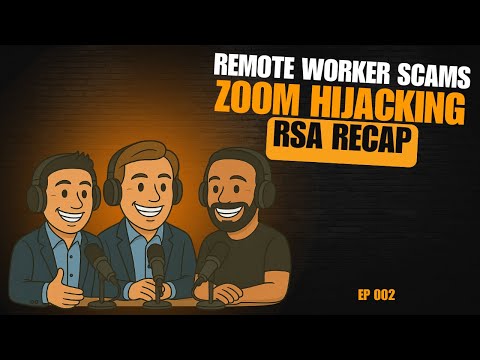
Prevent Zoom Hijacking, Detect Remote Worker Scams, RSA Recap -
0:02[Music]
0:20So, I was talking to someone last week and I was like, "Hey, I started this whole new little podcast thing. I got two homies with me and uh we're kind of talking about current events. and a bunch of other stuff. And you know, they're, you know, they're executives, they're leaders, they
0:35they've been industry for 10, 20, 30 years. And then it's me. Oh, cool, man. What's the name of this podcast? And I say DTF on a podcast.
0:50And you know, I kind of got a weird look and I think apparently there was a phrase known as DTF somewhere that came actually um I was informed that it came from Jersey
1:08Shore. So you remember uh Yeah, I remember that show. So there was the the GTL Yeah. Jim Tan Laundry, right? That was that was what the guys always did on the Jersey Shore on MTV, of course. And then apparently in this episode, they're
1:25the ones that coined the phrase DTF. Now, wait, did they know our names back then? No. No, they didn't. They didn't. Actually, no, not at all. I I was probably in junior high, maybe high school. And um I felt kind of sad to know that
1:41people are mistaking the name of our initials Damian Troy and Fern with us rated our phrase. But anyways, that's kind of funny cuz we didn't have a name for this podcast and we just took
1:57our initials and dropped it in and said, "Hey, Damen, Troy, and Fern on a podcast." Yeah. And it kind of stuck. Yeah. Like, so maybe we'll keep it because I don't know if we really have another name to go by. I don't know. I don't know if I if if I
2:13have the cycles to come up with um with another name, but if I don't, I think we're good with with what it is. So, it's kind of interesting when you tell people it's called DTF on a podcast. Um, but I don't know. Maybe we'll change it, maybe we won't. I think maybe the name
2:30is what got a lot of people to click originally. So now we have to continue the momentum. Um, so that's what we're going to do today. So today is officially episode two, DTF on a podcast. So today is Cinco de Mayo. Happy Cinco de Mayo. The party of
2:48my peoples. I'm the only one that can say that. So it's the party of my peoples. And there's no better way to party on a Cinco de Mayo if you're in tech and security other than listening to GTF on a podcast. So today, what we're going to
3:04talk about is last week RSA, I didn't go. I didn't want to spend the money. I'm not sure it's worth the money. We're going to get into that. Y we're going to talk about um people in North Korea scamming people in the US, taking their jobs. Well, I don't know if they're
3:21taking their jobs. are pretending to be Americans taking jobs to fund uh maybe the North Korean government. It's a cool topic. So, get into that one. Yep. Yep. So, there's that. And then, um the last one we're going to talk about is people
3:36that are hijacking Zoom calls. Oh, yeah. That's also originated from North Korea, by the way. Really? Yeah. Okay. Okay. And actually, no, we have one more. We have an S3 bucket that was left open last week. Oh, yes. Yes. So they were
3:51taking the um they were taking the pictures of uh screen screen uh captures, right? Right. Of of work another remote worker thing. So I think pretty good lineup today. Yeah, it's a great lineup especially going into RSA. You know, I'm anxious to hear you guys
4:07perspective on that. Yeah. Coming out of RSA. Well, you're talking about Cinco de Mayo. Um I would say last week a lot of people view it as what it's it's a really big cyber security conference still called RSA the largest right
4:24large yeah I think it's the largest one but it's still called why is it called RSA yeah RSA goes back to the encryption company and that was somebody's initials as well RSA but uh you know it was named after the RSA encryption uh company back in the day tokenization encryption.
4:40Yeah. I mean, but I mean, most people don't associate it with that with that company anymore. I think RSA got acquired by EMC. EMC got acquired by Dell. I think Dell then sold RSA and and so the company's still
4:55around. Still a cyber security company. But anyways, this is a a really large cyber security conference where a lot of people go to uh stay up to date. Um party. I don't know about partying. I'd say networking. Yeah. uh get sick. Uh Troy, I heard
5:12you're you're feeling under the weather. How how you doing today? Much better today. Yeah, last week uh last Friday was a bit rough, but um you know, I think this was the first time in 10 years that I was actually in my hotel room before 11:00 p.m. every night. So those late night parties were uh were
5:27very tempting and my phone was buzzing all night, but I did decline that and I crashed early just to try to get avoid to avoid that fatigue. Yeah. So, to give you a little bit of um an idea what our schedules look like, Fern, and I'm pretty sure Troy schedules the same way.
5:42It starts really early, uh you may have a breakfast meeting. The unfortunate part for me is that I still have to run a day-to-day security operations team. So, a lot of early meetings still happening. Uh and then you're like backtoback meetings all day long. Or
5:58you're if you have time, you can go to the conference, check out the vendor floor, go to some of the the actual talks. Uh this year I did not step foot on the vendor floor. I did not go to any talks. It was just all meetings. And then the evenings you have maybe a happy hour, maybe two
6:15dinners, and then more meetings later. I think uh can't deny that there was a a meeting or two in the cigar bar until 1:00 a.m. Mhm. Very easy to happen. I think, you know, if I had to be honest, I think the evening always ends up at either the the
6:32lobby of the Four Seasons or the St. Reges and uh, you know, usually pretty good to walk in there cuz you get to have a family reunion, all the people that, you know, in the industry. I loved it. Uh, catching up with those folks and I think a lot of people just go for the swag, too. I see a lot of people toing around bags full of t-shirts and swag. I
6:50stopped doing that here years ago. I think my wife will kill me if I bring home another Yeti mug or a t-shirt. I don't I don't understand. Did you see any Go ahead. I just I don't understand the swag. Like I've I've been I've been to a number of events um a lot of like
7:08vendor like type events where they have tables and booths and it's just always I I my feeling is hey take this so I don't have to throw it away is what it feels like to me. There's never really anything at a desk or at a vendor booth
7:24where I'm just like, you know, I've needed something like this for the longest time. Or I could really use this or the the usual is uh it's probably just going to make it in the trash and just fill up a landfill somewhere. So, let me ask you this. What would you like
7:39to see? What would That's a great question to walk over and say, I need to talk to that vendor because they have amazing swag. What is it? I don't know if it's for the swag. You know, I was at a um I tell you a really funny story. I was at a dinner with a guy that ran his
7:56own business and he was looking to get into state and local contracts with vehicles, the contract vehicles and stuff like that. And I said something to him and he I said, "Hey, you know, and when this is all done, maybe, you know, we'll we'll take you out to dinner or something." And he goes, "I don't need dinner. I can buy my own
8:14food." And my first thought was, "Wow, what a piece." you know, I don't need dinner. I can buy my own food. But then I started to think about it and I kind of get it. It's like he can just buy his own food. Like I don't He doesn't need anyone to buy him food. What he needs is
8:30these contract vehicles set up. Like there was something that he needed. And I almost feel like as executives walk around or or infosc people walk around, it's like I don't need a USB powered fan. I just need your product to work right. I need it to where we don't have
8:46support tickets that are going on for 10, 20, 30 days because thread actors are getting in and you guys haven't fixed this patch. And I don't necessarily care about AI or agents AI, agentic AI. I just want this to
9:04work so I can sleep. Right. to me if if if I was in your shoes or your shoes, Troy. Um, and I'm thinking about what these people could do for me, the swag doesn't really matter because I can get my own swag. I can go to Well, you're
9:19you're think coming from the approach that, yeah, you already be dealing with this vendor. But what about the ones you don't know about? So, I think you said, "Oh, I don't care about AI or Agentic AI." I'd say that's probably one of the biggest topics at this year's RSA. Troy, was there a larger topic? Oh, maybe data security.
9:36So it's it's uh definitely Agentic AI and AI security. So a ton of companies coming out in the AI security space how to secure everything from your LLMs to your MCP server to everything in between. Uh and then data security uh you know finding and classifying and protecting data. And then also uh lastly
9:53but every single year identity I think identity has so many new startups and and pivot points um that we've seen this year. So those three were top of mind. But I wanted to ask a question of Ferno before we get off the subject. I mean, you know, these product marketers of these uh companies have a very hard job
10:10to have their company rise above the noise. I'll give you an example. Crowd Strike versus Sentinel One um versus TRX, you know, not naming names, so I just named those three. Uh but you know, how do you build your brand above the the next? You know, how do you rise above the noise? How do you get someone's attention? And that's a very
10:26very difficult thing to do. I did see some pretty interesting things on the show floor. I did get down there. the big uh you know prices right wheel as you came down the escalators was pretty cool. I don't know who that was. Um some of the the stuff in the booths that they were giving away like uh custom painted guitars and you know hugely expensive
10:43Lego sets you had to put your name in a hat for. So I think they're doing some pretty cool things just to get you in so their sales people can talk to you. But I think these product marketers have a really tough job of of trying to find the things that matter to the people they want to talk to. And so, um, I
10:58think the most, uh, impressive swag I saw this year was some really cool t-shirts. I think t-shirts always are pretty cool. Um, and then of course, as you said, there's Yeti mugs and, you know, pens at every booth. So, uh, it's it's a it's a difficult game. Any any
11:14cool t-shirts with good sayings? I always like a good t-shirt that has a good message on. Oh, I don't have one in mind, but I did see one. I'll think of it. I'll let you know. Okay. should get t-shirts that say DTF with a question mark on a podcast. And then on the back it says on a
11:30podcast. Um and then people really want to understand what's going on. I Yeah. So I don't think it's about the swag, but it's definitely about drawing attention to try to get the the buyers attention into something new. Yeah. And so a lot of these startups, to Troy's
11:46point, they can't go, they don't have huge budget to go in there and fight, you know, the really large marketing dollars of some of these companies, but they may have something really cool. And I love to look at new technologies, love to look at small companies just to see
12:01what they're doing. I think that it's not it's not the swag that drives me to visit them. Yeah. It's always like a connection. Somebody says, "Hey, take a look at this company. Take a look at the what they're building." And uh you know I like to take a look at it but I think for the the normal people attending
12:18these conferences and going to the vendor hall they like to see good swag that will draw them in and maybe they don't know anything about that particular company but uh they may stop and ask questions watch a demo and hopefully they remember what they saw by bringing home that swag.
12:34So devil's advocate here. Um, we'll say in my life, I've worked with a lot of people, sold them a lot of stuff. People aren't buying the latest and greatest. You know, in fact, there's
12:51people that sweat gear 10, 12 years. There's people that will spend a million dollars on something and run it to to the ground where you can't even get Windows updates anymore. Um, and what I think about when I think
13:07about these events is I think about how many people are just window shopping versus how many people are actually going to implement some of these new technologies and what's the split. Because from what I've seen, not every customer, business, client, however you
13:22want to consider them, is spending money on bleeding edge technologies. They have to be a very very specific type of business that understands the value of security, understanding risk and the
13:39executives that are able to make decisions to mitigate that and make purchases that could be latest and greatest. But then you have a whole slew of people that don't fit into that bucket that there I I almost feel like
13:54RSA might be like going into like a kid in a candy store when your parents are going to say no. And because of from what I've seen, not everyone's buying. Well, you're you can't just look at it as, hey, I'm going there to buy something. Mhm. there's still some sense
14:13of educating, self-education to see, hey, what's coming up because I may not be interested in this right now, but I got to plan a strategic approach potentially over the next 3 to 5 years. Okay. So, so what you're saying is
14:28it's not that I'm I have the wrong perception, it's just that people have to understand what's coming down the pipe so they can build into this. I think if your if your your only approach is I only want to talk to you because you're a buyer today is wrong, right? I
14:43they may be a buyer in a year, a buyer in two years, but they're never going to be a buyer if you never educate them or if they never understand the concepts of things like aentic AI that that was a a a new term that started up last year. How many people are going to actually
14:59deploy that this year? I don't know. Not a not a lot, right? There's a few who will take that chance and go and deploy it, but there's nobody saying I'm going to do this all in this year. Yeah. Yeah. The interesting thing to me was, you know, I go there to talk to a lot of
15:15these startups and find out what what's the problem statement that they have identified that they're solving. You know, a lot of times I ask myself, do I have that same, you know, problem set? Would I write somebody a check for that or is it a feature I should get from my platform? And and that's really the kind of the key messaging amongst some of the
15:30startups. Now we're talking startups, but you know, I think decision makers like myself and like Damian, we don't normally go on to the show floor. So, I think that that mid-level uh, you know, engineer or director level may be spending more time on the floor than let's say Damian and I would, but I get a lot of value out of some of the the
15:46summits and the the education tracks that happen outside the conference. um including some of the venture capital firms that have you know half or full day summits where they bring in tremendous speakers and I'm talking about at the highest levels of government to to teach us about what's happening around the world and what's
16:02happening you know in the field of cyber. So um I think there's this massive disconnect between the intent of the show floor versus what you know most decision makers and buyers are actually getting out of it. Um and I think that's just something that I've always enjoyed doing and and seeing. Uh, I got on the
16:18show floor one time, but it was very quick just to do a runaround and see some vendors that I know and love. But I also talked to two people this week, um, which kind of broke my heart. They're like, you know, that company's not going to be around very much longer. I give you my word. They won't be here in 2 years. Talking about a company that I
16:34love. And I said, why would you say that? They're like with AI, you know, being able to do what they do, you know, this company's 5 years old now and AI is going to be able to eat their lunch within the next 6 to 12 months, you know, I think we're going to see this massive shift uh in the next 12 to 18
16:50months of, you know, not just best in breed versus platform, but also where is AI going to just completely gut some of these segments of the industry that we are so used to talking about. Yeah, I wouldn't be surprised if it's very similar to like online education
17:08platforms and how they're battling against like GPTs of the world, right? You've kind of seen it with a handful of them where or even like with Google search where people aren't using Google as much. I for one do not even use Google as much as I used to because you
17:24Google it and then you end up finding a link reading. Now I could just go into other areas and say, "Hey, like this is my problem. What do you recommend?" and it's like step-by-step instructions. Um, so it's very similar even with like online schools too or not online schools but like learning platforms where people
17:40can kind of get a good idea distilled down into a fifth grade reading level from a machine. Right. So, I don't know. I I guess it's interesting because I' I've never been to RSAC. Um, I've never been to Black Hat, but I'm I'm guessing
17:57that if I went, I'd have a different I'd have a a better appreciation for it. Yeah. So, this is again from the lens of scrolling LinkedIn and seeing what I see, right? You can't you can't measure it based off of LinkedIn. No. No. Okay.
18:15LinkedIn to some extent is a lot like Facebook where people post their happiest moments in the most positive light and they don't tell you about all the the negative things too. So not that negative things happen at RSA, but I just think that everything on LinkedIn, you know, I take with this grain of salt sometimes because I think it's, you know, a picture somebody's painting with
18:31the information they're putting there. Sometimes people post like obviously the best moments and it's not always like that. Yeah. Okay. So, okay. I have a very u I have a very um skewed view of of the
18:46world by not being there, right? Um but I I tell you one thing, I guarantee you Palo Alto did not have any women dressed in lampshades. Black hat, did they? They did not. No, I didn't see I didn't see
19:01anything. I I didn't see anything, but I wasn't at a whole lot of events. So, it it's it's tough to to know what other companies have have done and um some sometimes, you know, they make mistakes.
19:17I don't know. I don't think that mistake happened again, though. Yeah, that was that was a pretty big one. Yeah. Again, I didn't go black hat, but that was all over all over the feed. So, um and nobody was happy about whoever made that decision. So, yeah, I didn't see any posts like that. I don't know, Troy, if
19:32you saw any posts. No, I did not. Yeah. So, absolutely. I think it was a big big mistake and uh that that certainly won't happen again. But we got to change uh Fern that you haven't been out to Black Hat. I'll host you this year. Make sure you get the full experience. I he will be there this year. So next year, right? So I was I was talking with Eckles
19:48earlier today and he was saying how he had a dinner with like a 100 CISOs. He was at a dinner and he's like he he even said next year you have to go. And I said okay. So I think I'm on the hook now. Um I think the best dinner actually is the one that Troy and Shannon host.
20:04Um, sorry I left that out there before I Yeah. Yeah. Everyone's got to hit him up now. Hey, how do I get an invite? Yeah, it's a it's No, it's a great It's a Monday of Black Hat and we usually do it at a local uh Italian restaurant that we know the chef and uh we rent out the whole restaurant and have some of our
20:20friends come out and it's a good group of CISOs and uh venture capital and entrepreneurs. I I feel bad for mentioning that because everyone's everyone now knows you have this really exclusive dinner that they're trying to get invited to. Yeah. Okay. Interesting. I didn't I didn't
20:36know. I uh I've never been to a dinner in Vegas uh outside of or like a CESO dinner, right? I've been to a few, but not nothing like that. So So let me ask you this, Troy. How do you decide what events to go to?
20:51I'm sure you get multiple invites. I I get multiple invites as well. Um sometimes I have to do certain events. That's a great question. And I I thought about this this week and I had um you know most people have FOMO where you have the fear of missing out. Um I had
21:07the fear of letting others down, you know, because there's so much to do and you have um these great relationships with people that want you to come to their event and sometimes they're overlapping. So what I'll do is I'll accept multiple events, you know, and tell the people, hey, I'll come for a few minutes uh and then go to the next
21:23thing. Usually, like you said, it's a happy hour to another happy hour to a dinner where where I'll only eat an appetizer or something and then go to another dinner and then go to a post dinner drinks kind of thing. But you really choose to try to just be present with people. My the thing I get out of RSA is human connection. I think that
21:39cyber security is a people sport. I say this a lot. Um to me it has nothing to do with those events. Has nothing to do with happy hours or food or drinks. It doesn't matter. is about seeing these amazing people who I haven't seen for maybe a year and and asking them how how are things going? What's new with you?
21:55Are you working on something exciting? I had a friend this this week and I won't mention his name, but I'm super excited for him who's about to step out and do something amazing. You know, um I met him at the Four Seasons for breakfast, just the two of us, and I swear to God, I came out of there on like cloud9 just to hear um this friend of mine who's
22:12about to change his life and his family's life and do something really, really cool. Um and I want to support him in any way. So those are the kind of things that I go for. I go for that human moment. I think that really makes me always come out with a very positive view of RSA. All the other stuff doesn't matter, you know. But uh just the fact that we have all of our friends and
22:28family in one place where we can have that chat really it's awesome. Say the same thing. A lot of it is uh you know friends I haven't seen in years or the ones you only see once a year at this conference. Uh it's always good to see them though. See making sure they're doing okay and um things are going well.
22:46just getting caught up. Interesting. So, would you say money is better spent at RSA if you avoid the showroom floor? Because it depends on what your objective is. I I don't
23:01uh you know I don't view it as hey how am I going to spend my my money really it's my time my effort u you know what's what's kind of what I consider successful it would be how many
23:16connections did I uh did I make and how many did I rekindle and and how many did I catch up with um so it's not necessarily about uh I don't view it as hey I'm going to go there to, you know, generate business or or get my profile
23:32out there at all. It's really just reconnecting with a lot of people in a single spot and hopefully not coming back sick like Troy. Yeah. You know, it's funny because this is such a, you know, maybe controversial, so I I'll try to tread lightly, but um as an example,
23:47if you're a small company and you're thinking about getting a booth at RSA, booths are expensive, you know, and as we just said earlier, you know, sometimes your decision makers are not always on the show floor. And so I think a company's bet money is better spent curating, you know, a nice dinner or a nice event that people you can get people to go to rather than spending the
24:04hundreds of thousands of dollars it takes to get booth space. But I will tell you this on the flip side of that coin is once you have a booth or a presence on the show floor, people watch if you grow, if you contract, if you have a bigger booth this year or a smaller booth this year, it's indicative of how the company's doing. And it's
24:19really this whole subculture that track this stuff. We'll be reading for the next two weeks about, oh my god, did you see that booth over there? It was 10 feet shorter than it was last year. What's wrong with their company? You know, it's like the craziest thing that you can imagine. But, you know, those things matter once you get to the point of having a booth. So, be careful if
24:35you're a young startup and you're thinking about, should I get a booth or should I not? Once you do, it's kind of like if you don't do it the following year, where' they go? Are they going to close down? You're like puck committed. I um I guess that's kind of where I was getting at is like I've seen some of
24:51these floors in person at other events. Um and you know that there's hundreds of thousands of dollars. And my first thought is like do they does the marketing team actually see the ROI or or how do they how do they how do they attribute I I think that's good. Let's bring a marketing person on as a guest
25:07and ask them how do they track ROI because like we mentioned before it's not like buyers today. So, you can't translate, okay, in the next six months, how how many orders has RSA generated? Doesn't work like that because there may be a a year or a two-year lead time,
25:24right, of of just converting that into an actual PO. Yeah. And that's that's all they do, right? they they cost per click clickthroughs uh what C CPC or there's so many terms in marketing that I don't even
25:40understand, but attribution is the biggest one. Yeah. Right. And understanding where these leads came from. Um getting them to sales and then sales kind of closing it. Uh so yeah, I guess that's kind of where mine was my mind was going is how how do people
25:55spend all this money and justify the expense if they don't see the outcome for a few years because like in security like if you have a gap in your posture right and you know that a certain product can fix it and you buy it you
26:10implement it in three to six months you see a reduction in you know events or issues like justifiably you've spent that money well right? You've reduced maybe the impact to the business or the risk and this money is now from a
26:27business leaders uh perspective they've they've spent it well right I don't know if that it's an easy conversation to have with when it comes to marketing of these events and that's that's probably where my my brain was going um never had a booth at RSA probably never will
26:42unless it's a DTF booth that'd be cool we could have our own podcast booth where we bring in you know speakers to sit down and talk with us that'd be awesome Yeah, I think that'd be pretty cool. Um, but for now, we're just three dudes in a studio. Uh, but when you're in when you're in town, Troy, we're
26:58gonna record in person, so you'll probably sit right as All right. Keep it warm. Um, but okay. So, I think I think that's good for RSA. I don't want to I don't want to kind of get too far into the weeds on RSA, but overall sounds like it was a good event. I'm gonna have to go again next year. Or not again, I'm gonna have to go next year. Um, so that
27:15means I should probably book something before it gets to $2,000 a night or even Black Hat this year. So, I think Black Hat this year is probably the the the target for me. Um, but I we'll move on to the next topic before it gets too late. And for this one, I see a lot of
27:31this on LinkedIn, and it's not necessarily attributed to uh bad actors. It's just attributed to scams. Like, how many job postings are legit? How many aren't? Uh how many people are impersonating others through tools?
27:47We'll say AI tools. Um but this article specifically talks about North Korea and the things that they're doing or people from that part of the world are doing um to get in to companies based in the
28:04US without detection and earning a living but then also potentially being a risk to the business. So Damian, I mean there's two parts to that. Um the first side is yeah, you have all these
28:21employees finding jobs but really working in North Korea and maybe funding their government. Um how do we even get that far to begin with? Right? There's a lot of there's a lot of checks in place. I mean number one
28:36uh we're talking about RSA. So, if RSA you're you're invited to a meeting, how do you accept that meeting if you've never met that person before? Right. Yeah. At least that's in person. But I'm always always worried about physical safety as well. You show up at a meeting and you get kidnapped. Worst case
28:52scenario, right? But what about in the virtual world where these jobs are virtual and you go off of a fake LinkedIn profile as something that you trust. So, I know Troy, you mentioned
29:08this earlier. You you're what are you a LinkedIn uh open networker? Lion they call them. I am not a necessarily a lion. I I do make sure that the person I'm connecting to is at least in the industry, right? I mean, I get a lot of connections from
29:24people who are nowhere related to tech or industry. Um but I do generally connect with people that uh are in the tech industry. I love to mentor the next generation. I love to help people. But, you know, sometimes if you're too willing to help, you'll be taken advantage of. So, you got to be careful. Part of um part of that comes from
29:41looking at all of their past or their their similar connections, right? Every connection we have in in common. And sometimes that gives you context. Yeah. Well, hopefully you think, oh yeah, well, Troy is connected to this person, so he knows them. That means I should
29:58know them, too, and I'll I'll add them. So I add them and then they reach out to you Fern and you look at it you're like oh well Damian and Troy know them and then so it snowball you see that snowball effect. Yeah. Yeah. I mean this person could be just an accident that I made. Clicked on it by accident. Took it and now Damian's like well Troy knows
30:14the person. Now that person takes that and says hey I know so and so. I need a job. Can you hire me? And at the end of that end of the day they're not a real person. They could be it's a fake profile they built over I I don't know how long. today could take months,
30:29right? Could take years. Well, listen, this this problem, sorry, David, this problem is a lot more complex than just the North Korean actors, you know, having people apply for jobs and getting in. I think that HR in general needs to have some type of a checks and balances, not just for when we hire the person
30:44because, you know, you hire employee A and then they're on the job for a week and then employee B comes in um and then the employee just keeps going and getting new jobs. Oh, that's totally different. That's first somebody else getting the job and passing it off to someone else. So that's a totally
30:59different scam. Yeah. So the biometrics of who is our employee that we hired in a foreign country the person that we think it is that we that we put through some type of testing and some type of vetting and that's the person we believe is behind the keyboard. You know, you can do a background check. You can do all the things to try to make sure that
31:16your employee is not going to do something malicious inside your environment. Um I've done interviews, video interviews. Mhm. decided to hire a specific candidate and then a month later when they actually started the
31:32job, somebody else showed up. Really? Yeah. Like a different person completely on video and they pretended like they were the other person that and that you just forgot what they look like or Yeah. They're hoping that you forgot what they look like or they're not the same person. They sent somebody else to do the interview but it's the right name. I
31:49like that scam happens quite a bit actually. Yeah. Yeah. I mean, so is this kind of connected this kind of HR IT security uh a topic that we should be focused on? It's like a, you know, it's it's the whole zero trust, but zero trust for
32:04people, trust no one or verify. Most most companies once you're an employee, you have pretty much full reign. I mean, I know we talk about overprovisioning, right? But, uh, if you're an engineer, as an example, you get hired as an engineer, you're going to have access to a lot of data and and
32:20parts of the business. So uh I mean this is pretty big risk for a company especially if you have secrets that you don't want to get out. So how would you fix that? Would you say like for you like so that happened um Damian and you hired someone else shows up and would
32:36you say that I'm guessing that maybe this wasn't as a bad situation like it could have been or in some of these other cases where you know intent to do harm exists, right? Um, to me it just sounds like someone was really good at talking, they got the job, and then
32:52someone else maybe knew how to do the work, right? But does that mean people should start like putting um like guardrails around new employees for like a period of time without them knowing or like does that do people already do that or Yeah, I think that should happen
33:08regardless, right? Because you already have a lot of times you have a probationary period that you should be going through. Yeah, but I'm talking like more so like probationary where people um that everyone knows if they're on probation like you know you don't get health
33:24benefits for a certain period of time. You don't get the 401k match in a lot of cases. Like it's kind of like if you make it past these three months you get the job. But what if there are bad actors that make it past 90 days? Like how do how do companies ever protect
33:41themselves? Is it just like an identity problem where they have to solve for identity versus a person in a in a specific role? Because to me, I would just like throw a net over everyone and say, "Hey, if you're doing stuff you shouldn't be doing, right?" Then we kind
33:57of avoid these issues. You mean after after they're hired? So, let's say they get through the whole hiring process, somebody gets through it, and then you they take uh they they slot somebody else in to to actually earn the money. and maybe they take a cut, the person that did the
34:12interview. Yeah. Um well, in the case of like North Korea, that traffic, that worker, if they're actually in North Korea, that traffic has to come in somehow. So, either they're hopping through a VPN. Uh but hopefully there's a way to to see that. I mean, do you
34:28allow anyone to log in from from, you know, VPN services or do you have a way to where where do you even send that machine, right? Right? You send that laptop that they're working on to you're obviously not going to send it to North Korea. You may send somebody in the US
34:44and that person in US forwards it on, but you have tools to physically tell you where that machine is. I don't I don't know. There's there there's different things that you could probably controls you can look at to put in place. Mhm. Uh and then also see if that user is coming through a
35:01VPN, a known VPN. I mean, it's harder if they they have their own private one and they're VPN through somebody's house. brings up a great another topic about, you know, are you shipping a controlled corporate asset out to every employee or you could use something like a secure browser? You could use a secure browser
35:17so they can use a malware laden machine, but at least the company's browser is protected and you know where it is and where it's coming from. That might be a really good option for folks. Oh, okay. Yeah. I I haven't seen I I've seen so obviously like with uh certain
35:34brands out there they have uh VDI right you can do VDI and you can kind of lock it down but um I haven't noticed that there's a lot more interest in secure browsers enterprise browsers right like uh one of them is called
35:49island right so there's is that is that like the next thing that's what that's what I was thinking and you know PaloAlto spent $650 million on Talon which was a great u you know purchase for them to add the secure browser in there enterprise browser and release
36:05that. So I think the enterprise browser Yeah. I think uh as as a VDI replacement potentially since all apps are going web- based. Yeah, it is is a potential. Yeah, agreed. But here's here's another trip. Uh this is like a rabbit hole. I
36:20didn't even realize it was such a rabbit hole. But think about this. In my previous roles uh at multiple companies, I saw where uh thread actors were posting on LinkedIn that we were hiring and it wasn't us. It was somebody pretending to be us. And then they would contact the applicants. they would not only get all this personal information
36:36off the applications but they would also ask them for money you know $150 processing fee and uh so many people fell victim to that um specifically in South America and India those were yeah and so that's and that's the other way right so now that turn it around it's not a fake employee profile it's a fake
36:53recruiter so so what does a company do to protect themselves against that because we had no involvement it was completely outside of us somebody creating our logo on on a website saying that we're hiring and somebody unknowingly applying to the threat actor. We had no involvement. How would
37:08you as a company protect your brand? Well, I mean, if you're if you're looking for a job, make sure that LinkedIn profile is validated. That's an easy one. Oh, the company page. Yeah. A lot of people came through WhatsApp, believe it or not. You know, they would get a text
37:23on WhatsApp, hey, we're we're so and so and we're hiring. Is anyone actually hiring through WhatsApp? If if you're a company out there, you're listening to this and you hire through WhatsApp and do your interviews, let us know. But I don't think that's uh that should be a red flag right there. Yeah. Or or when someone hits you up on LinkedIn and they
37:40say, "Hey, let's go over to WhatsApp real quick." Like, "Okay, we know what this Yeah, exactly. We know what's about to happen." Um or so that I think maybe that's just a general thing, right? anything anything WhatsApp where someone tries to get you off of a certain
37:55platform into another like WhatsApp or Signal or Telegram, it should be a red flag. So, if you're looking for a job or if you're hiring or you get anything from anyone that's ask you to have the form of
38:12communication outside of the norm and in a app like WhatsApp, WeChat, Telegram, or Signal, it's probably not legit. That should just be like a poster somewhere. If if someone's trying to talk to you
38:28through these group chats and you don't know who they are, you've never met them, just stay away. But I feel like there's a lot of people that are in situations where they're desperate. They're looking for something to connect the dots and, you know, people see an opportunity um to maybe make a little
38:45bit of income, you know, feed their family, pay their bills, and they kind of overlook a lot of the security that they would otherwise, you know, enforce in a sense. Yeah. But use your network, too, right? If you're
39:00applying for a job at a company, I'm sure you could reach out to somebody that knows somebody who knows somebody who works there and and can validate, hey, this they are hiring or that that person is a real recruiter. Oh yeah, for sure. For sure. But I think the in on
39:17average most people aren't necessarily tapping their network, right? They're just auto applying, fast applying. I don't know how many jobs, Troy, have you gotten through just blindly applying? No, never. I mean, usually it's a friend
39:34of a friend or a networking type of situation where you know the person. Now, that doesn't work for everybody. I don't want to be, you know, dismissive or assumptive here. You know, people do go out and apply for job after job. So, uh, but for me, it's always been a warm intro is always the best way and and knowing your network.
39:51Yeah, I would leverage your leverage your network if you're looking for a job, right? somebody who knows you, who knows maybe somebody else that that's looking to hire, but you get an automatic reference. I always tell a lot of new and career and interns coming up through through our program, I tell
40:08them, build your your your network. Build it early because you never know where some of these people are going to work later. and through your entire it's it's not the same where you just list three references on your resume or you list them when you're when they're asked
40:23for. Now everybody on your LinkedIn profile your is your your really the person people that are going to vouch for you and everyone you worked with they're going to say well yeah that person's a hard worker or no definitely don't hire that person and you can't hide you can't say oh no don't call
40:38those people because somebody's going to know somebody that's going to you know give give the real reference. Yeah, I would say out of all the people that I've spoken with um you know with the other podcast, no, it's it's really hard to get into security and it's even
40:54harder if you do it without a some sort of referral or referral from someone that works at the company. It's it's basically impossible. And as one of the guests said, uh security is not an entry-level job, right? No, I don't
41:09know. I I I agree. But there are entry- levelvel security jobs that you can, you know, it can benefit people starting their careers and they can jump into it. Um, but you want to plug your podcast real quick? I don't think we really mentioned it on this show. I don't know
41:25if I would call it a podcast. I think I call it more so a way to meet really cool people, really interesting people. Um, and learn a little bit about the world of security. Uh, and mostly people's stories, right? Um, that's kind of how we met, right?
41:42And well, I was, for the record, I was never on that podcast. I said, "Hell no." Yeah, I'm not doing it. He said, "No." He said, "No." So, I had to get the story without the cameras. Um, on the trip to Vegas, actually, we got a bunch of We got We essentially did a 12-hour podcast, and you didn't even realize it.
41:59And then I was He social engineering me for 12 hours without recording it. Yeah. Exactly. And then I was uh had you as a captive uh audience for for that. Um and then for the AWS it was like what three or four days. So Oh yeah. No, we we did
42:15a podcast. You just didn't realize it. Um but yeah, it's it's like a little side fun project that I do. Um Troy, I don't think you've seen it, but it's just called In the Thick of It. So we'll put the Yeah, we'll put the link below. You guys can check it out. Yeah. Some pretty really interesting guests and and
42:31I know most of them. They're really good stories. Yeah. And I think the the main part of it is just to to kind of tell the stories that are really hard for people to make time to tell, right? Like when was the last time? So upcoming
42:47episode, right, is Ryan Murray for state of Arizona, CESO for the state of Arizona. And I asked him about the suit. He's always three-piece suit everywhere he goes. And I got the story. And it turns out it actually started when he
43:04was in high school. So I won't I won't spoil it for anyone, but you know that is I think the very first question that I asked him. So a lot of people see him, they see him in the suit with the with the hat, the fedora, and they just think, "Okay, cool." But like no one I don't think anyone's really ever asked
43:20him. Um and I have proof of him in in at high school age, right? I like that because you you have a a style that people recognize and it's like your own personal brand, right? That's that's kind of cool. So, yeah, we'll link it.
43:35We'll link it on this one. But, um, right now we're trying to get We're trying to be DTF. Yes, we are. We got to get personal brand for me, you know, thanks to Carl Matson. I think you know Carl Damian, invited me to an event in Atlanta, Georgia where I walked away with a
43:52sports jacket and it was amazing. So, I wear it everywhere I go and has this. There you go. Conference. We're always wearing the same thing. That's swag. That's swag that drew you in. Swag. So, one of these days, I want to do an event where it's uh bespoke suits and shoes.
44:08Now, I don't think anyone's ever done that. No, I happen to know a guy that flies in to do that for for here locally for a few people that I know. Uh myself included. It's just been a while since I've bought anything. I think that would be a really good Where does he fly in from? Uh Singapore. I got Yeah. I got
44:24some people in Southeast Asia. Okay. Yeah. So, it's really good quality, custommade. He measures it. He comes in with his wife. He has a booklet and everything. Um, I think, you know, maybe not even an event, but just doing an event where people come in and see him and just bring him the business. It's
44:40not even like a like a sponsored event. It's just like, hey, how many subscribers do we need for DTF to be able to give away a custom suit? Oh, that's a good one. You know, I would say 500. I think 500 would be a good number. Number Exactly. 500 subscribers
44:57and we're going to choose somebody in that subscriber list for a custom suit. I think that' be easy because this the it wouldn't be a very tough thing to pay for. So, how about this? We'll we'll throw this out there. This is Well, this is the offer. 500 subscribers on the DTF
45:14podcast by a certain date, right? If we get to what's the what? I don't know. End of May. I think yeah, we can hit it. End of May. By end of May. By the end of May, if we can get that, I will personally have Sandy do a
45:31coat for someone. All right. That's out there. It's on the record. We'll see if one of those 500 people and get get in. Yeah. Now, I just got to figure out how you pick them. So, you pick them and then Oh, there's apps that do that. You just put the the subscriber base in. Okay. Big pity. Yeah. Okay. Okay.
45:48Interesting. Well, that's out there. So, now I'm on the hook for that. I'm on the hook for RSA. I'm on the hook for a jacket. Everyone's on the hook for the subscribers. Um, but so we were talking about people in Korea. Well, the other scam that they have is the the
46:04cryptocurrency uh taking over people's Zoom uh like getting you into a Zoom session and then taking over your laptop or your your machine remote control. installing malware and then stealing your wallet essentially and draining your wallet.
46:21Yeah. So, how but again, how do they get there? Some sort of social engineering has to be. Yeah. But so that's what that's what's interesting too is like if someone's looking for a job or applying and they
46:37get a message from someone that's random and says, "Hey, here's a link to our app. We we do all of our interviews remotely through this application. I don't think people are going to question that normally or at least maybe not initially. How about I get you to install malware
46:53by saying here's here's a capture flag application. Run it. If you can break into it, we'll give you the job. Yeah. You better be smart enough to put that into a a VM or something. Yeah.
47:11It just doesn't seem like it's a safe world for anyone. Yeah. Well, that's why we're here, right? Education. But Damian, was that a Zoom uh vulnerability and have they patched it or was it just social engineering completely? It's not a vulnerability. I think Zoom has the feature and you know, a lot of help
47:27desks will use the Zoom feature to allow somebody to remote control their machine for support purposes. Makes sense, right? I mean, we've had tools like that for decades. Take the remote control. Um, this one just happens to happen over
47:42over Zoom and uh it's very quick. They just easily go in uh they don't even have to go find your wallet at that time. They just go install a piece of malware and get it later. Um or even the malware could be grabbing
47:57credentials. You name it, right? Once they get that package installed and it may only take two seconds, you're you're going to be in trouble. You may not even rec recognize it until months later potentially. Yeah, but the problem there is the
48:13people that know how to avoid that are insecurity. And this is not just a security problem. I mean, think about maybe your your parents. Well, yeah. Or your wife applying for a job at a doctor's office as a administrator. Mhm. Right. Hey,
48:31let's do this Zoom call. Uh we do an interview. Click. Click. Oh, wait a second. I can I just get control of your machine for a second? Or even if because it asks you. Yeah. You know, you could, oh, sorry, I accidentally did that. If you catch it, but you might actually click it by accident. The interviewer might say, "Oh, sorry. I didn't mean to
48:47do that." But, you know, let me check to see what applications you have on your computer. See if you qualify. Yeah. You got to work from home. Well, that's what I'm thinking. Like, it's I think it's really hard to get this by someone that's insecurity. Way easier to get it by anyone that's not in security because
49:04I don't know about that. I think insecurity. Sure. Right? Everyone should be more alert, but I'll I'll tell you, you know, just normal fishing campaigns. I don't know what's what the click rate is, but it's I know some some industries is still over 10%. People click on those
49:21uh educational fishing campaigns. Yeah. I think the Gartner benchmark is 12% at this point in time. 12%. Yeah. So 12% of people will fail. Yeah. For a generally uh you know, easy to spot fish. Yeah. See, there's different difficulties of
49:37fishes. You can make them so hard that almost everybody fails really. And then if you even if you look at cyber security uh employees, I think you're you're probably sitting about 5% still. So 12% is probably the overall company score. U but there's still going to be a few people within cyber security or even
49:53it that click on it. So you just need one, right? You just need one person to click or one person to allow access to the Zoom um to your your laptop. Yeah. one person or or even just one person that has money, right? If if you have I think uh so there was a report that
50:09talked about the FBI report, right? Um it said the average take on an incident like for personal or or people that are taken personally. Uh I want to say it was like 20,000. The ones that are
50:24reported. Yeah. Because I don't know what the percentage of people actually reporting them. Um, so if 20,000 report, there's probably another 50,000 that don't. Oh, no. $20,000. Oh, dollars. Dollars. Dollars. So they on average it was uh it
50:41was either See, I wish I had the article. It's either 20,000 or 40,000 like 39,000. And I think it was the article that Troy sent me um where it talked about of the reported incidents of the the large number uh of total uh volume uh that happened in
50:582024 the the average take was I it might have been like 39,000 or 29,000 but that that's a lot of money. Yeah. Like that's at least six months of living expenses for a lot of people or even more, right? Um so how do people even fight that?
51:15Like how like what are you supposed to do now? Like you had an off offline wallet. Do people have offline wallets and then they forget the passphrase? And I've heard stories, right? You always hear stories of somebody having that offline wallet in a on a USB drive somewhere encrypted and they don't
51:30remember the password. The passphrase. Yeah. And they can't get back into it. Like the guy that lost it in the dump and he was sitting there and he you can only get like so many password attempts and if you get it wrong it's the wallet is just like dusted off. Well, the guy that lost it in the dump, didn't he buy the entire dump? I don't know. I thought
51:47I heard that. He was trying to. Yeah, he was trying to. It would be Yeah. worth it. If you find it if you don't, he just went through a lot of garbage. So, he actually he tried to buy the the facility to look for his drive.
52:03Yeah. I think something like that. We got to find the article. Mhm. Yeah. They were able to uh narrow down the area where they were dumping trash that day. uh in the landfill and so he knows approximately where it is, how deep it is, and all this stuff. So, he's hopeful
52:18that if he's able to recover it, it'll be worth the the time and effort. Huh. Well, I guess speaking of searching through trash, how about that we get to the last article about the S3 bucket?
52:36So I don't want to I don't want to misspeak but when I read that article from what I understood was there are these companies that um or one company in particular that had an unsecured S3 bucket and what they were doing was they
52:52were taking screenshots or screen captures from their users like every 20 seconds and then loading it into this bucket. Now there was no proof that anything happened, right? So you say that nothing alleged, nothing even
53:08anyone's aware of. Well, just so for those people that don't know what an S3 bucket is, okay? Right. It's it's really just a data storage repository that sits within AWS. And um think of it as a large file
53:24store and what probably happened here is that S3 bucket the file store was just left open. Door was left open. Somebody there's a lot of people scanning. You talk about searching for garbage. A lot of people scanning these S3 buckets for ones that are left open. Yeah. And so
53:40it's not surprising if you have an S3 bucket that's left open. Uh any data in there would potentially be taken or copied. Uh so now this company, I think it's called Work Composer. Um they their whole model is to monitor remote workers. And so we're
53:57back to the remote worker problem again. Yeah. So the remote workers as they're working from home, uh you want to make sure that they're doing their jobs and what these guys do is they just take that snapshot of the the screenshot and then they store that and and they do
54:12this for multiple companies. So now if you're a customer and you have screenshots of your maybe customer information, proprietary information, I don't know what what are these employees working on, but if those screenshots were taken every minute, every 30
54:28seconds, stored in S3 bucket, you could consider them gone. Yeah. Well, so don't or not most, and maybe you guys can answer this because I've seen this personally. Have you guys ever tried to take a a screen capture on like a not like a webinar but like a not even a
54:44WebEx but like a like an online meeting and you go to like you know do the snippet tool and you take it and then everything is just black. Have you guys had that where it does that or purpose intently the intent is to where whatever is on the screen you can't copy it.
55:01Yeah. Right. So why wouldn't companies that have users with access to PII information or any anything of that matter? Um if if if the command is to do a
55:19screen capture, isn't there a way to block certain fields? No, but the companies are are wanting that screen capture to validate that the the employees not sitting there watching YouTube all day. Well, yeah, but so but like in most of these applications, they're they're built off of forms,
55:34right? Forms are are built off of like objects and classes and things like that. And you can define certain things like programmatically uh of what things what like what asy texts are tagged to certain properties,
55:49right? whether it's PII and so like this is more like on the application development side like where people could do that like if you have these frameworks you know that this subset of text hits a bucket that should be protected so is there I guess maybe my
56:06question is is like these companies that have access to the information are they building secure applications or is it up to so I think where you're getting at here is I don't think there's a storing data in the S3 bucket. A lot of companies do that.
56:23Yeah, the purpose of this one is a little bit different, but I think a lot of companies store data in S3 buckets or any other cloud storage repository. U but what you should be having is at least a tool to go back and check to make sure you close the door. Okay.
56:39Right. So, so how would you do that? Oh, there's tools out there. So there's you can you can take a look at um anything in the space of uh CSPM cloud security posture management or CNAP right um okay Troy did you ever deploy any of those oh
56:56yeah at scale too so I mean if you're going to have a presence in the public cloud or any of the hyperscalers like Microsoft Google Amazon you definitely need a tool to make sure that you're configuring it properly right because it is so complex that and they have all these intricacies of depend tendencies
57:13within the um environment that you need a tool like you said a C CSPM or CNAP um to go in and tell you that you haven't left the door wide open and you know we have seen so so many major breaches that are tied to something just like this whether it's an Azure blob storage
57:28whether it's a Google uh bucket or an S3 bucket from Amazon you know people just don't even realize that they have this information available to the world and so uh this is yet another case of somebody did not protect their cloud so that's the kind of underlying How did this happen? But kind of asks the
57:44question, you know, this type of software for employee monitoring. We talked a little bit about this, you know, pre-recording about, you know, you're really intrusive uh looking at screenshots every few seconds of what the employees doing during the day. In security and in it, that would never fly, right? I mean, we we have to build
58:00a culture of trust. We have to build a culture of inclusion and a place where people want to come to work. And if you can't trust your employees to do the job based on the outcomes and the goals that you've defined, then you're going to have a hard time keeping talent in cyber security. Yeah. It's never about, you
58:17know, a number really number of hours or a number of tickets uh if you're you're in an IT help desk or in a sock. Uh which it's really outcomes like like Troy said, we want to we want to have really solid outcomes and and goals for
58:33these teams. I I couldn't imagine working for an organization that's uh babysits you. Yeah. That's looking over your shoulder every every minute and and just making sure that you are doing ABC. Mhm. Uh because you know what if you
58:50want to take a break, you want to listen to the DTF podcast, you know, for for 20 minutes and in between, you know, to to reset and then and then go at it again, right? So I think it if you have a goal to say look I'm going to here's the project here's the task this is what you
59:06need to accomplish can you get it done by the end of the week uh then then that's all that matters. It doesn't really matter when that employee is working. Um now the the other side to that is if you're in a sock you we have to cover that 24/7. So obviously we
59:22can't have gaps in coverage. Yeah. Somebody's got to be sitting there watching for alerts. Um it's easier today because we have a lot of automations. Yeah. Um eventually we'll have Agentic AI and AI sock agents which we can talk about in future episodes, but that's a little bit different,
59:39right? We have to somebody's got to be uh really watching the screen. Yeah. But the interesting thing about the sock is you can really tell me time to detection, right? Because you can see when the alert fired and how quickly it was ticketed and triaged and so on. So
59:54if they're asleep at the wheel, so to speak, that's a self-correcting error, I think. Right. But you don't need to watch every single ticket. You just need to watch the the trends and the result of uh meantime to to detection uh you know, just addressing the issue u
1:00:11and then hopefully closing it out. Okay. Yeah. I I've never worked in a sock so I can only imagine how stressful that job is just getting alert after alert after alert. Uh so I think with automations
1:00:27those those alerts kind of become easier. Uh where it becomes stressful is when you have an incident or you think you have an incident. Uh could be a real one, could be a fake one. We don't know. False one. False positives are are huge. Yeah. So so that wasn't necessarily an article but it is an interesting topic.
1:00:44incident response, right? Um, and we probably have a few minutes before it gets too late, but maybe save it for next week. Um, or maybe like tap on it, do a little quick something on it
1:01:00because I'm curious for both of you, right? how based on not where you work or where you've worked based on the people that you know and the friends that you have in these different circles. Um how important is incident response
1:01:20for these organizations compared to revenue generation? Because I would I would be curious on how people kind of prioritize incident response. It depends on the ind industry. Are you are you specifically saying the tech industry
1:01:37because I think financials have probably a different take on it. Healthcare probably has a different take on it. Um I don't think any of them will say no that's not important. They're all important uh to different degrees. Yeah. Some of them you will want to own it and
1:01:54build it yourself. Mhm. And then some companies may realize, hey, I don't have the expertise to do that. and then they'll outsource it to a an MSSP. And so the M MSSP then takes it and manages their their their sock and then also
1:02:09incident response. And so you can always have an incident response retainer for third parties that can come in and help you later because there's no way you're going to have all that expertise on your team on on day one when you have an a real incident. Yeah, it's funny that you attributed the two from to revenue generation because I think the company
1:02:25has to make money or you know you don't have a company anymore, you don't have a sock anymore. So we always said you know cyber should be an enabler to the business to make money you know just like it keeps the lights on and the pipes flowing you know security is there to keep the data secure keep the company secure from operational outage litigation risk or other you know data
1:02:43uh exfiltration but you know I think and and I'm very passionate about incident response because that's where I believe the rubber meets the road honestly that's where you know uh you're watching all this telemetry which is the data from all of your tools in a single place which is the socks in other words
1:02:59funneling massive amounts of machine data from all these firewalls and endpoints and all this stuff into a central data repository and that's where you're able to apply AI analytics or something and look and see you know find that needle in the stack of needles to see what the bad guys are doing uh
1:03:15because we're talking about billions of events a day billions so and so logged on so and so logged off I mean all that stuff and coming down to what an attack is what a breach is what is you know uh normal what is not normal those kind of things take a lot of time and I have worked with some absolute superstars in
1:03:31the sock and and they are invaluable and I think that uh instant response is something we could talk about for like an hour and uh definitely deserves it. Okay, I think we definitely save that for for a future episode because it's definitely another part of the world of
1:03:46cyber that I don't understand. Right. So that's a nice part about this too is I get to sit with two experts and ask random questions or maybe not necessarily random but maybe perspective from outside of like the security engineering world, right? I
1:04:02kind of I get to be the voice of the common. Well, what's kind of cool is that as we get these going, we can bring we can bring in a guest, right? We I know we have a lot of friends working in the AI sock space. that we can bring in and and
1:04:18talk to them. Um, even people that work in the sock and have dealt with incidents, if they're willing to talk about it, you know, sometimes it's hard to get some people who've actually been through a major incident to talk about what that entailed. I kind of hard, but
1:04:34it'd be nice if we if we can get somebody in to talk about what it's like to go through a real incident. Yeah. And I think the only time they'll be willing to do that is if they're not working at the company anymore because even still, we might have to like anonymize them. Put the whole uh blurry face and the
1:04:50voice changer. The voice changer. Put them in a dark shadow. Yeah. Uh make them look like a just a silhouette. Give them the robot voice. Yeah. Okay. I think we could do that because I think uh you know part of what I like about having you guys, you know, teach me in
1:05:07this way is that I get to learn a lot more about kind of the the day-to-day stuff and and really how the news affects your day-to-day, right? Um so top things that we covered today, RSA,
1:05:24is it worth the money? To be determined. I'll let you guys know in a year from now what I think. We we know both of you guys enjoy um the uh so RSA and then the North Korean bad
1:05:42actors getting in through interviews and using tools to do things that they shouldn't be doing. Um, then that went into people that are applying for jobs as like almost like a um a wolf in sheep's clothing, right?
1:05:58Well, I think both of those had fake profiles in in the mix. Yeah. So, social engineering. So, just if you're watching this and you haven't looked at your LinkedIn lately, make sure it's, you know, make sure you you're not just accepting blindly people that reach out
1:06:13to connect. Yeah. And I think the easiest thing that you can do, and I don't know if if I don't know if you guys have seen this, but um there's a way where you can click on um if you go to someone's profile, just below their picture, it says like about or more. You can click on that and actually see when that profile was created. And chances
1:06:31are if it was created within the last week and they've got tons of connections, it's definitely not real. It kind of reminds me of a lot of like Facebook where you see um like Facebook Marketplace where people will post things and then you click on it and they've got like one friend. So that's
1:06:47another thing too. There's a lot of scams going on on LinkedIn especially. But if you go to LinkedIn and you go through the profile, there is a section that you can actually click on to see when it was created. Um and that'll at least give you some sort of context into
1:07:04You know what I like to do? I like to take the um profile image and search it. Search it. Or you can even ask uh AI who is this person. Really? Yeah. See what it comes back with. Did you do that for me? I'm going to now.
1:07:21Okay. And then uh so now that's that's a little creepy. I wonder what it says. But it'll probably just say uh some do with a podcast or two. We'll do it and we'll see if we can overlay the image at the end of this. Yeah. What does it what does it say about it? I've never Googled
1:07:37myself. I'm just afraid what it's going to what it's going to tell me. Um and then we got into a little bit of incident response. So, I don't know. I think we covered a lot of good things today. Uh my favorite is probably RS RSA. Um definitely seems like a
1:07:53party and when I was at ASU, I went to zero party. So, I'm definitely due for party. Not about the parties. No, I mean like like a party for me. Oh, for you? For me. I would make RSA a party. Okay. Yeah. All right. And don't forget Fern
1:08:10is going to buy Oh, the suits. A suit. No, it was a jacket, right? Just like the blazer. A blazer custom made. 500. Here's here's the promise. If we get to 500 subs by the end of May, today is Cinco de Mayo,
1:08:29we're all about to go party with Cinco deio style. But if we get to the end of May and there's 500 subscribers, yours truly will personally invest in a customtailored blazer for men and women. Yeah. I I have
1:08:45a friend that just bought a workblazer and she was telling me how it was a few thousand dollars. So, it's not going to be that nice, but it'll be nice. It'll be nice with their name sewn on the inside
1:09:00so no one can steal it. So, if you're listening and you got this far, just hit the sub button. Please drain my bank account. Um, any closing words, guys? No. As as usual, thanks for the conversation. And
1:09:18for those of you guys that are listening to this or watching, this is typically our conversations when we're sitting around just having a drink. Um, you know, this actually how the podcast came about. A lot of the topics we talked about, we said, "Hey, we should record that. Hey, we should talk about that."
1:09:33And here we are. Yeah. having cigars at the local cigar bar here in Arizona or Vegas or Vegas. Um, so if you're big on cigars and you're in the security world, let us know. Maybe maybe we'll start
1:09:50doing like a cigar meetup, right? B Yo C, bring your own cigars. Go to the cigar bar and commiserate with fellow security. I was at I was at an event and this vendor, talk about swag, this vendor brought in a cigar roller and he
1:10:08would hand roll the cigars for you and then put the uh their logo band on it. Wasn't that cool? Oh, is that the one you sent me the picture of? Yeah. They were rolling them in person. Yeah. Wow. At the golf event. Yeah. Wow. Okay.
1:10:25There's pl plenty of options. But the only way to get to that is people have to subscribe. Yeah. And when I look at the stats on the YouTube, 82% of people that listen to the last episode are not subscribed. What does that tell me? That number should be zero
1:10:42by next week after Cinco de Mayo, the episode for single demo for today goes out because everyone's going to want a Blazer. All right, Fern, you got any catchy phrase to end this off with? Uh, I forgot to think about that to be honest with you. All right. So, uh, I
1:11:00don't have anything to send to send off everyone, but we'll think of something cool for the next one. On to the next. Cheers everybody. We're out.
1:11:16[Music]